

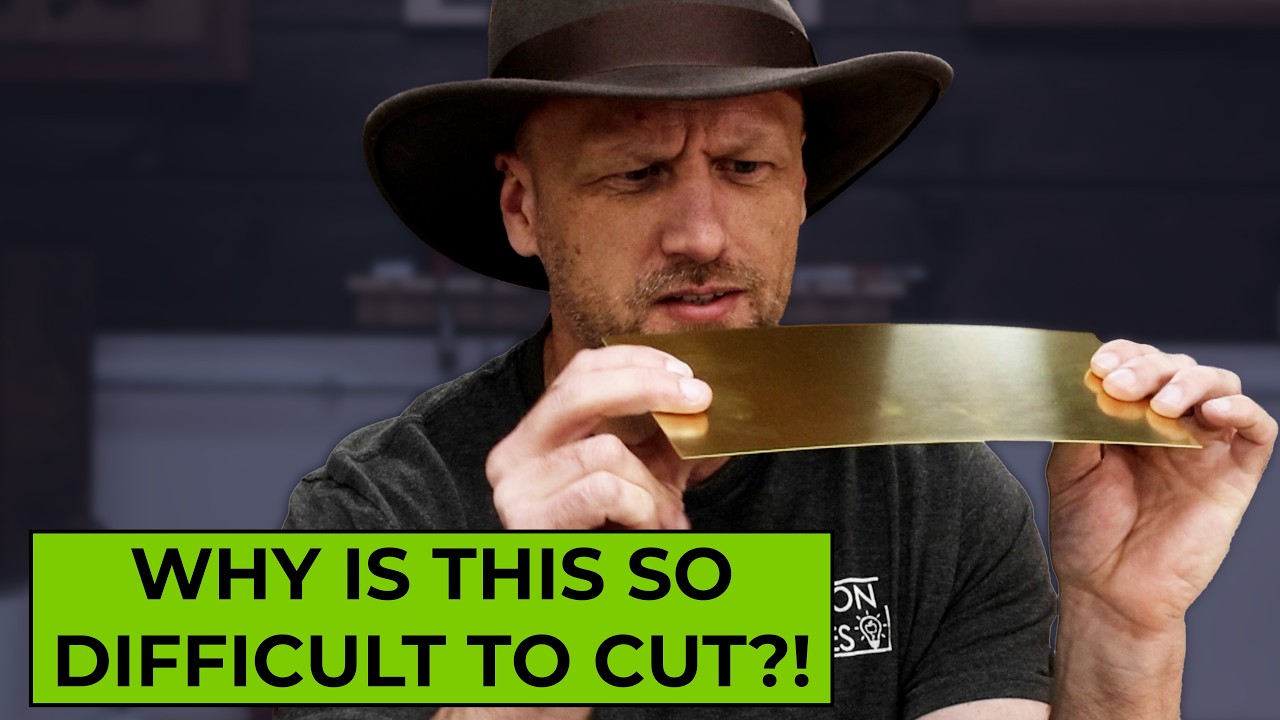
Billy from Newton Makes shared the woodworking tip featured in this video.
Billy demonstrates a counterintuitive principle of metalworking that applies to scroll saw cutting. While it seems logical that thinner material would be easier to cut, thin brass sheets actually present significant challenges when cut with a scroll saw.
Watch the full video and subscribe to Newton Makes:

The Thin Metal Problem
Billy starts with a brass sheet about a thirty-second of an inch thick. Despite using the proper blade for metal cutting, the thin brass proves surprisingly difficult to control.
The metal jumps around during cutting and wants to veer off course. Even with firm downward pressure and slow, steady cutting motions, the brass resists following a clean cutting line.
Using slow-motion footage at 120 frames per second, Billy reveals what’s happening. The thin brass bounces both up and down and side to side during cutting, with the side-to-side movement causing the most problems.
Understanding the Movement
The slow-motion analysis shows that while vertical bouncing can be managed, lateral movement disrupts the cutting process. When the brass goes out of parallel with the blade, it catches and causes the entire piece to jump around.
This bouncing occurs even with shop vacuum suction holding the workpiece to the table surface. The thin material simply lacks the mass and stability needed for controlled cutting.
Simple Solutions
Billy first tries adding painter’s tape to the brass surface. This approach increases the effective thickness of the material and provides a less slippery surface that helps prevent sliding.
The tape method shows immediate improvement. While some vertical bouncing remains, the problematic side-to-side movement reduces significantly, allowing for more controlled cutting.
The Thickness Solution
For the most dramatic improvement, Billy takes the technique further by adhering the brass to a wooden block using CA glue. The wood backing provides substantial mass and stability to the cutting process.
This method requires spreading the adhesive thoroughly to ensure the entire brass piece bonds securely to the backing block. Any loose areas would defeat the purpose of adding thickness.
With the brass now backed by solid wood, the cutting behavior transforms completely. The workpiece stays stable and predictable, allowing for smooth, controlled cuts through the metal.
Practical Applications
This technique opens up possibilities for incorporating metal elements into woodworking projects. The visual contrast between metal and wood can enhance project aesthetics significantly.
The method works for scroll saw art and various woodworking applications where precise metal cutting is needed. Understanding how material thickness affects cutting behavior helps woodworkers tackle materials beyond traditional wood.
Billy’s demonstration proves that sometimes adding material makes the job easier rather than harder. This principle challenges common assumptions about material removal and cutting efficiency. The stable cutting achieved with proper backing allows for clean edges that require minimal finishing work.
Watch the full video and subscribe to Newton Makes:

Matt’s Take
These are my personal thoughts and tips based on my own experience in the shop. This section is not written, reviewed, or endorsed by the original creator of this project.
This is one of those woodworking principles that sounds backwards until you experience it firsthand. I’ve noticed similar behavior with other thin materials on the scroll saw — they just don’t have enough mass to stay put when the blade starts working on them. The physics make perfect sense once you see it in slow motion like Billy shows.
The painter’s tape trick is brilliant for quick jobs, but that CA glue and wood backing method is really the way to go for precision work. When I’m backing thin material like this, I make sure to use a sacrificial piece of wood that I don’t mind cutting into. You’ll want to cut slightly into that backing material to get clean edges on your metal piece.
Safety-wise, always remember that metal generates more heat than wood when cutting, so take your time and let the blade do the work. A sharp metal-cutting blade makes all the difference here — dull blades will just fight you and create more heat. This technique opens up some interesting possibilities for inlay work and mixed-material projects that can really make pieces stand out.