

Jodee from Inspire Woodcraft shared the woodworking tip featured in this video.
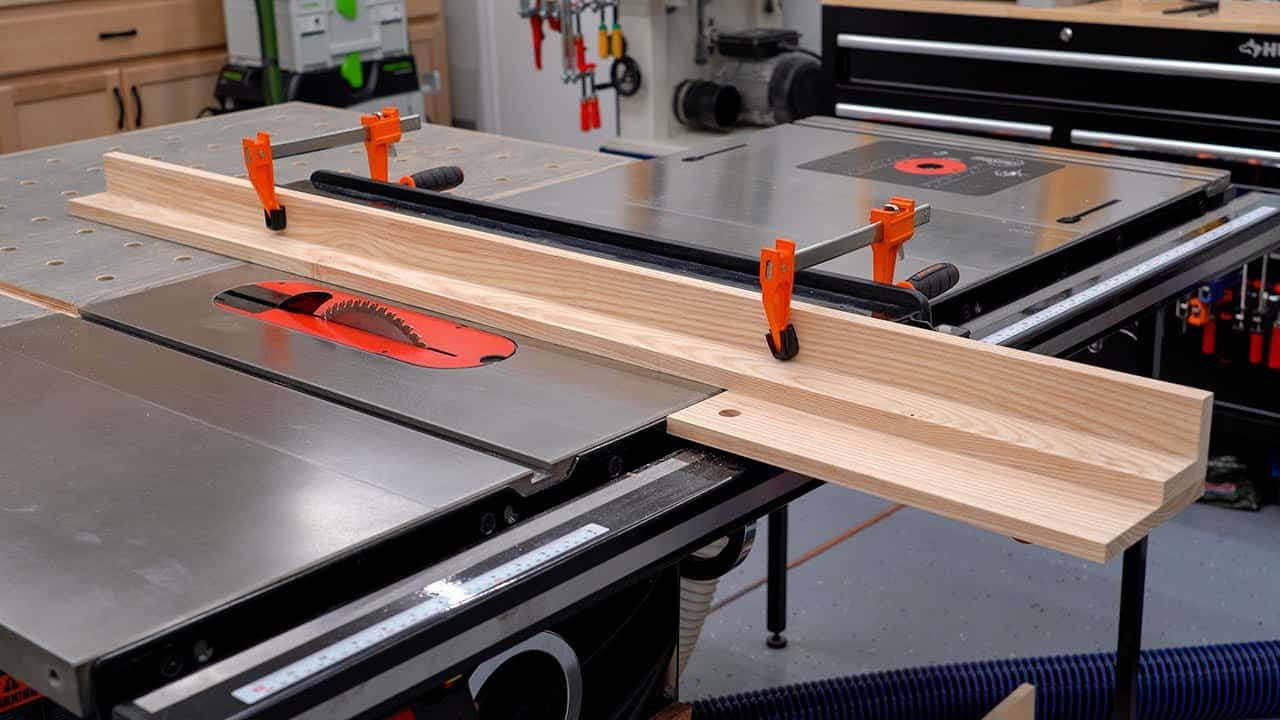
Jodee demonstrates a simple, clamp-on auxiliary infeed fence that gives extra support for long, wide, or heavy stock at the table saw. The concept is straightforward but effective, improving control and reducing the wobble and repositioning that often happens when feeding large workpieces.
Watch the full video and subscribe to Inspire Woodcraft:
Design and Purpose
The accessory is designed to clamp to the existing fence and extend both the infeed and outfeed support of the table saw, creating a longer ledger for material to rest on. This additional support helps keep boards flat on the table and firmly against the fence while feeding them through the blade, reducing wobble and alignment errors.
The extra fence area is particularly useful when ripping long panels or heavy boards and when using straight-line sleds that need stable support at both ends. By providing a stable edge to run against, the auxiliary fence helps produce straighter, cleaner cuts with less handling effort.
Construction Overview
The build is intentionally simple: a few boards screwed together to form a back piece that registers against the saw fence, a base surface the stock rides on, and a short outboard support to keep workpieces from tipping.
The whole assembly clamps to the fence and the table, making it removable and easy to store when not needed.
Because it is made from straightforward components, the accessory can be tuned or adjusted later if it gets dinged or compressed from repeated use. Detachable parts allow for resurfacing with a hand plane or replacing a worn section without remaking the entire unit.
Why Hardwood Helps
Using hardwood for the build adds stiffness and durability, which reduces flex and keeps the fence stable under load. Hardwood also takes a plane well, so any concentrated wear spots can be trued up to restore a flat, reliable surface.
The choice of material matters most when the support sees frequent, heavy use or when a perfectly rigid edge is required for sled-based straight ripping. A solid, tuneable surface extends the life of the accessory and maintains repeatable performance.
Sizing and Fence Alignment
The builder sized the fence to register cleanly with the saw’s scale so measurements align intuitively when ripping stock, but that approach is optional depending on how a shop measures from the blade or fence.
The key consideration is making the support wide and tall enough to resist bending without being unnecessarily bulky.
Keeping dimensions simple—enough mass for stiffness and enough height to hold material square to the fence—makes the accessory both useful and adaptable. The exact size can be tailored to shop needs, saw configuration, and the types of work typically handled.
Practical Uses and Adaptations
This clamp-on fence is useful anytime extra infeed or outfeed length is needed, including when guiding sleds, ripping long boards, or supporting heavy panels.
It pairs well with common clamp types, such as F-style clamps or track clamps, and can be moved or removed quickly between tasks.
The concept can be adapted into lighter-weight versions for frequent on/off use or beefed up for a permanent auxiliary fence that stays in the shop. It can also serve as a staging surface when setting up other jigs and fixtures that benefit from extra ledger support.
Shop Tips and Lessons Learned
Making the accessory detachable and serviceable pays dividends: a replaceable wear surface or the ability to plane the contact edge keeps it accurate over time.
Planning for common clamp locations and ensuring the assembly registers solidly against the fence will save setup fuss later.
Finally, consider how the accessory will be used with sleds or heavy workpieces and size it accordingly for stiffness rather than purely for length. A modest, well-built support is more effective than a long, flimsy one that introduces more movement than it prevents.
Support Jodee by visiting his online store here: https://inspirewoodcraft.com/collections/all.

Matt’s Take
These are my personal thoughts and tips based on my own experience in the shop. This section is not written, reviewed, or endorsed by the original creator of this project.
The beauty of this design is its simplicity — sometimes the most effective shop accessories are just well-thought-out pieces of wood in the right configuration. Jodee’s approach of making it clamp-on rather than permanent gives you the flexibility to use it when you need it and get it out of the way when you don’t. That’s gold in a smaller shop where every inch of table saw real estate matters.
The hardwood choice really does make a difference here. I’ve seen similar setups made from construction lumber that work initially but start to sag or develop dips after heavy use. Hardwood holds up to the clamping forces and repeated contact with workpieces without deforming. Plus, when it does get dinged up, you can run a hand plane over it to bring it back to true — try doing that with pine or plywood.
One thing I really appreciate about this build is how it addresses the outfeed side too. A lot of shop-made infeed supports ignore the fact that long boards need somewhere to go after they clear the blade. Having that outboard support prevents the tail end from dropping and potentially causing binding or kickback as the cut finishes.
For anyone considering building one of these, think about your clamp setup before you start cutting. The placement and type of clamps you use will determine how much clearance you need and where to position mounting points. Getting that right from the start saves a lot of frustration during setup.