

Jodee from Inspire Woodcraft shared the woodworking tip featured in this video.
Jodee demonstrates a simple way to extend the rip capacity of a small contractor-style table saw by adding a rigid ledger to the end of the table and using it as a guide rail for breaking down large panels.
Watch the full video and subscribe to Inspire Woodcraft:


Why this trick works
Small contractor saws often have limited rip capacity that prevents breaking down wide panels in a single pass, which can be frustrating when both the offcut and the keeper are large.
By installing a stiff ledger that is parallel to the blade, the table edge becomes a reliable reference surface and the saw can be used to cut much wider sheets with the aid of a straight guide.
Making and installing a ledger
The ledger should be made from a material that won’t flex or follow imperfections in the table edge, and it can be milled to match the tabletop profile for a clean fit.
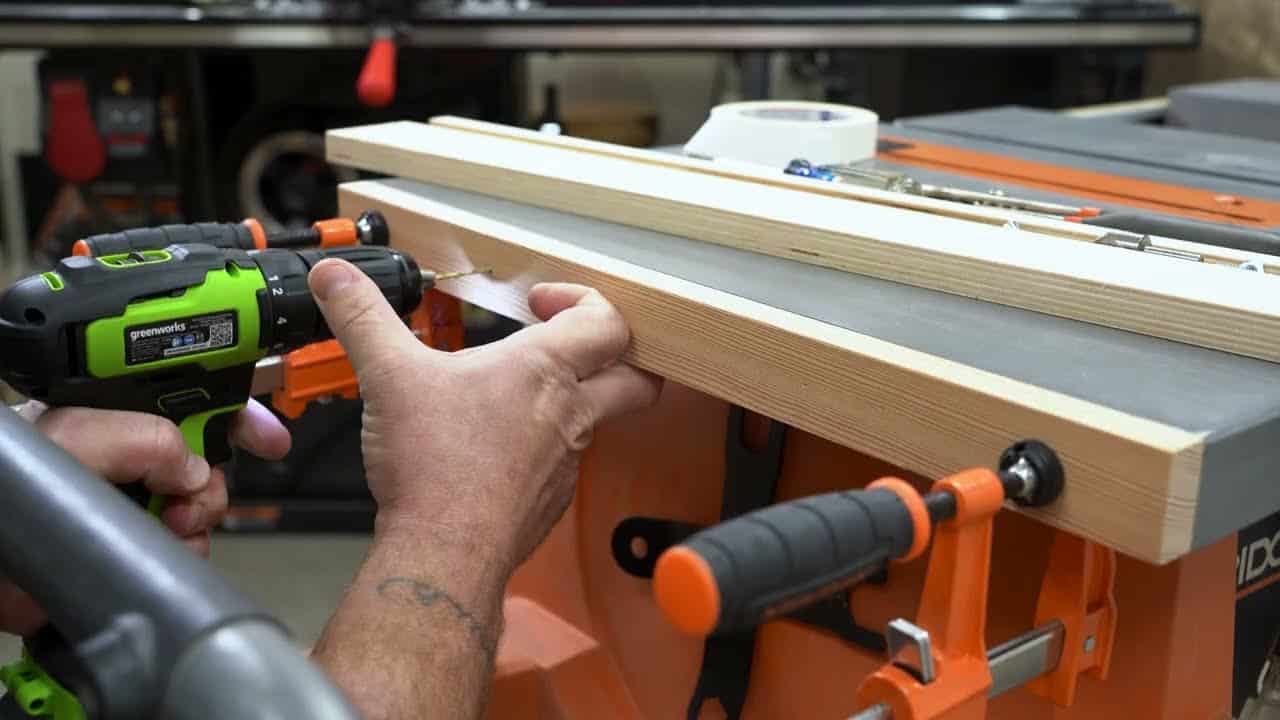
Jodee shows clamping the ledger flush, drilling for fasteners, and using countersunk hardware so the attachment sits flush with the table surface.
Setting the ledger parallel
Once installed, the ledger must be checked for parallelism by measuring the distance from the blade teeth to the ledger at both the front and rear of the blade and adjusting with thin shims if needed. After fine-tuning, Jodee emphasizes recording that measurement on the saw so the reference remains consistent for future cuts.
Cutting large panels with confidence
The cutting workflow is straightforward in concept: measure to the desired cut, back off the recorded blade-to-ledger distance and mark a reference line, then clamp a straightedge to the panel just inside that mark.
With the straightedge running against the table edge and the ledger providing a repeatable offset, the panel is flipped and fed through the blade to produce a straight, clean cut even on oversized panels.
Shop setup and safety tips
Jodee highlights the importance of proper outfeed support and not attempting to handle panels that are too large or heavy for one person, since control and safety are paramount during these operations.
Additional practical tips include securing lightweight saws to a solid base, using an appropriate quality blade for the material, and keeping the table and outfeed surface slick to reduce friction.
Adaptability and final thoughts
The approach works on many contractor-style saws, though individual table conditions may require some creativity during installation; a straight, smooth table edge may even eliminate the need for a ledger.
Overall, this method unlocks much of the capability of a small table saw and can let a woodworker safely and accurately break down full sheets when other tools aren’t an option.
Support Jodee by visiting his online store here: https://inspirewoodcraft.com/collections/all.

Matt’s Take
These are my personal thoughts and tips based on my own experience in the shop. This section is not written, reviewed, or endorsed by the original creator of this project.
This is exactly the kind of practical shop problem-solving that makes a huge difference in small shops. I’ve been in that frustrating spot where you need to break down a full sheet but your saw just can’t handle the width. The ledger approach really opens up possibilities without requiring a major tool upgrade.
The parallelism step is critical here — even being off by a sixteenth can throw your cuts way out on a wide panel. I like using a good combination square or marking gauge to check that blade-to-ledger distance at multiple points. Taking the time to get it dialed in perfectly and then recording that measurement saves so much headache down the road.
Safety-wise, this setup demands respect. Large panels can get unwieldy fast, especially if you’re working alone. Having that outfeed support properly positioned and making sure your saw is anchored to something solid are non-negotiables. If a panel feels too big or awkward to control confidently, it’s worth enlisting help or finding another approach entirely.
The beauty of this method is its simplicity — you’re essentially turning your table saw into a panel saw without the complexity or cost. For shops where a track saw isn’t in the budget, this ledger system can be a real game-changer for handling sheet goods accurately.