

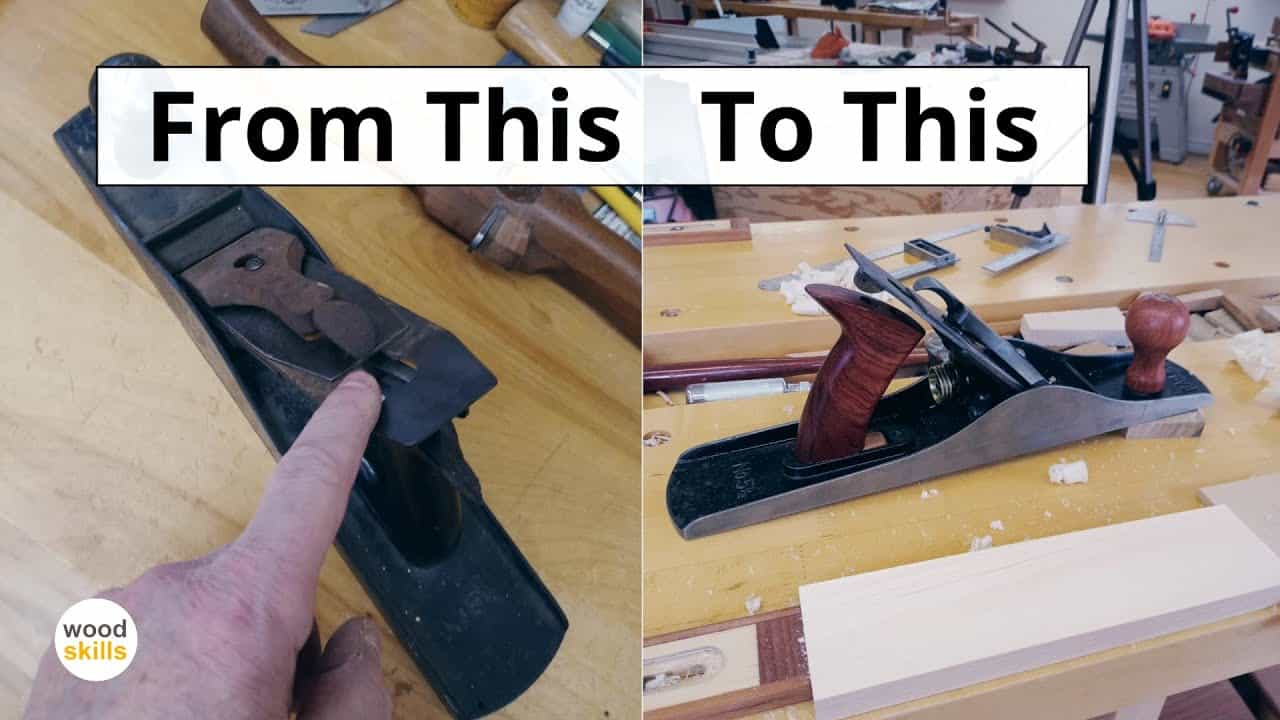
Norman Pirollo from WoodSkills shared the woodworking tip featured in this video.
The piece documents a full restoration of a rare Stanley No. 5 1/2 jack plane, tracing the work from assessment through final tuning while keeping as much original character as possible.
The focus is on practical metalwork, sharpening, and ergonomic upgrades that remain reversible so the plane can be returned to its original state if desired.
Watch the full video and subscribe to WoodSkills:
Plane Overview
The restoration centers on a vintage Stanley No. 5 1/2 jack plane, a wider and heavier version of the standard No. 5 with some uncommon features for its era. Norman highlights distinctive elements such as a corrugated sole designed to reduce friction and a very tight mouth opening that affects what replacement parts will fit.
Identification of the plane as a later Type 11 (with a few Type 12 traits) informs the approach because it influences blade size and adjustment mechanics. Understanding these historical details helps prioritize preservation of cast markings, dates, and original machining during cleaning.
Assessment and Disassembly
The first step is a careful assessment to determine which parts are salvageable and which need sympathetic replacement, with attention to cracks, worn mating surfaces, and rusted hardware. Norman emphasizes keeping all original parts and documenting their condition so restorations can be reversed or original components repaired later.
Disassembly focuses on the sole, frog, iron, cap iron, lever cap, tote, knob, and fasteners, taking care to preserve patent marks and cast details. This methodical approach makes subsequent cleaning and tuning more effective and protects the plane’s historical value.
Metalwork and Sharpening
Rust removal and careful cleaning restore machined surfaces without erasing character, and the frog is tuned for solid bedding and reliable blade support. Norman reground and honed the original iron, noting that thin, original blades can outperform a modern replacement when properly prepared.
The cap iron is set up to maintain tight contact and prevent tear-out, while the tight mouth is preserved because it contributes to the plane’s fine control when shooting thin shavings. These metalwork steps are presented as broadly applicable techniques for returning vintage tools to dependable service.
Wood Components and Ergonomics
The original rosewood tote and knob were assessed and retained, but Norman chose to fit modern replacements to improve ergonomics while keeping the original hardware. He adapted off-the-shelf handles, solved a rotation issue with a custom insert, and tested the setup until it locked securely in place.
These reversible ergonomic upgrades show how modest changes can make a historic tool comfortable for modern hands without permanently altering the plane. The lesson is that fit and feel matter as much as function when bringing old tools back into daily use.
Final Tuning and Performance
After cleaning, sharpening, and reassembly, the plane is tuned for different tasks—from aggressive stock removal to smoother finishing passes—by adjusting the frog and setting the mouth. Norman reports the corrugated sole reduces friction in use, making glide and control easier without adding additional surface treatments.
The restored plane demonstrates that a careful, conservation-minded approach can return a century-old tool to 90–95% of modern performance, offering a practical alternative to purchasing a new high-end plane. These results highlight why restoration is a valuable skill for any woodworker interested in hand tools.
Overall Takeaways
The restoration blends historical sensitivity with practical improvements, showing that preserving original parts while making reversible upgrades yields the best of both worlds. Norman’s approach emphasizes documentation, conservative cleaning, effective sharpening, and thoughtful ergonomics to make the plane useful and respectful of its past.
These broad techniques—assess, preserve, clean, tune, and test—are adaptable to most vintage bench planes and can help hobbyists and professionals alike get reliable performance from older tools. The project also underlines the educational value of learning how older tool designs work and why small details like mouth width and frog adjustment matter.
The restored Stanley jack plane is a good example of how careful restoration returns historical tools to everyday service while retaining their character.
Support Norman by visiting his website: https://www.woodskills.com/

Matt’s Take
These are my personal thoughts and tips based on my own experience in the shop. This section is not written, reviewed, or endorsed by the original creator of this project.
Plane restoration is one of those skills that pays dividends throughout your woodworking journey. The methodical approach Norman demonstrates here—assess, document, preserve—is spot-on for getting the best results while maintaining the tool’s integrity. That corrugated sole feature is particularly interesting since it was Stanley’s attempt to reduce surface friction, though opinions vary on how much practical difference it makes in daily use.
The reversible upgrades really caught my attention, especially the handle modifications. It’s a smart balance between making the tool comfortable for modern hands while respecting its history. When you’re considering any vintage tool purchase, that tight mouth opening Norman mentions is crucial to check—it can limit your replacement blade options and affect how the plane performs with different wood species.
One thing worth emphasizing is the safety aspect of working with rusty metal parts. Always wear eye protection when cleaning, and consider respiratory protection if you’re doing heavy rust removal work. The time invested in proper sharpening technique really shows in the final performance, and Norman’s point about thin original blades outperforming modern replacements rings true when they’re properly prepared.
Getting 90-95% of modern performance from a century-old tool is impressive, and often these restored planes develop a character and feel that’s hard to replicate with new tools. Plus, there’s something satisfying about bringing a neglected tool back to life.