

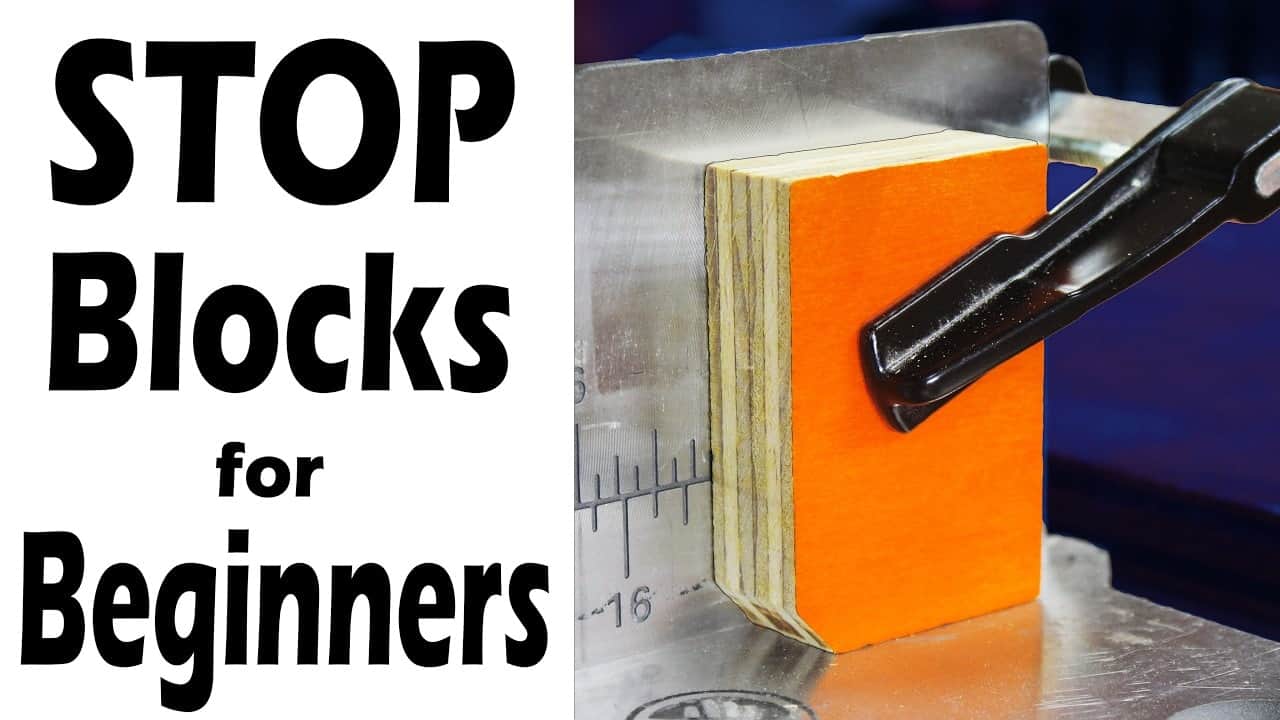
Clinton from Specific Love Creations shared the woodworking tip featured in this video.
A stop block is a small jig that guarantees repeatable, consistent cuts by giving stock a fixed place to register against a saw fence.
This article summarizes Clinton’s simple, shop-friendly method for making and using a stop block so beginners can speed up batch cutting and avoid measurement mistakes.
Watch the full video and subscribe to Clinton’s channel:
What a stop block does
A stop block creates a physical reference so every piece can be bumped to the same location and cut without re-measuring.
That consistency saves time and prevents the gradual measurement drift that happens when you repeatedly measure and mark by hand.
Materials and basic sizing
Clinton recommends using scrap material you already have—plywood, MDF, or solid wood all work as long as the piece is reasonably stiff. A block of moderate width and thickness gives enough mass to hold up under repeated contact without breaking easily.
Squaring the block and adding relief
All edges that will register against the fence or the workpiece should be square so the stop block doesn’t introduce errors into the layout. A small relief or curved cut at the corner where sawdust would collect keeps debris from packing in and changing the effective stop position during a batch run.
Clamping and adjustability
Choose a clamp that holds the block securely and clears the saw path; screw-style clamps are a reliable option when a tight hold is needed.
Making one end of the block slightly longer lets the block be flipped or moved for better clamp access and fine height adjustments.
Using a temporary fence for longer work
When required cuts are longer than the saw’s factory fence can support, add a temporary straight fence to the front of the existing fence using clamps, thin tape, or the machine’s mounting holes.
Make sure the temporary fence is securely supported on both sides of the blade and does not sit higher than the factory fence to avoid interference with the saw.
Safety notes and using stop blocks on other machines
Stop blocks are most commonly used on miter saws where the workpiece is held against a fence while the blade moves, giving good control.
Exercise extra caution if attempting similar jigs on table saws or other machines where feed dynamics differ, because unsupported stock can bind or kick back.
Why this simple solution matters
The simple stop block is low-cost, quick to make, and adaptable—ideal for one-off projects or the occasional batch run in a home shop.
Starting with a basic block and learning the placement and clamping nuances lets woodworkers upgrade later if they need a more permanent or fancy solution.
Conclusion and where to watch
Clinton’s straightforward stop block method is a practical, beginner-friendly way to speed up repeated cuts while reducing errors and frustration in the shop.
The technique is flexible enough to adapt to different saws and projects and is a great first jig to add to a woodworker’s toolkit.
Watch the full video and subscribe to Specific Love Creations:

Matt’s Take
These are my personal thoughts and tips based on my own experience in the shop. This section is not written, reviewed, or endorsed by the original creator of this project.
The beauty of a shop-made stop block like this is how it solves multiple problems at once. Beyond the obvious benefit of repeatable cuts, you’re also eliminating that nagging worry about whether your last measurement was actually 7-3/4″ or closer to 7-13/16″. When you’re cutting a dozen pieces for cabinet face frames or deck balusters, those little variations add up fast and can throw off your entire assembly.
That relief cut Clinton shows is one of those details that separates a functional jig from a frustrating one. Sawdust has a way of finding every corner in the shop, and even a small buildup between your stop block and workpiece can throw your cuts off by 1/16″ or more. I like to make that relief generous enough that I can easily blow out any debris with compressed air between cuts.
The temporary fence approach is particularly clever for longer stock. Just remember that any auxiliary fence needs to be dead straight and well-supported. A slightly bowed temporary fence will telegraph that error into every single cut, which defeats the whole purpose of using a stop block in the first place.
One safety point worth emphasizing: always double-check that your stop block won’t interfere with the blade path or guards. I’ve seen folks get excited about their new jig and forget to account for blade deflection or guard clearance, which can turn a helpful tool into a dangerous situation real quick.