

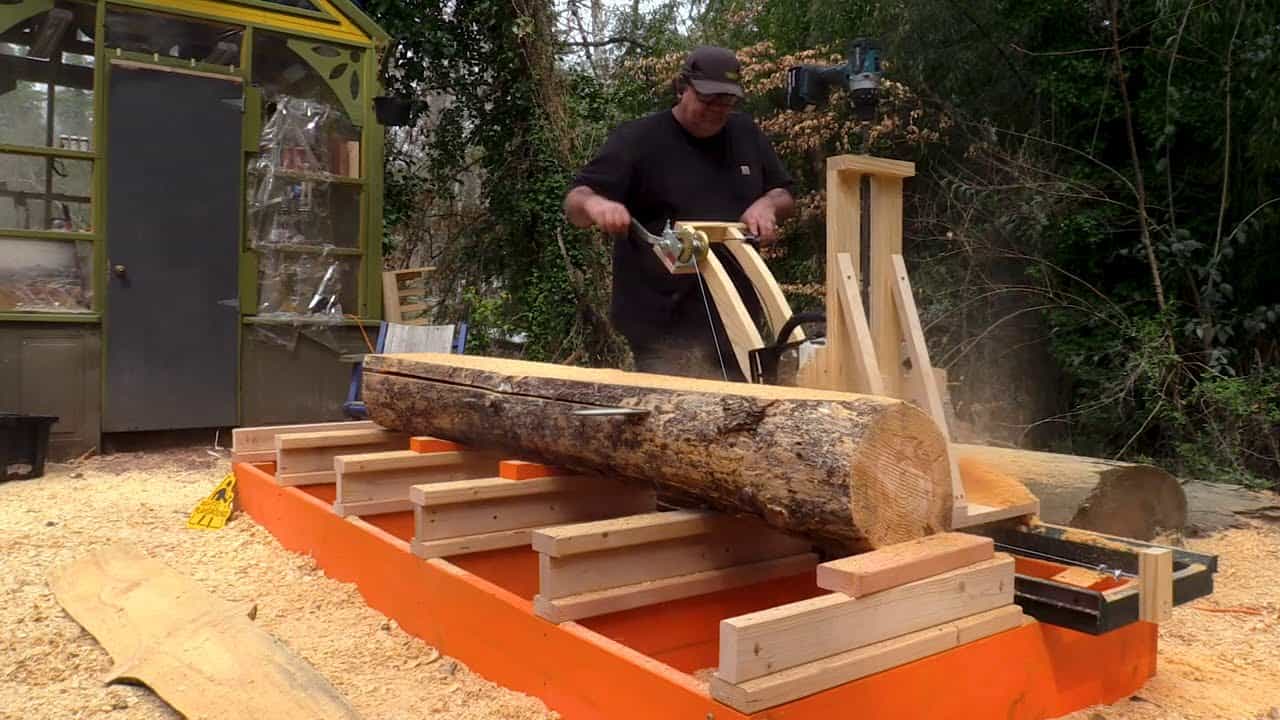
Izzy Swan demonstrated the test featured in this video.
Izzy shows a lightweight, low-cost chainsaw mill built from simple materials and a few clever upgrades that make milling small logs practical for a one-person shop.
The project focuses on portability, simplicity, and real-world tweaks that improve usability without adding much complexity.
Watch the full video and subscribe to Izzy Swan:
Design
The mill is a straightforward frame built to hold a chainsaw on a guided carriage and translate along a track to cut slabs from a log. Izzy kept the design intentionally simple so builders can adapt the concept to available tools and saw sizes.
Key design choices favor portability and ease of assembly: the tower and handle can be removed, the track can be mounted temporarily or set up permanently, and the carriage is made to be installable without sliding it on from the end.
These choices make it easy to use the mill in the woods or at a home shop.
Track and Carriage
The track evolved from a basic two-by-four setup into something with a few metal components and an angled section to route the winch cable.
Izzy found that some metal additions were unnecessary and that a wood-to-wood riding surface with regular waxing often works best.
Carriage changes included adding bearings and capture mechanisms to lift the carriage off the track easily, though the lesson learned was to avoid over-complicating the interface; a flat carriage riding on the track is durable and simpler to maintain.
Regular cleaning to remove sawdust and a light wax keeps the carriage gliding smoothly.
Saw Mounting and Operation
Mounting a chainsaw to the carriage requires drilling matching holes in the bar and a laminated plywood mount, and Izzy emphasizes using quality drill bits, oil, and slow drilling speeds for reliable results.
The plywood sandwich and a few bolts provide a secure, practical attachment without exotic hardware.
Operation uses a boat winch and a crank to control feed rather than a powered drill, because a human-held crank lets the operator feel the cut and adjust speed or pressure in response to the saw’s behavior.
Izzy also added a trigger-style pull mechanism to make engaging the saw comfortable, while noting that the design still benefits from refinement to reduce vibration.
Choosing a Saw and Cutting Strategy
The build accepts a range of chainsaws, but performance scales with saw size and chain type; larger saws and specialized ripping chains make long cuts through the grain easier.
Izzy advises matching saw size to log diameter and paying attention to feed rate to avoid binding or overloading the blade.
Using a drill to automate the carriage is discouraged because it removes tactile feedback, which is essential for safely managing pressure and torque during a long rip cut. Slow, steady feeds matched to chain type produce the cleanest slabs and protect the equipment.
Practical Use and Portability
The mill breaks down for transport and can be mounted temporarily on simple supports or installed on a permanent station for frequent use.
Its portability makes it useful for cutting logs at a job site or at home without heavy equipment.
Small features like adjustable indicator marks let operators make consistent slab thicknesses without measuring each pass, saving time and improving repeatability.
Holding logs with temporary blocks worked during testing, and Izzy plans to add dedicated log-holding accessories in future iterations.
Lessons Learned and Tips
Simpler is often better: wood-on-wood bearing surfaces with routine waxing are low-cost and low-maintenance compared with elaborate metal carriages. Avoid unnecessary complexity when a well-waxed wooden guide will do the job reliably.
Modular construction and easy disassembly are valuable for storage and transport, and a human-controlled crank preserves tactile awareness during cuts.
When mounting a saw, take time to drill accurately and use quality bits so the attachment is secure and repeatable.
Why This Sawmill Matters
This sawmill demonstrates how thoughtful, low-cost design can put milling within reach for hobbyists and small shops that lack large, expensive equipment.
The approach emphasizes adaptability, letting users match the build to their saw, log sizes, and mobility needs.
Izzy’s refinements and candid notes about what worked and what didn’t provide practical guidance for builders who want a reliable, portable solution without overengineering.
The mill is a useful tool for anyone looking to turn downed timber into usable lumber with modest investment and a bit of shop know-how.
Please support Izzy by visiting his website: https://www.izzyswan.com/.

Matt’s Take
These are my personal thoughts and tips based on my own experience in the shop. This section is not written, reviewed, or endorsed by the original creator of this project.
This type of chainsaw mill setup really highlights how accessible lumber milling can be with the right approach. The emphasis on simplicity resonates with my shop philosophy — sometimes the most elegant solution is the one that strips away unnecessary complexity. That wood-on-wood bearing surface with regular waxing is a perfect example. I’ve found that overengineering moving parts often creates more maintenance headaches than benefits.
The safety aspect of using manual control instead of a powered feed is crucial and worth emphasizing. When you’re making long rip cuts through logs, that tactile feedback becomes your early warning system. You can feel when the saw is struggling or when you’re pushing too hard, which helps prevent kickback and protects both you and your equipment. Always wear proper PPE when operating any chainsaw mill — eye protection, hearing protection, and cut-resistant chaps are non-negotiable.
For anyone considering this build, take your time with the saw mounting process. Those plywood laminations need to be perfectly aligned, and rushing the drilling will create wobble that shows up in every cut. A drill press makes this much easier than a handheld drill, and backing up your holes with scrap wood prevents tearout. The investment in quality drill bits pays dividends when you’re working with the laminated plywood — cheap bits will wander and give you sloppy holes.
The portability factor makes this design particularly appealing for anyone dealing with storm-damaged trees or wanting to mill logs where they fall. Being able to break it down for transport opens up opportunities that stationary mills simply can’t match.