

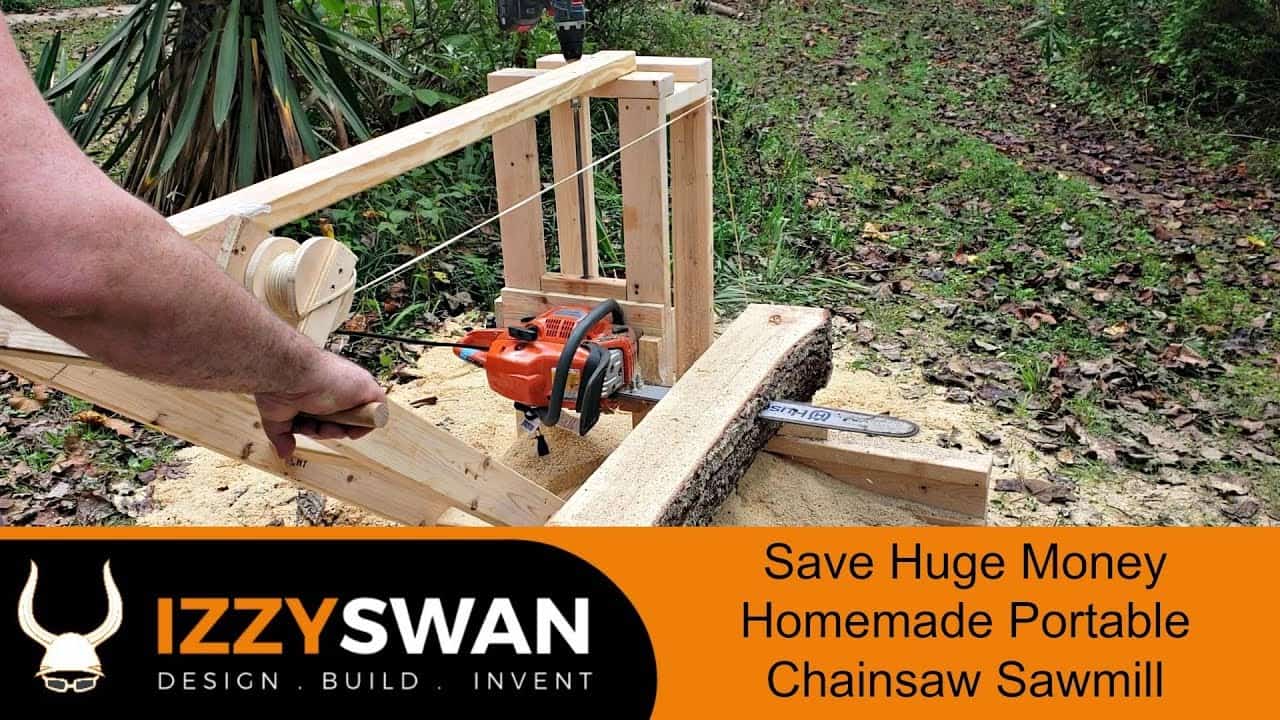
Izzy Swan demonstrated the test featured in this video.
Izzy shows a homemade, highly portable chainsaw mill built for about fifty dollars and paired it with a Husqvarna Rancher 460 from Tractor Supply to mill slabs in the woods.
The video focuses on design choices that favor portability, simple upgrades that improve performance, and real-world testing on freshly felled southern yellow pine.
Watch the full video and subscribe to Izzy Swan:
Design
The mill was designed around portability and simple construction so the whole setup fits in the back of a small car and can be assembled quickly at the jobsite.
Izzy used a mostly wooden frame and runners, which keeps costs down but makes keeping the mill level essential to getting consistent slabs.
Lumber Prep
The test material was freshly cut southern yellow pine, which is dense and very sappy when green, and the video demonstrates that a proper chain and steady feed will still handle it.
Izzy secures the log with simple wedges and screws for milling, and notes that a sliding clamp system would be a useful future upgrade for repeated use.
Mounting the Saw
To attach the chainsaw to the mill, Izzy drilled through the bar and used an L-shaped wooden mount with through-bolts and a backup screw in the handle for safety and rigidity.
A ripping chain was chosen for the work because it cuts slabs more efficiently than a standard crosscut chain when doing slab milling.
Clamping and Holding the Log
Simple wedges and a few screws kept the log from shifting during the cuts, which is a practical approach for occasional milling away from the shop.
For frequent milling, Izzy suggests a more robust sliding clamp that can be adjusted quickly and keeps the log perfectly aligned to the runners.
Drive System and Ergonomics
Adding a hand-crank pulley to control feed rate transformed the mill’s ergonomics, letting the operator turn a crank while holding the throttle for a smooth, steady cut.
The setup keeps the operator at a safe distance from the blade and reduces fatigue compared with pushing the saw by hand.
Performance and Cutting
The Husqvarna 460 Rancher started easily and, paired with a ripping chain, chewed through the wet pine slabs with surprising speed for a 60cc saw.
Izzy emphasizes that slow and steady feed rates yield the best slabs and that the saw’s power and chain selection are a good match for this kind of work.
Finishing and Maintenance
Because the mill is wooden, Izzy recommends painting exposed parts with exterior paint and keeping the runners waxed so the sliding action stays smooth and weather-resistant.
Small refinements—like rerouting the cable under the housing and protecting moving parts—make the mill more durable and easier to use over time.
Lessons Learned and Improvements
Keeping the mill perfectly level is the single most important detail; any twist in the frame produces uneven slabs, so setup time pays dividends in material quality.
Simple upgrades such as a better log clamp, a protected cable route, and an optimized crank placement improve safety and usability without undermining the low-cost, portable ethos.
The project demonstrates that practical milling can be done with modest tools and clever engineering, and it highlights how small, targeted upgrades turn a budget build into a reliable field mill.
For makers who want milled slabs without expensive equipment, this approach balances cost, portability, and performance effectively.
Please support Izzy by visiting his website: https://www.izzyswan.com/.

Matt’s Take
These are my personal thoughts and tips based on my own experience in the shop. This section is not written, reviewed, or endorsed by the original creator of this project.
What really impresses me about this build is how thoughtfully Izzy approached the portability challenge. A lot of chainsaw mill designs get heavy fast, but keeping the frame mostly wooden while still maintaining rigidity is smart engineering. The trade-off is that setup becomes critical — as he mentions, any twist in that frame will telegraph right into your slabs. I always tell folks that time spent on setup saves twice as much time in fixing problems later.
That hand-crank feed system is brilliant for ergonomics and cut quality. Pushing a chainsaw mill by hand gets tiring quick, and when you’re tired, you rush. Rushed cuts mean wavy slabs and potentially dangerous situations. Having that mechanical advantage lets you maintain steady pressure and keeps your hands where they should be. The ripping chain choice is spot-on too — crosscut chains will work, but they fight you the whole way on long cuts like this.
Southern yellow pine is no joke when it’s green and full of sap. It’ll gum up a chain fast and really test your saw’s oiling system. The fact that a 60cc saw handled it well speaks to both the chain setup and Izzy’s steady feed technique. For anyone considering a similar build, remember that fresh lumber mills differently than seasoned — you’ll get more tear-out and the cut surface won’t be as clean, but that’s just the nature of working with green wood.