

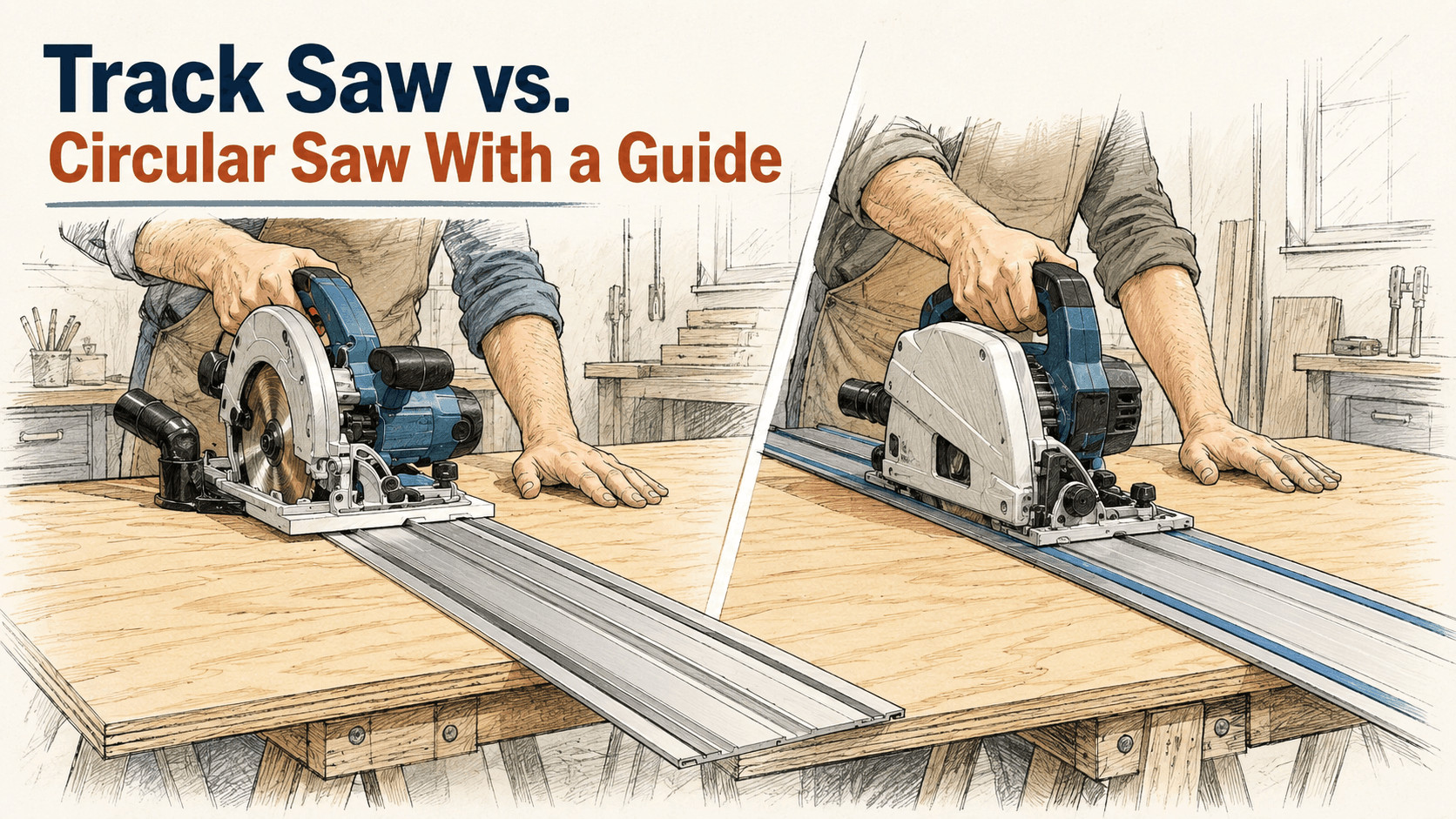
If you’ve ever wrestled a full sheet of plywood onto a pair of sawhorses, you already know that making a straight cut isn’t always as easy as it sounds.
A standard circular saw is one of the most versatile tools in any workshop, but freehand cuts over eight feet rarely end up perfectly straight. Even using a clamped straightedge leaves room for small errors that become noticeable when you’re building cabinets, furniture, or built-ins.
That’s why many woodworkers eventually consider buying a track saw.
But today, there’s another option that’s worth considering before spending hundreds, or even thousands, of dollars on a dedicated saw.
A quality guide rail lets you turn the circular saw you already own into a much more accurate cutting system. The question isn’t whether a track saw is a great tool. It absolutely is. The real question is whether you actually need one.
For many hobbyists and serious DIY woodworkers, the answer may be no.
Three Ways to Cut Sheet Goods
When comparing a track saw to a circular saw with a guide, you’re really looking at three different approaches.
A Circular Saw and a Straightedge
This is how many of us started.
Clamp a straight board, level, or aluminum guide to the plywood and run the edge of the saw against it.
It works, it’s inexpensive, and for occasional cuts it’s perfectly adequate. It’s similar to the kind of shop-made accuracy improvements featured in 7 DIY Woodworking Jigs You Didn’t Know You Needed.
The downside is that nothing actually holds the saw in place. You’re relying on steady hand pressure throughout the cut. If the saw drifts away from the guide even slightly, so does your cut.
There’s also the extra setup. Every cut requires measuring the offset between your blade and the edge of the saw base before positioning the straightedge.
A Circular Saw with a Guide Rail
A guide rail takes the same circular saw but removes much of the guesswork.
Instead of pushing the saw against a straightedge, the saw rides on a dedicated guide system that keeps it tracking in a straight line. The splinter guard also shows exactly where the blade will cut, eliminating repeated offset measurements.
The biggest advantage is cost.
Rather than buying another saw, you continue using the circular saw you already own while gaining much of the accuracy people associate with dedicated track saws.
For most woodworking projects, that’s all many people actually need.
A Dedicated Track Saw
A track saw combines a purpose-built plunge saw with a matching guide rail.
Everything is designed to work together.
The saw locks onto the track, plunges into the material, collects dust exceptionally well, and makes repeated cuts quickly.
It’s a fantastic system.
It’s also the most expensive option by a considerable margin.
If you’re a cabinet installer or make your living breaking down sheet goods every day, the investment often makes sense.
For everyone else, it’s worth asking whether you’ll actually use those extra features often enough to justify the price.
As covered in 10 Reasons Why You Don’t Need a Track Saw in Your Woodworking Shop, it is often better viewed as a valuable specialist tool than an essential purchase for every workshop.
Quick Comparison
| Feature | Straightedge | Guide Rail | Track Saw |
|---|---|---|---|
| Cost | $ | $$ | $$$$ |
| Accuracy | Good | Excellent | Excellent |
| Uses your existing saw | Yes | Yes | No |
| Plunge cuts | No | No | Yes |
| Dust collection | Limited | Good | Excellent |
| Best for | Occasional use | Most woodworkers | Professional production |
Looking at the table, something becomes obvious.
A dedicated track saw certainly offers the most features.
But a good guide rail delivers most of the benefits that matter to the average woodworker while costing considerably less.
What Makes a Good Circular Saw Guide Rail?
Not every guide rail controls the saw in the same way.
Some systems are little more than an aluminium straightedge with an adapter attached. Others are designed to guide the saw positively throughout the entire cut and limit unwanted side-to-side movement.
When comparing systems, there are several features worth considering.
Positive Saw Guidance
The saw should track smoothly along the rail without relying entirely on hand pressure to keep it aligned.
A well-designed rail profile reduces sideways movement and makes it easier to maintain a consistent cut over the full length of a sheet.
A Stable Tracking System
A centre keyway or similar locating feature can help keep the saw adapter aligned as it moves along the rail.
This becomes especially important on long rip cuts, where even a small amount of movement can affect the finished edge.
Anti-Chip Protection
An anti-chip strip supports the wood fibres beside the blade, helping reduce splintering on plywood, veneered panels, and other sheet materials.
It also creates a visible reference for the blade path, allowing the rail to be placed directly against the cut mark.
Modular Rail Sections
Long rails are useful for breaking down full sheets, but they can be awkward to store and transport.
A modular system lets you connect shorter rail sections when needed, then separate them for easier storage.
Circular Saw Compatibility
One of the main reasons to choose a guide rail is to keep using the circular saw you already own.
Before buying a system, check that the adapter suits your saw’s base plate, blade position, motor housing, and adjustment controls.
Dust Collection
Dust collection on a circular saw guide system depends partly on the saw itself.
A guide cannot completely enclose the blade in the same way as a dedicated plunge saw, but compatibility with a dust port or extraction attachment can still make cutting cleaner and more comfortable.
Together, these details determine how accurately the system tracks, how quickly it can be set up, and how repeatable each cut will be.
How the TrueTrac Guide Rail System Works

TrueTrac is designed to do more than act as a fence beside the saw.
Its rail profile and saw adapter work together to guide the circular saw throughout the cut. Opposing bevels help keep the adapter centred on the rail, while the centre keyway supports smooth tracking over longer distances.
The anti-chip strip marks the blade path and supports the material at the cut line. Once it has been trimmed to match the saw, the edge of the strip shows where the blade will cut.
The rails are also modular, allowing multiple sections to be joined when cutting larger sheets and separated again for transport or storage.
This gives woodworkers a system that feels closer to a dedicated track saw while still allowing them to use a compatible circular saw they already own.
The TrueTrac Guide Rail System can be seen in action in this video:
For woodworkers who want more control than a straightedge provides but do not need a dedicated plunge saw, this type of system offers a practical middle ground.
Where a Dedicated Track Saw Still Wins
Circular saw guide systems have become increasingly capable, but a dedicated track saw still has several clear advantages.
The most important is plunge cutting.
A track saw can begin a cut in the middle of a panel, making it well suited to sink openings, floor registers, access panels, and other internal cut-outs.
Dedicated track saws also typically provide:
- Better dust collection through a more enclosed blade housing
- Faster and more precise depth adjustment
- Refined bevel controls
- Easier setup for repetitive production work
- Better integration between the saw, blade, rail, and extraction system
If you install kitchens, build cabinets professionally, or cut sheet goods most days, those improvements can save time across every project.
For occasional workshop use, however, they may not justify the cost of moving to an entirely separate cutting platform.
Which Option Should You Choose?
A straightedge remains a sensible option if you only cut sheet goods occasionally and do not mind taking extra time to measure and position each cut.
A circular saw guide rail is likely the best value if you already own a good saw and want cleaner, straighter, and more repeatable cuts. It removes much of the measuring and hand control required with a straightedge without forcing you to buy another power tool.
TrueTrac is a strong option in this category because its rail is designed to actively guide the saw rather than simply provide an edge to push against. Its modular construction, anti-chip strip, centre keyway, and compatibility with many circular saws make it suitable for furniture, cabinetry, shelving, built-ins, and general sheet-good work.
A dedicated track saw is the better choice when plunge cutting, high-volume production, fast adjustments, and maximum dust collection are regular requirements.
The right system ultimately depends on how often you cut sheet goods and which features you will genuinely use.
For many woodworkers, pairing a quality guide rail with an existing circular saw provides the best balance of accuracy, versatility, and cost. It delivers the straight, repeatable cuts needed for better-fitting projects without adding another specialist saw to the workshop.