

This project was built and designed by Drew Fisher from Fisher’s Shop. If you enjoy woodworking, be sure to check out his YouTube channel for more creative projects and detailed tutorials.
Watch the full video and subscribe to Drew’s channel:
A Creative Take on Cutting Boards
Drew’s idea for these boards came from everyday design elements he saw around his home. Inspired by wall art and tile patterns, he set out to recreate those textures in wood using end grain techniques.
He challenged himself to make three different cutting boards that each had a unique 3D visual effect. The result was a series of functional and beautiful pieces that show off both creativity and craftsmanship.
Building the “Missing Brick” Board
The first board Drew created was designed to look like a brick wall with some bricks missing. To achieve the illusion, he used maple for the bricks, walnut for the mortar, and cherry to add contrast.
He began by selecting and milling rough walnut, maple, and cherry boards to prepare clean faces and edges. The pieces were then ripped to size, ensuring the strips aligned well before the first glue-up.
To simulate missing bricks, Drew used miters and staggered gaps within the layout. He glued up small bundles with tape, then joined those into longer brick sections with varying lengths.
After flattening the panels and slicing them into new strips, Drew arranged them into a final layout. During the glue-up, some small sections cracked, so he revised his approach by using longer strips for more stability.
Once the final layout was assembled and dry, he used a CNC to flatten the board and trimmed the edges clean. A food-safe finish of beeswax and mineral oil brought out the rich grain and completed the build.
Creating the Pyramid Board
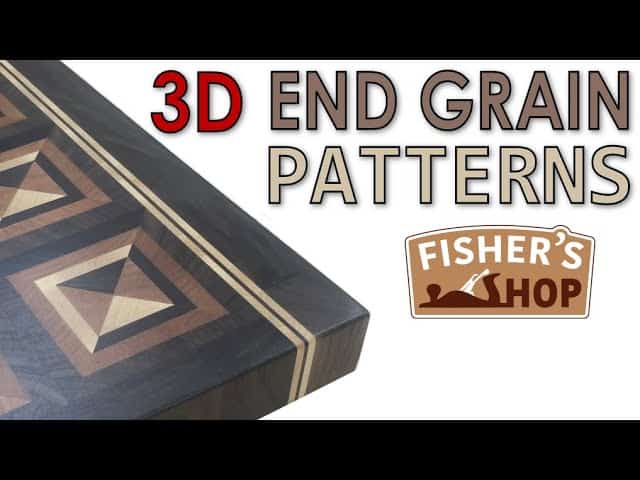
For the second board, Drew based the design on a pyramid motif, inspired by geometric art in his home. The concept involved stacking square blocks with four contrasting wood species arranged to give the look of depth.
He began by resawing and planing walnut and maple into thin pieces, which were glued up in layers with cherry. Once dry, he cut the blocks at 45-degree angles to create a series of repeating triangles.
His first glue-up attempt revealed alignment issues and noticeable gaps. He resolved this by cutting the boards into smaller blocks before making the angled cuts, which made the final fit much more precise.
The pieces were then arranged into rows and bordered with walnut for contrast. After flattening and sanding, the finished board had a strong 3D pyramid effect and clean, defined edges.
Constructing the Hex-Weave Board
The final cutting board was inspired by the pattern of woven baskets. This hex-weave design required precision cutting and angles to bring the illusion to life.
Drew used walnut and cherry, milling each piece square before cutting them at 60-degree angles on the table saw. These angled strips were arranged into a large hexagonal grid that mimicked a woven surface.
Because the panel was too large to run through his planer, Drew cut it into two smaller sections before final glue-up. He used cauls during assembly to keep the strips aligned and flat.
Once the glue dried, he trimmed, flattened, and sanded the board to a smooth finish. Rubber feet were added to the bottom for grip and functionality.
Final Thoughts
Each cutting board demonstrates a different technique and pattern that pushes traditional woodworking into creative territory. These builds combine form and function, offering lasting kitchen tools that are also artistic expressions.
Drew’s video walks through the entire process for all three boards, offering insights for anyone interested in building their own. His attention to detail and willingness to troubleshoot along the way make the video both educational and inspiring.

Matt’s Take
These are my personal thoughts and tips based on my own experience in the shop. This section is not written, reviewed, or endorsed by the original creator of this project.
End grain cutting boards like these are some of the most rewarding projects in the shop. The 3D visual effects Drew achieved really showcase how thoughtful wood selection and precise cuts can transform simple lumber into something that looks almost impossible. That pyramid design especially caught my eye – the way those 45-degree cuts create depth is just brilliant.
One thing I always emphasize with end grain work is taking your time with the glue-ups. Those small sections cracking during Drew’s first brick board attempt is actually pretty common when you’re working with shorter pieces. The wood movement can create stress points, so his switch to longer strips was smart thinking. End grain glue joints need extra attention to alignment since any gaps really show up in the final piece.
For anyone thinking about tackling similar projects, invest in good cauls and clamps. Drew’s hex-weave board shows exactly why – keeping all those angled pieces perfectly aligned during glue-up is crucial for that clean, woven look. Also worth noting that food-safe finishes like the beeswax and mineral oil combo he used will need periodic reapplication, but they really let the wood’s natural beauty shine through.
These boards prove that cutting boards don’t have to be boring rectangles. With some creative thinking and solid technique, they become functional art pieces that any kitchen would be lucky to have.