

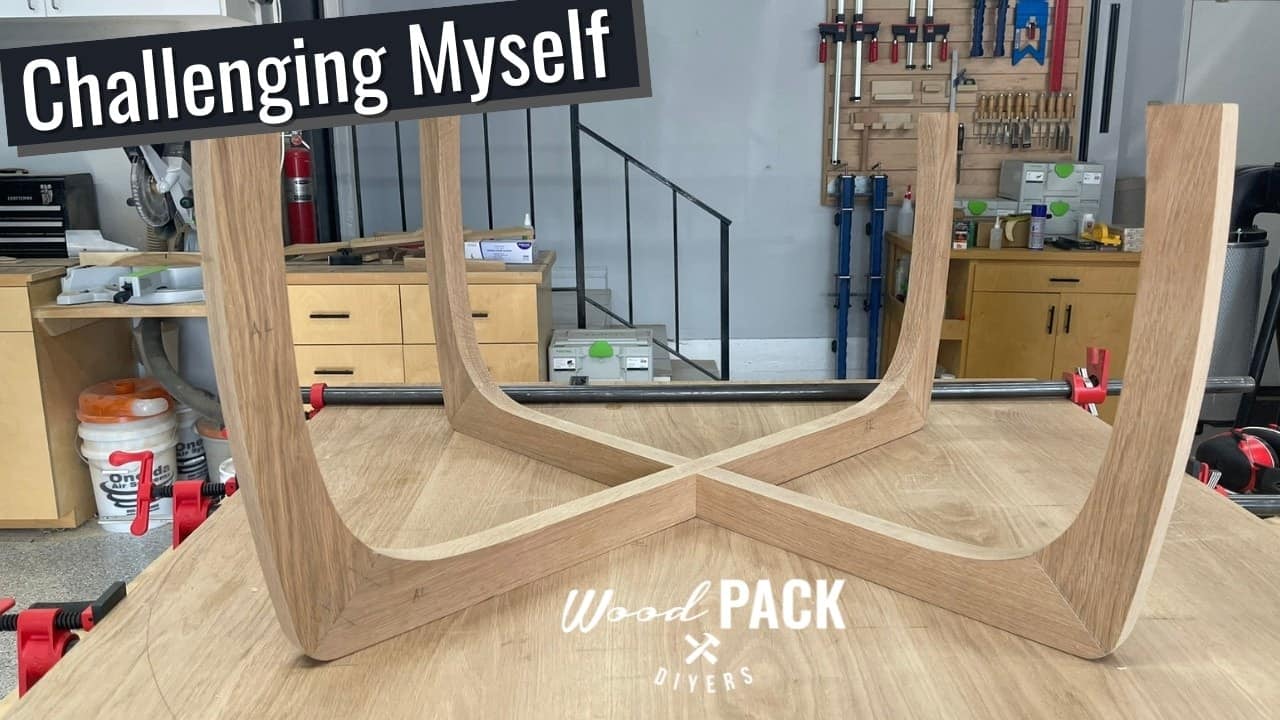
This project was built and designed by Anthony from Wood Pack DIY.
Anthony set out to make a flowing, rounded white oak coffee table for his living room, working without a bandsaw and solving problems as they appeared.
The result blends gentle curves, thin-profile legs, and a 4-foot circular top assembled from multiple glued-up boards.
Watch the full video and subscribe to Wood Pack DIY:
Design
Anthony departed from his usual hard-edged modern pieces and designed a softer, more organic coffee table with flowing leg shapes and a circular top.
The aesthetic relies on matched grain runs and generous roundovers to create a cohesive, approachable silhouette.
Lumber Prep
The build starts with six-quarter white oak milled down to manageable sizes and arranged to keep grain continuity through the top and legs. Boards were flattened, inspected for figure, and staged so lamination and joint locations would minimize visible Domino joinery.
Joinery
Loose tenons made with a Domino joiner form the primary structural connections for the legs and the top attachment, using the thick 10 mm tenons where possible for added strength.
Anthony laid out the joinery carefully to keep fasteners hidden and to reduce stress on those joints as the top moves across the grain.
Clamping and Glue-Ups
Because the top was large, glue-ups were done in sections and then joined, a practical choice when clamp inventory is limited and to reduce panel stress during curing.
Anthony used pipe clamps, a long straightedge to prevent bowing, and auxiliary pieces to apply steady 45° clamping pressure on the leg assemblies.
Shaping and Templates
Templates were developed early from thin plywood then transferred to 3/4″ MDF for durability and used at the router table with a flush-trim bit to produce consistent leg profiles.
The absence of a bandsaw forced careful jigsaw work and extra material allowance before trimming, which increased the importance of cleanup at the router and hand tools for final shaping.
Chip-out and tool grabs were recurring challenges, so Anthony took a conservative approach with multiple lighter passes on roundovers and used climb cuts where grain direction demanded it.
Repairs were handled with tailored patches and inlays, and one notable crack in the top was repaired successfully by drawing glue into the joint with vacuum assistance and clamping until set.
Final Fitting and Movement Considerations
Legs were oriented to put seasonal wood movement in the least destructive direction relative to the joints, allowing the assembly to flex rather than put direct pull on a glued seam.
Small levelers were added to the feet to accommodate uneven floors and protect the table over time.
Finishing
The table received a Rubio Monocoat finish blended from bourbon and a touch of smoke to hit the warm, slightly darker tone desired for the living room. Multiple thin applications and light sanding between coats preserved the smooth roundovers and the tactile quality of the piece.
Lessons Learned and Practical Tips
Templates speed up repeatable shaping and protect final stock from aggressive tool work when a shop lacks certain machines, like a bandsaw.
Slow, controlled routing with progressive passes reduces tear-out, and planning climb cuts for difficult grain areas pays off in time saved on repairs.
When working with large glued panels and limited clamps, divide the glue-up into sections, use long straightedges to prevent bowing, and be prepared to flatten joints after assembly.
Small mistakes are fixable with patches and inlays, and the problem-solving process can be a valuable part of learning in the shop.
Please support Anthony by visiting his Etsy Store: https://www.etsy.com/shop/WoodPackDIY.

Matt’s Take
These are my personal thoughts and tips based on my own experience in the shop. This section is not written, reviewed, or endorsed by the original creator of this project.
This white oak build really showcases how you can create flowing, organic shapes without specialized machinery. Working around the lack of a bandsaw by using templates and taking conservative router passes is smart shop strategy — sometimes constraints force you to develop better techniques. That MDF template approach gives you repeatability and protects your final stock from aggressive cutting.
The Domino joinery choice makes a lot of sense here, especially using those beefy 10mm tenons where possible. White oak moves quite a bit seasonally, so thinking through grain orientation and joint placement early in the design phase saves headaches later. Those adjustable feet are a nice touch that more people should consider — they’re cheap insurance against wobbly tables and protect your finish from floor imperfections.
That vacuum-assisted crack repair is a clever technique worth remembering. Sometimes defects show up during the build, and having a few tricks like that in your back pocket keeps projects moving forward. The sectioned glue-up approach is practical too when you’re working with limited clamps — better to take your time and get flat panels than rush and spend twice as long flattening afterward.