

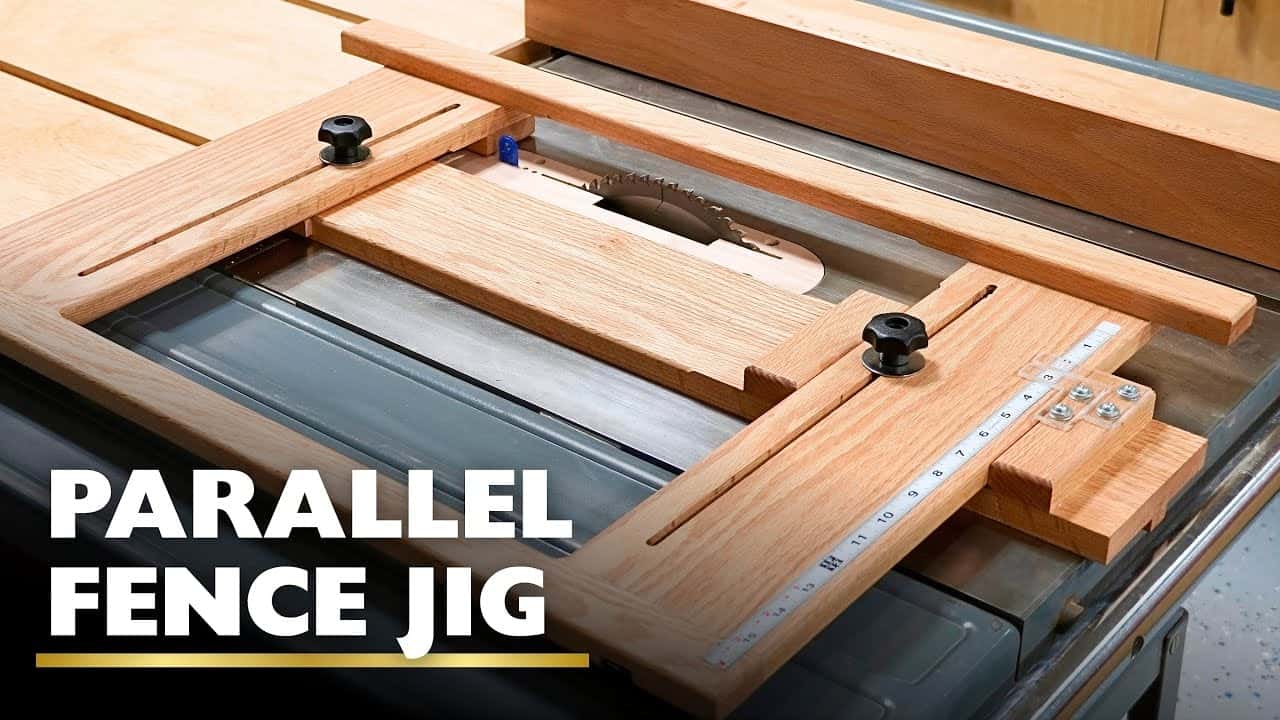
This project was built and designed by Connor from Shopfix.
The parallel guide jig is a shop-made alignment tool that references the table saw’s miter slot to create a dead-parallel reference face for aligning a misbehaving fence.
It combines a miter-slot runner, sliding top rails, and a readable measuring strip with acrylic guides to produce repeatable, accurate rip cuts on older or imperfect saws.
Watch the full video and subscribe to Shopfix:
Design
The jig is built around a simple premise: use the factory-machined miter slot as the single mechanical reference and create a flat, parallel face that can be trimmed directly against the blade.
That trimmed face then serves as the alignment surface for the saw fence, removing guesswork and cumulative measurement errors.
Connor focused on rigidity and repeatability so the jig behaves the same every time it’s installed and removed. The sliding top rails are locked once dialed in, turning a temporary setup into a reliable shop fixture.
Materials and Prep
The platform centers a tight-running miter-slot runner and a pair of sliders that bear on machined dadoes, so initial milling and test-fitting are critical for accuracy. Trimming the runner and platform ends ensures the jig enters and exits the miter slot cleanly without catching.
Before glue and fasteners, a dry fit confirms everything slides freely and stays square; this step prevents binding or racking later.
Small shims and pilot holes can be used to align embedded tracks and fasteners so the finished assembly keeps consistent pressure across the face.
Joinery and Mechanical Alignment
Critical joints are simple but deliberate: dados for runners, routed slots for adjustable bolts, and a connector that ties both sliders together to keep pressure even.
Using a square clamped to a miter gauge or similar mechanical reference while cutting those grooves locks the geometry to the blade, not just to visual alignment.
Glue and brads hold the runner and platform while clamps bring everything together during curing, and a few reinforcing supports on the outer slider prevent rocking when the jig is extended. Those details keep the jig from introducing error when used on wider rips.
Adjustment, Measuring, and Usability
An adhesive measuring strip and clear acrylic guides provide a readable, repeatable scale that outperforms many stock fence tapes. By switching the jig between left and right miter slots the usable range extends well beyond the measuring strip’s basic span, so wider rips remain simple to set up.
Adjustable bolts running in routed slots let both sliders move freely during setup, then lock solid once the fence is positioned. Connor also added a simple hanger so the jig slips into the miter slot, is adjusted, and stowed quickly — improving workflow for real shop use.
Why This Jig Matters
Older table saws often have perfectly machined miter slots even when their fences are out of alignment, so a jig that references the slot solves a common, persistent problem.
By converting the miter slot into a mechanical truth, this approach prevents burn, binding, and inconsistent rips caused by an off-kilter fence.
The design is adaptable to many shops: it’s a repeatable fixture that restores accuracy without replacing the saw’s fence or relying on complicated measuring routines.
For woodworkers who value precision and efficiency, the jig saves time and reduces waste while making accurate ripping straightforward.
Please support Connor by visiting his website: https://www.shopfix.services/.

Matt’s Take
These are my personal thoughts and tips based on my own experience in the shop. This section is not written, reviewed, or endorsed by the original creator of this project.
The genius of this jig really lies in trusting your miter slot over your fence — and that makes perfect sense when you think about it. Those slots are machined at the factory with tight tolerances, while fences can drift over time or never been properly aligned in the first place. I’ve seen plenty of older saws where the fence rails have shifted or the cursor isn’t reading true, but the miter slot is still dead-on.
What I appreciate about Connor’s approach is the attention to those small details that make or break shop jigs. Getting that miter bar fit just right is crucial — too loose and you’ll have play that defeats the whole purpose, too tight and it’ll bind up when you need smooth operation. Take your time with test cuts and sneaking up on that final dimension.
The measuring strip is a nice touch that turns this from a basic alignment aid into a proper fence system. For anyone building this, consider adding a dust port if you plan to use it regularly — sawdust has a way of building up in those slots and affecting the fit. Also, a quick coat of paste wax on the sliding surfaces will keep everything moving smoothly over time.