

This project was built and designed by Izzy Swan from Izzy Swan.
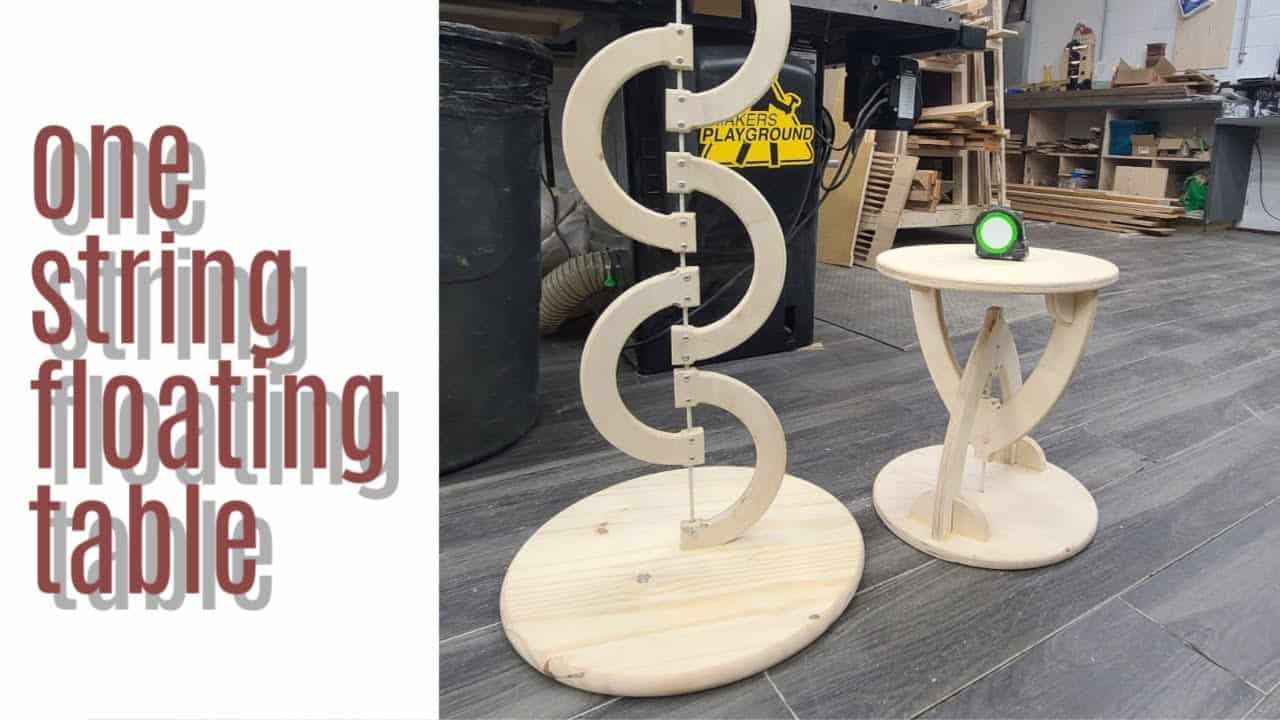
Izzy explores a minimalist take on tensegrity by attempting a floating table supported by a single continuous string rather than multiple suspension lines. The build combines a simple CNC-cut form, careful hole placement, and tensioned hardware to create an object that appears to defy intuition.
Watch the full video and subscribe to Izzy Swan:
Design
The design is intentionally simple: a pair of nested plywood shapes with precise hole locations to route one continuous string through the stack. Izzy kept the geometry pared back to test whether a single run of tensioned line could stabilize a floating table form.
Rather than elaborate ornament or complex joinery, the concept relies on balance and the positioning of fasteners to carry load through tension. This approach highlights how geometry and suspension paths create structural behavior that looks impossible at first glance.
Lumber Prep and Layout
The build used scrap birch plywood cut on a CNC to ensure repeatable, accurate holes and profiles. Izzy marked drill points and matched the hole sizes to the chosen string thickness to reduce friction and unwanted movement.
Keeping the parts consistent was prioritized over fancy material selection, since the experiment focused on proving the single-string concept rather than finishing details. Using offcuts kept the stakes low and allowed quick iteration when adjustments were needed.
Joinery & Assembly
Assembly centered on feeding the string through the stacked pieces and clamping it at strategic points with small screws so the tension could carry the upper element. Fasteners act as anchors that translate the axial pull of the string into support for the floating plane.
Izzy used a single continuous run of string and tiny screws, opting for less hardware to see how much stability one line could provide. The method exposes how small changes in anchor placement or fastening quality dramatically affect overall stiffness.
Stability Testing
Testing was informal but revealing: the single-string assembly supported a surprising amount of weight before a top screw pulled out. Izzy demonstrated that while the concept works, it is inherently more wobbly than multi-line tensegrity setups and sensitive to fastening points.
The failure mode underscored the importance of secure anchors and possibly reinforcing the critical fastening locations for repeated use. Even with a minor pull-out, the prototype remained a persuasive proof of concept that single-line tensegrity can hold practical loads.
Finishing & Display
Rather than finishing during the shoot, Izzy planned to sand, stain or paint the pieces and re-run the string for a permanent display in the office. A finished surface and improved anchoring would both refine the look and increase reliability for everyday use.
Small decorative choices—like balancing beads or a lamp on the floating surface—were discussed as ways to make the piece feel intentional and less like a workshop experiment. These finishing touches can also help visually stabilize the floating effect.
Lessons Learned and Adaptations
The main takeaway is that minimal suspension can be surprisingly effective, but attention to anchor strength and tension paths is crucial for durability. Izzy’s experiment shows how an unconventional approach can produce playful, conversation-starting furniture with modest effort.
Builders interested in adapting the idea can explore stronger fasteners, different cord materials, or slight changes to geometry to trade off stability for aesthetic minimalism. The concept is flexible enough to scale into larger pieces or decorative floating shelves with thoughtful reinforcement.
Why This Build Matters
One-string tensegrity challenges expectations about how simple elements can work together to carry load, making it both an educational and decorative project. The experiment encourages woodworkers to think about tension, geometry, and the role of negative space in structural design.
Beyond the novelty, the project offers practical lessons in layout precision and the consequences of fastening details—skills that translate to more conventional joinery and furniture making. It’s a compact way to practice problem-solving and fast iteration in the shop.
Please support Izzy by visiting his website: https://www.izzyswan.com/.

Matt’s Take
These are my personal thoughts and tips based on my own experience in the shop. This section is not written, reviewed, or endorsed by the original creator of this project.
Tensegrity builds like this are fascinating because they make you rethink everything you know about supporting weight. The physics feel counterintuitive until you see it working — then it clicks that tension can be just as effective as compression for carrying loads. Izzy’s single-string approach really strips the concept down to its essence, which makes the engineering more visible.
The fastening points are absolutely critical here, and I’d probably lean toward beefing them up from the start. Small screws in plywood can work for testing, but adding washers or even threaded inserts would give you much better holding power for long-term use. The beauty of using CNC-cut parts is that you can easily iterate on hole sizes if you want to upgrade the hardware later.
What strikes me about this build is how it demonstrates that precision matters more than complexity. Getting those hole locations exactly right and maintaining consistent string tension throughout the assembly makes all the difference. It’s a great reminder that sometimes the simplest approach — one continuous line instead of multiple anchor points — can actually be the most elegant solution.