

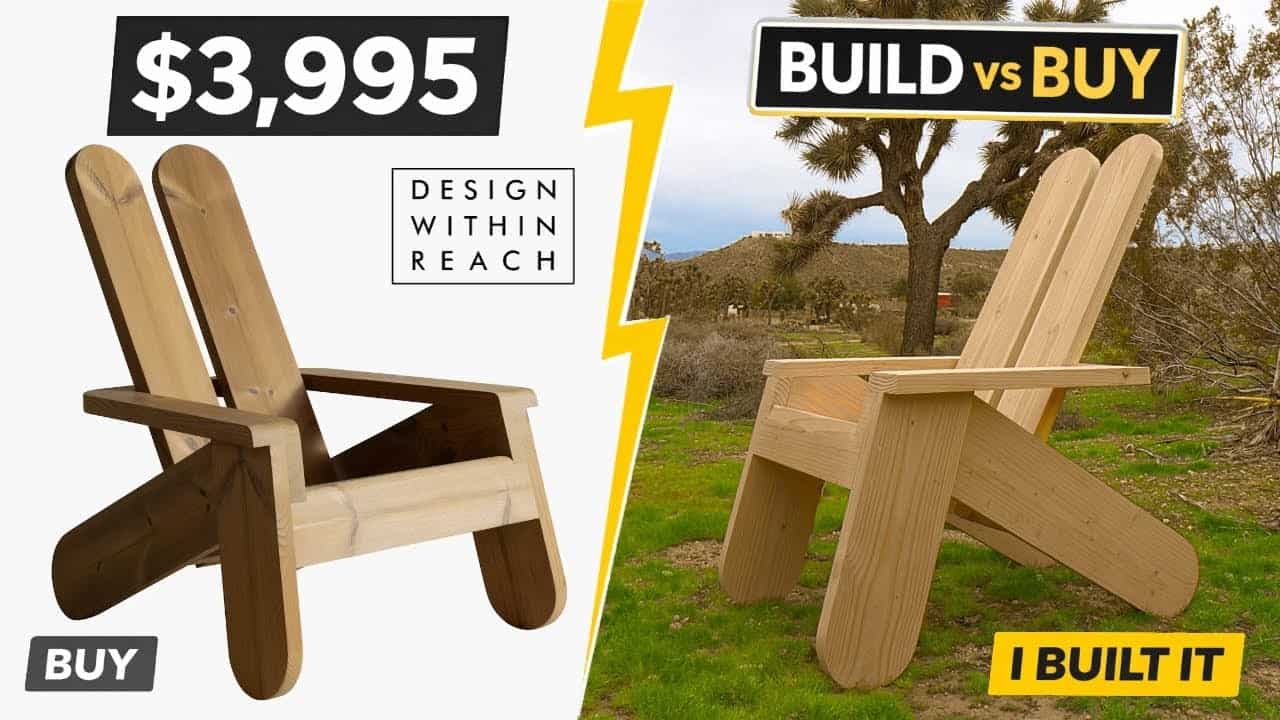
This project was built and designed by Mike Montgomery from Modern Builds.
Mike makes a simplified, modern take on a popsicle-stick–inspired Adirondack lounge chair and shows how careful layout and clean joinery can create a high-end look on a shoestring budget.
Watch the full video and subscribe to Mike’s channel:
Design
The chair riffs on contemporary Adirondack silhouettes, translating the popsicle-stick aesthetic into long, rounded back slats and bold leg profiles.
Mike balances visual simplicity with thoughtful angles so the pieces read cleanly from a distance while still offering a comfortable recline up close.
Lumber prep and layout
The build starts with milling common boards to consistent thickness and then laying out parts oversized so they can be fine-tuned during dry fit assembly.
Mike uses printed reference images and angle-measuring tools to reverse-engineer the original proportions, which helps keep the look proportional without relying on exact copies.
Joinery and assembly
Rather than elaborate joinery, the design relies on straightforward glued joints reinforced with recessed fasteners and dowel plugs for a tidy, high-end appearance.
Hidden pocket screws and plugged recesses give the chair a through-dowel visual without exposing mechanical fasteners, keeping the aesthetic clean and intentional.
Shaping and shaping options
Rounded popsicle-stick ends are achieved with simple curve-cutting techniques and sanding, demonstrating that complex profiles can be made with basic methods.
Mike shows alternate approaches—cutting curves with a jigsaw for speed or using multiple straight cuts and aggressive sanding for a square-reference blade—so makers can choose what fits their shop and comfort level.
Clamping, fitting, and ergonomics
Dry-fitting the assemblies and trimming parts to match the frame is central to a successful outcome, and small spacer blocks are used to set consistent slat spacing and stops.
Mike evaluates the chair’s recline and armrest height in real use, noting small tweaks that would improve comfort for future iterations, which highlights the value of prototyping over perfect first-time dimensions.
Sanding and finishing
After assembly, the chair is smoothed through progressive sanding and small details like flush-trimmed dowels are finished to make the joinery disappear into the surface.
A light, durable exterior finish seals the wood while keeping the natural character of the boards—an approach that emphasizes longevity for outdoor furniture without hiding the grain.
Lessons learned and adaptation ideas
The build underscores a few repeatable lessons: measure with a plan but leave parts oversized for fitting, use concealed fasteners for a refined look, and prioritize comfort with small ergonomic tweaks.
The design is easy to adapt into a set; by adjusting back recline or armrest height, other makers can tailor the chair for different silhouettes or user preferences while keeping the same visual language.
Conclusion
The project demonstrates how careful design decisions and modest techniques can produce a luxury look for a fraction of the retail price, and it’s a useful plan for anyone wanting to make modern outdoor seating that reads expensive without requiring exotic materials.
Please support Mike by visiting his website: https://www.modernbuilds.com/.

Matt’s Take
These are my personal thoughts and tips based on my own experience in the shop. This section is not written, reviewed, or endorsed by the original creator of this project.
What I really appreciate about this build is how Mike demonstrates that “high-end look” doesn’t require high-end joinery. Those pocket screws with dowel plugs are a perfect example of working smarter, not harder. The visual impact of through-dowels without the precision headaches of actual through-mortises makes this accessible to woodworkers who might shy away from more complex chair builds.
The oversized-then-trim approach is gold for furniture projects like this. Chairs are unforgiving when proportions are off, so having that wiggle room during assembly can save a project. That dry-fitting phase Mike emphasizes isn’t just about checking joints—it’s your chance to actually sit in the thing and feel where adjustments need to happen before committing to final dimensions.
For outdoor furniture, that finishing choice is spot-on too. Heavy film finishes might look great initially, but they’ll eventually peel and flake in weather cycles. A penetrating finish that lets the wood move naturally tends to age much more gracefully, even if it means occasional reapplication. The real beauty of this design is how those simple curves and clean lines will still look intentional even as the wood weathers to gray.