

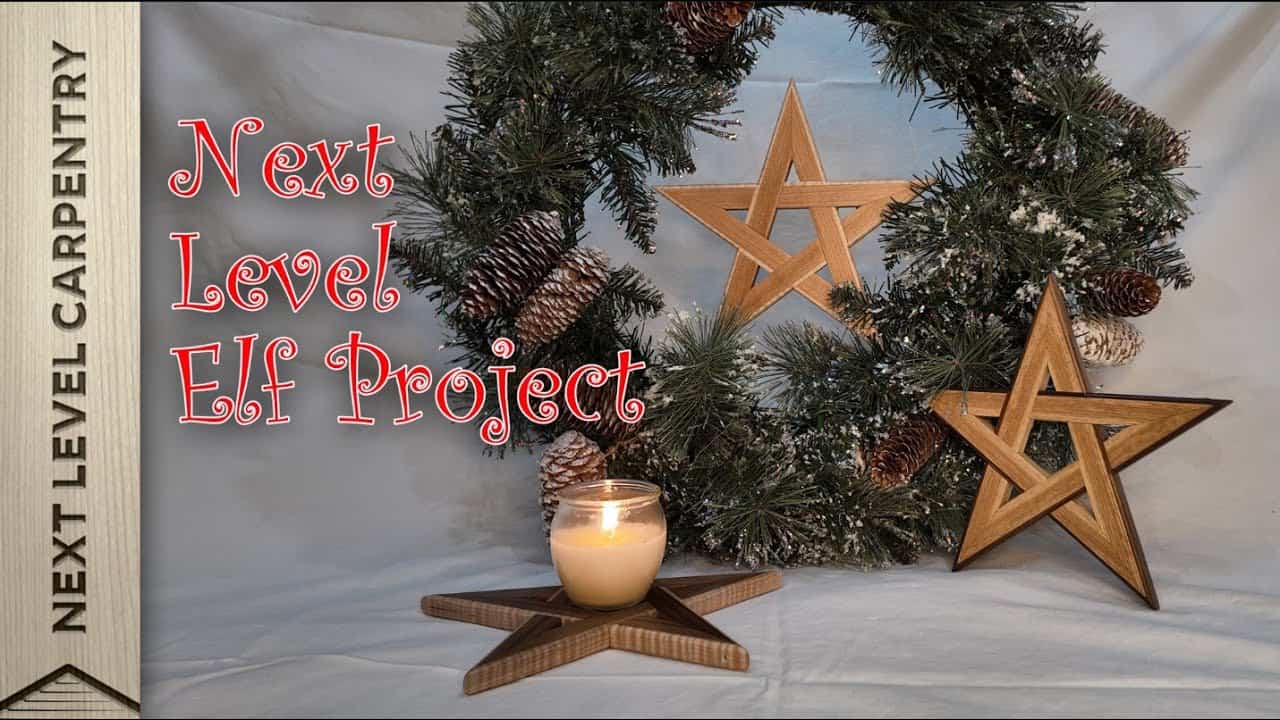
This project was built and designed by Matt from Next Level Carpentry.
Matt lays out a refined five-point star made from contrasting hardwood scraps, then shows the milling, jig-building, joinery, and finishing techniques needed to produce a batch of heirloom decorations.
The approach balances traditional geometry and careful fixture design so each star is repeatable, precise, and visually striking.
Watch the full video and subscribe to Next Level Carpentry:
Design and Geometry
Matt begins with full‑scale geometric layout to establish the star’s proportions and the placement of lap joints, using the drawing to confirm the lengths and miter angles before any wood is cut. This upfront drafting simplifies the rest of the process by turning a visual idea into measurable references for fixtures and stops.
The design relies on an interwoven half‑lap look and a thin contrast perimeter strip, so accuracy in laying out points and dividing the circle is essential. Using a full‑size drawing also gives an immediate way to test fit assemblies and refine jig settings without wasting material.
Milling and Material Prep
Rather than buying stock, Matt repurposes small hardwood scraps—maple, walnut, cherry, oak and more—and mills them into matched blanks with a built‑in contrasting strip. He demonstrates a practical pro tip: glue larger 5/8‑sized pieces into a sandwich, plane them square, then rip and plane to yield blanks that already include the thin accent stripe.
The milling routine follows classical steps: flatten faces, rip parallel edges, and go through the planer for consistent thickness before ripping final blanks. The batch approach maximizes shop time and produces multiples of identical parts ready for repetitive operations.
Jigs and Fixture Strategy
To cut precise miters and repeatable half‑lap dados, Matt builds a modified crosscut sled with custom runners, a clearance cut, and a micro‑adjustable fence. The fixture evolves to include an innovative off‑center dowel adjustment that lets him rotate the fence a few thousandths at a time, which proves crucial for dialing in angle accuracy across many parts.
Safety and repeatability get equal attention: the sled receives paste wax for smoothness, a handle for control, and toggle clamps for holding parts during dado operations. The fixture is deliberately modular so components can be swapped for different phases—miter cutting, stop‑based length cuts, and dado notching.
Cutting, Dado Setup, and Joinery
Matt sets up a dado stack sized slightly wider than the parts to avoid overly tight fits, then uses the sled and an 18° wedge to hold pieces at the proper angle for half‑lap cuts. The parts are ambidextrous, so one fixture and two flips of each piece produce matching slots on opposite faces without separate left/right guides.
Fine adjustments are where the work gets real: small indexing mistakes multiply across five pieces, so micro adjustment on the fence and careful test assemblies are essential. When the fit is right, the half‑lap joins interlock cleanly and create the intended woven visual effect.
Assembly and Glue‑Up Techniques
Matt avoids a painful hand‑sanding scramble by lightly sanding each part before assembly and by using a purpose-built glue‑up fixture that holds the five points precisely while shims and clamping blocks close the joints. The fixture’s geometry and shimming strategy allow controlled pressure around the star to tighten gaps evenly.
For fast, secure bonding and minimal clamp time, he uses thin CA glue with accelerator in conjunction with surface CA for gap filling. A clever trick for the stubborn final piece is splitting it, inserting the halves, then re‑lapping and gluing them back together, which solves the classic “last piece won’t weave in” problem without damaging points.
Shaping, Finishing, and Details
Once assembled, the stars receive a light roundover on outer edges and careful hand filing into the sharp corners to preserve crisp points where desired. Matt emphasizes removing any routed or burn marks and smoothing the profile before final sanding to minimize rework after finish.
The finish chosen is simple and effective: a couple of thin spray coats of a clear satin lacquer applied from multiple angles, with light sanding between coats to remove nibs and ensure a clean sheen. The outcome accentuates the contrast between woods and brings out fiddleback maple chatoyance without overpowering the joinery detail.
Lessons Learned and Adaptability
The project illustrates how upfront geometry, batching, and modular jigs reduce stress and increase consistency when making multiples of a small, intricate part. Matt’s process shows that taking time to prototype jig settings and making test pieces saves far more time than rushing into full production.
Many techniques here are adaptable: the laminated blank trick works for any small accent strip, the micro‑adjustable fence idea translates to other fixtures, and the split‑and‑reattach trick for tight assemblies is a handy general tactic. The project rewards careful planning and a willingness to iterate.
Conclusion
These heirloom stars are a study in design, precise layout, and thoughtful fixture work that turns small scraps into sophisticated holiday decor. The workflow—geometry, batch milling, micro‑adjusted jigs, and focused glue‑up—offers useful lessons for small‑part production and decorative joinery.
Watch the full video and subscribe to Next Level Carpentry:

Matt’s Take
These are my personal thoughts and tips based on my own experience in the shop. This section is not written, reviewed, or endorsed by the original creator of this project.
This project really showcases how proper planning and jig work can elevate what might seem like a simple decoration into something genuinely impressive. The full-scale drawing approach is spot-on — I’m a big believer in taking time upfront to work out geometry on paper rather than trying to figure it out with expensive wood in your hands. That micro-adjustable fence setup is particularly clever, and the principle applies to so many other projects where tiny angle adjustments make or break the final result.
The CA glue and accelerator combination for assembly is a smart choice here. When you’re dealing with multiple joints that need to come together simultaneously, having that instant bond eliminates the usual wrestling match with clamps and shifting parts. Just keep your workspace well-ventilated — CA fumes can sneak up on you, especially when using accelerator in an enclosed shop.
That split-and-reattach trick for the final piece is pure problem-solving gold. Anyone who’s done interlocking joinery knows that last piece can be the most frustrating part of the whole build. It’s one of those techniques that seems obvious once you see it, but takes real shop experience to think of in the moment. The whole approach here demonstrates how taking time to develop proper fixtures and techniques pays dividends when you’re making multiples of anything.