

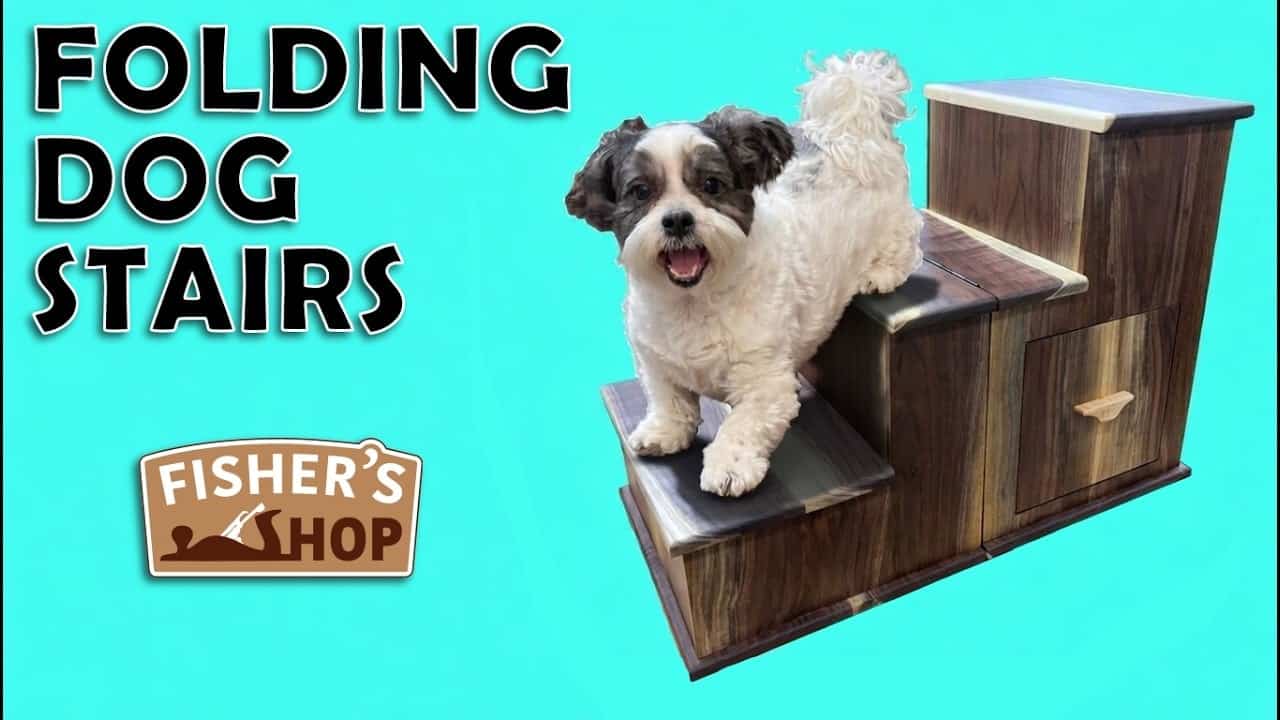
Drew Fisher from Fisher’s Shop shared the woodworking build featured in this video.
This folding dog-stair project solves a real household problem: helping a small dog get onto the bed while keeping the footprint tidy when the stairs are not needed.
Watch the full video and subscribe to Drew’s channel:

Design: Stairs That Disappear (and Still Look Good)
The core idea is simple but clever: the stairs fold, and when they fold away, the piece can function like an end table or nightstand. That means the build is both practical and visually integrated into the room.
A taller section includes a drawer for storage, so the project is more than just “dog access”—it becomes a place to keep small essentials organized. The hinge design is the key to the smooth transition between “deployed stairs” and “folded furniture.”
Lumber Prep: Choosing Boards for Color and Character
Black walnut was selected for its depth and contrast, with attention paid to how sapwood and heartwood show through on the treads. Rather than treating the grain as random, the boards were cut so the pattern flows across the assembled faces.
To keep the final product stable and consistent, the stock was milled down to uniform thickness before cutting parts to size. Letting lumber be prepared evenly helps prevent surprises later when panels get glued and fastened.
Joinery and Panels: Building Stable Stair Sections
The stairs’ upper and lower portions were built as separate assemblies, each formed from multiple parts joined into panels. Panel glue-ups were sanded until the seams disappeared, then trimmed down to final shape.
For the internal bottom mounting strategy, slots and fasteners were used so the bottoms could accommodate wood movement. That detail matters for anything that will be handled, folded, and exposed to normal humidity changes.
Drawer Integration: Storage Without Complication
The drawer opening wasn’t just added for convenience; it also made assembly easier during the build. A flush-trim approach and controlled routing helped define the opening cleanly.
The drawer box itself used familiar construction methods (edge banding and a simple, durable bottom) so the focus stayed on fit and function rather than exotic joinery. The end result is a drawer that looks like it belongs with the furniture form, not like an afterthought.
Rails, Slides, and Alignment: Making Smooth Motion Real
Drawer slide mounts were positioned with an emphasis on squareness and clearance so the drawer could move smoothly. Adjusting alignment early prevents binding that can be hard to fix after finishing.
During installation, spacers were used to hold the correct height and keep the rails level. That kind of “fixture thinking” reduces trial-and-error, especially in a project where small alignment errors can show up immediately.
Shaping the Details: Comfort and Visual Refinement
Edges were softened with rounding and sanding so the stairs feel friendly in use. This matters for dog-access stairs—comfort prevents accidental roughness on paws, and it elevates the look from “shop project” to furniture.
In addition to edge rounding, the designer aligned the look with coordinated drawer hardware details. Small aesthetic matches help the whole piece read as one cohesive system.
Hinge and Fold Mechanism: The “Furniture Mode” Switch
The hinge was mortised so it sits flush and enables the two stair sections to fold cleanly. Centering the hinge and fitting it carefully is what makes the transition feel smooth instead of clunky or misaligned.
A first test fit confirmed the fold behavior before finishing. Running the hinge and checking alignment early prevents finish-time regret when something binds or doesn’t sit flat.
Finishing: Deep Walnut Color With Easy Application
For the finish, a wipe-on style oil was used, thinned for easy penetration and applied with a foam brush. The goal wasn’t just protection—it was bringing out the wood’s richness, including the contrasting sapwood character on the treads.
Multiple light coats built up protection, followed by curing and buffing. This approach keeps the surface attractive without looking overly heavy, which is especially important since the piece can live in “furniture mode” every day.
Lessons Learned: Test Fit Everything (and Expect the Unexpected)
Once the stairs were installed at the bed, the dog initially showed zero interest—behaviorally, that part of the test was real and immediate. Rotating the setup sideways helped change the dog’s perception of the surface and reduce how far it felt like it needed to reach.
As a final reminder, careful handling during assembly matters—drawer and alignment mistakes can create time-consuming fixes. The broader takeaway is to verify fit and function before committing to adhesives or final fastening.
Overall Takeaways: A Practical Shop Project With Real-World Payoff
This project stands out because it treats a “pet problem” like a furniture-design challenge. The fold feature, integrated storage, and coordinated styling mean the end result belongs in the room, not just in the dog corner.
It’s also a strong intermediate learning platform: it combines panel work, repeatable shaping, hinge fitting, and drawer alignment into one cohesive build. With the same concept, similar fold-and-storage furniture could be adapted for other household needs—while keeping the footprint small.
Watch the Full Build
For more on how the folding mechanism, drawer workflow, and walnut finishing come together, the full process is shown in the video from Fisher’s Shop.
Get Drew’s plans here: https://fishersshoponline.com/plans/p/dogstairs.

Matt’s Take
These are my personal thoughts and tips based on my own experience in the shop. This section is not written, reviewed, or endorsed by the original creator of this project.
The hinge mortising on this build is where things get critical. When you’re dealing with a piece that needs to fold cleanly and still look like furniture, those hinge cuts have to be spot-on. Even a sixteenth off can make the whole thing feel sloppy when it transitions between modes. I always do test cuts on scrap first when I’m mortising hinges for anything that’ll see daily use.
The drawer slide installation caught my attention too. Using spacers to maintain consistent height during mounting is one of those shop habits that saves so much headache later. Nothing’s more frustrating than a drawer that binds because one rail is a hair higher than the other. That attention to alignment early in the process shows through in the final result.
What I really appreciate about this project is how it treats the “pet furniture” challenge seriously from a design perspective. The walnut choice and the clean lines mean this doesn’t scream “dog accessory” when it’s folded up. That dual-purpose thinking is smart woodworking – you’re solving the immediate problem while making something that actually enhances the space.
The edge softening detail is worth noting for anyone considering a similar build. Dogs are surprisingly sensitive to sharp edges, and taking that extra time with sandpaper makes the difference between something they’ll use confidently and something they’ll avoid.