

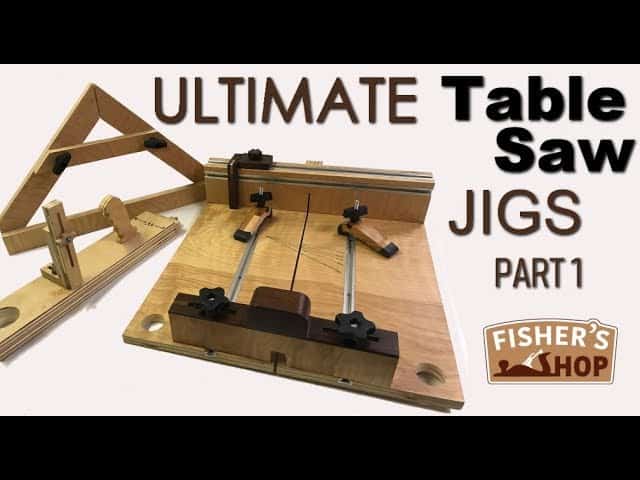
This project was built and designed by Drew Fisher from Fisher’s Shop. It includes three table saw jigs that are designed to improve accuracy, efficiency, and safety in the workshop.
The jigs featured in this project are the Thin Strip Jig, a versatile Crosscut Sled, and a Miter Sled Attachment. Each serves a different purpose and brings precision to repetitive woodworking tasks.
Watch the full video and subscribe to Drew’s channel:
Making the Thin Strip Jig
The Thin Strip Jig is designed for safely cutting narrow strips of wood at consistent widths. Drew starts by creating a plywood base and shaping a comfortable handle using a bandsaw and spindle sander.
Once the base is set, he moves on to building the hold-down clamp. Instead of drilling through the wood, he uses the bandsaw to cut slots for bolt access.
A hardwood knob is added to make clamp adjustments easier. After assembly, the jig holds wood securely against the saw fence, allowing for safe, repeatable cuts.
The jig includes a back catch and hold-down system to stabilize the workpiece during cutting. With the fence locked in place, there’s no need for repeated fence adjustments between cuts.
Building Fisher’s Crosscut Sled
Next, Drew builds a large Crosscut Sled for precise crosscutting tasks. The base is made from smooth, stable plywood and paired with a laminated fence built from multiple layers.
The fence block is thick and durable, allowing it to stay square under regular use. Once glued and dry, T-track slots are added to the base and fence to allow for adjustable stop blocks and hold-downs.
A dust-collecting chamfer is added to reduce sawdust buildup behind the fence. This small feature keeps the sled functioning cleanly without constant clearing.
To ensure the sled is perfectly square, Drew uses the five-cut method. By measuring and trimming across multiple cuts, the fence is adjusted for maximum accuracy.
Once complete, the Crosscut Sled becomes a staple tool for many types of woodworking projects. It makes quick, accurate cuts much easier and more reliable.
Creating the Miter Sled Attachment
To expand the sled’s functionality, Drew builds a miter sled attachment. Strips are cut at 45-degree angles and glued together to form a stable platform.
A speed square helps ensure all the miters align correctly. Precise angles are important when working on frames or any piece requiring clean, tight corners.
Once finished, the attachment is mounted to the Crosscut Sled. This setup allows for consistent and repeatable miter cuts at accurate angles.
The attachment also gives extra support when working with longer or wider material. This improves both safety and the quality of the finished joint.
Why These Jigs Matter
These jigs are a great example of how simple tools can improve a woodworking shop. They’re not only functional but also help reduce errors and increase repeatability.
Having jigs like these ready to go saves time during setup. It also helps woodworkers of all levels produce clean, consistent results on a variety of cuts.
Each one is designed with ease of use in mind, making them approachable for beginners. At the same time, experienced woodworkers will appreciate the refinements and versatility they offer.
Detailed plans for all three jigs are available on Drew’s website, Fishers Shop Online. These resources are helpful for anyone interested in adding these tools to their own workspace.
Watch the Full Build
Get Drew’s plans here: https://fishersshoponline.com/plans/p/fishers-table-saw-jigs-part1

Matt’s Take
These are my personal thoughts and tips based on my own experience in the shop. This section is not written, reviewed, or endorsed by the original creator of this project.
These three jigs really showcase how a few well-built shop helpers can transform your table saw work. The thin strip jig is particularly clever — cutting narrow strips safely is one of those tasks that makes everyone nervous, and having a dedicated jig removes that anxiety completely. The hold-down system Drew designed keeps everything locked in place, which is exactly what you want when working close to the blade.
That crosscut sled looks rock-solid with the laminated fence construction. Building up layers like that creates serious stability that won’t bow or twist over time. The five-cut method for squaring is spot-on — it’s one of those techniques that seems fussy until you realize how much more accurate your cuts become. Taking the time to get it dialed in perfectly pays dividends on every future project.
The miter attachment is a smart addition that really extends the sled’s usefulness. Picture frames, boxes, anything needing clean 45-degree cuts becomes much more straightforward. Having T-track built into the base gives you flexibility for stops and hold-downs, which is especially helpful when you’re doing production runs or need to match multiple pieces exactly.
Jigs like these are investments in consistency. Once you have them dialed in, they eliminate the setup time and second-guessing that comes with freehand cuts. Your shop efficiency goes up, and more importantly, your cuts become repeatable and predictable.