

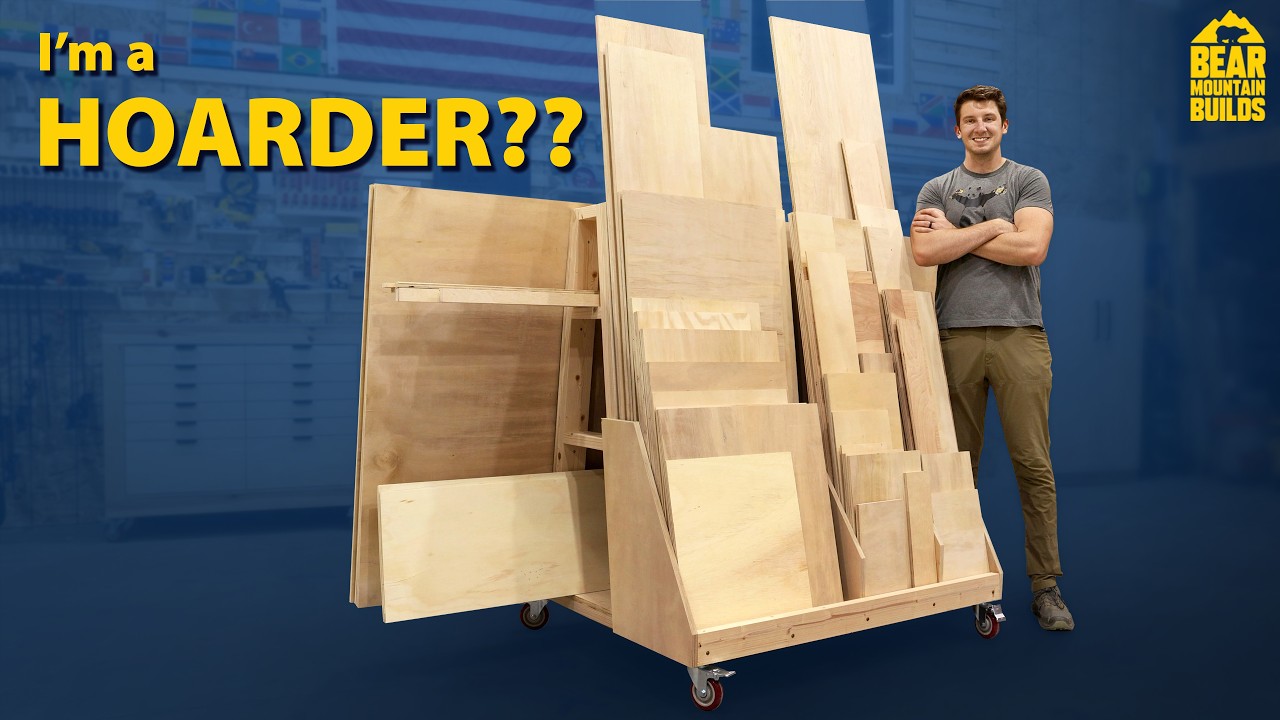
This project was built and designed by Zach from Bear Mountain Builds.
The mobile storage cart addresses the common challenge of organizing plywood sheets and offcuts in small workshops. Zach creates a compact solution that maximizes storage efficiency while maintaining easy access to materials.
Watch the full video and subscribe to Bear Mountain Builds:


Design and Layout
The cart features a clever multi-zone design that accommodates different types of lumber storage. The front section includes compartmentalized cubbies sized for various plywood remnants, from large half-sheets to smaller offcuts.
Central A-frame structures create storage channels perfect for longer pieces like molding and dimensional lumber. The back panel provides vertical storage for full sheets of plywood, keeping them accessible but out of the workspace.
At just over four feet wide and three feet deep, the cart fits comfortably between workbenches while maximizing storage capacity. The compact footprint makes it practical for garage workshops where space is at a premium.
Structural Foundation
Zach begins with a reinforced plywood platform that forms the cart’s foundation. A frame made from dimensional lumber adds structural integrity and provides mounting points for the caster wheels.
The reinforcing frame prevents sagging under load and eliminates the risk of screws penetrating through the top surface. Pocket screw joinery creates strong connections while maintaining clean sight lines.
This robust base design ensures the cart remains stable even when fully loaded with heavy plywood sheets. The foundation approach could be adapted for other mobile workshop storage solutions.
A-Frame Construction
The three A-frame assemblies use consistent seven-degree angles throughout, simplifying the cutting process. Each frame includes three cross braces positioned using spacers to ensure accuracy and repeatability.
Zach demonstrates how spacers eliminate measurement errors when positioning components at angles. This technique ensures all three A-frames match perfectly, creating uniform storage channels.
The angled design maximizes the storage area while providing natural stops for materials placed in the channels. This geometry prevents items from sliding through while maintaining easy loading access.
Panel Installation
Side panels cut with matching seven-degree angles create seamless joints with the A-frame structures. A baseline reference system ensures consistent positioning during assembly.
The panels attach from behind to hide fasteners, maintaining a clean appearance. This approach requires careful pre-drilling and angled driving but results in professional-looking joints.
Front stops made from dimensional lumber prevent stored sheets from sliding off the cart during movement. These substantial stops add visual weight while providing essential safety.
Storage Organization
The front cubby system uses custom-shaped sidewalls that follow the cart’s angled design. Removable dividers create multiple compartments sized for different material widths.
Zach shows how staggered heights in the front compartments improve visibility of stored materials. This organization method helps identify specific pieces without moving other items.
The modular divider approach allows customization based on the types of offcuts typically generated in individual workshops. Users can adjust compartment sizes to match their specific storage needs.
Mobility Features
Four-inch caster wheels provide smooth rolling over shop debris and small obstacles. The robust casters handle the cart’s loaded weight while maintaining maneuverability in tight spaces.
The wheel placement on the reinforced frame distributes weight evenly and prevents stress concentration. This mounting approach extends caster life and maintains smooth operation under heavy loads.
Mobile storage transforms material organization from a space problem into a workflow enhancement. The cart can move materials directly to project locations, reducing handling and setup time.
Workshop Integration
This storage solution addresses the transition from material hoarding to organized collecting through systematic storage. The cart’s design accommodates the reality of accumulated offcuts while making them easily accessible.
The compact dimensions allow the cart to integrate into existing workshop layouts without requiring major reorganization. Its mobility means it can serve active projects while maintaining material organization.
For small workshops, this type of vertical storage maximizes floor space utilization. The design principles could be scaled or modified for different shop sizes and storage requirements.
See Zach’s plans here: https://www.bearmountainbuilds.com/products/wood-storage-cart

Matt’s Take
These are my personal thoughts and tips based on my own experience in the shop. This section is not written, reviewed, or endorsed by the original creator of this project.
Storage carts like this are absolute game-changers in small shops. I’ve found that the key to any mobile storage system is getting the foundation rock-solid — that reinforced plywood base with the dimensional lumber frame is spot-on. Without proper reinforcement, these carts develop wobbles and sags that make them frustrating to use. Those four-inch casters are worth the investment too. Cheap wheels will bind up with sawdust and make you regret the whole project.
The seven-degree angle throughout the design is brilliant for preventing materials from sliding around. When you’re wheeling this thing across an uneven shop floor, angled storage naturally keeps everything in place. Using spacers for consistent positioning during assembly is one of those techniques that separates clean builds from wonky ones — especially when you’re working with angles.
For anyone building something similar, consider your typical offcut sizes before cutting those dividers. I tend to accumulate certain dimensions more than others, so customizing those compartments to match your actual workflow makes a huge difference. Also remember that fully-loaded sheet goods get heavy fast, so test those caster mounting points with some weight before calling it done.