

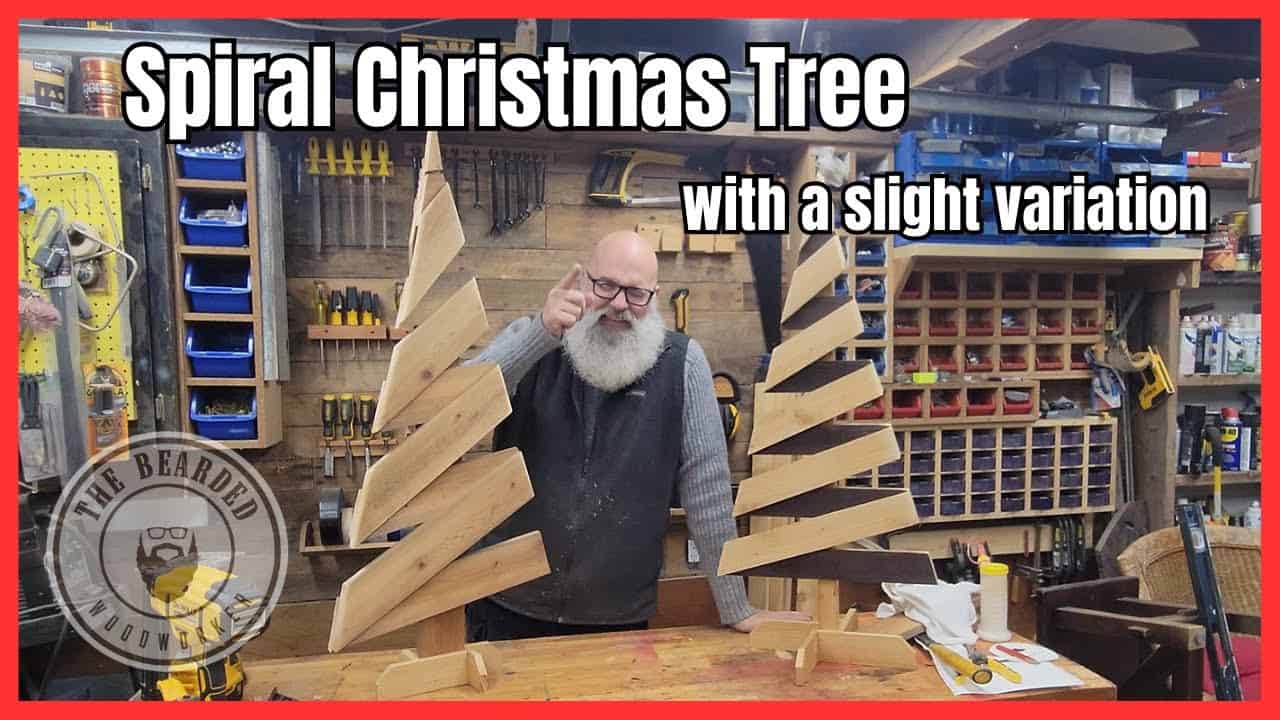
This project was built and designed by Gary Herd from The Bearded Woodworker.
Gary experiments with a popular DIY spiral tree idea and pushes it a step further by rounding edges and testing an alternate spiral angle for a more sculptural look.
Watch the full video and subscribe to The Bearded Woodworker:
Design
The project reinterprets the familiar stacked-board holiday tree by emphasizing contrast and profile rather than ornamentation.
Gary uses a simple trunk and staggered boards to create a silhouette that reads as a tree while allowing room for variations like rounded edges or alternating angles.
Lumber Prep
Boards are broken down to repeatable widths and pre-stained where contrast is desired so the final assemblies have depth without complicated joinery.
Choosing the trunk material and stock thickness affects how the spiral reads from the side, so material choice is treated as a design decision rather than a technical detail.
Joinery and Assembly
The build relies on glue and fasteners to secure the stacked boards to the trunk, with spacers used to keep consistent gaps during assembly.
An alternate approach—angling successive boards for a spiral effect—adds visual interest but introduces alignment challenges as the stack grows taller.
Shaping and Detailing
Rounding over the board edges softens the overall form and creates a curvier, more finished appearance; small bevels on the base pieces add a subtle decorative touch.
Trimming the assembly into a triangular tree silhouette is the final shaping step, and small sanding passes help unify the profiles before finish is applied.
Base and Finishing
A simple stacked-block base with chamfered corners keeps the tree stable and complements the rounded boards above it.
Back boards are stained early to create contrast, and a clear topcoat is applied to protect the surfaces and decide whether each piece stays indoors or goes outside.
Lessons Learned
Testing different angles taught that the more aggressive the twist, the more careful one must be with layout and fastener placement to maintain alignment up the stack.
The straightforward stacked version remains the most reliable for quick builds and gifting, while the angled spiral is a good exercise in visual experimentation for makers who enjoy a challenge.
Watch the full video and subscribe to The Bearded Woodworker:

Matt’s Take
These are my personal thoughts and tips based on my own experience in the shop. This section is not written, reviewed, or endorsed by the original creator of this project.
The genius of this project is how it takes a simple concept and shows you can push it in different directions. The stacked board approach is forgiving for beginners — if one layer goes slightly off, you can usually correct it with the next one. But when you start angling those boards for the spiral effect, tolerance stack-up becomes real. Each small misalignment compounds as you go up.
Pre-staining those contrast boards is a smart move that saves a ton of masking time later. Just make sure your glue surfaces stay clean — a light sanding on the contact areas after staining ensures good adhesion. For the rounding over, a 1/4″ roundover bit is probably the sweet spot here. It softens the edges without making them look too pillow-like.
The base design Gary shows is clean and stable, but don’t overlook how important that foundation is. A wobbly tree becomes a liability quickly, especially if kids are around. If you’re making these as gifts, consider adding felt pads to the bottom — it protects surfaces and shows that extra bit of care in the details.
The spiral version definitely looks more dynamic, but Gary’s right that the straight stack is your friend for production runs. Sometimes the simple version of a project is simple for good reasons.