

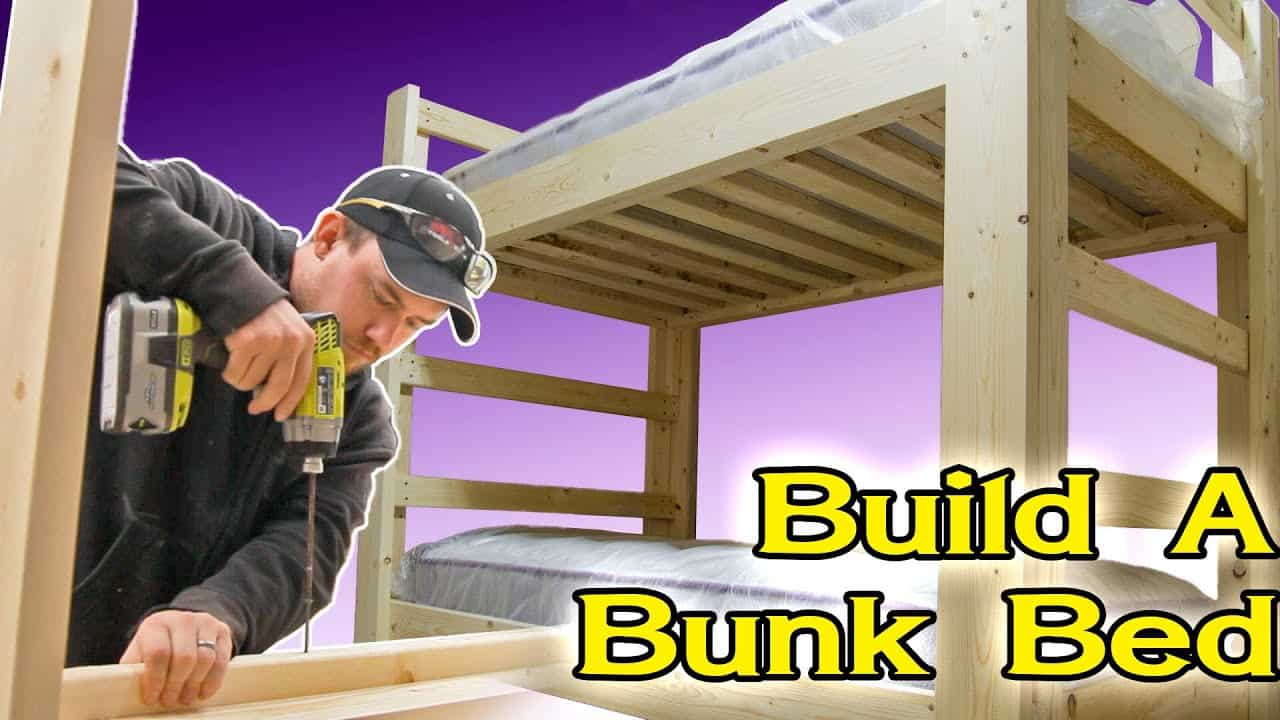
This project was built and designed by Jay Bates. It’s a durable and straightforward bunk bed that balances cost, strength, and accessibility using standard construction lumber.
Jay’s approach combines smart joinery and thoughtful layout to create a bunk bed that looks clean, feels solid, and can be made with basic tools. The result is a strong, no-frills design that works well for kids’ rooms, guest spaces, or shared living setups.
Watch the full video and subscribe to Jay’s channel:
Starting with the Bed Frames
The bunk bed is built around two bed frames, each made from 2×6 boards. This lumber choice adds rigidity and minimizes flex, even under daily use.
To keep the wood looking natural, minimal sanding is done—just enough to remove factory markings. Jay runs each board through a thickness planer to expose clean grain and level the surface without removing too much character.
Making the Mattress Supports
Mattress slats rest on 2×2 ledgers mounted along the inner edges of the frame. Rather than buying 2x2s, Jay rips down 2x4s to size, making better use of materials and saving on cost.
The slats themselves are also cut from 2x4s, which are often cheaper than traditional 1x4s. A rabbet is cut along each edge of the frame to seat the slats. Instead of screwing every slat in place, only the center one is fixed—while the rest are dropped in using spacers made from the rabbet offcuts.
Circular Saw Tips and Jig Use
Jay shows that even without a table saw, accurate cuts are still achievable. By making a simple jig, he’s able to guide a handheld circular saw for precise rabbets.
This jig setup is especially useful for DIYers with limited tools. It proves that you can build professional-quality furniture without needing a full workshop setup.
Constructing the Legs
The legs are built as L-shaped assemblies using a 2×4 joined to a 2×6 with pocket hole screws. This method increases strength while hiding all visible fasteners for a cleaner look.
Pocket holes are positioned so they won’t be seen once the bed is assembled. This creates a professional appearance without the need for additional trim or plugs.
Assembling the Bed
Small locator blocks are used during assembly to line everything up consistently. Once each frame is set into place, it’s secured using wood screws that hold tight and prevent shifting or racking.
The design results in a bunk bed with no visible screws or bolts on the outside. This creates a seamless finish that looks clean from any angle.
Built-in Ladder Access
One standout feature is that either end of the bunk bed acts as a full-size ladder. The vertical spacing between boards is ideal for climbing, eliminating the need for a separate ladder piece.
This design makes access easier and helps conserve floor space—especially important in tighter bedrooms or shared spaces.
Plans for Finishing
At the time of filming, Jay hasn’t yet applied a finish to the bunk bed. He mentions plans to experiment with steel wool and vinegar for a weathered effect, followed by a layer of briwax.
That finishing process will be shared in a future video. For now, the raw wood look adds to the simplicity and flexibility of the design.
Affordable, Functional, and Repeatable
What makes this project especially useful is how replicable it is. The materials are common, the tools are accessible, and the build techniques are within reach for most intermediate woodworkers.
The design can be adapted to fit different mattress sizes or room dimensions. It’s also sturdy enough to be used in real-world settings without modification.
Please support Jay by purchasing his plans here: Jay’s Custom Creations.

Matt’s Take
These are my personal thoughts and tips based on my own experience in the shop. This section is not written, reviewed, or endorsed by the original creator of this project.
I really appreciate how Jay approached this project with standard construction lumber—there’s something refreshing about keeping things simple and accessible. That 2×6 frame choice is spot-on for minimizing flex, and ripping your own 2x2s from 2x4s is a smart move that often gives you better quality material than buying pre-made smaller stock.
The circular saw jig technique he demonstrates is a game-changer for folks without table saws. I’ve found that taking the time to build simple jigs like this often results in cuts that are just as accurate as what you’d get from stationary tools. The key is really taking your time with the setup and making sure your guide is perfectly square before making any cuts.
Safety-wise, whenever you’re working with pocket screws on structural joints like those legs, it’s worth double-checking your screw length to avoid blowout on the opposite face. The L-shaped leg assembly is a solid approach that distributes weight well, and hiding those fasteners makes all the difference in the final appearance.
The integrated ladder design is clever—it eliminates a separate component that could become loose over time. For anyone building this, just remember that raw construction lumber will continue to move and settle, so checking all connections after a few months of use is always good practice.