

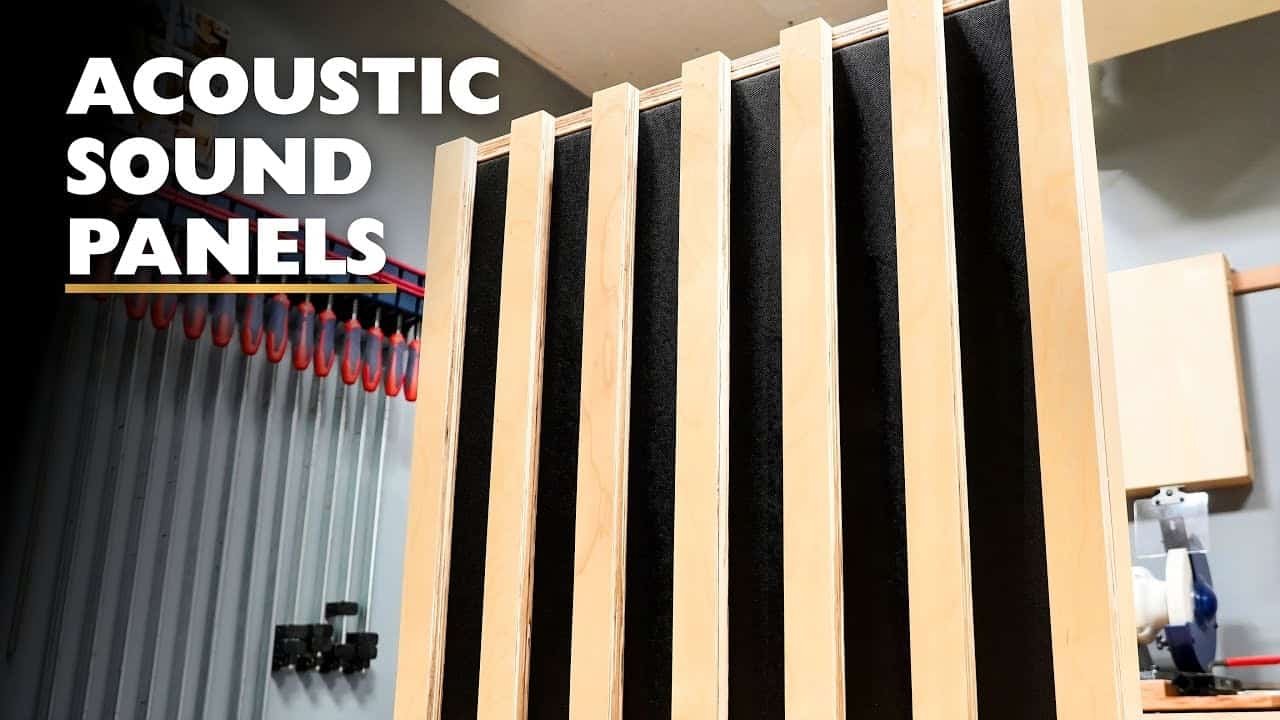
This project was built and designed by Connor from Shopfix.
Connor shows how relatively simple, well-considered acoustic panels can kill reverb, tighten low end, and visually lift a one-car garage shop into a cleaner, more professional workspace.
Watch the full video and subscribe to Shopfix:

Design
The panels combine a simple box frame with a perforated back, acoustical insulation, and a fabric wrap to achieve both function and a refined aesthetic.
Connor intentionally left a bit of fabric exposed around the edges and added thin face slats to create a floating, architectural look that complements his prefinished shop surfaces.
Materials and Acoustic Principles
Each panel layers breathable acoustic fabric over mineral wool, with a rear panel that is perforated so sound can pass through and be absorbed rather than reflected.
Connor emphasizes the importance of avoiding compression of the insulation and maintaining an air gap between the panel and ceiling or wall for better low-frequency performance.
Construction Overview
The builds favor lightweight backing material to keep overall panel weight down, making ceiling installation more manageable when hanging multiple units overhead.
Joinery is straightforward—glue and brad nails to square up simple boxes—followed by edge rounding and sanding to protect the fabric during wrapping.
Fabric Wrapping and Finishing Touches
Connor approaches the wrap like gift-wrapping: secure one side, pull the opposite side tight to remove creases, and fold neat corners before stapling to the back.
Prefinishing the wood members before attaching them to the fabric-faced panels is essential, since finishing after installation risks damaging the fabric and the finished look.
Framing and Visual Details
Adding a thin perimeter frame and spaced slats breaks up the fabric visually and provides additional nail surface while keeping the overall profile light and refined.
Connor calculates consistent spacing with a simple spacer block, which makes repeatable installation fast and keeps the panels uniform across the ceiling grid.
Mounting and Installation
For ceiling mounting, the panels use screw hooks anchored to ceiling studs and consistent marker depths so every panel hangs the same distance from the ceiling.
Layout is deliberate: once the grid is dialed in, hanging becomes a repeatable process and the acoustic improvement is immediate upon installation.
Results and Practical Takeaways
The panels significantly reduce echo and make the space sound tighter and more controlled, which benefits recording, tool noise management, and general comfort in the shop.
Techniques shown—softened edges to protect fabric, leaving insulation uncompressed, and preserving an air gap—are adaptable to different room sizes and panel scales.
Why This Project Matters
Beyond the measurable audio improvement, these panels demonstrate how small architectural moves can elevate a space both sonically and visually.
Woodworkers and content creators can adapt the design ideas here to suit walls, ceilings, or smaller accents without specialized gear or complex joinery.
Please support Connor by visiting his website: https://www.shopfix.services/.

Matt’s Take
These are my personal thoughts and tips based on my own experience in the shop. This section is not written, reviewed, or endorsed by the original creator of this project.
Acoustic panels are one of those projects that deliver way more impact than the effort suggests. The mineral wool Connor uses is the real workhorse here—it’s incredibly effective at sound absorption, but handling it requires some care. I always keep a dust mask handy and work in a well-ventilated area when cutting or installing any fibrous insulation. Those loose fibers can be irritating to skin and lungs.
The air gap behind the panels is crucial and worth emphasizing. That space essentially extends the effective thickness of your acoustic treatment, especially for lower frequencies that tend to bounce around shop spaces. Without it, you’re leaving performance on the table. The perforated backing is a smart detail too—solid backing would just reflect sound right back instead of letting it pass through to be absorbed.
From a shop efficiency standpoint, pre-finishing the wood components before fabric installation is brilliant. Once that fabric is on, any finish work becomes a nightmare of masking and careful brushwork. The gift-wrap approach to fabric installation really does work—I’ve found that starting with opposite sides and working your way around gives you the best shot at eliminating wrinkles and getting clean, tight corners.
These panels prove that thoughtful design details can transform functional shop improvements into something that actually enhances the space visually. The floating slat detail and exposed fabric edges turn what could be purely utilitarian into something architectural.