

Josh Wright built and designed this project.
Josh set out to make a decorative wooden barrel using common lumber, shop tricks, and a deliberately inefficient process to highlight the fun side of making things that could have been bought cheaper.
Watch the full video and subscribe to Josh’s channel:
Design
The barrel is a mostly decorative piece that borrows the silhouette and visual cues of a traditional coopered barrel without following historical techniques or materials. Josh prioritized the look—staves, bands, and an engraved top—over true function, which created room for creative problem solving.
The decision to use common dimensional lumber and rope bands makes the project approachable for most woodworkers while keeping the focus on shaping and visual finish rather than liquid-tight construction.
Lumber Prep and Bending
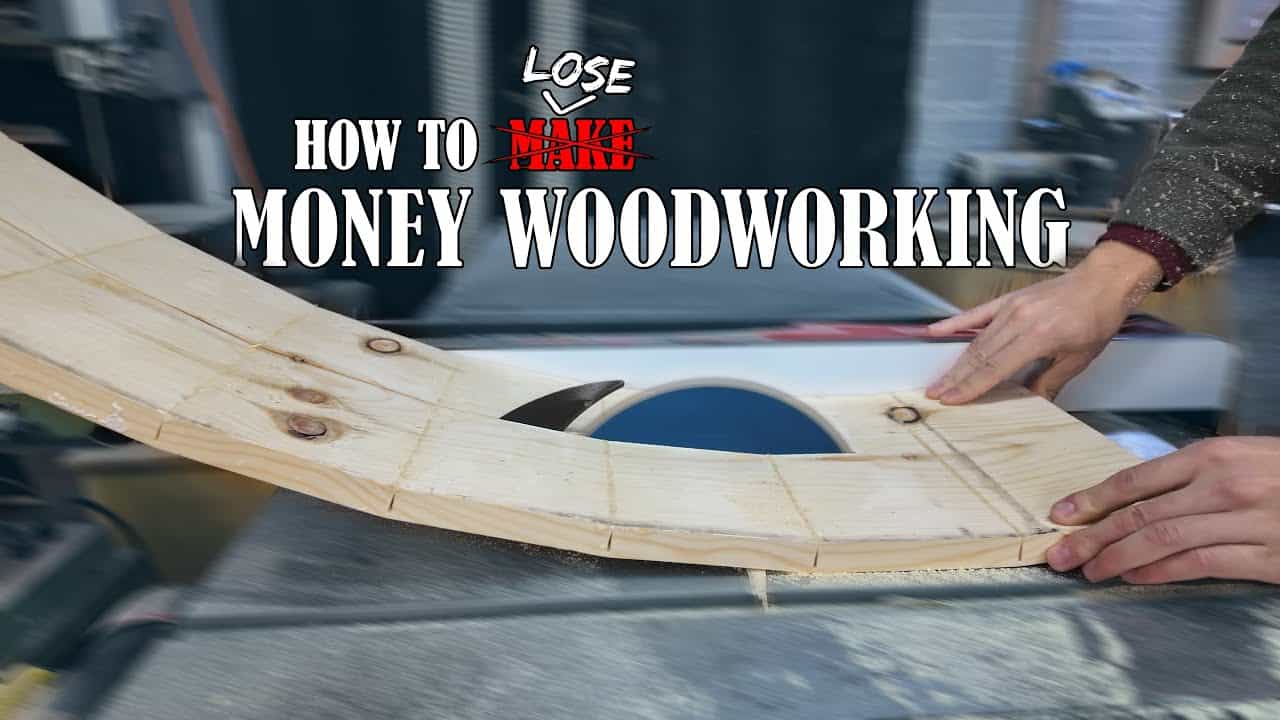
For the staves, Josh broke down standard boards and introduced relief cuts to give the lumber bendability before filling those cuts with thick glue to lock in a curved profile. This glue-and-clamp curve-bending technique is a reliable way to coax straight stock into compound curves without steam bending equipment.
After the bent blanks cured, Josh ripped them into staves and relied on careful layout to preserve grain flow and stave proportions, a good reminder that preparation and mock-ups pay off when working with irregular shapes.
Edge Profiling and Shaping
To get the compound angled-and-curved edges that let staves nest into a barrel form, Josh used sacrificial spacer blocks glued to each edge and then trimmed the profile back against a joiner. The disposable blocks lifted the work just enough to create the intended bevel and sweep without specialized cutters.
This is a practical adaptation for shops without custom tooling: use simple jigs and sacrificial parts to create complex profiles, then refine the surfaces with light sanding and test fitting.
Alignment and Assembly
Aligning more than twenty staves into a round form is awkward, so biscuits were used in high quantity to index joints and create a friction-fit assembly that stayed square during the dry-fit. The large number of alignment points made the assembly manageable and predictable without a forest of clamps.
Rather than permanent glue at that stage, Josh used hot glue along seams to stabilize the form long enough to move on, which is an example of choosing temporary adhesives for fit-up before committing to permanent joinery.
Bands, Ends, and Access
Instead of metal hoops, Josh wrapped rope around the barrel to suggest bands, glued in layers for thickness and visual contrast. Rope is an accessible alternative when metalworking tools aren’t available and it reads authentically at a glance.
For the top and bottom, leftover scraps were reassembled into panels and trimmed to fit, then a simple internal lip made from coiled rope created a removable lid. The result isn’t watertight, but it delivers a functional and removable top for storage and display.
Finishing and Detailing
Josh stained the barrel to give the softwood a warmer, oak-like appearance and used paint and sanding to accent engraved and routed details on the top. These layered finish techniques emphasize surface texture and add the aged feel associated with coopered barrels.
Engraving the lid with a laser cutter added a custom graphic and helped sell the illusion of an authentic barrel top, showing how small CNC or laser work can elevate a largely hand-shaped project.
Lessons Learned and Adaptations
This build demonstrates that good-looking pieces can be achieved with common materials and inventive shop techniques, even when the result is purposefully impractical. The trade-off between time, cost, and enjoyment is central: making something by hand often costs more than buying it, but the maker’s pride and problem-solving are the real returns.
Many of the methods used here—relief cuts for bending, sacrificial jigs for shaping, heavy use of alignment aids—translate well to other projects and are useful options for shops that lack specialized equipment.
Why This Project Matters
The barrel is less about efficiency and more about the pleasure of making, exploring techniques, and pushing shop creativity with limited resources. Josh’s approach encourages woodworkers to experiment, accept inefficiency as part of the process, and prioritize learning over strict practicality.
For anyone curious about adapting these ideas, the core takeaway is to identify where clever jigs or temporary solutions can replace expensive tooling while still achieving satisfying results.
Support Josh by visiting his Etsy Store.

Matt’s Take
These are my personal thoughts and tips based on my own experience in the shop. This section is not written, reviewed, or endorsed by the original creator of this project.
This project perfectly captures what I love about woodworking – taking on something challenging just because you can. Josh’s approach of using relief cuts and glue to bend straight lumber is brilliant for shops without steam bending setups. That technique works great for chair backs, curved aprons, and any time you need a permanent curve from straight stock. The key is making your relief cuts deep enough to allow the bend but not so deep that you weaken the piece.
The sacrificial spacer block method for creating those compound bevels is pure shop ingenuity. When you don’t have specialized cutters or complex jigs, sometimes the simplest solution is to temporarily attach scrap pieces that let you make the cuts you need. I’ve used similar approaches for creating tapers and complex profiles – it’s all about thinking through the geometry and finding creative ways to position your workpiece.
Safety-wise, working with that many small pieces and repetitive cuts means staying extra focused on hand placement and keeping your workspace organized. Hot glue for temporary assembly is a smart choice here – it holds well enough for fitting but releases cleanly when you’re ready for final glue-up. The biscuit joinery really shines in a project like this where alignment is everything and you need the assembly to behave predictably.
This barrel proves that sometimes the “wrong” way to build something teaches you more than doing it the conventional way. Josh’s willingness to embrace inefficiency while exploring creative solutions is exactly the mindset that leads to breakthrough techniques you can apply to future projects.