

This project was built and designed by Mike Montgomery from Modern Builds.
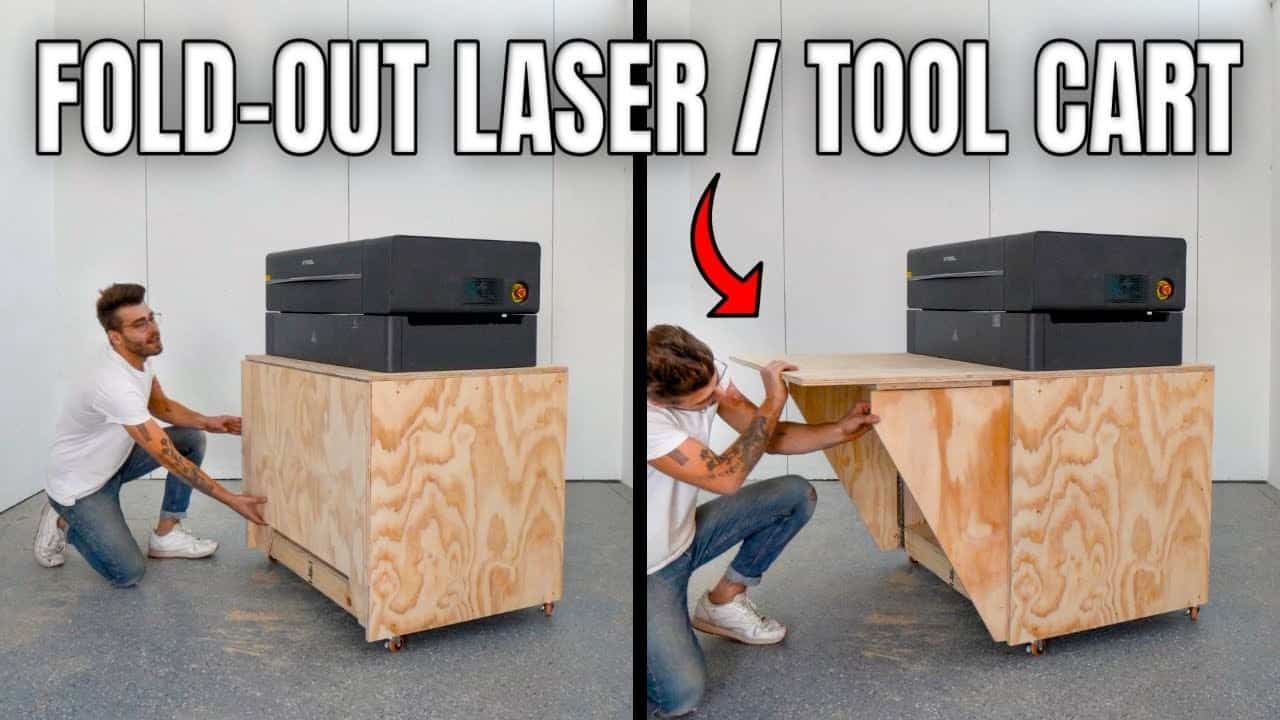
Mike designed a compact, mobile cart to house an xTool P2S laser with a fold-up tabletop extension that supports material passing through the conveyor infeed and outfeed.
The cart keeps the laser, filtration, and shop tools together while staying small enough for a tight workshop.
Watch the full video and subscribe to Modern Builds:


Design
The cart was conceived around one constraint: let material pass through a benchtop laser while providing stable outfeed support without taking over the shop.
Mike prioritized a compact footprint, integrated storage for the air filtration and accessories, and a fold-up leaf that tucks away when not needed.
That simple brief makes the cart flexible — it’s equally useful as a mobile base for a laser, a small planer, or as a temporary support table for larger machines.
The design choices emphasize repeatable joinery and robust attachment points so the cart stays rigid under load.
Frame and Plywood Shell
Construction begins with a basic framed box that provides the structural skeleton and mounting points for equipment and shelving.
Mike framed the legs and aprons with solid lumber, relied on glue and screw joinery for strength, and wrapped the frame in plywood to create clean faces and hidden storage.
Clamping and alignment are called out as essential — pressing warped plywood flat while fastening prevents gaps and improves the finished fit.
A few well-placed internal supports and a center top member keep the table rigid and reduce vibration from tools mounted on the cart.
Fold-out Extension and Hinges
The fold-up extension uses piano hinges and two fold-out wings to create a continuous support surface when deployed.
Mike planned hinge placement so the extension folds flat against the top and added a small underside strip to prevent the hinge from interfering with the wings’ travel.
Minor misalignments were solved with thin shims glued to the wings until the tabletop sat perfectly level. This pragmatic approach — test, shim, and re-test — is a useful shop technique when working with imperfect stock or slightly warped panels.
Mobility and Load-Bearing
Mobility comes from locking casters screwed into the leg ends, and the cart’s usefulness increases when heavy tools are stored low on the shelves. Mike loaded the base with heavier equipment to lower the center of gravity, which keeps the cart stable while rolling or when the extension is loaded.
Designing for weight distribution and using locking wheels makes a mobile workstation feel safe and predictable in a small shop.
The cart doubles as storage and a stand, freeing floor space and keeping commonly used tools accessible.
Laser Integration and Testing
With the cart assembled, the xTool P2S and its air filtration were installed and routed so the filtration hose and power are tidy and out of the way.
The conveyor belt infeed/outfeed setup lets oversized material pass through the machine while the fold-up leaf supports the exiting stock.
Initial tests included quick engraves and cuts on plywood and melamine to confirm alignment, belt pinch settings, and that the extension provided adequate outfeed support.
Small setup mistakes — like sending an oversized file — were easily corrected and highlighted the benefit of quick stops and checks during the first runs.
Lessons and Adaptations
Key takeaways from the project are pragmatic: use strong internal framing, clamp panels to counteract warp, and expect to tune hinge-mounted surfaces with shims.
Piano hinges offer lots of screw holes and durability, but careful pilot drilling keeps the installation clean and flat.
Mike also points out the cart’s adaptability — the same approach can be used for a compact planer stand, a table saw outfeed, or other shop tools that benefit from a stable, mobile platform and a fold-down support.
Plans and basic templates can speed a repeat build and make it easier to scale the idea to different tools.
Please support Mike by visiting his website: https://www.modernbuilds.com/.

Matt’s Take
These are my personal thoughts and tips based on my own experience in the shop. This section is not written, reviewed, or endorsed by the original creator of this project.
What I really appreciate about Mike’s approach here is the emphasis on getting the fundamentals right — solid internal framing and taking time to properly clamp warped plywood during assembly. Those details make the difference between a cart that wobbles after a few months and one that stays rock-solid. The piano hinge choice is smart too; they distribute stress across multiple screws instead of concentrating it at two or three points like butt hinges would.
The shimming technique for getting that extension perfectly level is classic problem-solving. Rather than fighting with the material or starting over, Mike worked with what he had and made small adjustments. That’s the kind of practical approach that keeps projects moving forward. Testing the setup with actual material before calling it done is another good habit — it’s better to catch alignment issues early than discover them mid-project.
Loading heavy equipment low in the cart is crucial for stability, especially with those fold-out extensions. A top-heavy mobile cart can tip unexpectedly, and that’s not something you want to learn the hard way. The versatility Mike built into this design is worth noting too — the same basic structure could easily adapt to other benchtop tools that need outfeed support.