
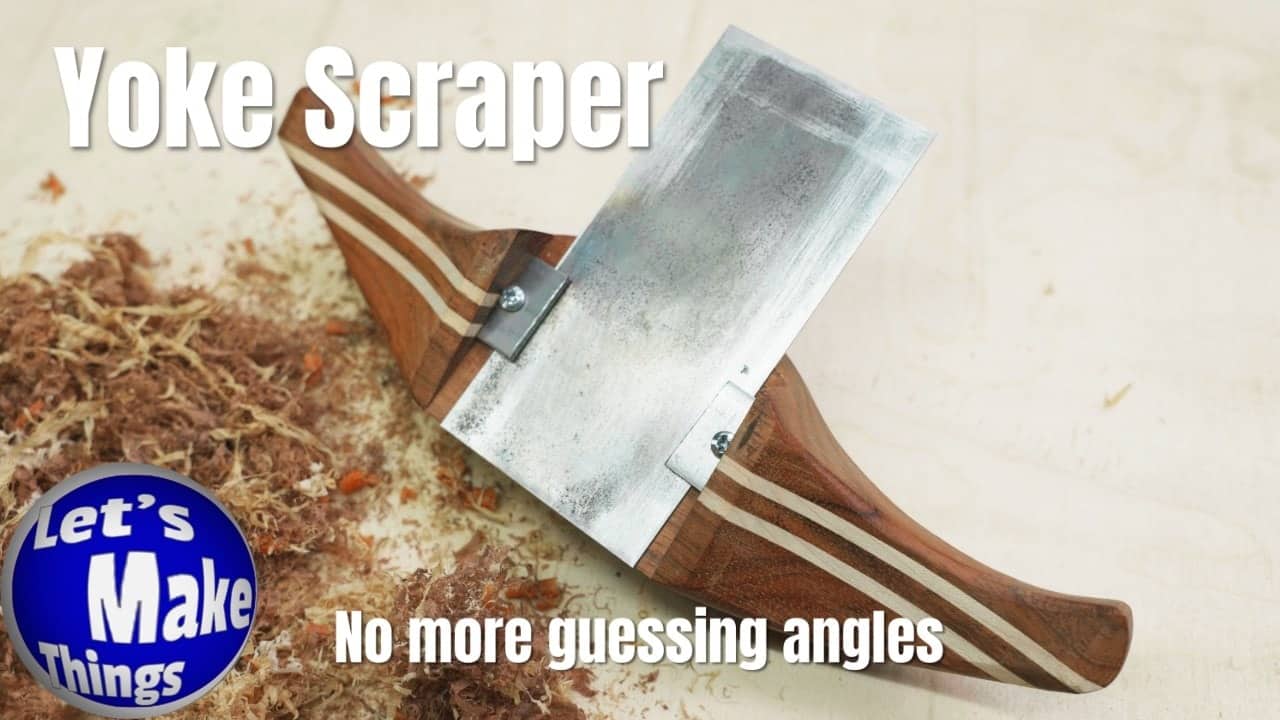
Rob from Let’s Make Things from Let’s Make Things shared the woodworking tip featured in this video.
Card scraping can produce beautiful grain, but it often turns into an uncomfortable fight with thin steel, changing angles, and sore hands. This approach adds a “yoke” that locks the blade’s working angle, improves grip comfort, and makes pushing the tool feel natural.
Watch the full video and subscribe to Rob’s channel:

Why a Yoke Scraper Changes the Experience
The core problem with traditional card scraping is control: the blade angle is easy to drift, and the pressure has to be managed by hand while the steel edge does the work. That “hands-on-steel” interaction is often what makes the method feel punishing even when it’s technically working.
The yoke concept shifts those responsibilities into the tool itself by holding the scraper at a fixed relationship to the work surface. With that angle stabilized, the user can focus on smooth, consistent passes instead of constantly re-finding geometry with fingertips.
Design Goals: Fixed Angle, Comfortable Pressure
The yoke design is simple in principle: create a stable base that the blade sits in, then provide grips and a geometry that supports pushing. Instead of wrestling the blade into position, the blade becomes a replaceable cutting element captured by the holder.
Because different scraper sizes exist, the same idea is adaptable by resizing the pressure components that control how the blade sits and how much it can flex. This keeps the tool concept reusable across narrower or shaped scrapers without reinventing everything from scratch.
Material Prep and Layout Thinking
A key theme is starting with straightforward stock and then shaping accurately. The build emphasizes making parts that align consistently, so the blade plane stays predictable as it moves across the workpiece.
Segregating the setup into a “sled for shaping” and a separate “base for assembly” helps keep geometry controlled. That separation also supports drilling straight holes later, which matters for reliable clamping and repeatability.
Sled Shaping: The Underside Matters More Than It Seems
The shaping step uses a small sled concept to produce an underside profile that matches the intended blade stance. Even small inconsistencies here can change the effective cutting angle, which then changes how cleanly the scraper engages the surface.
Rather than relying on quick-and-easy alignment tools, the design encourages controlled setup so the blade doesn’t tilt during cutting or fitting. That “controlled back-and-forth” approach reduces frustration and improves symmetry across both sides.
Drilling and Threaded Inserts for Reliable Clamping
The holder uses threaded inserts so the scraper blade can be clamped securely without repeatedly forcing hardware in and out. Threaded inserts also improve alignment longevity because the fasteners return to the same positions each time.
Hardwood drilling guidance is also part of the idea: tests on scrap help choose a bit size that cuts cleanly without forcing or wandering. Getting this right reduces strip-out risk and keeps clamping force consistent.
Template-Driven Pattern Work
A pattern step keeps the holder geometry consistent, especially around the centerline features needed for the blade interface. Folding and fitting the pattern onto the work helps visualize where all critical lines and centers land.
This is also where optional capability is planned, since the holder can include a center bolt feature for blade camber adjustment. Even if camber isn’t needed at first, thinking ahead in the layout prevents rework later.
Pattern Cutting and Cleanup for Smooth Fit
After layout, cutting and cleanup focus on removing excess material while preserving the intended surfaces. The idea is to get parts to slide together cleanly and to keep edges from interfering with the blade’s seating.
Stopping short of final geometry during rough cuts, then cleaning up afterward, helps maintain accuracy. That same approach reduces measurement chasing and supports a more repeatable result.
Why Camber Matters (and Why Manual Camber Is a Hassle)
Camber is about shaping how the scraper’s corners behave during use. Without camber, corner contact can burnish the surface, leaving visible track lines across the face instead of cutting where the center should be working.
Manual cambering is possible, but it can be inconsistent and often has to be repeated after sharpening. The yoke concept makes camber a built-in adjustment so the corners can be lifted consistently without fighting the blade every session.
The Camber Adjustment: Turn a Bolt, Focus the Cut
The adjustment mechanism adds a center screw and a set of pressure braces so turning the bolt applies controlled bending force to the blade. That slight bend increases effective cutting focus in the middle and helps minimize unwanted corner burnishing.
Importantly, this is not about extreme bending. Small, incremental movement is enough to change how the scraper behaves, which keeps the edge engaged without stressing the tool beyond what’s needed.
Screw Braces for Consistent Pivoting
The braces are shaped to support controlled pivot behavior while staying close to the blade’s plane at the edges. That geometry is what allows the center pressure to lift the corners without letting the whole assembly wander.
For users with narrower scrapers, the same principle applies with resized braces. Adjusting brace width ensures the camber mechanism still functions properly even when the blade profile is different.
Using It: Push Passes Instead of Hand-Fighting Angles
In use, the grip and the blade holder let the user push across the work surface with steady pressure. Because the angle is already set, the hands don’t have to constantly correct slant or compensate for awkward steel geometry.
When cambered, the user can fine-tune corner behavior by applying only a little additional force. The result is quicker, cleaner engagement that better targets the cutting action along the desired part of the blade.
Overall Takeaways
The best part of the yoke scraper idea is not that it makes scraping “easier,” but that it makes scraping more consistent. Stabilizing the angle and handling the camber as an adjustment removes two of the biggest sources of variability and hand fatigue.
This is also a design pattern worth reusing: push controllable geometry into the tool, and reserve the user’s effort for clean technique. With minor scaling, the same yoke-and-camber approach can support different scraper widths and working styles.
Conclusion
A yoke scraper turns a high-quality but uncomfortable process into something that feels controlled, repeatable, and efficient. By locking the blade angle and optionally adding camber through a center adjustment, it helps reduce track lines and keeps the cutting action focused where it belongs.
Get Rob’s plans here: https://makethingswithrob.com/make-a-yoke-scraper/.

Matt’s Take
These are my personal thoughts and tips based on my own experience in the shop. This section is not written, reviewed, or endorsed by the original creator of this project.
Card scraping is one of those techniques that can produce absolutely stunning results, but it often comes with a steep comfort curve. Your hands get sore, maintaining consistent angles becomes a real challenge, and it’s easy to end up with chatter marks or missed spots. This yoke design addresses the core issues by taking the guesswork out of blade positioning.
The threaded insert approach is smart thinking for long-term use. Nothing’s more frustrating than having threads strip out in a shop-made jig, especially when you’re dealing with the clamping forces needed to secure a scraper blade properly. Those inserts will handle repeated blade changes without degrading, and they keep everything aligned consistently. When drilling for threaded inserts in hardwood, I always test the bit size on scrap first — hardwoods can be unforgiving if you’re even slightly off on hole diameter.
The camber adjustment feature really sets this design apart. Hand-cambering scrapers is tedious work, and getting it consistent every time is nearly impossible. Having that built into the tool means you can dial in exactly how much corner relief you need for different situations. Light camber for general smoothing, more aggressive camber for removing plane tracks — it’s all adjustable without touching the blade edge.
Safety-wise, remember that scrapers can generate surprisingly long, sharp curls. Keep your work area clear and consider where those shavings are going to land. The improved control this yoke provides should help with that too, since you’re not fighting the tool for consistent cuts.