

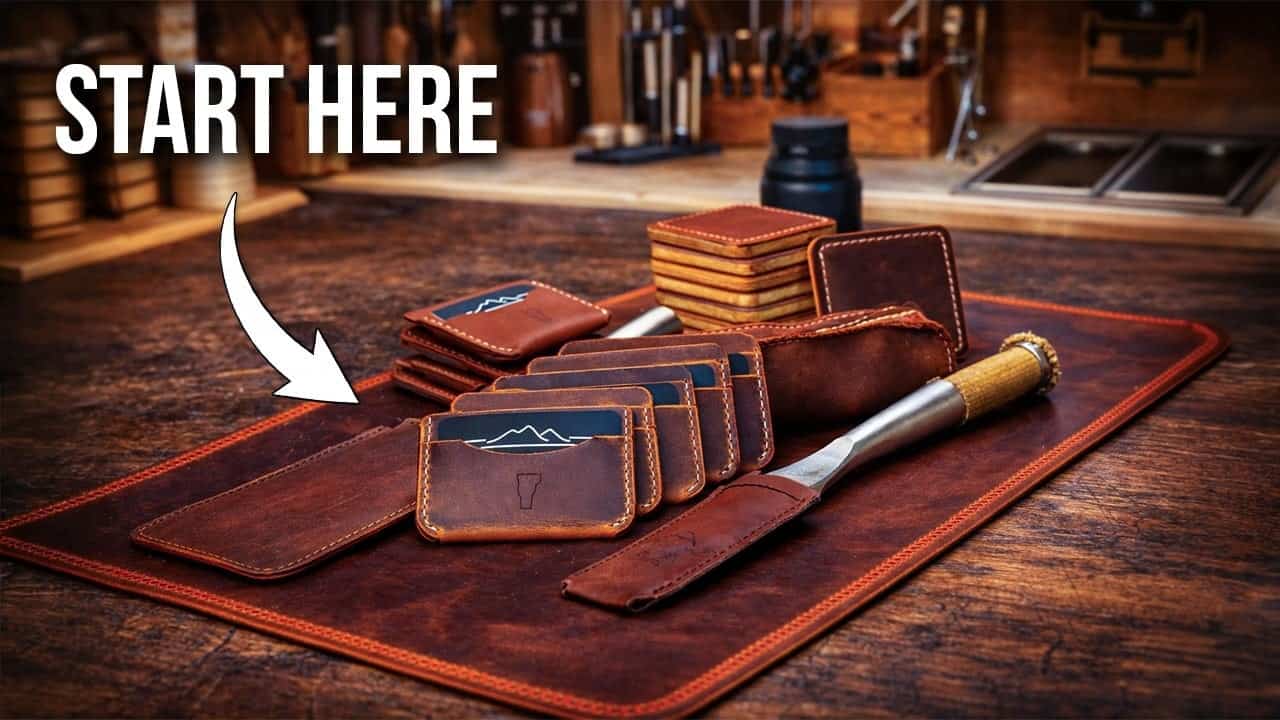
These projects were built and designed by Sam Macy from Sam Macy Designs.
The collection covers five approachable leather builds—a card holder, a zipper pencil case, a large stitched mouse pad, leather-topped coasters paired with wood, and a protective chisel sheath—each chosen to teach core leatherworking skills without requiring expensive gear.
Watch the full video and subscribe to Sam Macy Designs:
Simple Card Holder (5-Pocket Wallet)
The card holder is a compact, fold-over design made from second-run leather to keep costs low while learning pattern layout and edge finishing techniques.
Key techniques practiced were pattern transfer, cutting with precision, edge burnishing, and a saddle stitch for internal seams; these fundamentals translate directly to most small leather goods.
This piece demonstrates how a few clean details—a chamfered edge, careful burnish, and a subtle laser-engraved mark—can elevate a small project into a saleable or giftable item.
Leather Pencil Case with Zipper
The pencil case introduces working with hardware by integrating a zipper into a soft leather shell and shows how templates and patient cutting make zipper installation manageable for beginners.
Gluing, shaping, and hand-stitching small assemblies are the main takeaways, along with a reminder that leather can shift while assembling, so sequencing glue-and-stitch steps helps keep parts aligned.
This project is useful for practicing curved seams and closures, and it’s easily adapted to different sizes or lining options once the builder is comfortable with zipper work.
Giant Cross‑Stitched Mouse Pad
The oversized leather mat is designed as a versatile shop or desk surface and is an ideal vehicle for developing long-run stitching skills because it requires consistent spacing and a steady hand.
Sam used a cross stitch around the perimeter to create a visual statement and practiced edge beveling and burnishing across a large surface, which helps refine technique faster than many small pieces.
The end result is both practical and decorative, and the method scales to desk pads, placemats, or simple leather panels for photography backdrops.
Wood and Leather Coasters
These coasters pair finished hardwood squares with leather tops, exploring the challenge of joining two different materials by gluing and then stitching through leather and wood.
The approach emphasizes careful marking, light hole drilling (a drill press helps but is not required), and saddle stitching through multiple materials to create a durable, tactile product.
Coasters are a great small-batch item for sellers because they practice efficiency, finishing, and mixing materials while remaining forgiving enough for learners to iterate on.
Leather Sheath for a Timber Framing Chisel
The chisel sheath is a functional, protective sleeve that combines layout, skiving (thinning seam allowances), folding, and hand stitching to produce a rugged, useful cover for a prized tool.
Design choices focused on fit and moisture relief—cutting small corner vents and leaving space for the chisel blade—to prevent trapped dirt and ease insertion and removal.
This build highlights how leatherwork complements woodworking by protecting tools and can be adapted to knives, chisels, or other hand tools with simple pattern tweaks.
Overall Takeaways
Across the five projects, the emphasis is on learning foundational techniques—accurate cutting, glue sequence, pricking irons, saddle and cross stitches, beveling, and burnishing—rather than chasing specialty tools or perfect materials.
Using second-run hides and affordable tools lets beginners practice mistakes and iterate quickly, while simple design choices (clean lines, exposed stitching, subtle finishes) keep the projects looking intentional and marketable.
The builds are deliberately adaptable: proportions, thread color, and minor details can be changed to suit different tastes or to create a consistent product line for sales or gifts.
Please support Sam by visiting his website here: https://sammacydesigns.com/.

Matt’s Take
These are my personal thoughts and tips based on my own experience in the shop. This section is not written, reviewed, or endorsed by the original creator of this project.
What I really appreciate about Sam’s approach here is how he’s built this collection around mastering core techniques rather than jumping into complex projects. The progression makes sense—starting with basic cuts and stitches on the card holder, then gradually adding elements like zippers and mixed materials. Each project teaches something specific while reinforcing the fundamentals.
The emphasis on second-run leather is spot-on for anyone getting started. When you’re learning to cut patterns and work on your stitching consistency, practicing on premium hides can be expensive and stressful. Starting with more affordable materials lets you focus on technique without worrying about waste. You can always upgrade your leather quality once you’ve got the basics down solid.
I’m particularly drawn to how these projects bridge into woodworking territory—especially the coasters and chisel sheath. The coaster build is clever because it teaches you to work with mixed materials while keeping the stakes low. And making protective gear for your tools is always time well spent. A good leather sheath can add years to a chisel’s life by preventing nicks and keeping the edge protected during transport.
The scalability aspect is important too. Once you nail the techniques on these smaller builds, you can adapt the same methods to larger projects like tool rolls, knife sheaths, or shop aprons. Starting with these fundamentals gives you a solid foundation to build on.