

These projects were built and designed by Clinton from Specific Love Creations.
Three approachable 2×4 builds are presented that teach useful shop skills while producing attractive, practical pieces for the home or yard.
Each project focuses on simple joinery and finishing techniques that are easy to adapt for different tools and skill levels.
Watch the full video and subscribe to Specific Love Creations:
Project 1 — Interlocking 2×4 Cross
This design uses two boards cut with partial-depth slots so they slide together to form a large cross that works indoors or outside.
The approach emphasizes careful layout and cutting depth instead of complex joinery, making it an accessible first project for beginners.
Key techniques include using a saw to limit cut depth, clamping boards flush for accurate marking, and testing fit with a spare piece while leaving the option to remove more material if needed.
For an outdoor version, a waterproof glue and a darker or weathered stain are recommended to improve durability and appearance.
Project 2 — Tealight Display
This stacked-piece display is a compact project that combines simple layout with shallow recesses for tealight candles, resulting in a classy tabletop accent.
The pieces are centered and fastened together, producing a tiered stand that highlights candlelight.
Drilling shallow recesses with a Forstner-style bit gives clean, flat-bottom pockets for the lights, though care is advised to keep the bit straight while starting each hole.
Pre-drilling screw holes helps prevent splitting when joining the pieces, and a dark stain unifies the look for a refined finished piece.
Project 3 — Rustic Flag Wall Art
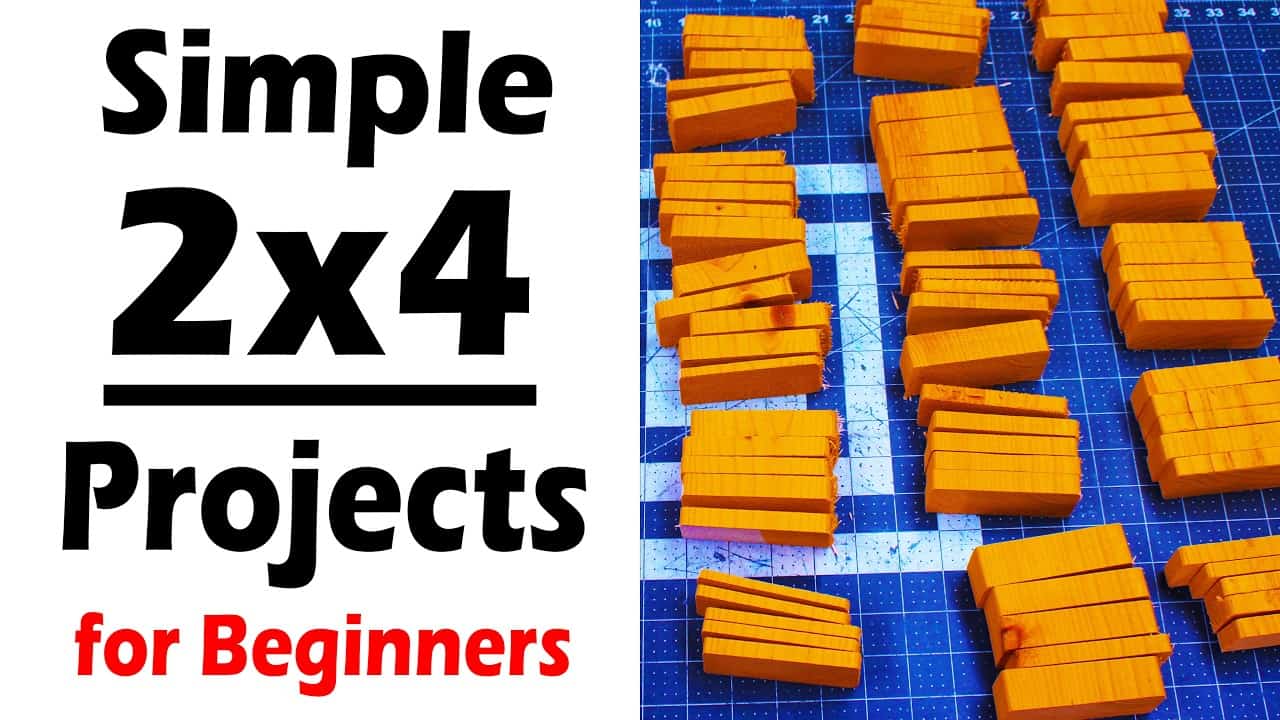
This wall art repurposes many thin slices of 2×4 into a textured, dimensional flag that reads well from a distance and rewards close inspection.
Variation in slice thicknesses is intentional to create visual movement and a subtle waving effect without complex shaping.
Only the end grain is painted to suggest stripes and stars, and a light sanding cleans up rough edges before assembly. To secure the arrangement, the pieces are best glued or fastened to a backing board or framed so the composition stays stable and is easy to hang.
Why These Builds Matter
Each project teaches foundational woodworking skills—layout accuracy, cutting partial-depth dados, drilling clean recesses, and practical finishing choices—without requiring specialized joinery techniques.
These simple builds make it easy to practice with basic tools while producing useful and giftable items.
The concepts translate well to other small projects: adjust proportions, experiment with paint and stain, or use leftover scraps to minimize waste and cost.
Beginners gain confidence by repeating these methods and adapting them to fit personal style or available materials.
Watch the full video and subscribe to Specific Love Creations:

Matt’s Take
These are my personal thoughts and tips based on my own experience in the shop. This section is not written, reviewed, or endorsed by the original creator of this project.
These kinds of 2×4 projects are perfect for building confidence in the shop. Clinton shows how basic lumber can become something special with thoughtful design and clean execution. What I really appreciate about his approach is the focus on getting fundamentals right — accurate layout, consistent depths, and taking time to test fit before committing to final cuts.
The partial-depth cutting technique he uses for the interlocking cross is a great skill to master early on. Whether you’re using a circular saw with a depth stop or a miter saw with careful technique, controlling cut depth opens up a lot of joinery possibilities down the road. That same precision comes in handy for dados, rabbets, and half-lap joints in future projects.
Safety-wise, remember that Forstner bits can grab unexpectedly when starting holes, especially in softwood like pine. Starting with a small pilot hole or using a drill press if you have one makes the process much more controlled. And when you’re working with 2×4 material, pre-drilling is almost always worth the extra step — construction lumber can split in surprising ways, even when you think you’re being careful.
The beauty of these builds is their adaptability. Once you’ve got the basic techniques down, you can scale them up or down, mix different wood species, or combine multiple projects into larger installations. Simple doesn’t mean boring — it means you’re building a solid foundation for everything that comes next.