

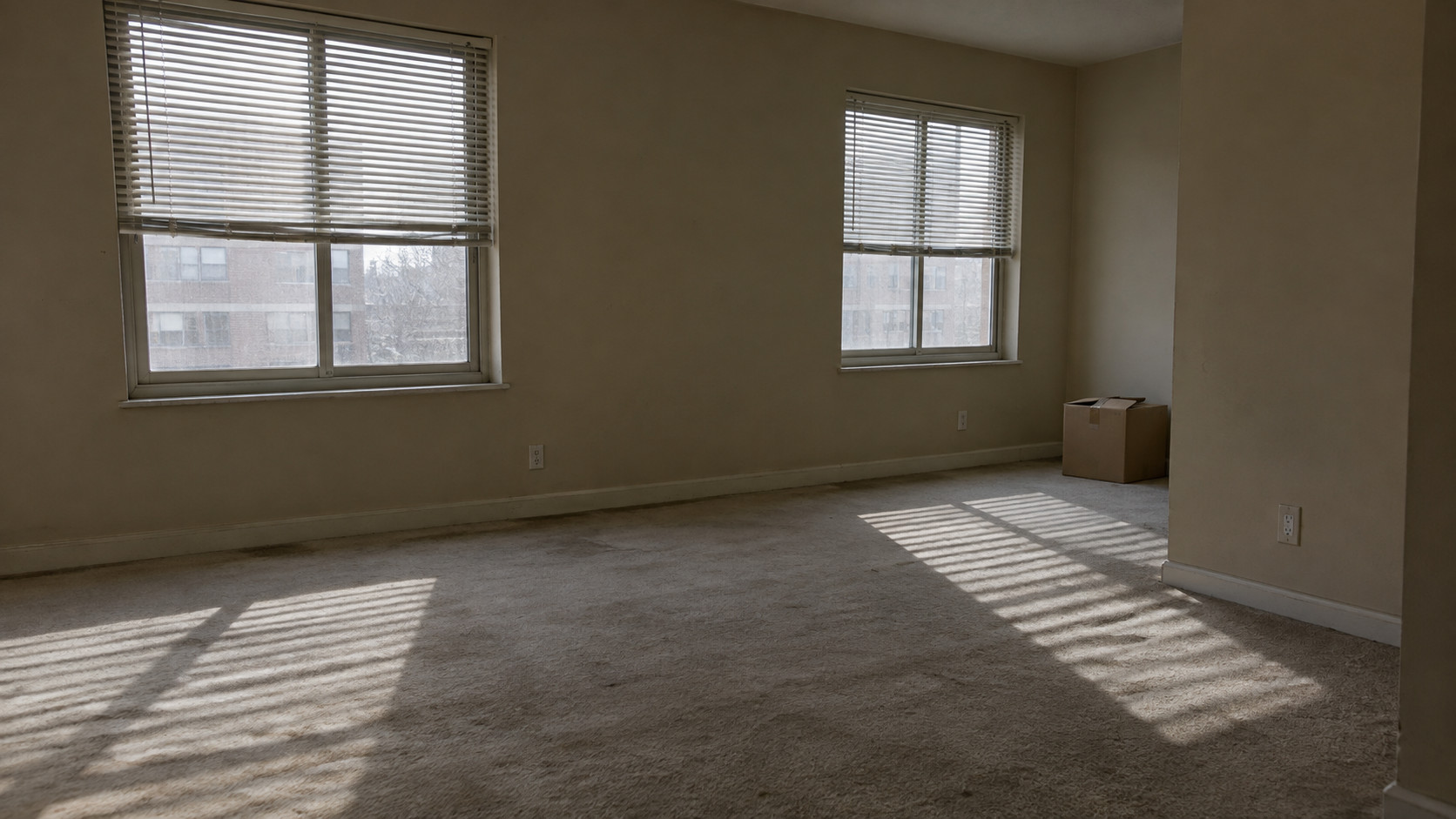
Walk into a room and you’ll know in about two seconds whether anyone actually lives there.
It’s almost never the furniture. It’s the windows.
Windows are the largest uninterrupted surface in most rooms, and they’re the one thing renters and rushed homeowners consistently leave to whatever came with the place. A landlord’s blinds, a twelve-dollar panel, a tension rod jammed in the jamb. The room can hold a nice sofa and a real rug and still read temporary, because the eye goes to the window first and finds nothing there.
Designers have known this forever, which is why window treatments eat a disproportionate share of any real decorating budget. The good news: most of these tells cost almost nothing to fix. Some of them just need a drill and a steamer.
Here are 27 window treatments that quietly announce you’re renting — even when you own the place.
1. Bare Windows With Nothing But the Landlord’s Blinds

Zero fabric at the window is the thesis of this whole list.
Stock mini blinds get cut roughly to width from hardware-store inventory, so they hang loose in the opening and look tired on day one. Nothing softens the glass. Nothing absorbs sound.
A room with no soft goods at the windows has no color, no texture, and no evidence anyone chose anything. Bare glass plus bare blinds is the visual equivalent of a furnished corporate apartment.
Even one pair of cheap floor-length panels flanking the blind changes the read completely.
2. Curtain Rod Screwed Tight to the Window Frame

This is the most common hanging mistake in America, and it’s free to undo.
Brackets bolted straight to the casing chop the window off at the knees and press the ceiling down. Designers mount the rod 4 to 8 inches above the frame — higher in low-ceilinged rooms — and run it 6 to 12 inches past each side, per the standard guidance Bob Vila lays out.
The window suddenly looks twice as tall. The panels stack clear of the glass instead of blocking it.
Twenty minutes, a drill, four new anchor holes. Do this one first.
3. Yellowed Vinyl Mini Blinds With the Bent Slats

You know exactly which three slats.
Someone parted them with two fingers to see who pulled into the driveway, and vinyl doesn’t forget. The crimp is permanent. Meanwhile UV turns white vinyl a sour amber over five or six years, so the top half of the blind no longer matches the bottom.
Once the slats are crimped, nothing else in the room can save that window.
4. High-Water Curtains That Stop Above the Floor

Off-the-shelf panels come in 63, 84, and 96 inches — lengths sold for windows, not for walls.
So millions of panels die five or six inches above the baseboard, hovering like slacks that shrank in the wash. The gap draws the eye straight to it.
Floor-length panels that just kiss the floor cost the same money. Measure from the rod to the floor, not from the rod to the sill.
5. Vertical Blinds Clattering Across the Patio Door

Nothing dates a room faster than a wall of vinyl vanes.
They peaked between 1985 and 2005 and they’re still the builder default on sliding doors, which is why a living room with them reads as a dentist’s waiting area. The vanes snap off at the punched hole. The chain at the bottom tangles into a knot nobody ever untangles. Any draft and the whole thing chatters.
The problem is real, though: a slider is a 6 to 8 foot opening that has to be covered and still walked through. That’s why the vertical blind survived so long.
Better options exist now and they’re not exotic. Panel track shades run on the same overhead track but use wide fabric panels — typically three to five, each 18 to 25 inches — that slide behind one another and stack to one side. They read like drapery, they don’t rattle, and you can spec them in linen weaves, solar screen mesh, or blackout.
Vertical cellular shades are the other move. Same honeycomb construction as a cellular roller shade, just rotated 90 degrees and run on a track. They fold accordion-style to the side and they insulate, which vinyl vanes never did. Hunter Douglas rates cellular products through the Attachments Energy Rating Council, so there are actual performance numbers behind the claim rather than marketing adjectives.
Cheapest path if you’re staying put: leave the slider uncovered at the top, mount a real rod above the whole opening with two heavy drapery panels that stack outside the glass, and add a solar roller behind them for daytime glare. Costs less than most panel track systems and looks intentional.
6. Skimpy Flat Panels With No Fullness

Fullness is panel width divided by window width, and it’s the number that separates custom-looking from cheap-looking.
Under 1.5x, fabric hangs stretched and flat like a flag. At 2x to 2.5x, you get the soft vertical column of folds people read as expensive. The Deconovo fullness guide walks the math if you want to check your own windows.
Two 50-inch panels on a 72-inch window is not enough fabric. It’s barely 1.4x.
Buy four panels of the cheap stuff instead of two of the nice stuff. Generous and inexpensive beats stingy and expensive every time.
7. Temporary Paper Pleated Shades, Two Years Later

The stick-up accordion shade is sold as a 30-day fix. Everyone knows it.
That’s what makes a sagging, dust-grayed one so loud — it says the occupant never emotionally unpacked. The pleats collapse unevenly, the pull tab tears, and the whole thing takes on a grubby gray that no cleaning touches.
The adhesive strip has one last insult waiting. It pulls paint off the casing when you finally remove it.
8. Tension Rods and Adhesive Hooks Doing All the Work

No-drill hardware exists to protect a security deposit, and it looks exactly like that’s its job.
Tension rods creep down the jamb under the weight of lined fabric — usually a half inch a week until someone notices. Adhesive hooks release on the first humid day in June, at 3 a.m., loudly.
The dead giveaway is position. The rod sits inside the window opening instead of spanning the wall above it.
Two drywall anchors and a proper bracket leave holes the size of a pencil lead. Fill them with spackle on your way out.
9. Shiny Faux-Silk Polyester Panels

Faux dupioni has a sheen that reads as plastic in person and worse in photographs.
It also drapes badly. Real silk and linen fall in soft irregular folds; faux silk holds stiff triangles that stand away from the wall like cardboard.
Matte cotton, real linen, or a heavy poly-linen blend costs the same and immediately stops the room from looking like a hotel conference space. Look for weight, not shine.
10. The Clip-On Plastic Valance Across the Blind Headrail

That bowed strip of vinyl snapped over the top of a stock blind has exactly one purpose: hiding the headrail mechanism.
It never sits flush. One end always pops loose, usually the end nearest the cord.
Smallest item on this list. One of the loudest signals on it.
11. Package Creases Still Folded Into the Fabric

Horizontal fold lines from the retail bag say these went up the day the truck left.
Polyester holds a crease nearly forever. Hanging alone won’t drop it, no matter how many months pass.
Fifteen minutes with a handheld steamer, top to bottom, and the panel finally hangs like fabric. Or hang it damp straight out of a cold wash and let gravity do it.
12. The White Vinyl Roller Shade With the Ring Pull

Basically unchanged since the 1930s, and not in a charming way.
The spring roller snaps up like a gunshot at 6 a.m. The plastic ring pull sheds within a year, leaving a knotted loop of string. The vinyl cups along both edges as it ages, which opens a lens-shaped sliver of daylight down each side of the window that no amount of tugging closes.
And it yellows. Always yellows.
13. Grommet-Top Panels on a Skinny Rod

Grommets took over big-box curtain racks around 2005 because they’re fast, functional, and cheap to manufacture.
They also force wide, lazy scallops between each ring, which is the fold pattern your brain files under dorm room. Silver grommets riding a warm wood rod make it worse — two finishes fighting at eye level.
Pinch pleats, pencil pleats, or plain rings with clips give you a tighter, more tailored fold for a few dollars more per panel.
Clip rings will work on the grommet panels you already own. Just tuck the grommet edge under.
14. A Tangle of Lift Cords Wrapped Around a Cleat

The loop of cord wound around a plastic cleat beside the window is a visual mess and a documented hazard.
Corded window coverings have been linked to child strangulation deaths for decades, and the accessible-cord problem is why the industry moved to cordless as the default on stock blinds sold through major retailers starting in 2018. If your blinds predate that, they probably have a continuous loop or a free-hanging pull.
Quick checks worth doing this week:
- Any cord a toddler can reach when standing on a bed, crib rail, or sofa arm
- Continuous-loop chains not anchored to the wall or floor with a tension device
- Inner lift cords you can pull out into a loop behind the slats
- Cribs, beds, and changing tables positioned within arm’s reach of a window
The fix that solves both problems at once is a cordless retrofit. Cordless roller shades, cellular shades, and faux wood blinds all come in stock sizes now, and the price gap against corded versions has mostly closed. You lift the bottom rail with your hand, and there’s nothing hanging anywhere.
Motorized lift is the other route, especially on tall or hard-to-reach windows. Battery wands last a year or two per charge on a typical shade.
Cut off the visual clutter and you also get a cleaner window. Nothing dangling down the wall beside the casing.
15. Sheer Voile Panels Hung With Nothing Behind Them

A single sheer is the one-layer apartment compromise, and it fails at both jobs.
After dark it gives you no privacy — the room lights up and the sheer turns into a glowing screen with silhouettes on it. At noon it does nothing for glare.
So you’ve paid for curtains and gotten neither benefit.
Layer it. A sheer inside, an opaque panel outside on a double rod, and the window reads designed instead of improvised.
16. Cut-to-Size Blinds That Were Cut Wrong

Every hardware store has the saw, and every neighborhood has the story.
An inch too narrow leaves matching bars of daylight down both jambs. An inch too wide and the blind rests crooked on the stops, permanently tilted, one corner high.
The usual failure point is that the in-store saw trims the slats cleanly but the headrail and bottom rail don’t always come down with them. Measure the opening at three heights and use the smallest number.
17. A Hollow Rod That Bows in the Middle

The 5/8-inch telescoping rod with molded plastic finials sags under any lined fabric across a span over about five feet.
That droop is visible from the doorway. It makes the whole window look like it’s melting.
Heavier hardware — a 1-inch or 1 3/8-inch rod, a metal center support bracket, real finials — is the single cheapest upgrade in window treatments. It makes twelve-dollar panels look like ninety-dollar panels, which the hanging guides at Curtarra get right.
Spend on the rod. Save on the fabric.
18. The Scarf Swag Draped Over a Decorative Rod

Peak 1995 to 2008, and you can still find them in model homes.
A length of sheer tossed over the rod with no functional panel underneath is pure ornament. It can’t close. It can’t block light. It collects a gray fur of dust inside the loop where nobody dusts.
The lone fabric valance floating above a bare window has the same problem. Decoration standing in for a treatment.
19. Frosted Privacy Film Bubbling on the Lower Sash

Adhesive privacy film answers a real question: how do you get privacy in a bathroom or a street-facing window without giving up daylight?
The problem is what happens at month six. Air bubbles migrate under the film and never leave. The corners lift and curl. The pattern goes hazy and streaked, and the view is gone for good — you can’t see the yard, the weather, or whether the mail came.
There are three better answers, all of them reversible.
Bottom-up shades are the one most people don’t know exist. The shade mounts at the sill and raises upward, so you cover the bottom half of the glass for privacy while the top half stays open to the sky. Perfect for a bathroom or a first-floor bedroom facing a sidewalk.
Café curtains do the same thing with fabric. A rod mounted at the sash meeting rail, a short panel below, open glass above. Cheap, washable, and it reads as a design choice rather than a patch.
True obscure glass is the permanent fix, and it’s less expensive than people assume — a single insulated glass unit swapped in a bathroom window usually runs a few hundred dollars installed. Reeded, seeded, and acid-etched patterns all scatter light without looking like a frosted decal.
If you must use film, buy the static-cling kind. No adhesive, no bubbles, peels off clean.
20. Pinch-Pleat Drapes on a Traverse Rod With the Plastic Wand

The clacking metal track and its dangling plastic baton ran from the 1960s into the early 1980s, and plenty are still up there.
By now half the carriers have snapped, so the drapes bunch in clumps instead of gliding. You end up shoving them by hand and pretending the wand works.
Same underlying story as the vinyl blinds: hardware a landlord chose, left in place through four tenants. The drapes might even be nice fabric. The track is what dates them.
21. Three Different Treatments in One Room

Blinds on one window, a curtain on the next, a bare sash on the third.
That’s not eclecticism — it’s a timeline of three separate move-in weekends where the money ran out. The eye reads the disagreement instantly, even if it can’t name what’s wrong.
Consistency matters more than the specific choice. Same treatment on every window in a room, even a plain one, and the whole space tightens up. It’s the same principle behind the small details that secretly make a house look cheap.
22. Shrink-Film Insulation Kits Left Up Year-Round
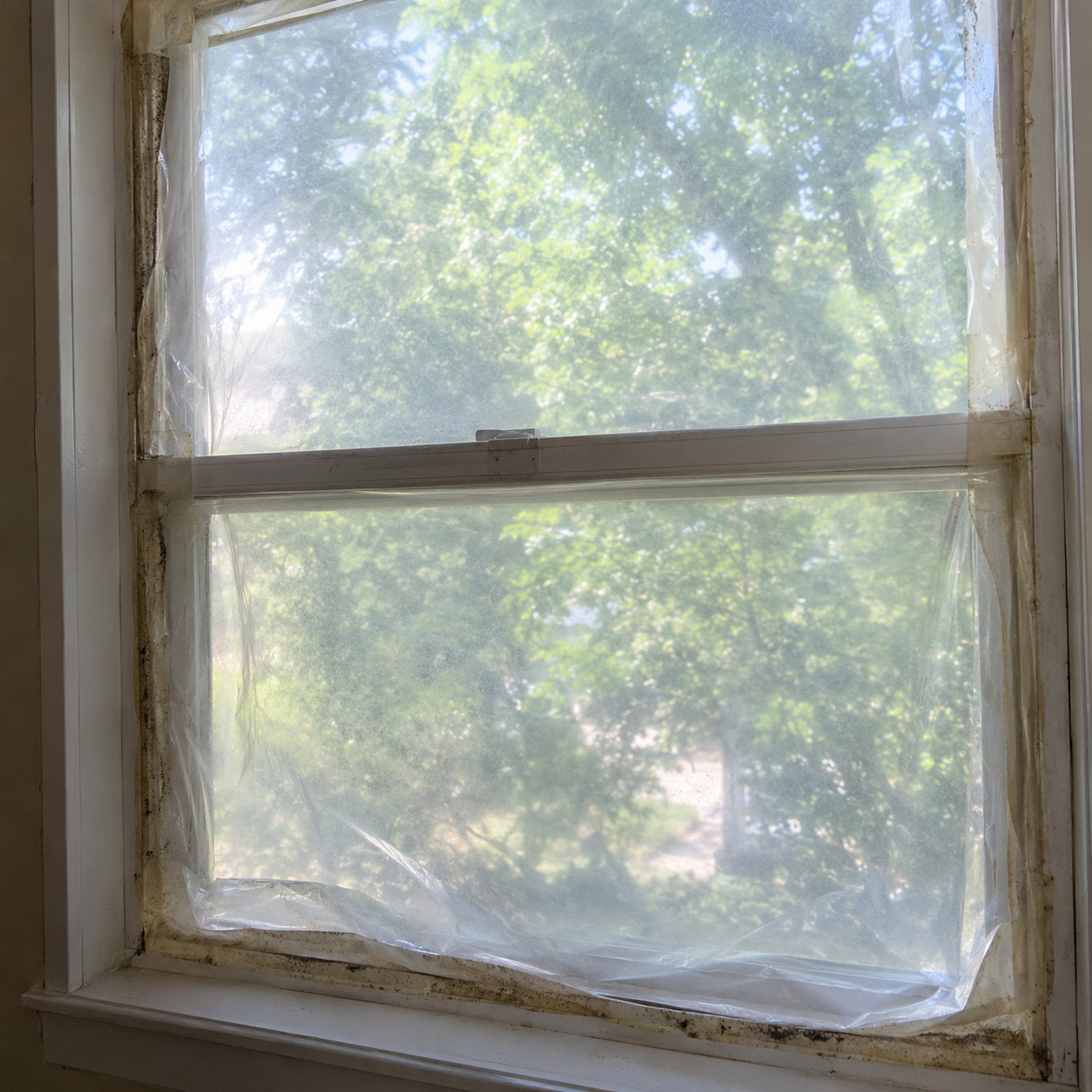
Hair-dryer window film is one of the few items on this list that actually works.
On a single-pane sash in a cold climate, a taped interior film creates a dead air space that measurably cuts convection and drafts. Cornell Cooperative Extension’s rundown on energy saving window treatments treats it as a legitimate low-cost option, alongside insulated shades and tight-fitting cellulars. A drafty old double-hung can lose a real share of a room’s heat, and a $15 kit per window is the fastest thing you can do about it in November.
Then July arrives and it’s still up.
That’s when it becomes a tell. The film clouds after a season of sun, sags loose in the heat, and catches a dark line of dust along the double-sided tape. From the street it looks like the window is wrapped in cellophane, because it is.
Pull it in spring. Every spring, without exception, and re-do it in fall — the tape won’t survive a second winter anyway.
If you’re doing this year after year on the same windows, the film is treating a symptom. Exterior storm windows are the better long-term move on an old house and they don’t touch the original sashes, which matters if the wavy glass is part of why you love the place. Low-e interior storm panels cost more but stay up permanently and don’t look like anything from outside. Weatherstripping the sash meeting rail and adding sash locks that actually pull the rails tight often kills most of the draft for under $20.
And if it’s glare and summer heat rather than winter cold, you’re solving the wrong problem. Consumer Reports found that reflective and cellular coverings do the heavy lifting there — a film kit does essentially nothing against August sun.
23. A Bedsheet Tacked Over the Window
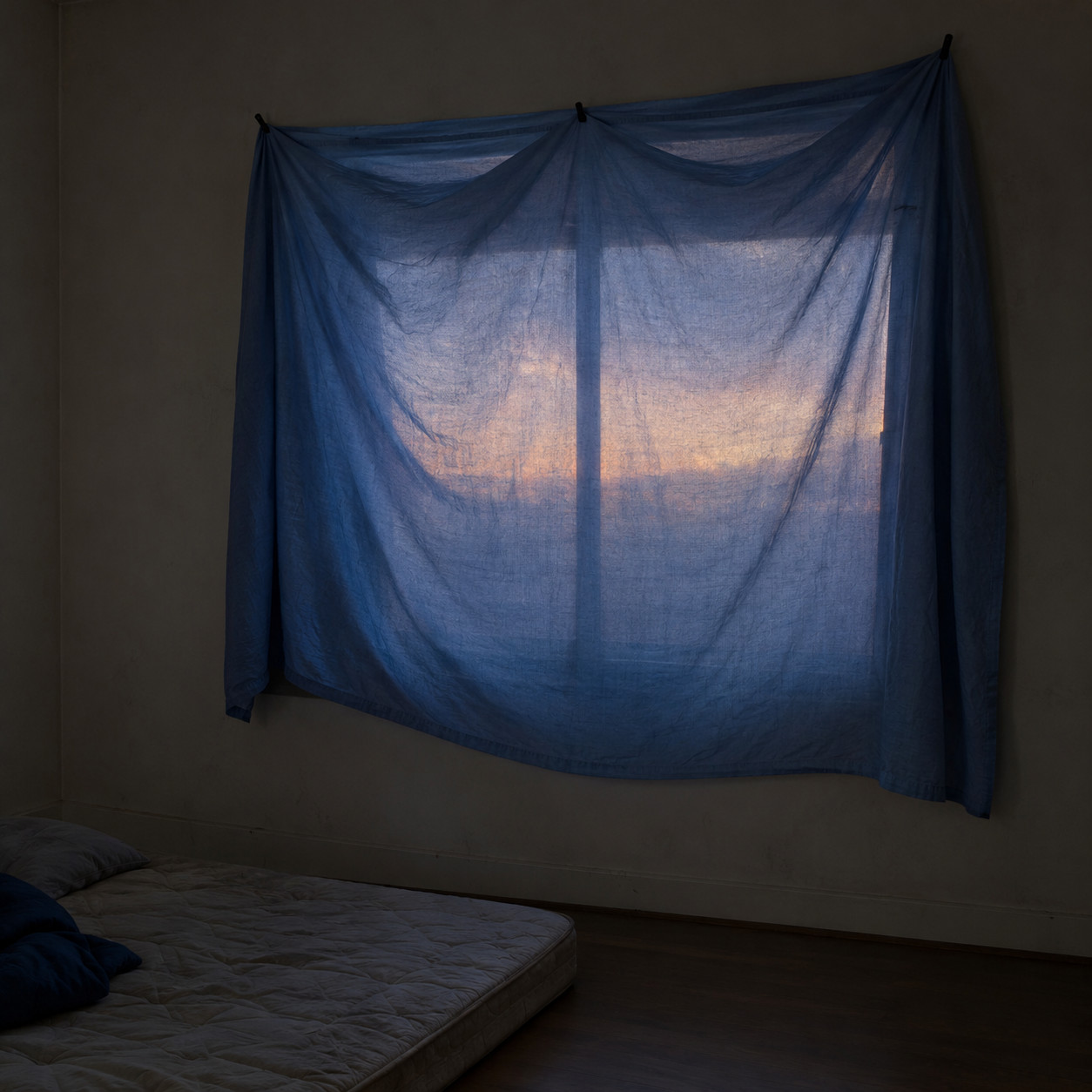
Thumbtacks in the casing, a folded flat sheet, and a permanent sag in the middle.
Nearly everyone reading this has done it. First apartment, no money, Sunday night, and the streetlight was right outside.
It works. It also announces itself from the sidewalk — the sheet glows at night and the tacks make little hills in the fabric.
A $12 rod and one $10 panel beats it immediately. There’s no budget so tight that this is still the answer after week two.
24. Blackout Panels Kept Closed All Day

Good drapery still reads as a rental if it never opens.
Night-shift schedules and the hope of a cheaper cooling bill keep a lot of curtains drawn from June to September. The room goes dim and flat, the fabric holds a permanent wrinkle from sitting in one position, and the window stops being a window.
A room with the curtains always shut is a room nobody has invested in. You can feel it walking in.
This fix costs nothing. Hang the rod wide enough that the panels stack completely clear of the glass, then open them in the morning — the same trick behind most of the old-house tricks that make rooms feel bigger.
25. Sun-Warped Faux Wood Blinds
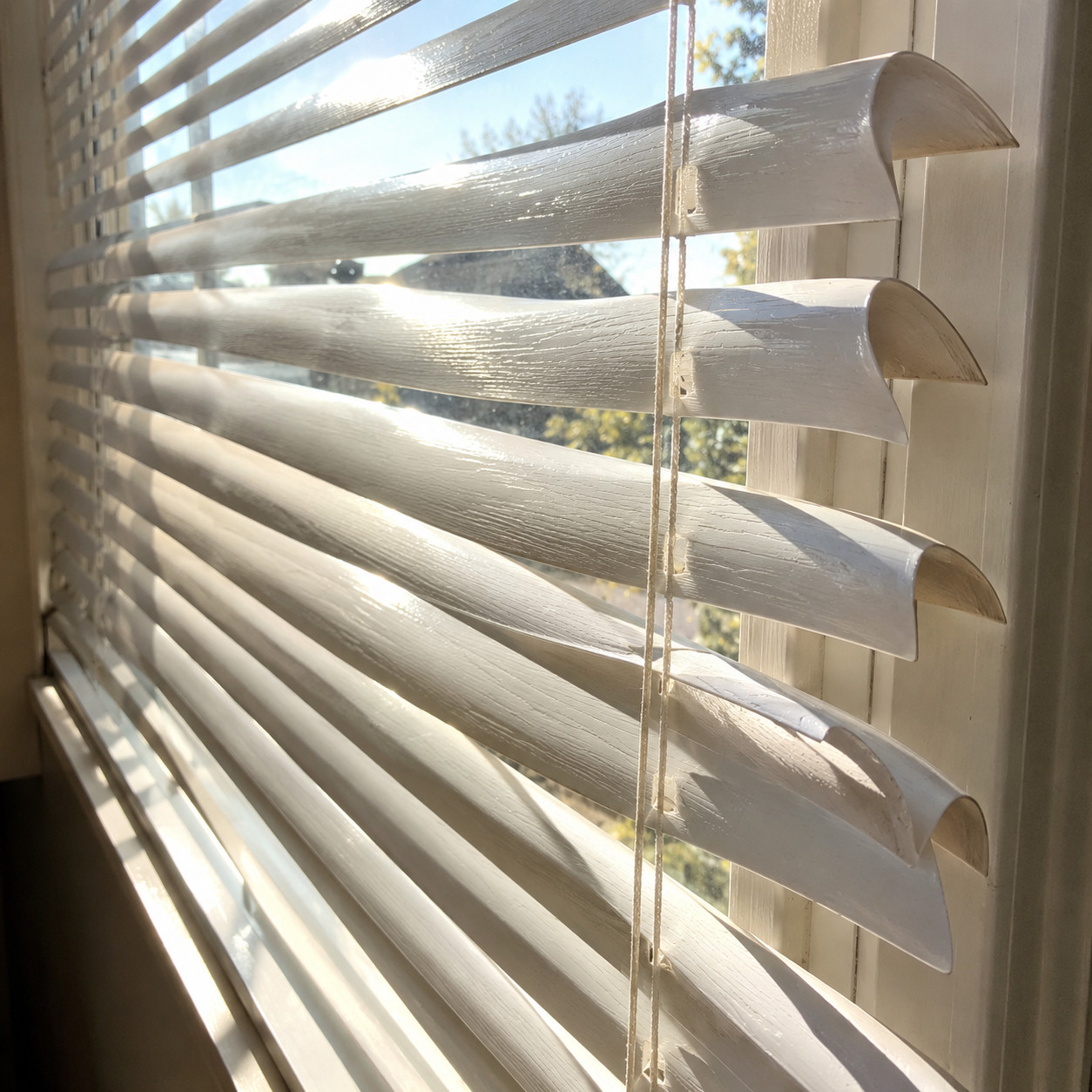
PVC faux woods took over in the 2000s because they cost a third of real basswood and shrug off bathroom humidity.
South and west windows destroy them. The slats absorb heat, soften, and bow permanently — usually curling up at both ends like a stale cracker. Once they’ve taken a set, they never flatten.
Real wood blinds hold their shape in direct sun. Composite blinds sit between the two on both price and warp resistance.
26. The Fused-Back Roman Shade That Hangs Crooked
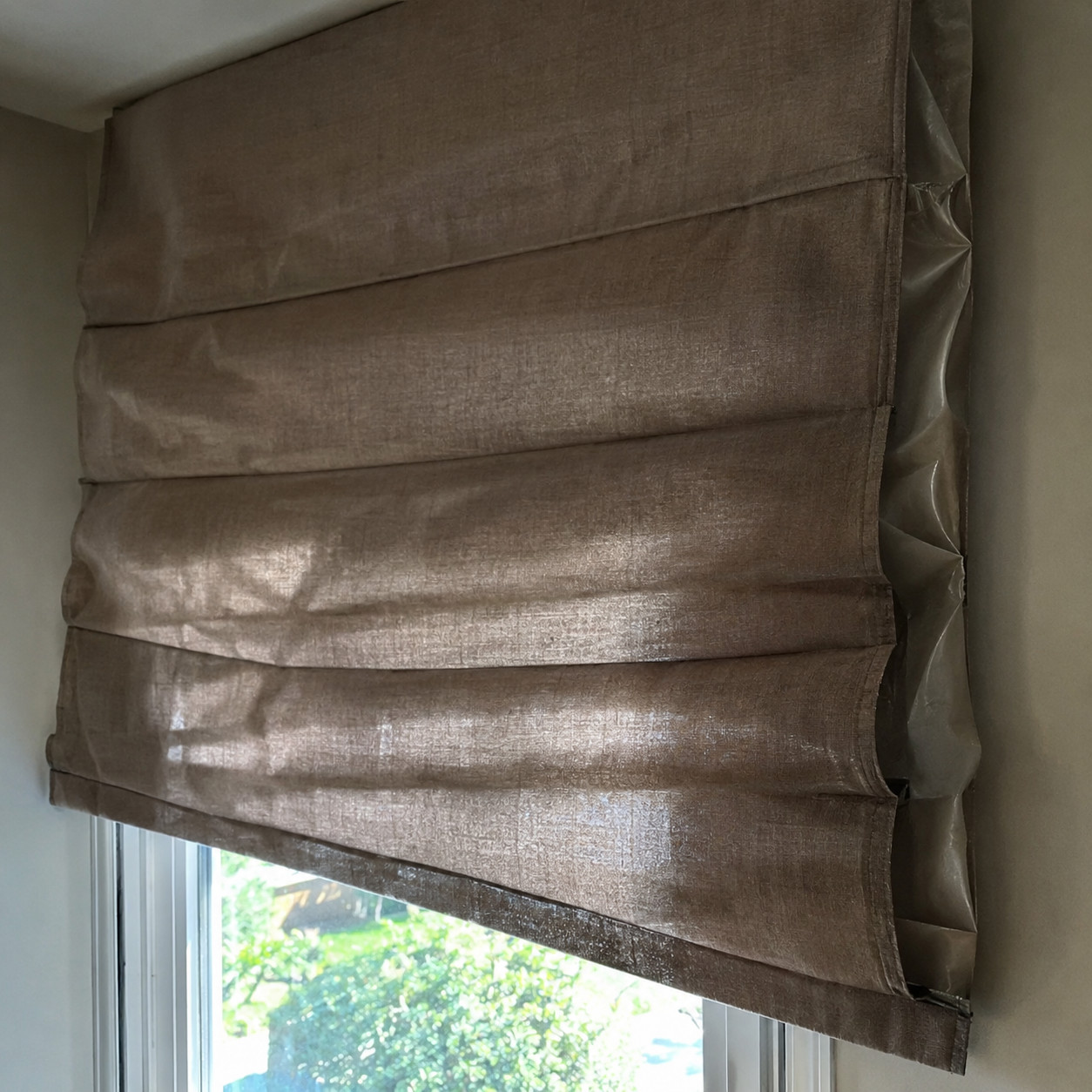
Cheap stock Romans skip the sewn dowel pockets and glue a stiffener to the back instead.
The glue buckles. The pockets warp. Within a year the hem pulls off level and the folds stack unevenly, so one side hangs a half inch lower than the other for the rest of its life.
Look for sewn rod pockets and a weighted bottom bar. That’s the difference, and it’s visible in the product photos if you zoom in.
27. A Fabric Shower Curtain Used as a Window Curtain

It’s a 72-inch square with twelve grommets across the top, which is both why it works and why everyone can tell.
The proportion is wrong for a window — too wide for its height, so it either puddles on the floor or stops short. And the grommet spacing is unmistakable once you know to look, roughly six inches apart, right across the header.
Some readers will call this clever thrift, and on a bathroom window it genuinely is. On a living room window it’s a shower curtain.
None of this is about spending money. The single highest-impact change on the list is moving a rod six inches higher and a foot wider, and that’s a Saturday morning with a drill and a stud finder.
Windows are where a room tells you whether anyone’s staying. Bare glass and bent slats say the boxes are still in the garage.
Pick one window this weekend. Hang the rod high, hang it wide, and hang twice as much fabric as you think you need.