

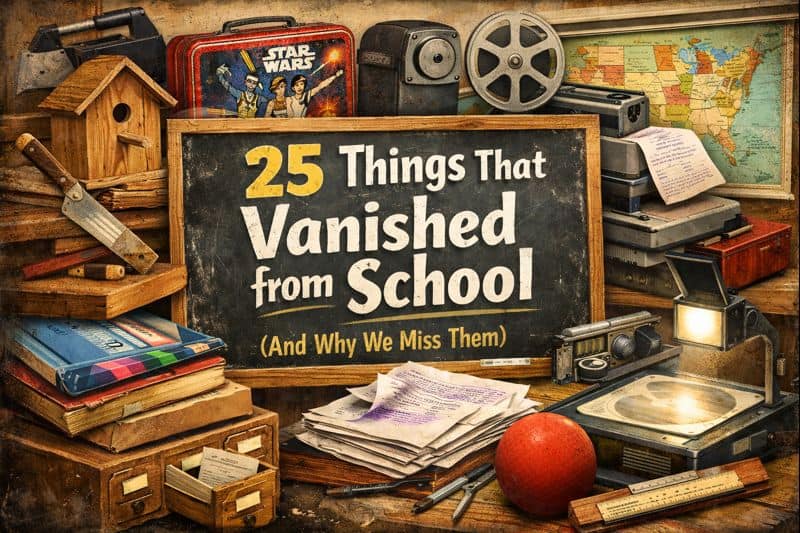
I was sitting in my shop the other day, looking at a lopsided pine spice rack I made when I was 14.
It’s uneven and the varnish is thick, but I keep it on the shelf for inspiration.
It reminds me that before I had fancy tools or perfect joinery, I just had a block of wood and a desire to make something real.
It got me thinking about the woodshop class where I made it.
Walk into a school today, and it feels sterile. It is safe, efficient, and digital.
But the school we went to years ago was loud. It smelled like floor wax, chalk dust, and mimeograph ink. We didn’t have iPads; we had survival skills.
We used our lockers.
We navigated card catalogs, dodged rubber balls, and operated machinery that could take a finger off. We think of these things as “obsolete,” but they taught us patience and how to work with our hands.
Here are 25 things from the American classroom that prove we learned differently back then.
1. Woodshop Class
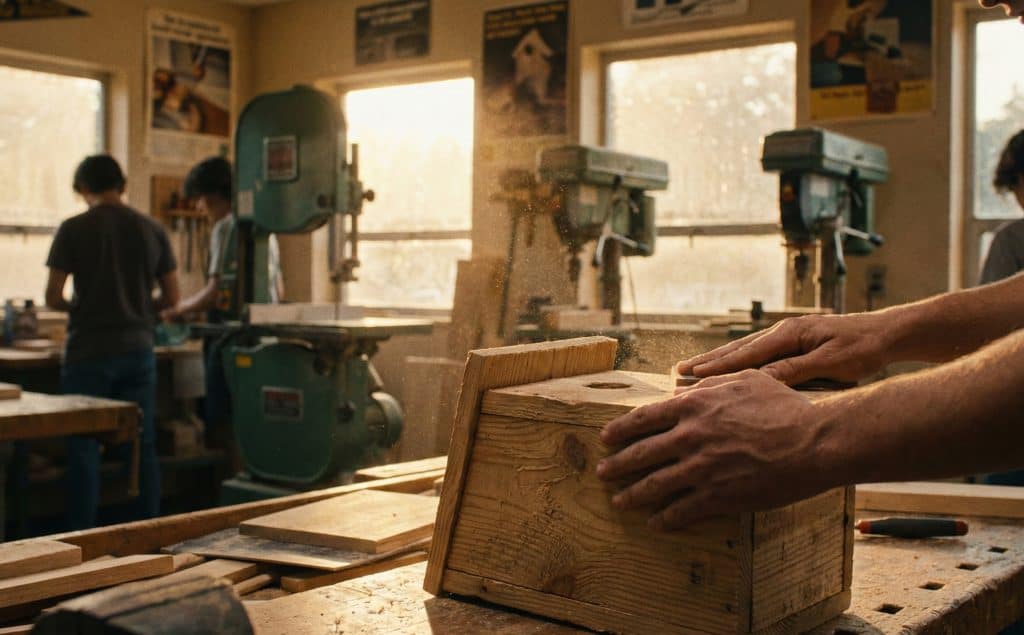
If you walk into a high school today, you might find a “Maker Space” with a 3D printer and some coding tablets.
In 1980, you found the Woodshop.
The smell hit you the second you walked through the double doors: a mix of pine sawdust, machine oil, and varnish.
It was the one place in school where you were treated like an adult. The teacher looked at a room full of 14-year-olds and said, “Here is a band saw. Don’t cut your thumb off.”
We didn’t just click a mouse. We planed rough lumber. We turned bowls on a lathe. We built spice racks and birdhouses that our mothers still have hanging in the kitchen today.
It taught us that if you wanted something, you had to build it. And if you messed up, you couldn’t just hit “Undo.” You had to sand it down and start over.
Liability lawyers killed the woodshop, but they couldn’t kill the pride of building something with your own two hands.
2. Brown Paper Bag Book Covers
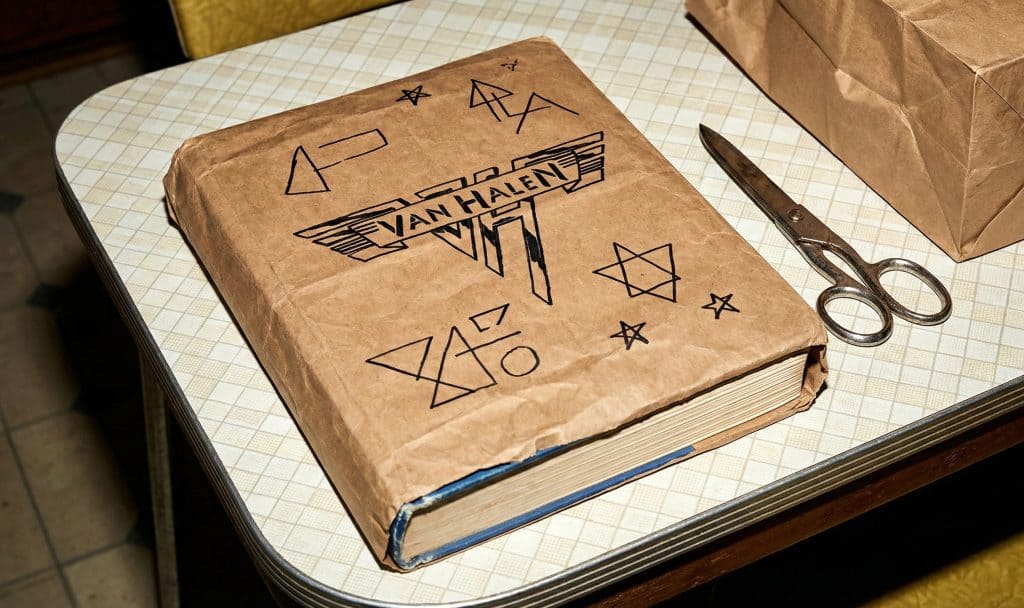
We didn’t have stretchy, store-bought fabric covers.
We had a brown grocery bag, a pair of scissors, and rudimentary origami skills.
The night before school started, you sat at the kitchen table folding the thick paper around your textbook. It had to be tight, or it would rip in a week.
Once it was on, it was a canvas. You drew the Van Halen logo or your crush’s name in Sharpie. It was custom, protective, and free.
3. Cursive Writing
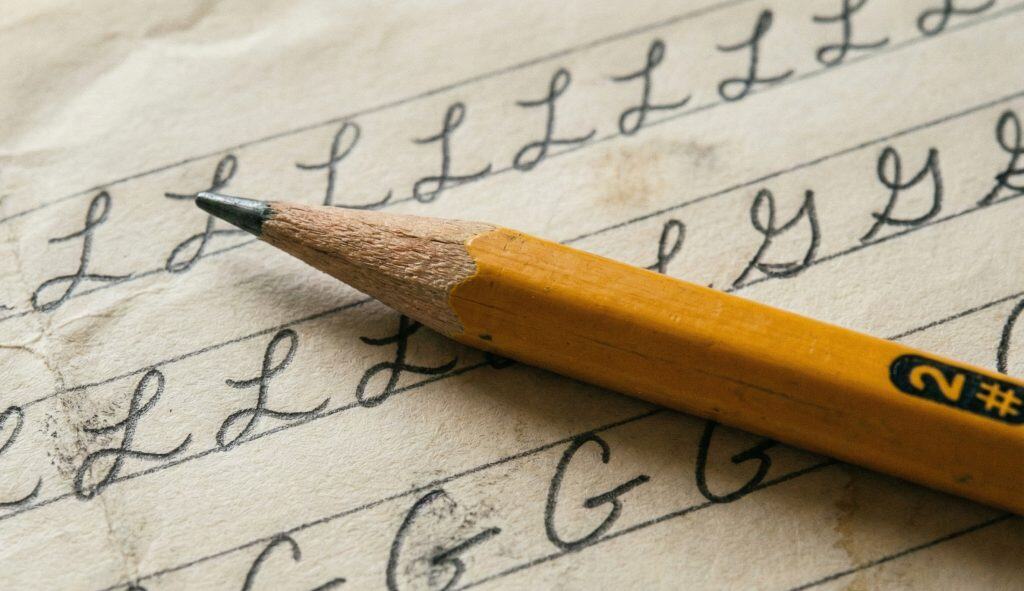
We spent hours making loops and swirls on lined paper.
We were told we would use it every day of our lives.
Today, it is a “lost art”. Kids can’t read the Declaration of Independence or their grandmother’s birthday cards.
It was tedious, but it taught fine motor control and discipline. Now, we just thumb-type.
4. Scholastic Book Orders
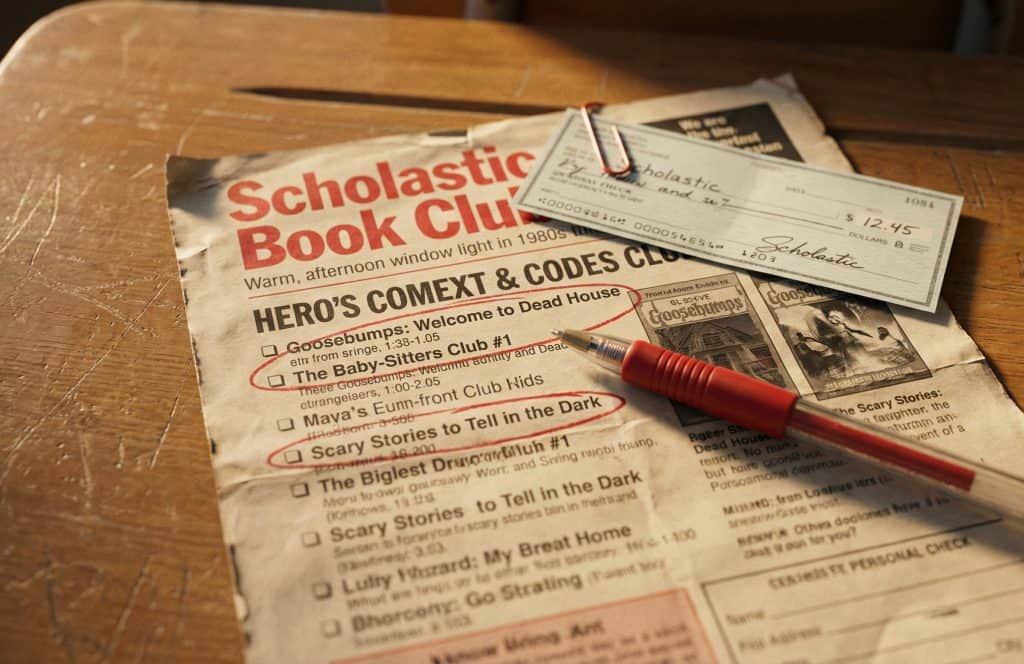
This was the Amazon Prime of the 1980s.
Once a month, the teacher handed out a flyer printed on newsprint. You circled Goosebumps or Clifford, brought in a check from your mom, and then waited.
Six agonizing weeks later, a box arrived.
The smell of fresh paperback glue filling the classroom was the best smell on earth.
5. Trapper Keepers
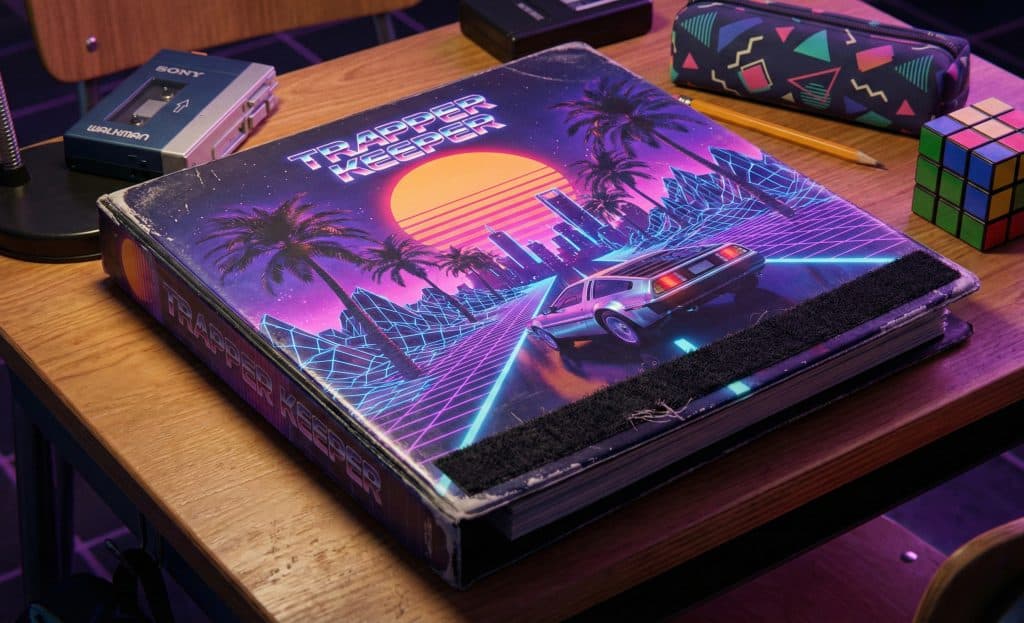
If you didn’t have a Trapper Keeper, were you even organized?
It was a massive three-ring binder held shut by a loud strip of Velcro. It had folders, pockets, and usually a picture of a Lamborghini or a unicorn on the front.
It was the ultimate 80s status symbol—until the Velcro wore out and your papers exploded into the hallway.
6. Metal Lunchboxes
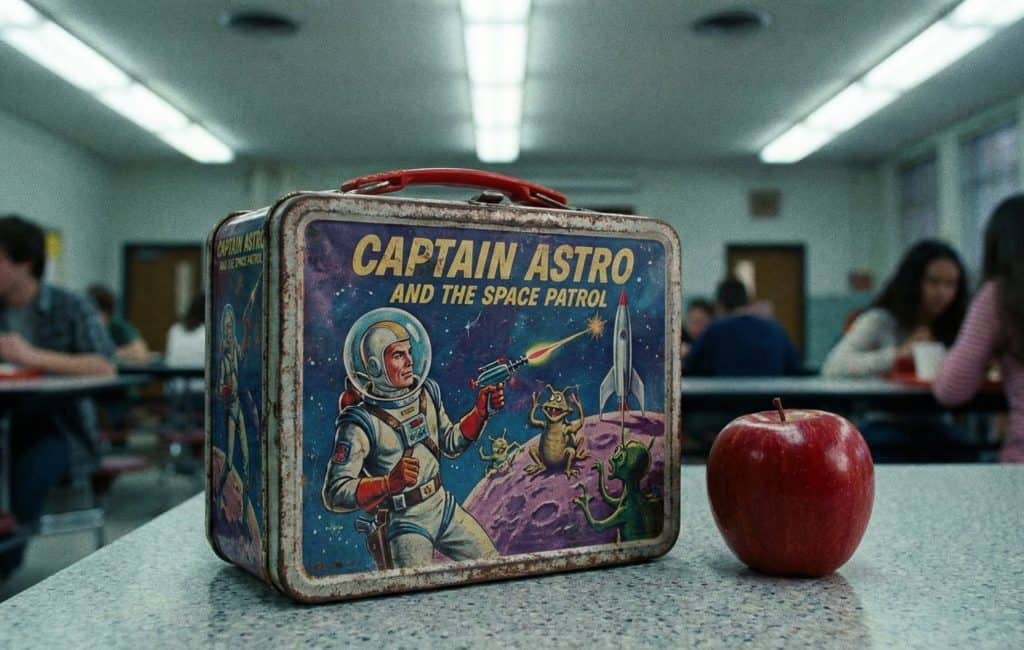
Plastic crushes. Metal endures.
The old rectangular lunchboxes were stamped steel. They were painted with the Dukes of Hazzard, Star Wars, or Strawberry Shortcake.
They were more than food storage; they were social status. You walked to the cafeteria carrying your billboard.
And if a fight broke out on the playground, they doubled as a shield.
7. Library Checkout Cards
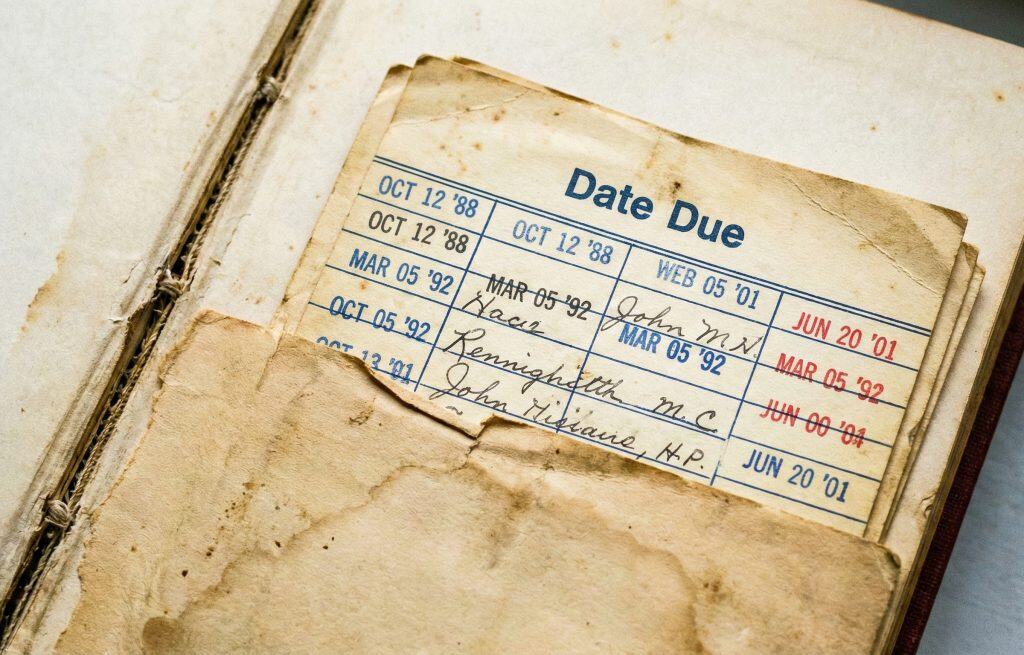
Privacy didn’t exist in the school library.
Every book had a paper pocket in the back with a card. To check it out, you signed your name.
You could see exactly who had read the book before you. You saw your older brother’s name from four years ago. You saw your crush’s name from last week.
It was a physical history of the book’s journey through the school.
8. The Card Catalog
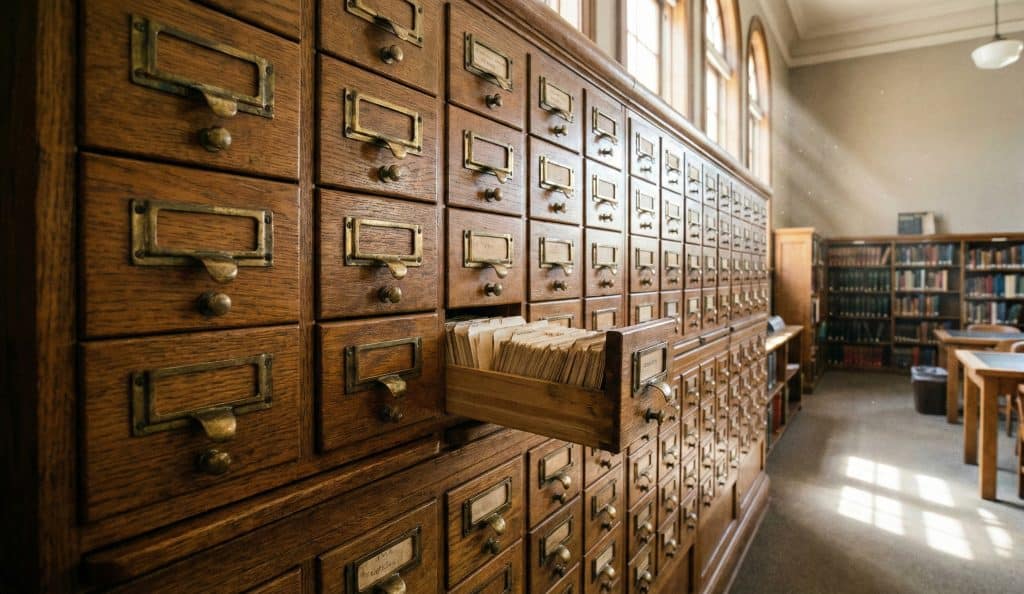
Google gives you a million answers in a second. The Card Catalog made you work for one.
It was a massive wooden cabinet filled with thousands of index cards, organized by the Dewey Decimal System.
You had to understand the logic of the system. You had to hunt through the drawers, write down the number, and then navigate the physical stacks.
It wasn’t fast. But it taught us how to actually search for information, rather than just waiting for an algorithm to feed it to us.
9. Hinged-Top Desks
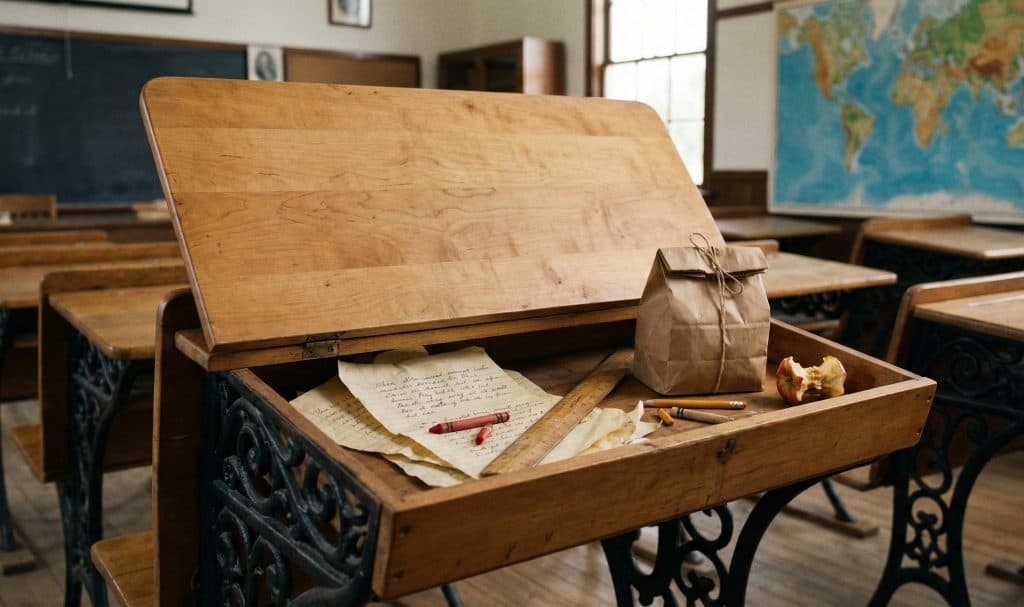
Modern desks are just tables. Old desks were fortresses.
They were built from cast iron and solid maple. But the best feature was the hinged top that lifted up.
Inside, it was your private world. You stored your books, your pencils, and a sandwich you forgot to eat three weeks ago.
You could lift the lid to hide from the teacher, creating a literal wall between you and long division.
10. The Glass Thermos
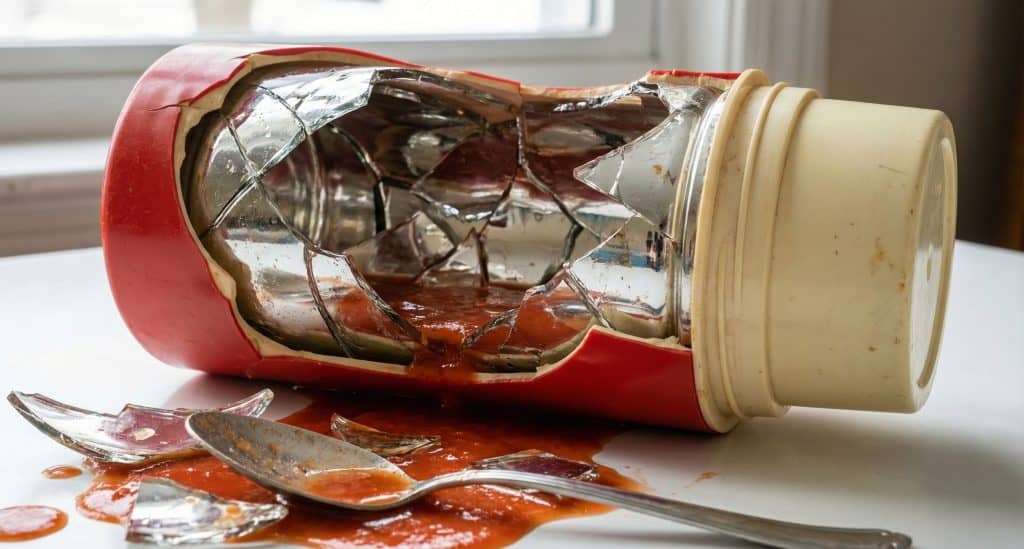
Inside that indestructible metal lunchbox was a fatal flaw: The Thermos.
To keep soup hot, they used a vacuum-sealed glass liner.
It worked perfectly—until you dropped it.
Every kid remembers the sound of the “tinkle” inside the plastic casing. You opened it up at lunch to find your tomato soup full of glass shards. It taught us a hard lesson in fragility.
11. The Mounted Pencil Sharpener
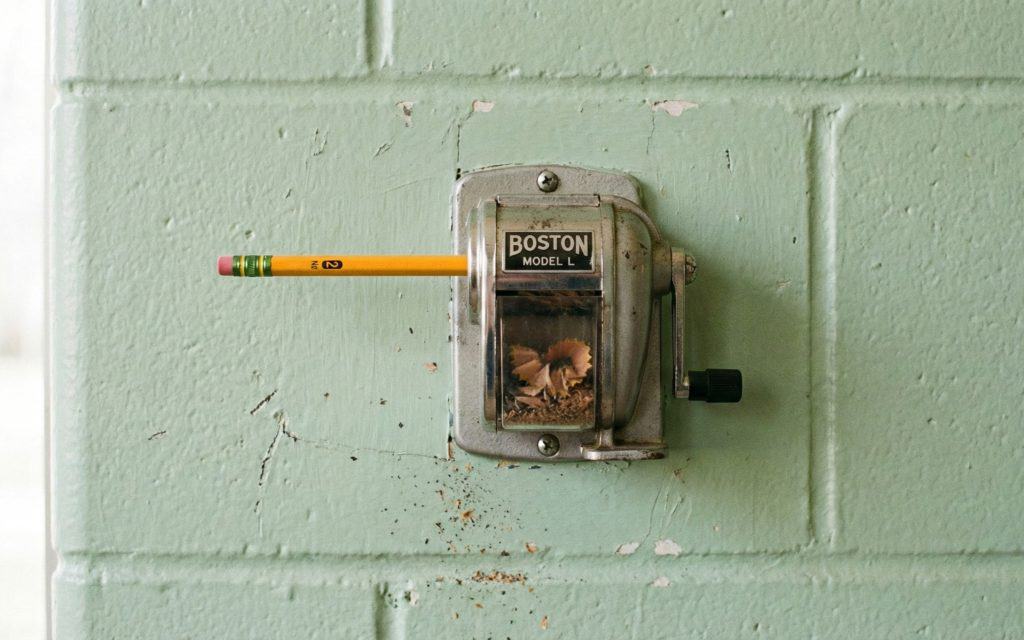
It was mounted to the wall with screws that could hold up a car.
It didn’t use a battery. It used a hand crank and two spiral steel grinders.
It was loud. It smelled like cedar shavings and graphite.
And if you weren’t careful, you would grind your knuckles against the metal casing. It was a tactile, mechanical ritual that signaled the start of work.
12. The Mimeograph Machine
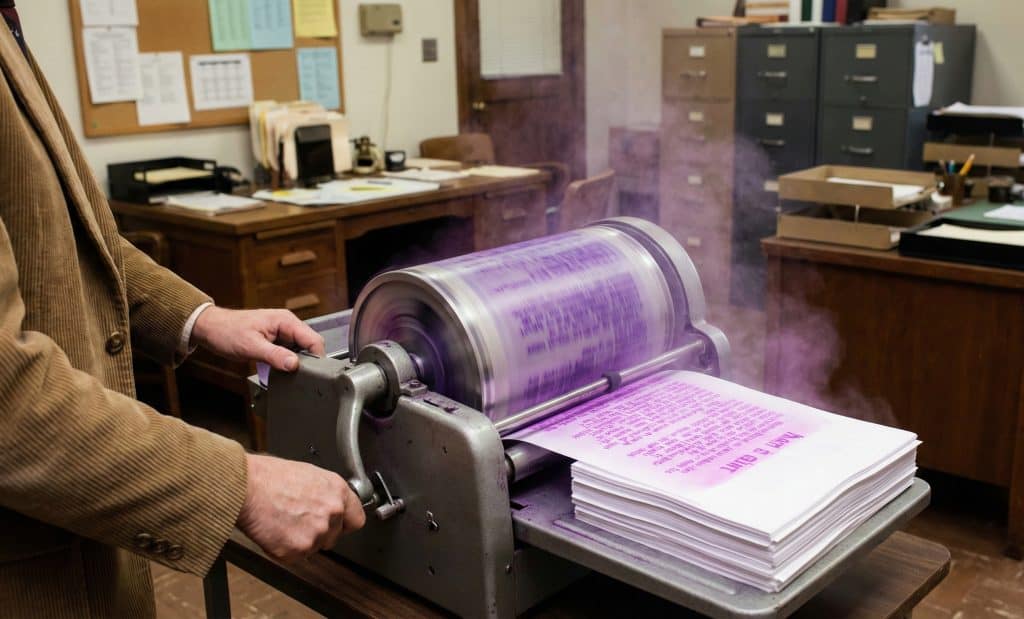
Before laser printers, teachers had to crank copies by hand.
The “Ditto” machine forced purple ink through a stencil on a spinning drum.
It was messy and loud. But every kid remembers the smell.
When the teacher handed out a fresh warm worksheet, the whole class would lift the paper to their noses and inhale that sweet, chemical solvent smell. It is the scent of 1980s education.
13. Eraser Duty
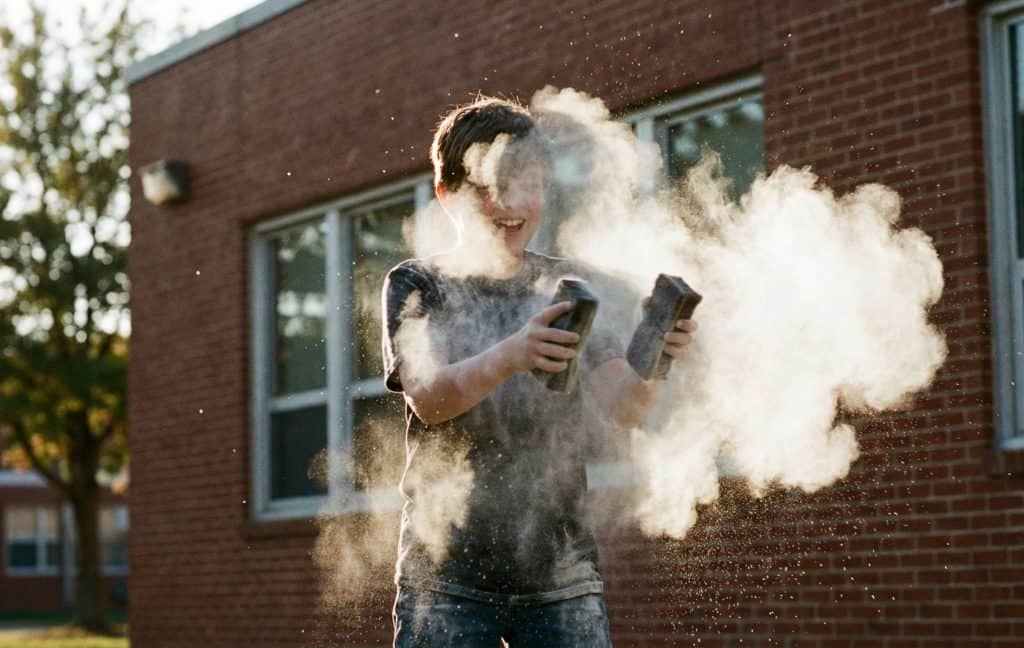
Chalkboards got dirty. The erasers got full of dust.
Being asked to “clean the erasers” was a privilege.
You went outside and clapped them together, creating massive clouds of white dust. You came back inside covered in chalk, but you had five minutes of freedom.
14. The Report Card Envelope
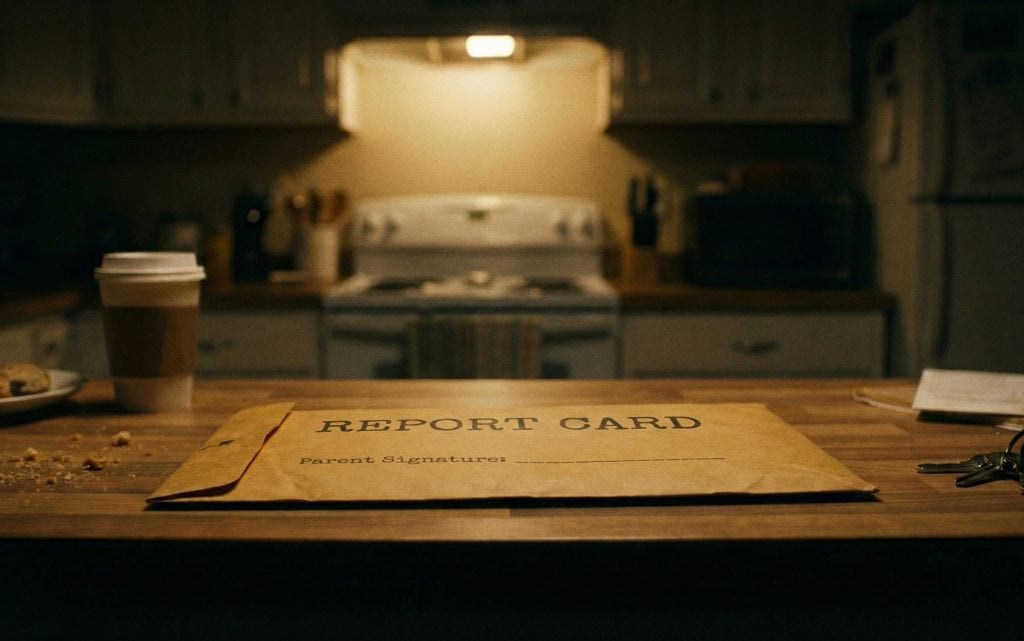
There was no online portal. There was no email alert.
There was a thick manila envelope.
You had to carry it home, watch your parents open it, and then—the hardest part—bring it back signed.
It taught us accountability. There was no “I forgot my password.” There was just the paper, the grade, and the signature.
15. The Weekly Reader
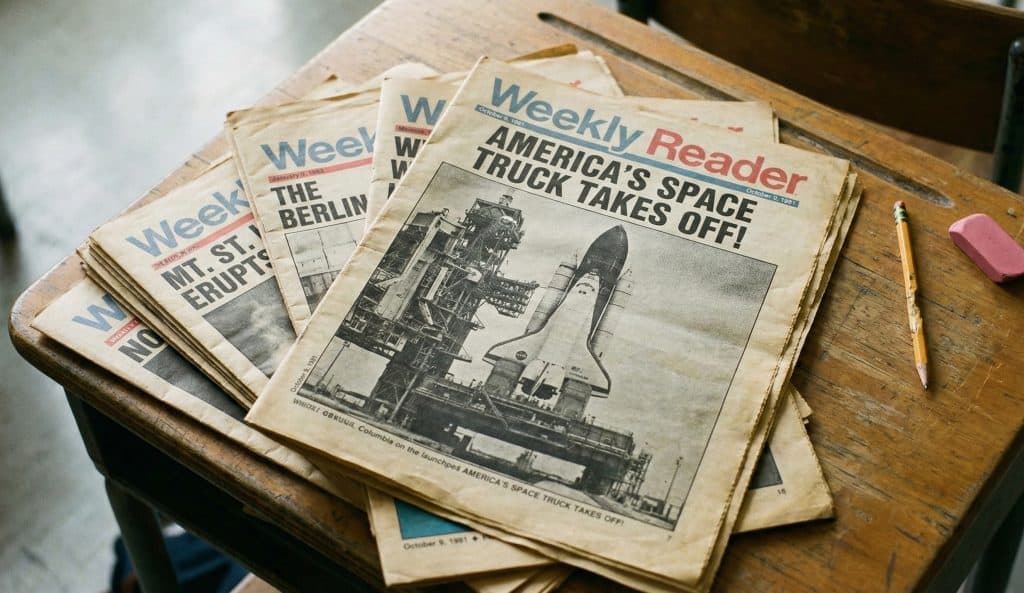
Long before social media, we had The Weekly Reader.
It was a flimsy newspaper printed just for kids. It tried to explain the Cold War or the Space Shuttle to a third grader.
We all sat there reading the same article at the same time, feeling like informed citizens for exactly twenty minutes.
16. The Overhead Projector
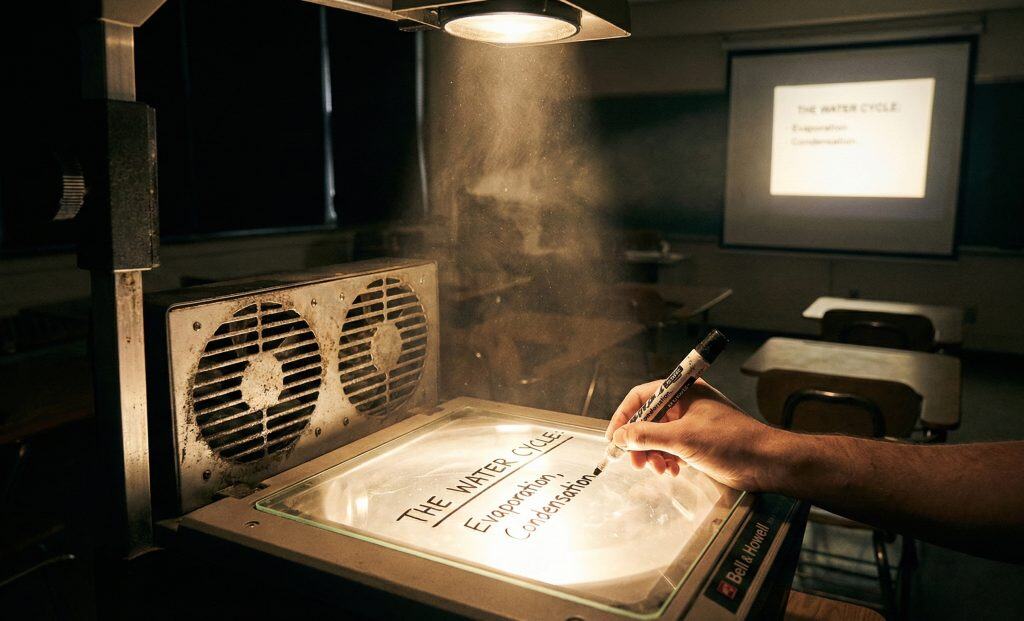
It was a hot, buzzing box of light with a fan that sounded like a jet engine.
The teacher would write on clear acetate sheets with “Vis-a-Vis” wet-erase markers.
If they left the machine on too long, the bulb would get so hot it could melt the plastic.
We spent half the class watching dust motes float in the giant beam of light.
17. The Paper Cutter
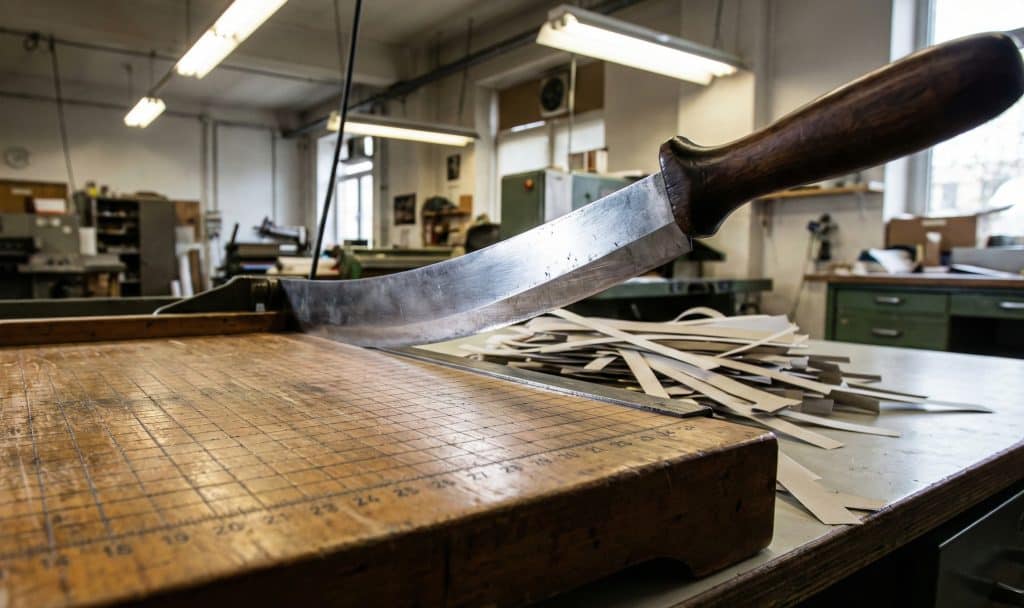
Every classroom had a device that looked like medieval weaponry.
The heavy wooden block with the massive steel blade—the “guillotine” style paper cutter.
It made a satisfying shhh-chunk sound as it sliced through thirty sheets of construction paper at once.
Today, they are deemed too dangerous. But back then, we just knew not to put our fingers under the blade.
18. Film Strip Projectors
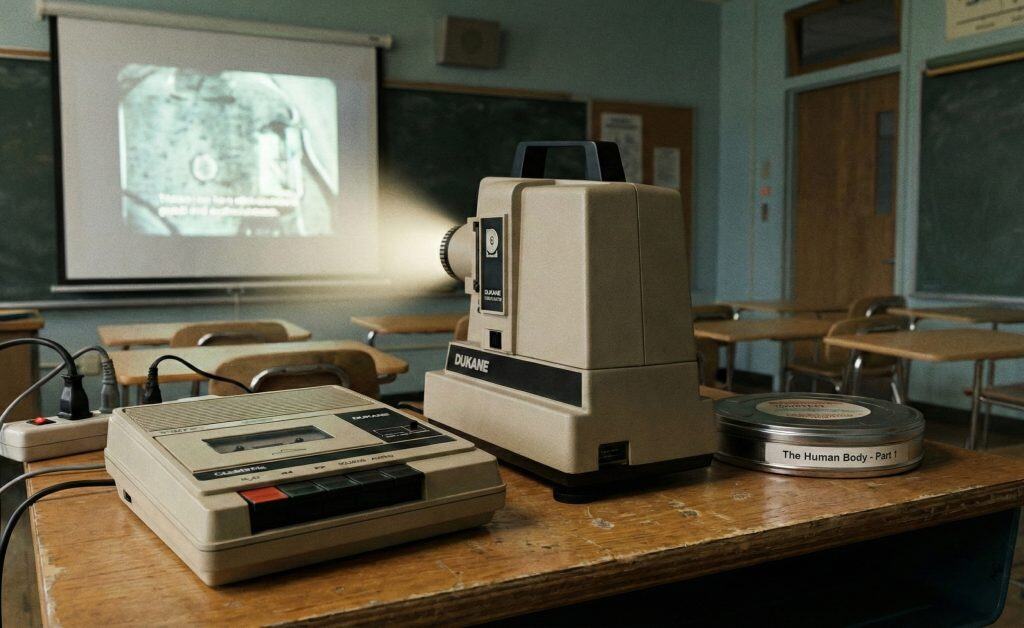
Movie day wasn’t Netflix. It was a film strip.
A series of still photos on a reel, synchronized with a cassette tape.
The whole class waited for the audible BEEP from the tape player, which was the signal for the AV monitor to turn the knob to the next frame.
If you missed the beep, the narration stopped making sense. It required active participation.
19. Pull-Down Maps
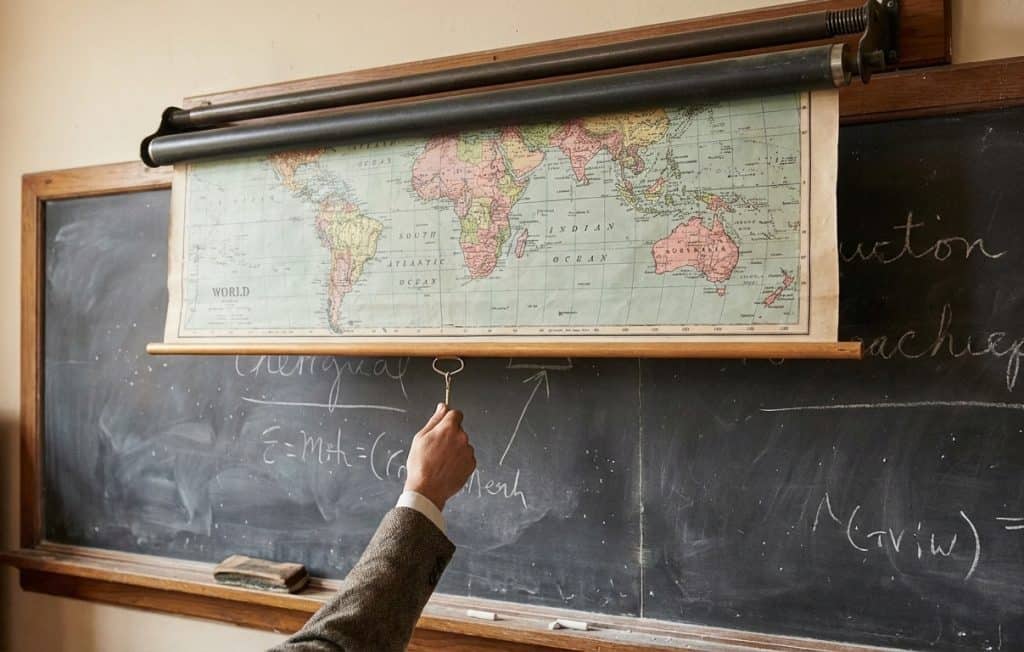
Above the chalkboard hung a mysterious metal cylinder.
With a sharp tug, the teacher would pull down a giant canvas map of the world.
They were spring-loaded like a window shade. If the teacher let go too fast, the map would snap back up with a violent THWACK that woke up every kid in the back row.
Teachers also used them to hide pop quiz questions written on the board behind them.
20. The AV Cart
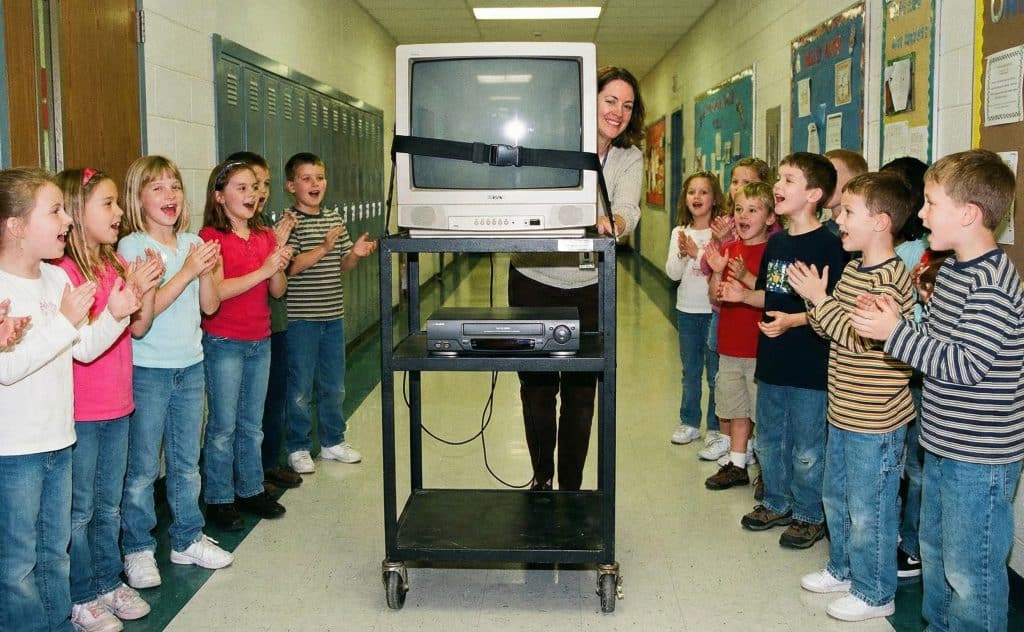
The most beautiful sight in the world was the substitute teacher rolling in the AV Cart.
A heavy steel cart with a CRT television strapped to the top with a black belt.
It meant you weren’t learning long division today. You were watching a blurry VHS tape about volcanoes.
21. Analog Clocks
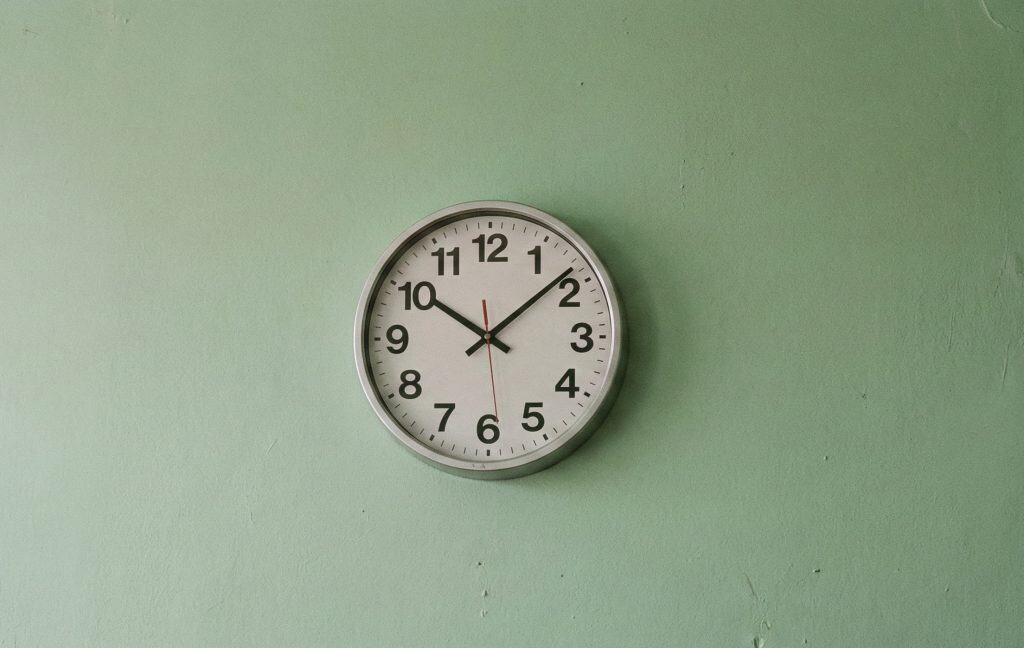
High up on the wall, there was always a round clock.
You could hear it ticking during tests. You watched the second hand sweep around, physically visualizing how much time you had left.
Today, many schools are replacing them with digital clocks because students can no longer read the dial. We are losing the ability to see time as a cycle.
22. Chalk Holders
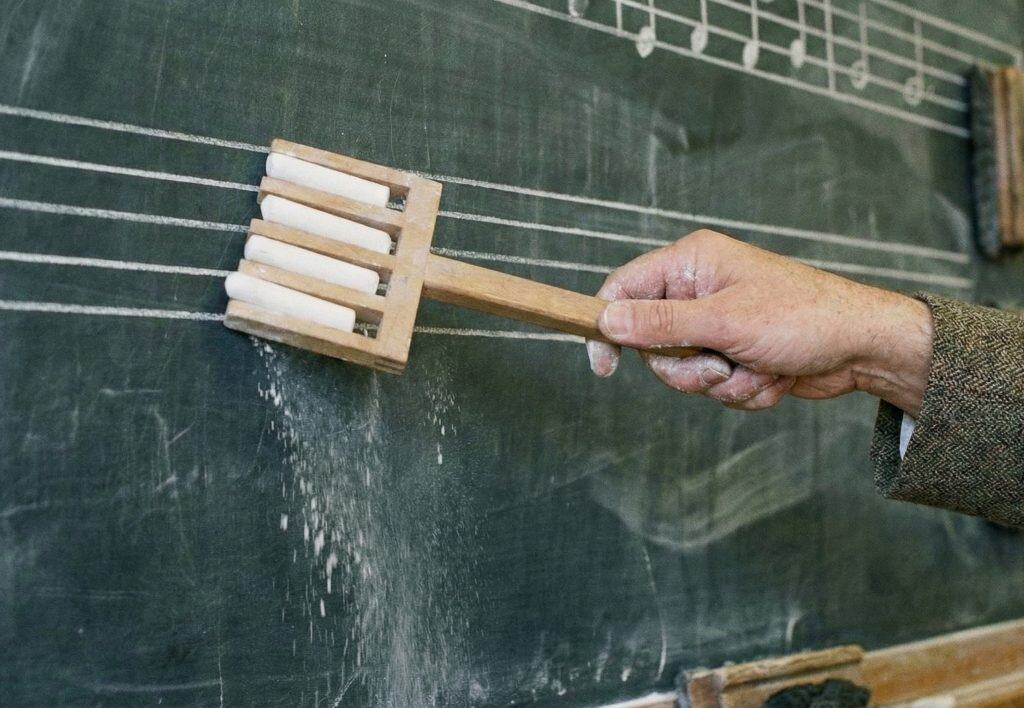
Music teachers had a specific tool that looked like a rake.
It held five pieces of chalk at once.
With one sweep of the arm, they could draw a perfect musical staff on the board. It was a simple, genius piece of analog engineering that computers have made obsolete.
23. Geometry Kits
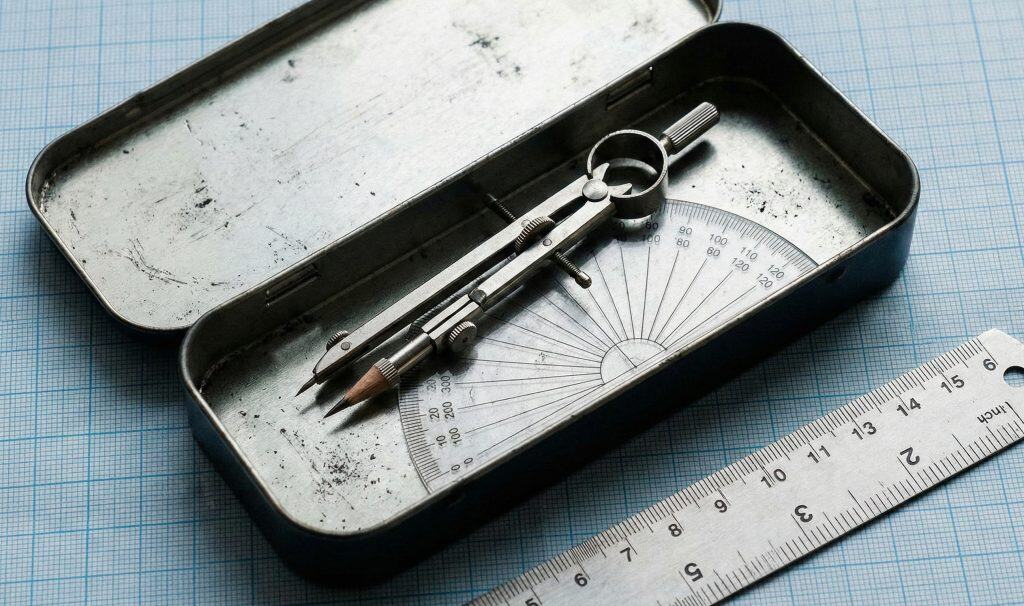
In math class, they handed you a metal tin.
Inside was a protractor and a metal compass with a steel spike on one end.
You used it to draw circles. You also used it to carve your name into the desk (see item #9).
It was a sharp, precise tool for drafting. Today, we just drag a shape on a screen.
24. Slide Rules
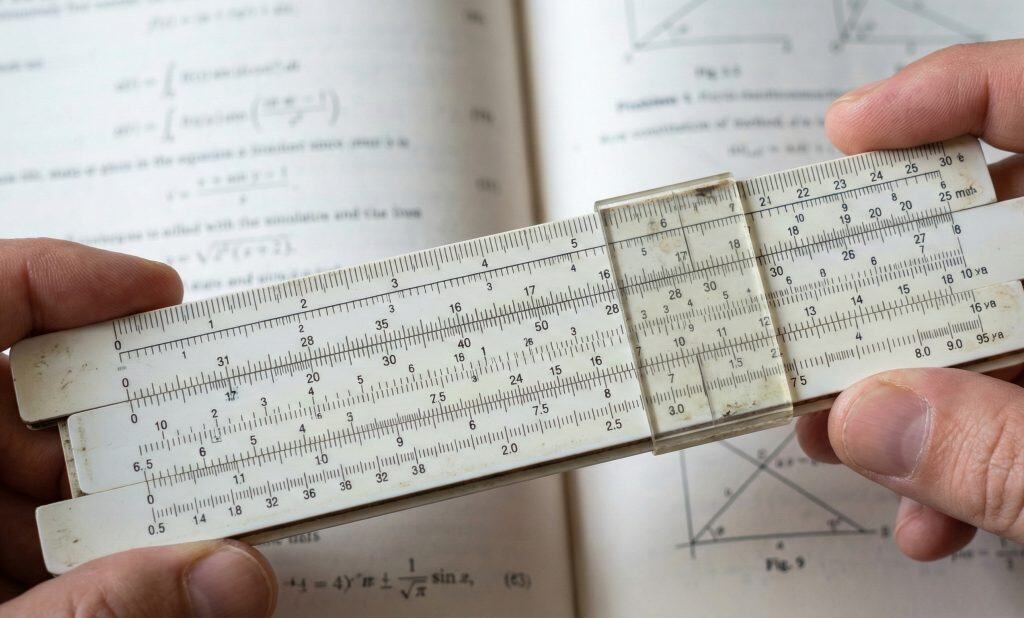
Before the pocket calculator, there was the slide rule.
It looked like a ruler, but it was a mechanical computer. By sliding the center strip, you could multiply, divide, and find square roots.
It required no batteries—just a brain and good eyesight. It visualized math in a way a digital screen never could.
25. Dodgeball
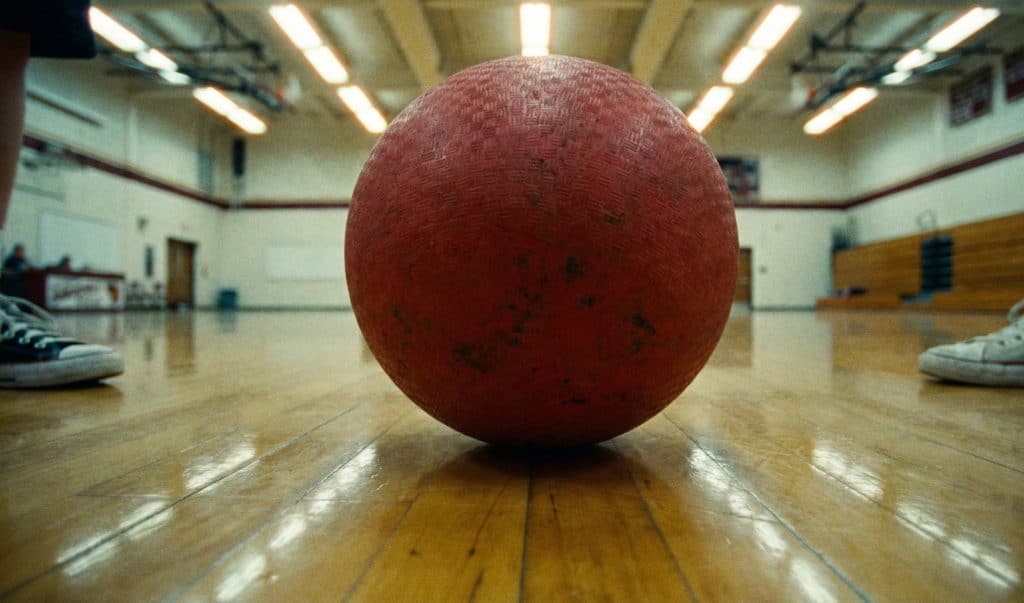
Gym class wasn’t about “wellness.” It was about warfare.
The weapon of choice was a red rubber ball.
It made a specific ping sound when it hit you. It stung. It left a mark.
Today, schools use soft foam balls or ban the game entirely. We learned to keep our heads on a swivel and move our feet.
Conclusion
We look at these items and smile because they are nostalgic.
But we also miss them because they were real.
The world used to be heavier. It had friction. It required muscle, maintenance, and attention.
We built things in woodshop. We cranked the pencil sharpener. We folded the book covers.
We didn’t just attend school. We participated in it.