

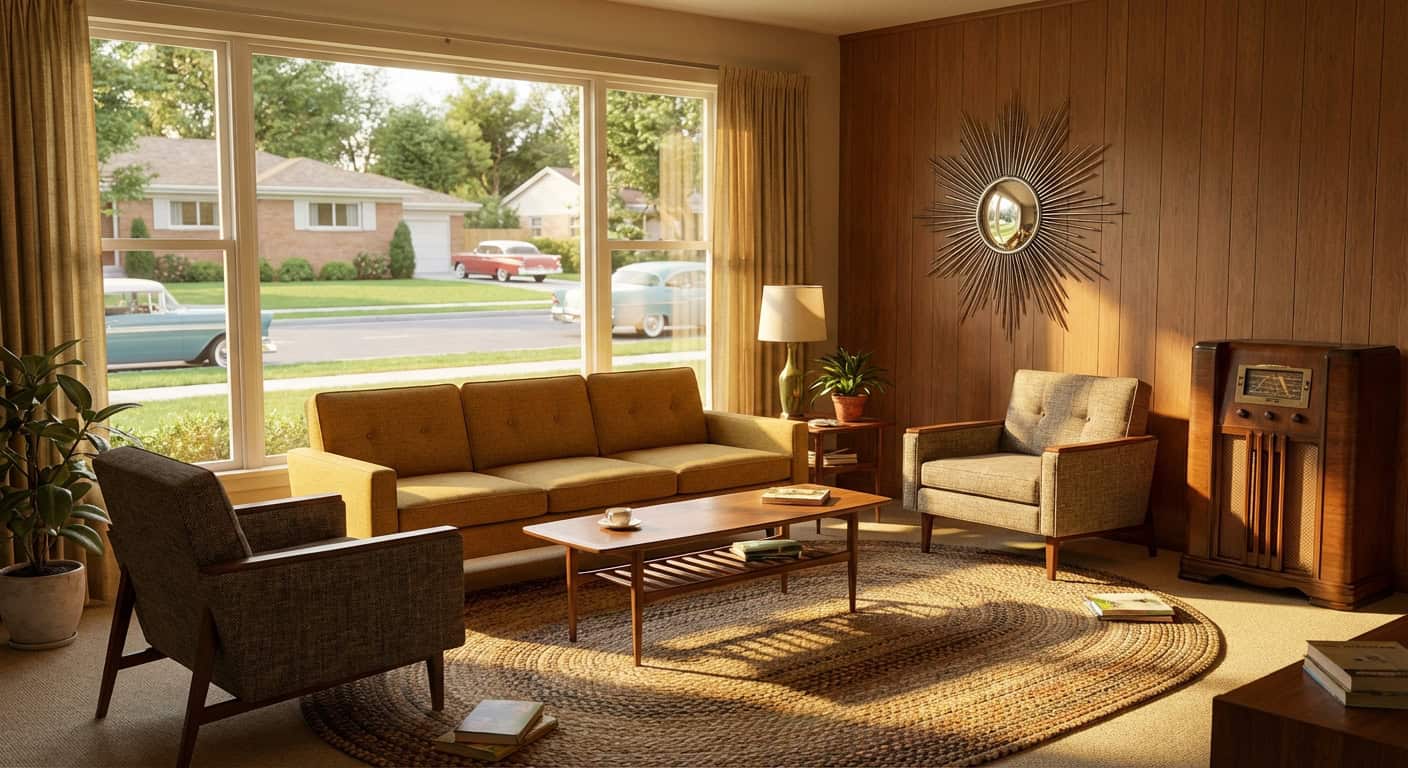
The 1950s home was brand new.
Not just new as in recently built — though millions of them were. New as in nothing like it had ever existed before. New appliances. New materials. New colors. New rooms. A new way of living that was being invented in real time, one subdivision at a time.
The war was over. The boys were home. The GI Bill was putting families in houses faster than anyone thought possible. And the American home — that small, pastel-colored, picture-windowed box on a quarter-acre lot — became the most powerful symbol of a nation that was absolutely certain its best days were ahead.
If you walked through the front door of one of those homes between 1950 and 1959, these 25 things were waiting inside. Some of them were revolutionary. Some of them were delightfully strange. And all of them helped build the world we live in today.
How many do you remember?
1. The Pink Bathroom
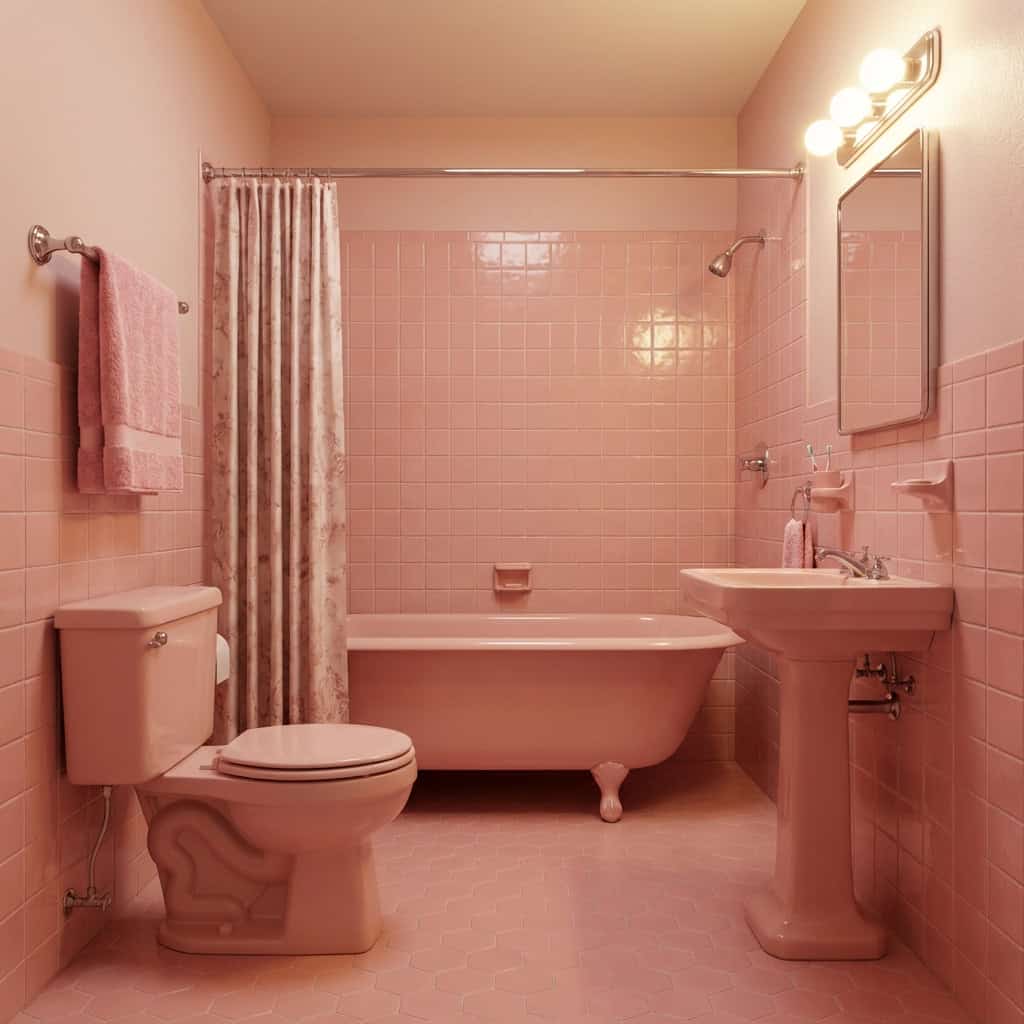
The most iconic room in the 1950s home was not the kitchen. It was the bathroom.
And it was pink.
Pink toilet. Pink bathtub. Pink sink. Pink tile on the walls and the floor. Pink everything — from the soap dish to the towel bar to the toilet paper holder.
It was not just any pink. It was a specific, warm, slightly peachy pink that the industry called “Mamie Pink” — inspired, depending on who you ask, by First Lady Mamie Eisenhower’s well-known love of the color.
An estimated five million American bathrooms were installed in pink during the 1950s. Millions of them are still there today — and they have survived not because they are easy to update, but because replacing a pink toilet, pink tub, and pink tile is so expensive and labor-intensive that most homeowners just learn to live with it.
The pink bathroom was the 1950s in a single room — cheerful, optimistic, and completely committed to a color choice that nobody would make today but nobody can quite bring themselves to destroy.
2. The First Family Television Set
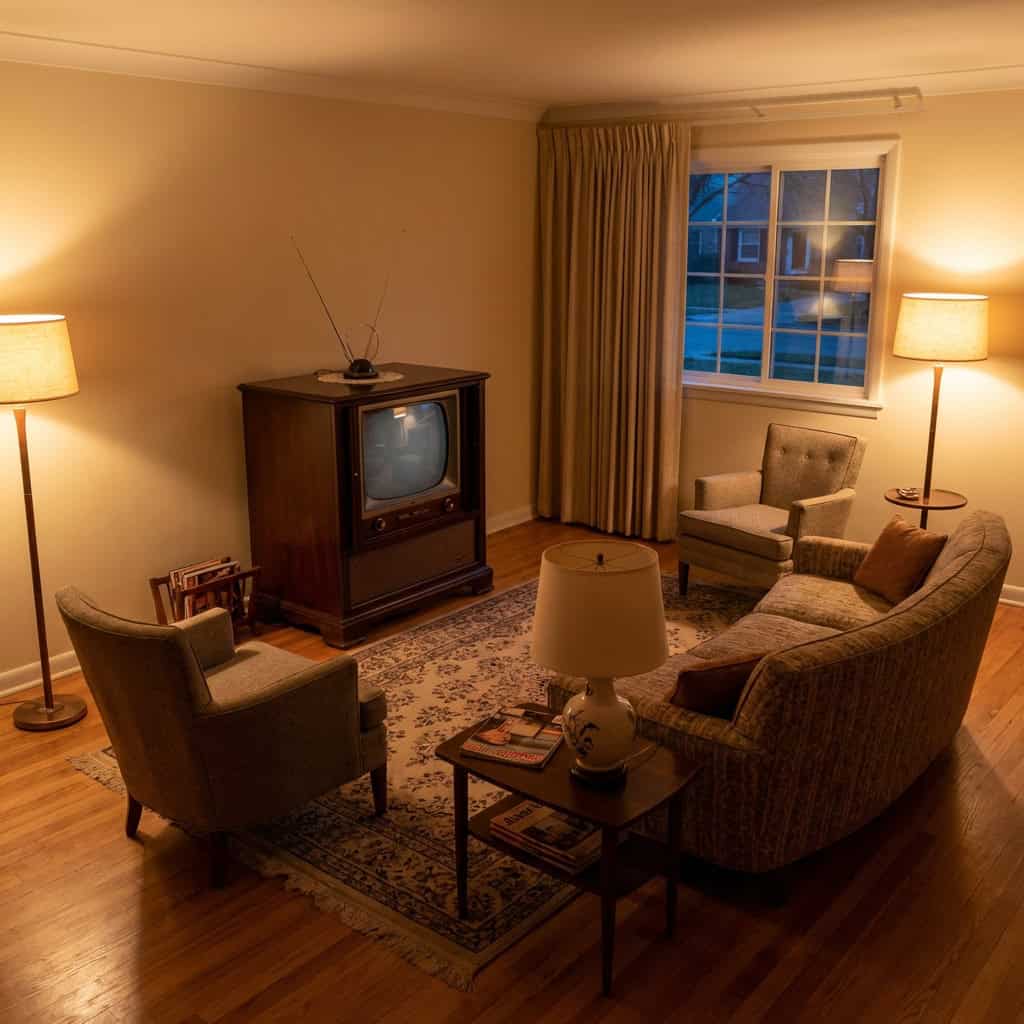
In 1950, fewer than 10 percent of American homes had a television. By 1960, nearly 90 percent did.
That is the fastest adoption of a new technology in the history of American households, and it changed everything — how families spent their evenings, how they arranged their furniture, how they ate dinner, and how they understood the world outside their front door.
The first TV was a small screen in a large cabinet, usually placed in the living room against the wall that got the least glare. The family arranged the sofa and chairs to face it. The room, which had previously been arranged around the fireplace or the picture window, was now arranged around a glowing box.
Reception was unreliable. The picture rolled. The rabbit ears on top had to be adjusted constantly — and every family had one person who could hold them at exactly the right angle to get a clear picture.
But none of that mattered. The television was a miracle. It brought the world into your living room, and the American home was never the same.
3. The Pastel Kitchen
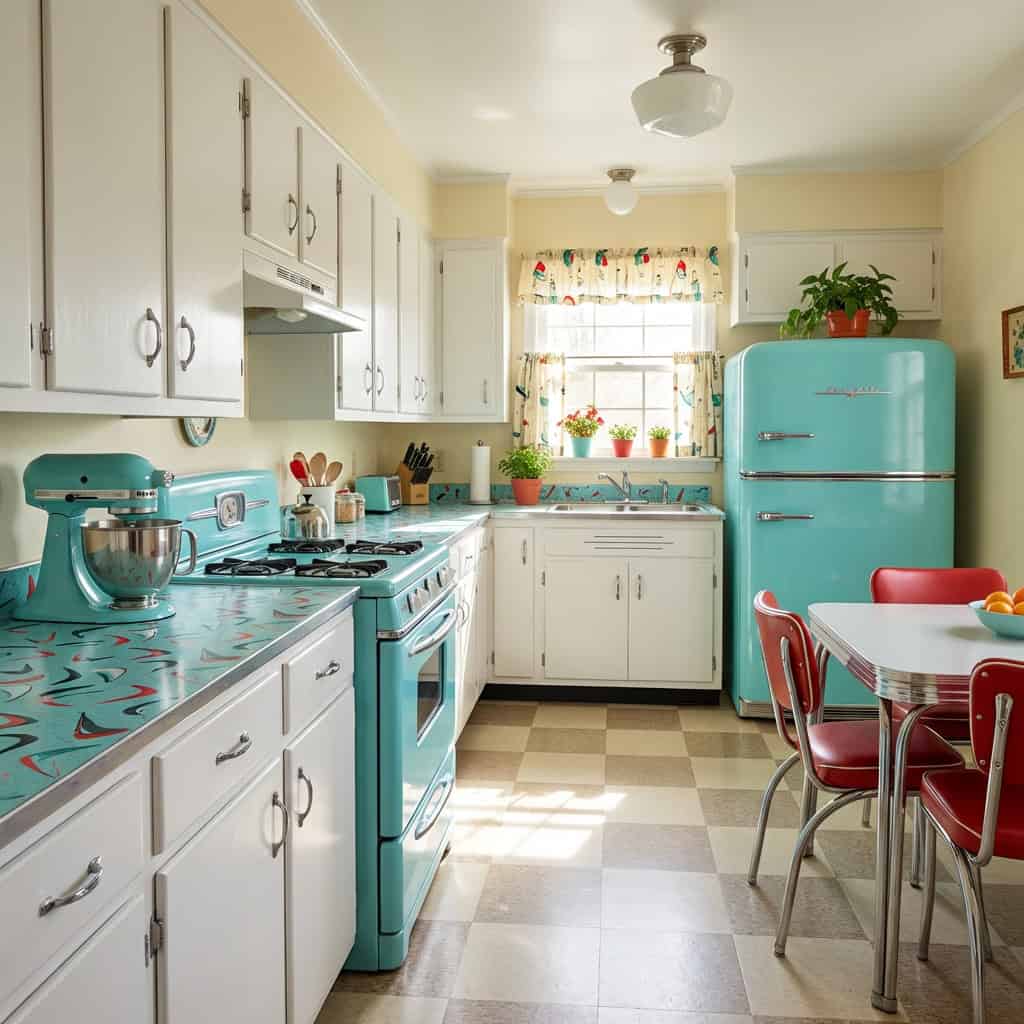
The 1950s kitchen was the happiest room in the house.
Appliances came in pastel colors that sound made up but were absolutely real — Turquoise, Petal Pink, Canary Yellow, Mint Green, and Stratford Yellow. Refrigerators, stoves, and even toasters were available in coordinating shades, and the expectation was that everything in the kitchen would match.
The cabinets were often painted to coordinate. The curtains matched. The canisters on the counter matched. The kitchen was a fully designed, color-coordinated environment that looked like it had been assembled from a magazine spread — because it often had been.
Appliance manufacturers marketed directly to women, and the kitchen was presented as a place of pride, efficiency, and beauty. The turquoise refrigerator was not just an appliance — it was a status symbol that told the neighborhood you had arrived.
4. Knotty Pine Paneling
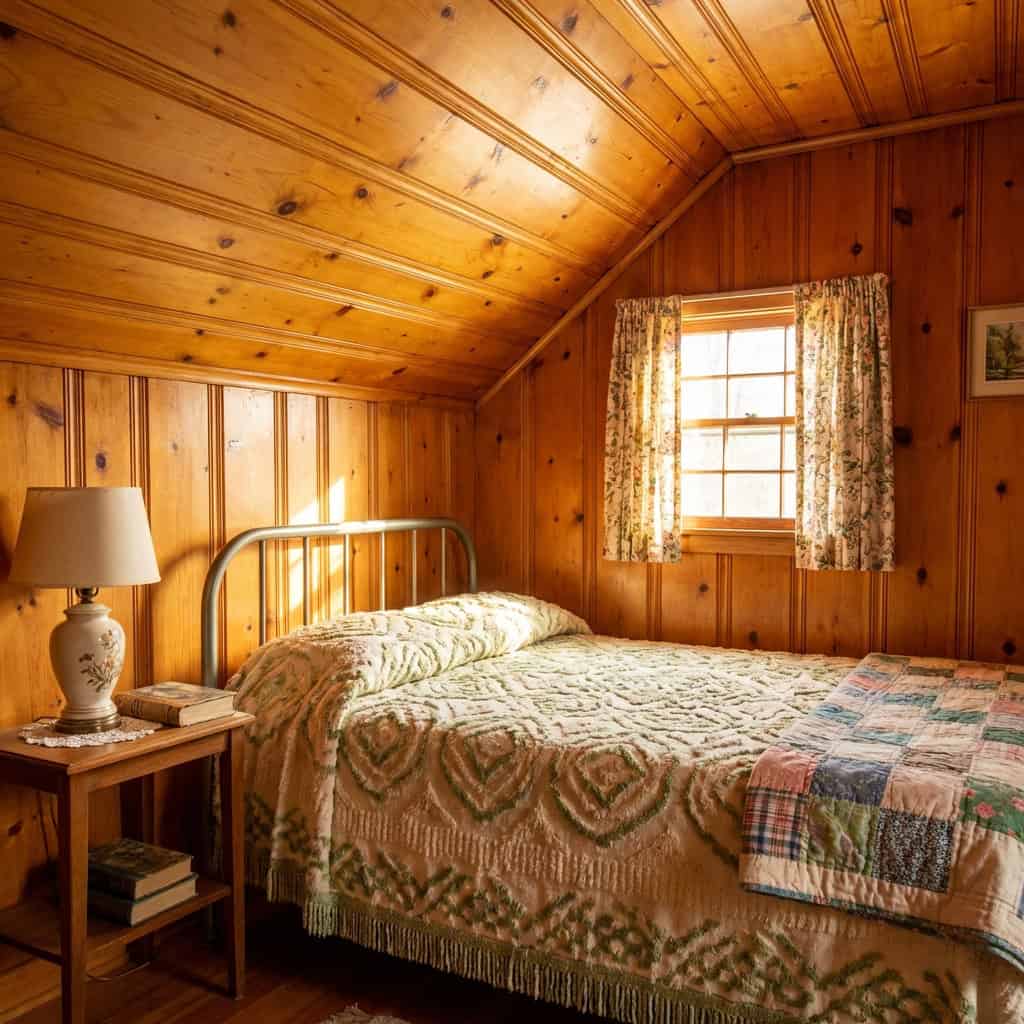
Not the dark, fake wood paneling of the 1970s. Knotty pine.
Real pine boards with visible knots, installed on walls and ceilings in kitchens, dens, bedrooms, and especially finished attics and basements. The wood was usually left natural or given a light varnish that turned it a warm, honey-gold color over time.
Knotty pine was the go-to wall treatment for the 1950s homeowner who wanted warmth without formality. It was affordable, easy to install, and gave a room a cozy, rustic character that drywall alone could never achieve.
Cape Cod homes — especially the original Levittown houses — were famous for knotty pine. The upstairs bedrooms, often finished by the homeowner as the family grew, were almost always paneled in it.
Decades of paint and renovation have covered much of the original knotty pine in surviving 1950s homes. Discovering it during a renovation — stripping back layers of paint to find honey-toned pine underneath — is one of the great joys of owning a mid-century house.
5. The Rotary Dial Telephone
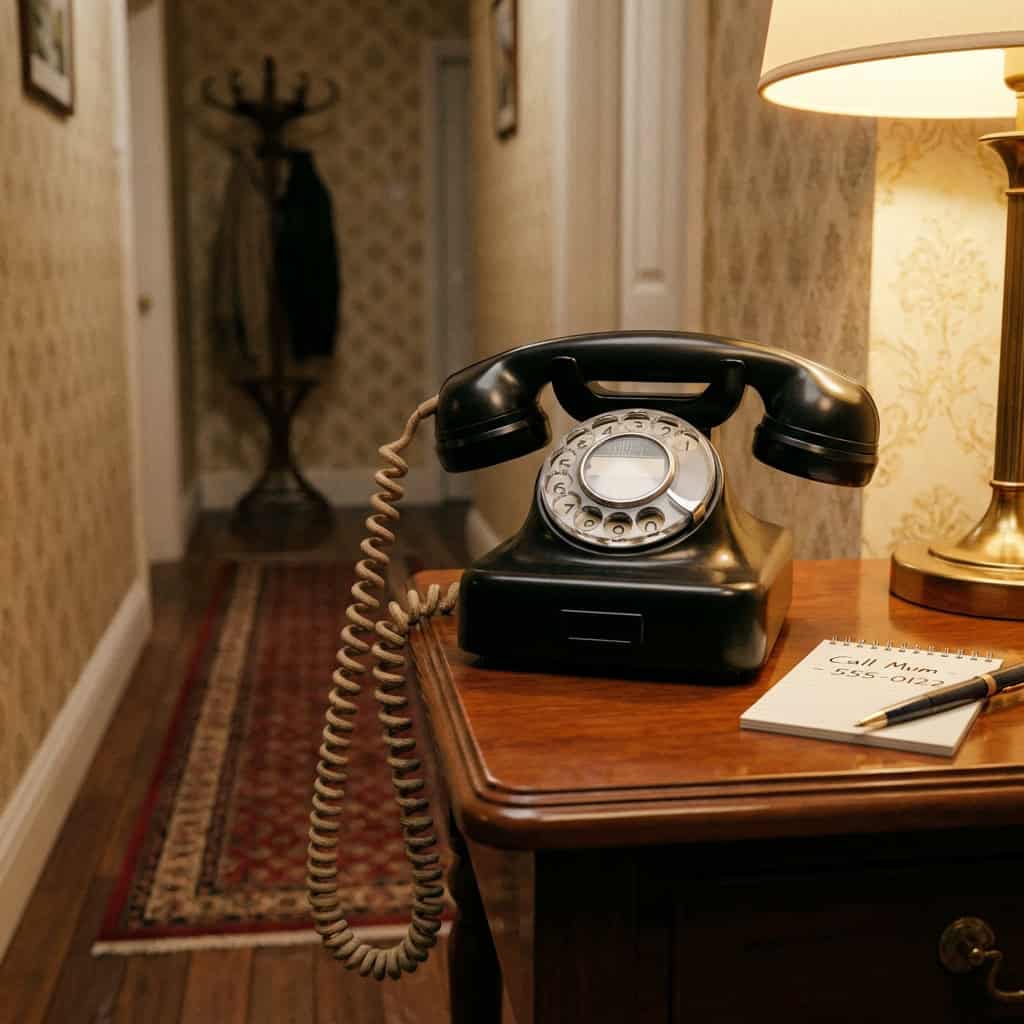
Before push buttons, before touch screens, there was the rotary dial.
The 1950s telephone was a heavy, solid, black or beige device with a circular dial on the front. You stuck your finger in the hole above each number, rotated the dial clockwise until your finger hit the metal stop, then released it and waited for the dial to click back to its starting position before dialing the next number.
Dialing a phone number took 15 to 20 seconds. A wrong number meant starting over from scratch. And long-distance calls were so expensive that families scheduled them like appointments.
The phone sat on a table in the hallway or the kitchen, and everyone in the house used it. There was no privacy. There was no caller ID. The phone rang, and someone answered it — not knowing who was on the other end until they spoke.
It was slow, deliberate, and completely unlike the instant communication we take for granted today. But there was something about the physical act of dialing — the weight of the phone, the click of the dial, the coiled cord connecting you to the wall — that made every call feel like it mattered.
6. Linoleum Floors in Bold Patterns
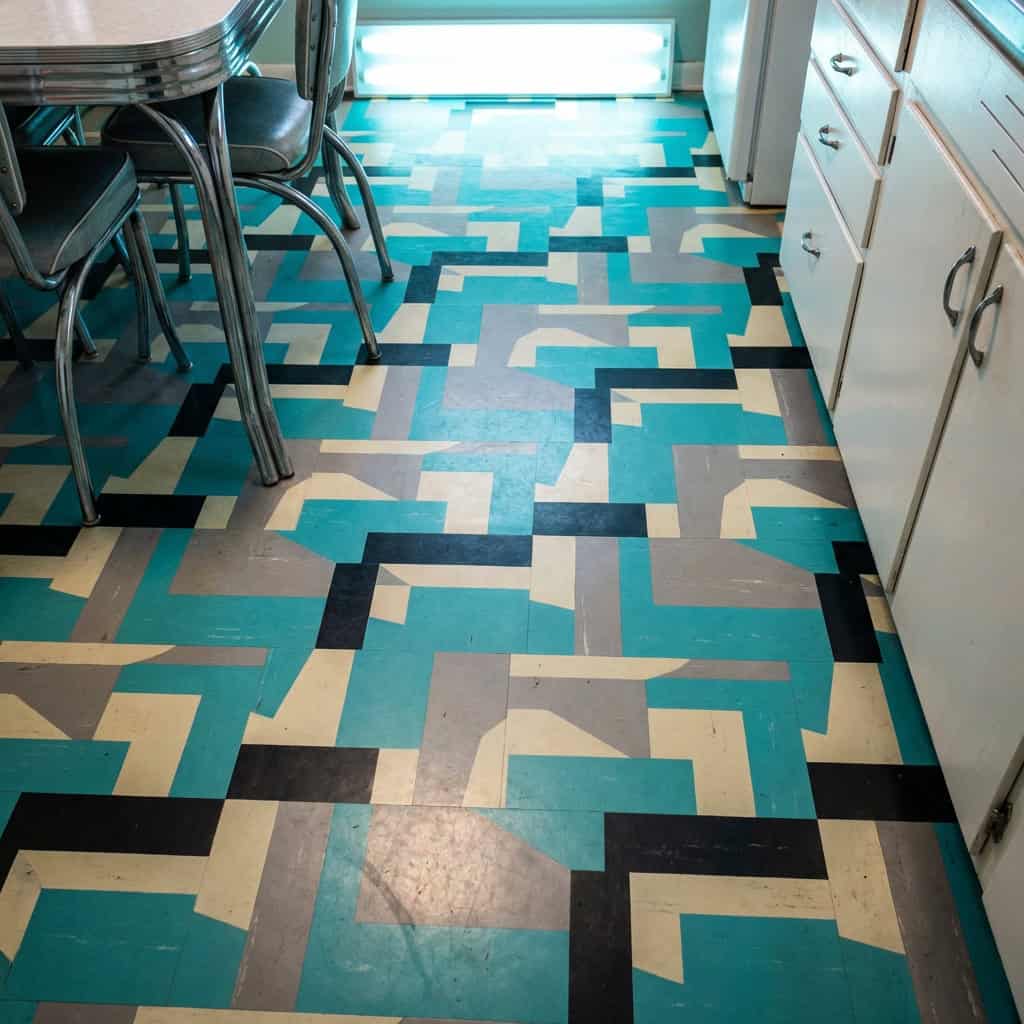
The kitchen and bathroom floors of the 1950s were linoleum — and they were not shy about it.
Bold patterns in bright colors covered millions of American floors. Geometric shapes, speckled terrazzo imitations, checkerboard designs, and marbled swirls in turquoise, pink, gray, yellow, and white turned the floor into a visual event.
Linoleum was practical. It was waterproof, easy to clean, and soft enough underfoot to make standing at the counter less punishing than tile or hardwood. It was also remarkably durable — some original 1950s linoleum floors have survived 70 years of foot traffic and still look presentable.
Armstrong was the dominant brand, and their pattern catalogs from the 1950s are works of art in themselves — pages of designs in colors that make modern vinyl plank flooring look like it gave up before it started.
7. The Formica Countertop
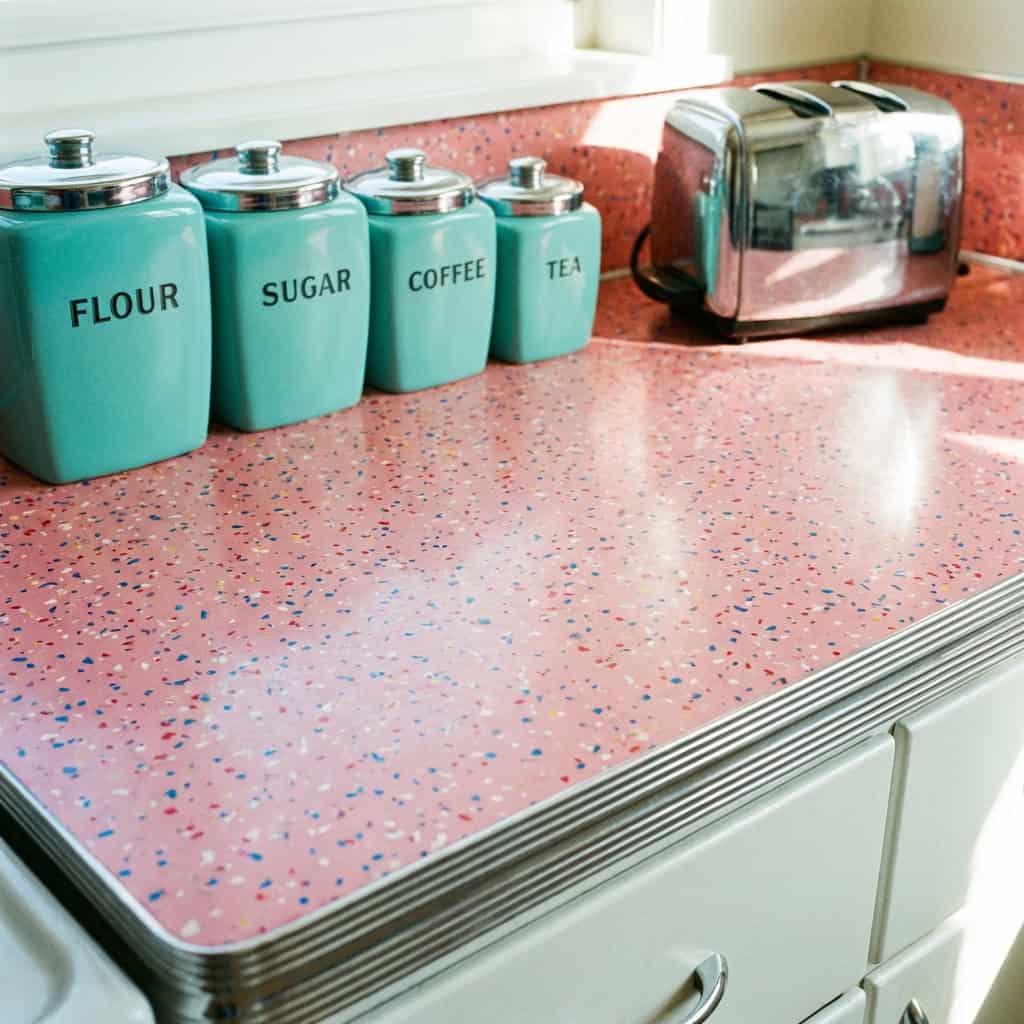
The 1950s kitchen did not have granite. It did not have quartz. It did not have butcher block.
It had Formica — and Formica was the future.
Plastic laminate countertops were a revelation. They were heat-resistant, stain-resistant, easy to clean, and available in a catalog of colors and patterns that made the old wooden and tile countertops of the pre-war era look ancient.
The most iconic 1950s Formica patterns were the “Skylark” boomerang design, the confetti speckle, and the woodgrain imitation. They came in pastels and bright colors — pink, turquoise, yellow, and gray — and they gave the kitchen a clean, modern, almost space-age quality.
Formica countertops were installed with a metal edging strip — usually chrome or aluminum — that finished the edge and became a design detail in its own right. That metal edge is now the single most recognizable indicator that a kitchen has not been updated since the Eisenhower administration.
8. The Picture Window
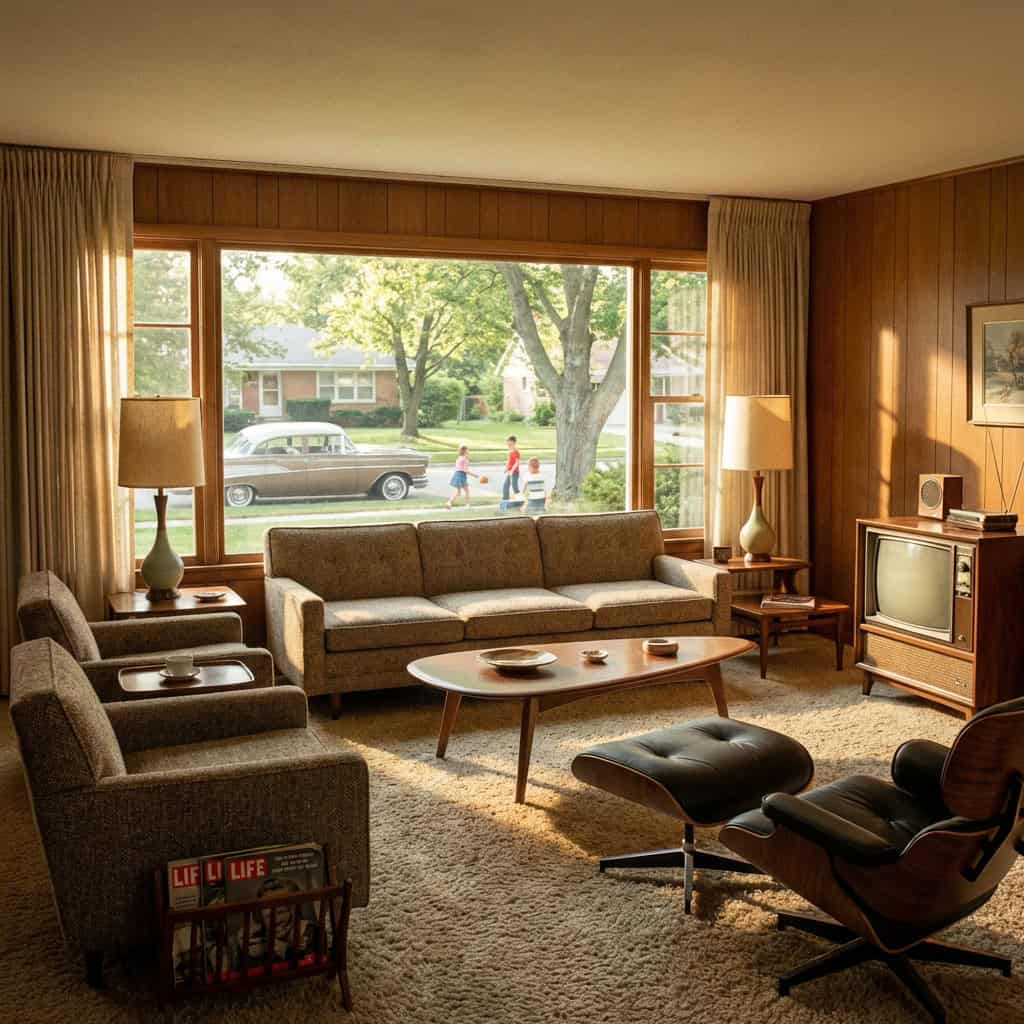
The 1950s home wanted you to see outside.
The picture window was a large, fixed pane of glass — often the biggest window in the house — installed in the front wall of the living room. It framed the view of the front yard, the street, and the neighborhood like a painting.
It let in enormous amounts of natural light. It made the living room feel open and connected to the world. And it was a complete departure from the smaller, divided-light windows of earlier home styles.
The picture window was as much about being seen as it was about seeing. The living room was on display to the neighborhood, which meant the curtains were always open, the furniture was always arranged, and the Christmas tree always went in front of it.
The picture window was the 1950s home’s public face — a clear statement that the family inside had nothing to hide and everything to show.
9. The Three-Piece Matching Living Room Suite
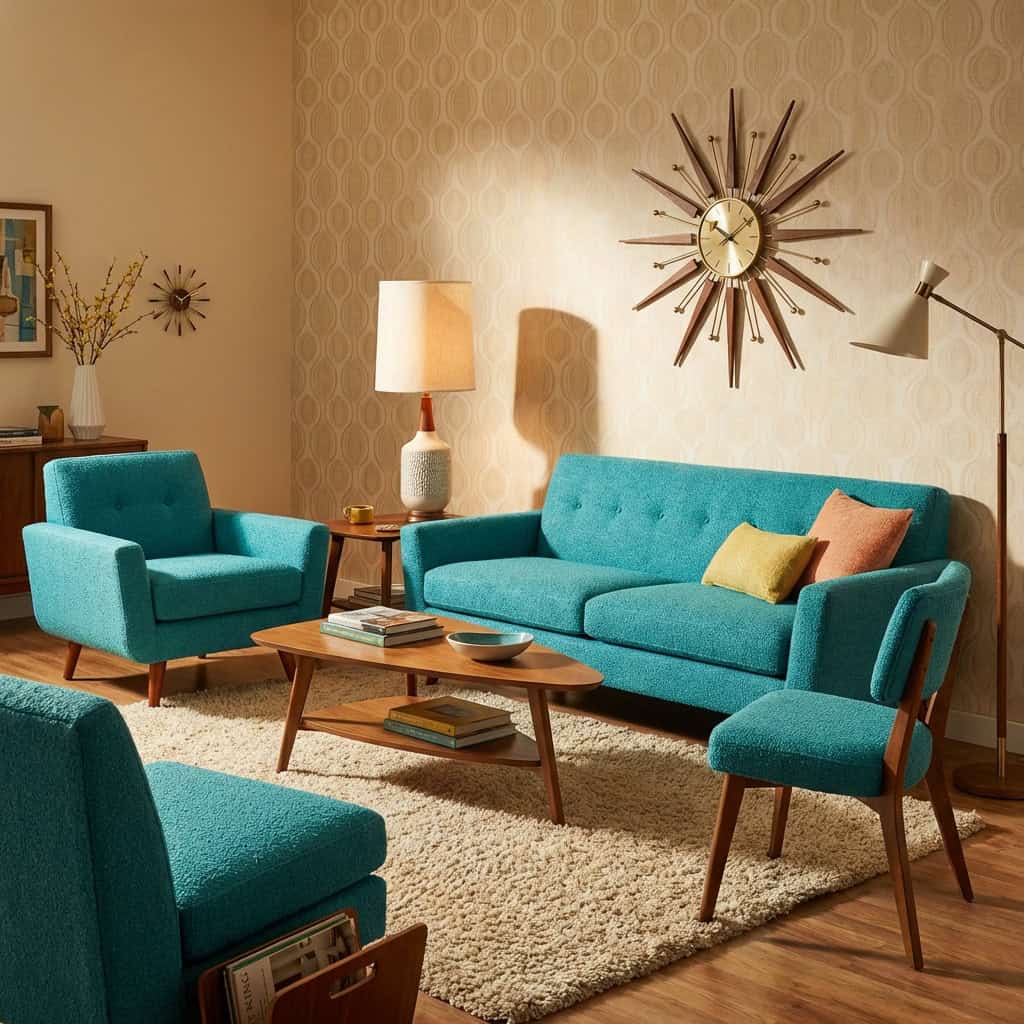
The living room furniture in the 1950s came as a set — and the set matched.
A sofa, a matching armchair, and a coordinating side chair, all upholstered in the same fabric, all purchased together, all arranged in the living room according to a layout that was practically standardized across America.
The fabrics ranged from nubby tweeds in muted colors to bold prints in turquoise, coral, or chartreuse. The legs were tapered and splayed — the signature silhouette of mid-century modern design.
Buying a matched suite was a major household event. The furniture store was visited. Fabric swatches were brought home. The delivery truck was watched for from the picture window. And once the suite was in place, it stayed there — in the same arrangement, in the same room — for a decade or more.
The concept of mixing and matching furniture from different sources and styles did not become mainstream until much later. In the 1950s, your living room matched. Period.
10. Boomerang and Atomic Patterns
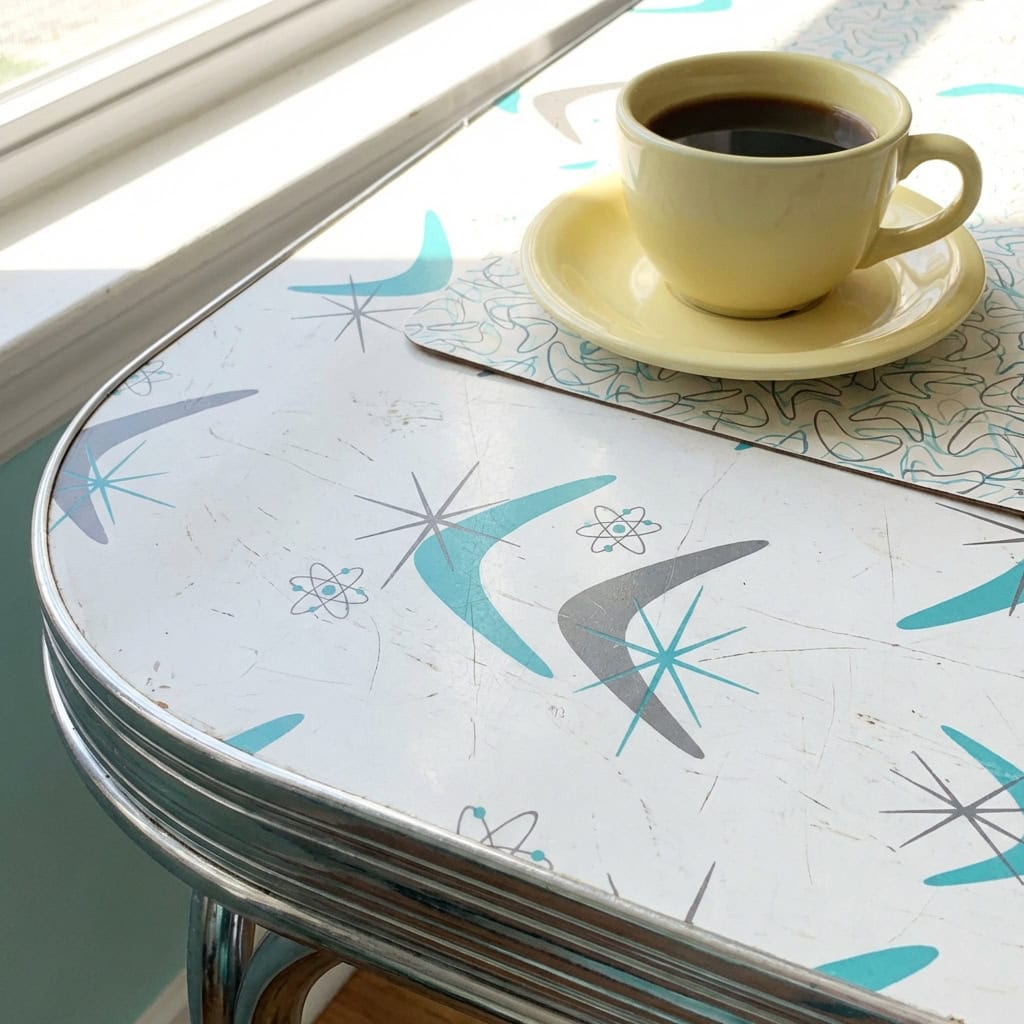
The 1950s were obsessed with shapes that did not exist in nature.
Boomerangs. Starbursts. Atoms with orbiting electrons. Abstract amoeba shapes. Sputnik-inspired radiating lines. These patterns showed up everywhere — on Formica countertops, on curtain fabric, on dinnerware, on wallpaper, on linoleum, on lamp shades, and on upholstery.
The atomic age was not just a political reality — it was a design movement. The same energy that split the atom and launched satellites also inspired a generation of designers to create patterns that looked like they came from a science textbook.
These patterns were playful, optimistic, and forward-looking. They said “the future is exciting and we are part of it.” They were printed on everything because the decade could not get enough of them.
Finding original 1950s atomic-pattern Formica or fabric today feels like finding a fossil from an era when America genuinely believed that science would solve everything.
11. The Built-In Ironing Board Closet
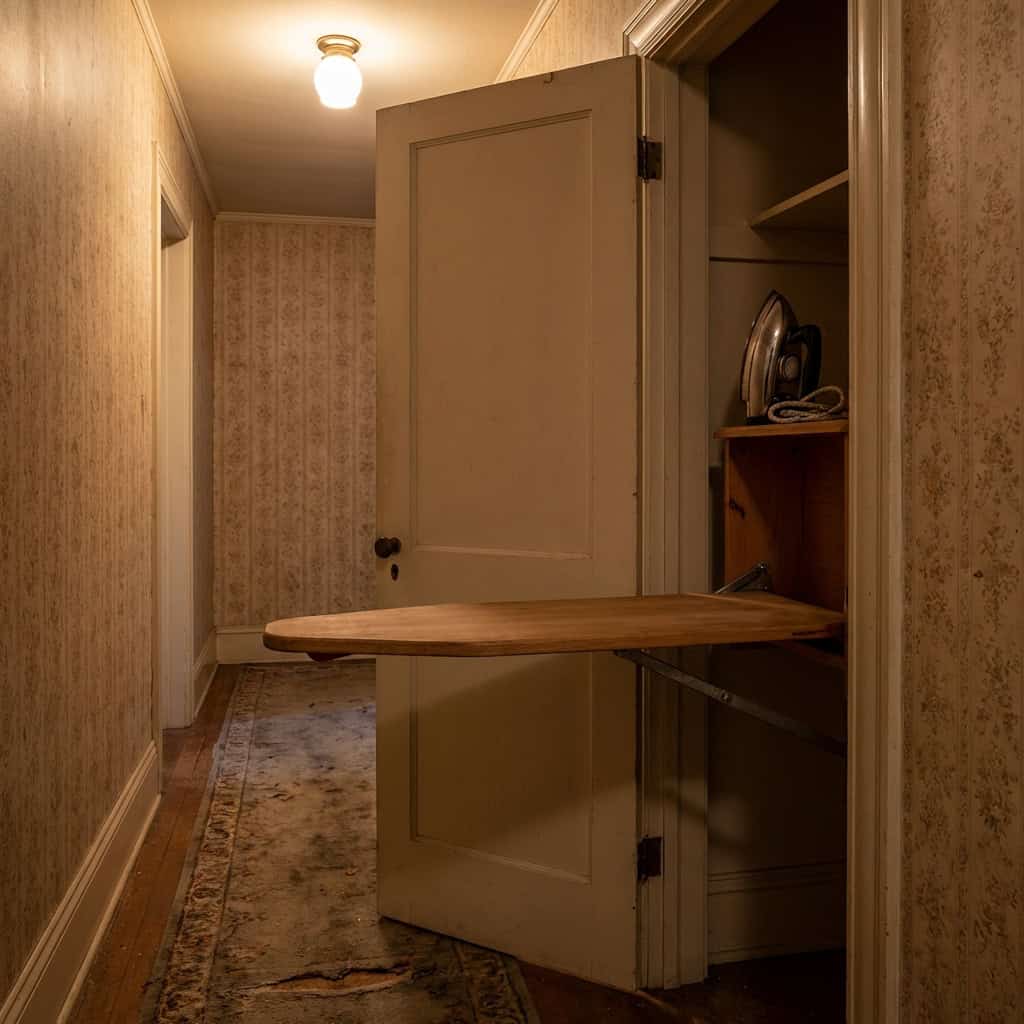
The 1950s home had a secret weapon hidden in the wall.
A narrow closet — usually in the kitchen, the hallway, or the laundry area — that opened to reveal a full-size ironing board mounted on a hinge. You pulled it down, ironed your clothes, folded it back up, and closed the door. The ironing board disappeared completely.
It was a piece of engineering that solved a real problem — ironing was a daily task in the 1950s, and a full-size ironing board took up valuable floor space in a small home.
The built-in ironing board closet was standard equipment in ranch homes and Cape Cods across America. Many of them are still there, painted shut or hidden behind drywall, waiting to be rediscovered by a homeowner who opens a weird narrow door and finds a perfectly preserved piece of 1950s domestic engineering.
12. Black and White Checkered Floors
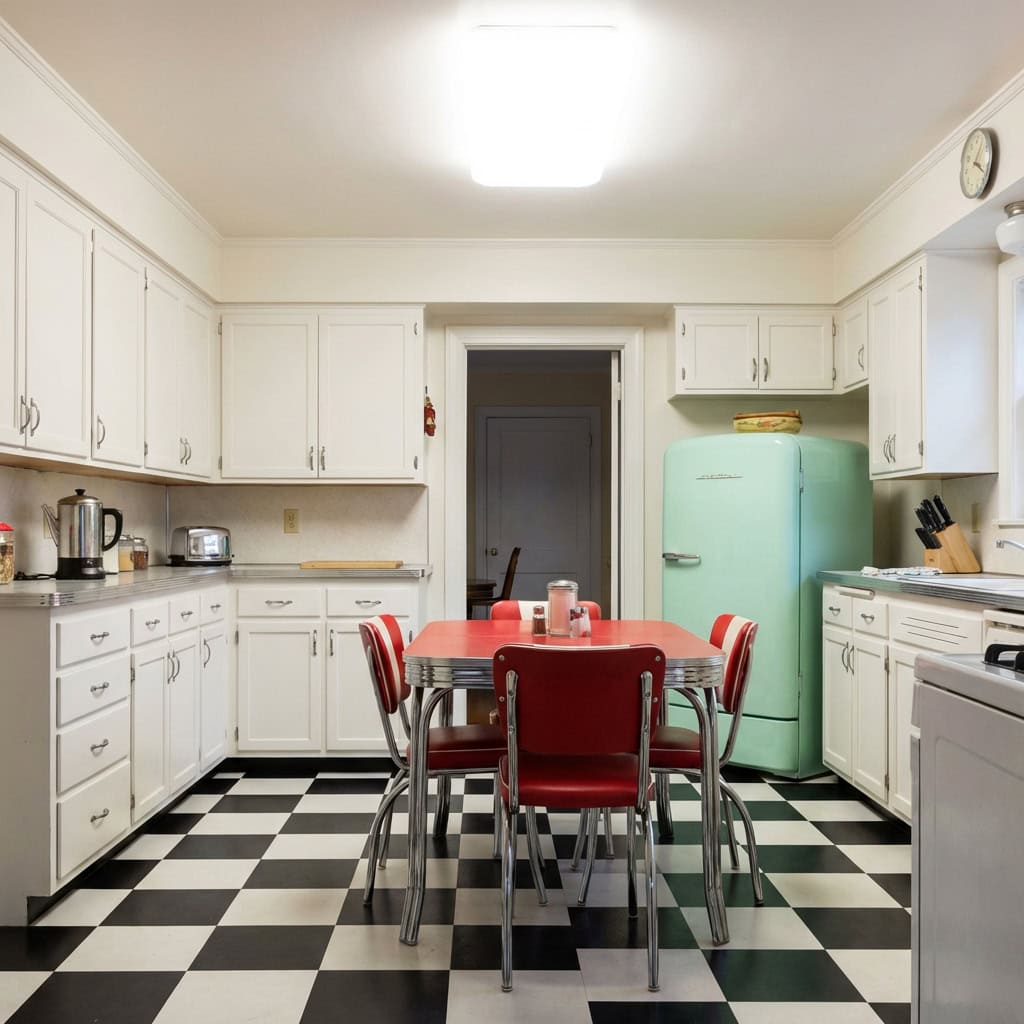
The most classic floor pattern in the 1950s home was also the simplest.
Black and white checkered tile — usually nine-inch or twelve-inch squares laid in an alternating pattern — covered kitchen floors, bathroom floors, entryways, and mudrooms. The look was clean, graphic, and timeless.
The tiles were usually vinyl composition or asphalt tile — affordable, durable, and easy to install. The pattern gave even a small kitchen an architectural quality that plain flooring could not match.
The checkered floor showed up in diners, barbershops, and soda fountains too, which gave it a cultural association with the 1950s that goes beyond home design. A black and white checkered floor is a visual shorthand for the entire decade.
The pattern has never fully gone out of style — it shows up in designer kitchens and vintage-inspired renovations to this day. The 1950s got this one right, and everyone knows it.
13. The TV Antenna on the Roof
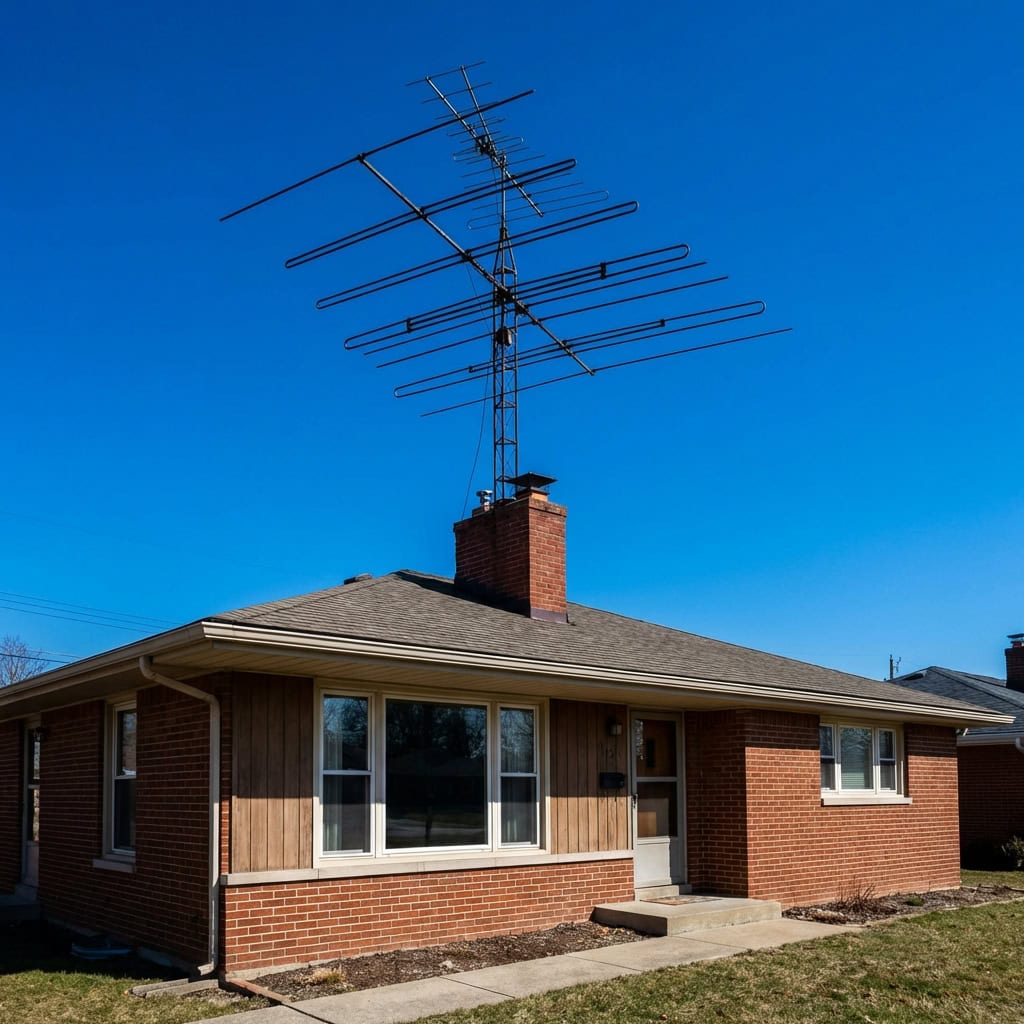
If a house had a television in the 1950s, it had an antenna on the roof.
The TV antenna was a metal framework of horizontal elements mounted on a vertical mast, bolted to the chimney or the roof peak, and connected to the television by a flat, ribbon-like cable that ran down the side of the house and through the wall.
Getting good reception was part science and part superstition. The antenna had to be aimed at the broadcast towers, which meant someone — usually dad — climbed onto the roof, loosened the bolts, rotated the antenna a few degrees, and waited for someone inside to shout whether the picture improved.
Some homes had motorized antenna rotors — a control box on the TV that let you rotate the antenna from inside the house. This was considered a significant luxury.
The TV antenna on the roof was a public declaration: this family has a television. In the early 1950s, when TVs were still uncommon, the antenna was as much a status symbol as the TV itself.
14. The Breezeway
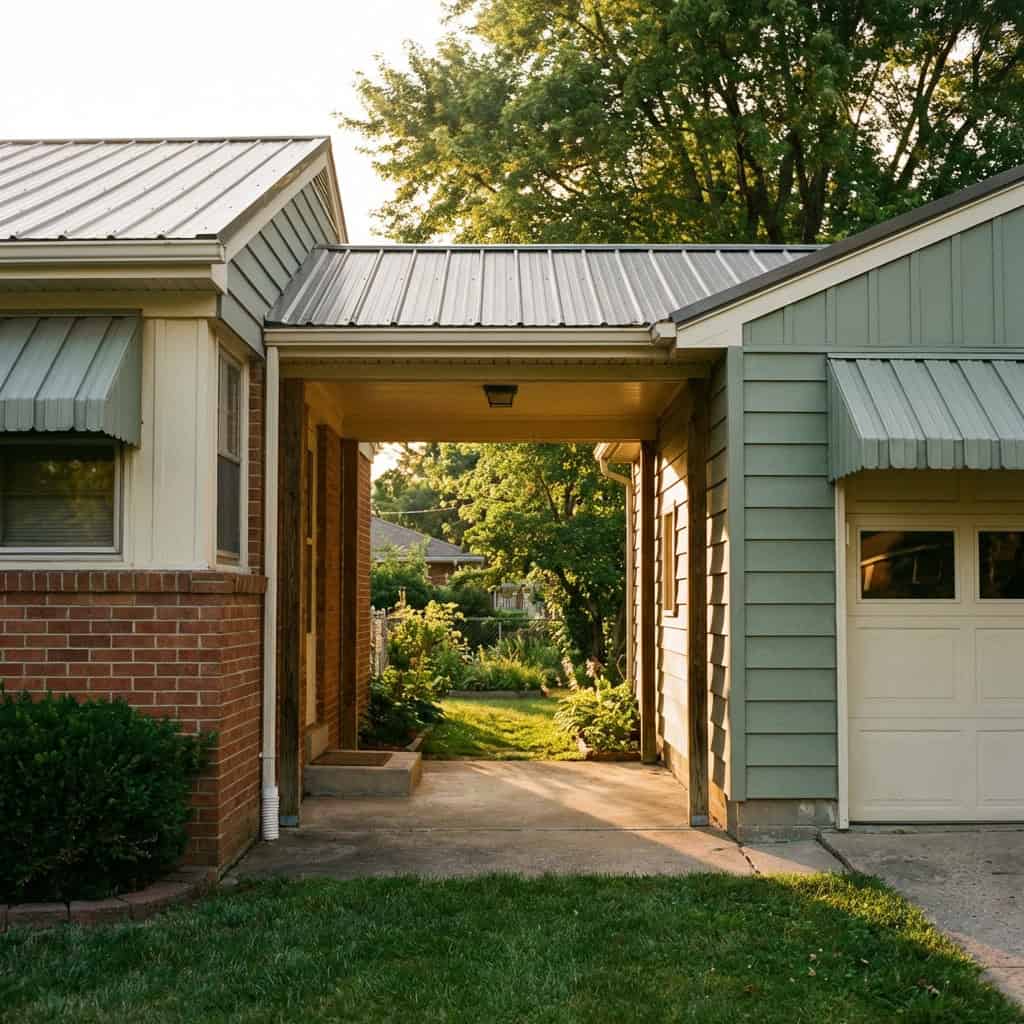
The breezeway was a covered, open-air passageway that connected the house to the garage — and it was one of the smartest design features of the 1950s home.
It was a roof with no walls, or sometimes screened walls, that created a shaded outdoor corridor between the side door and the car. In warmer months, it caught the breeze. In rainy weather, it kept you dry on the walk to the garage.
But the breezeway was more than a passageway. It was a hangout spot. Families put chairs there. Kids played there on hot days. It was the place where you kicked off your shoes before going inside and where the dog waited for you to come home.
The attached garage of the 1970s and beyond eliminated the breezeway entirely. The house and the garage merged into one structure, and that covered outdoor space — that small, breezy, in-between place — disappeared from American home design.
15. Metal Venetian Blinds
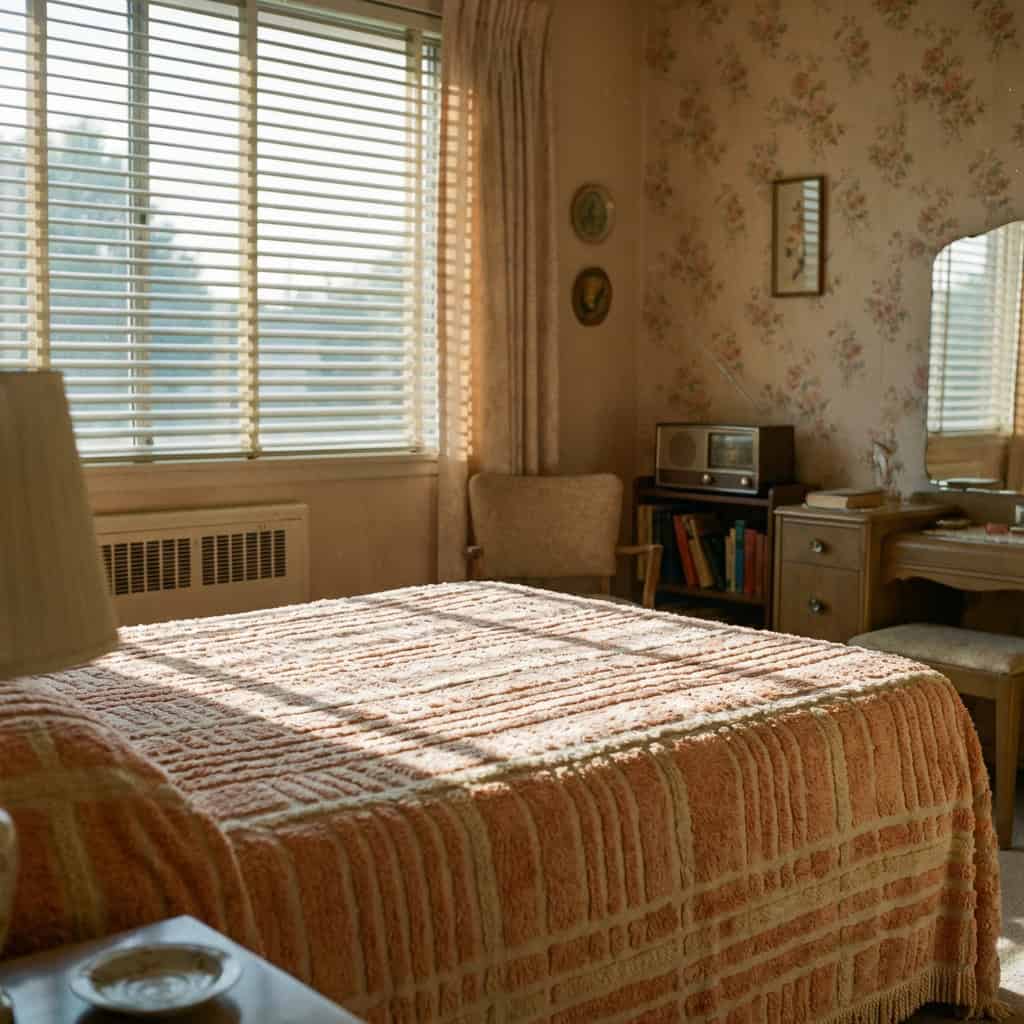
Before vertical blinds, before plantation shutters, before the roller shade revival — the 1950s had metal venetian blinds.
Thin horizontal aluminum slats on a cord-and-ladder system that tilted to control light and pulled up to open the window completely. They were white, cream, or occasionally a pastel color, and they were on every window in the house.
The sound of metal venetian blinds is unmistakable — the clatter when you pulled the cord too fast, the ticking as the slats tilted, the crash when the whole thing came down because a child yanked the cord at the wrong angle.
They were simple, functional, and universal. The metal venetian blind was the standard window treatment of the American 1950s home, and it gave every room a filtered, striped quality of light that defined the look of the decade.
16. The Telephone Table and Gossip Bench
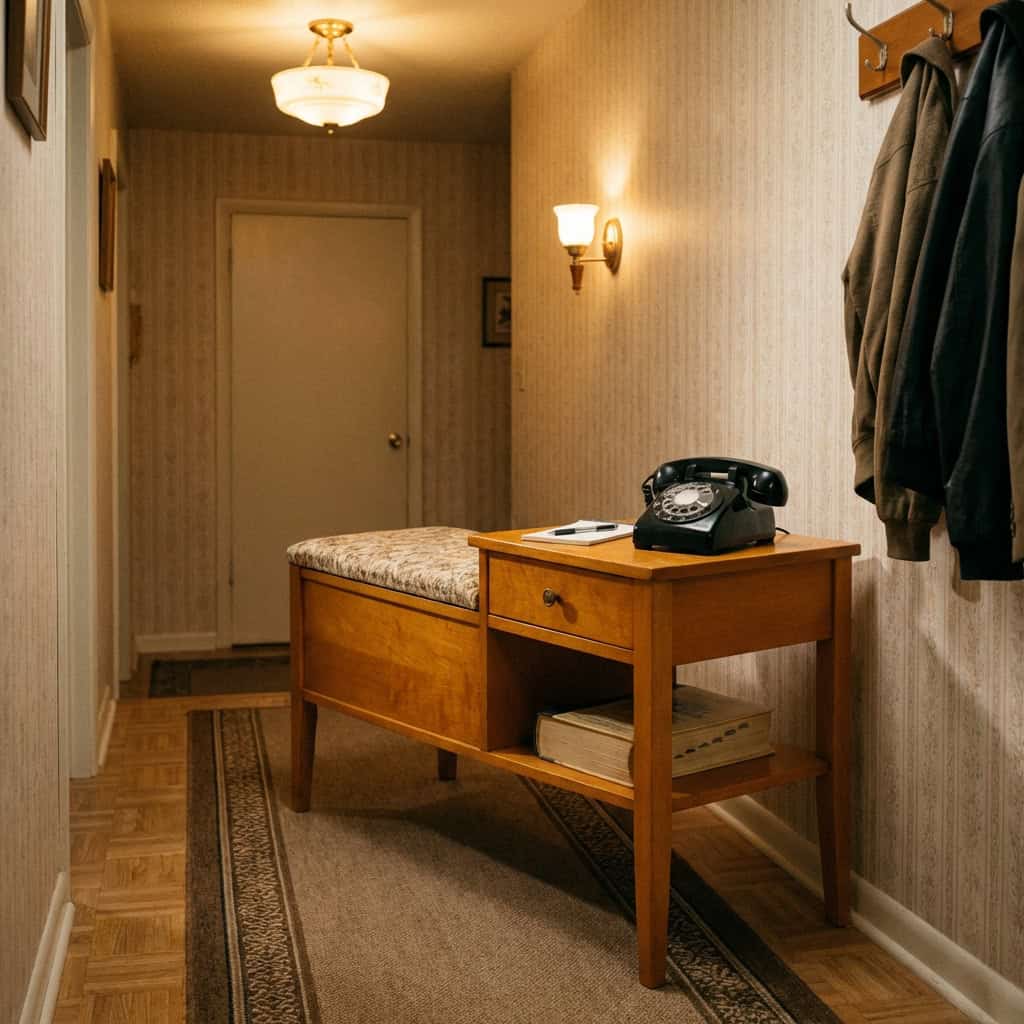
The telephone in the 1950s home did not sit on the kitchen counter. It had its own furniture.
The telephone table — sometimes called a gossip bench — was a small, dedicated piece of furniture that combined a seat, a small table surface for the phone, and sometimes a shelf underneath for the phone book. It sat in the hallway, the entryway, or a corner of the living room.
The seat was important. Phone calls in the 1950s were not quick. You sat down, got comfortable, and talked. The gossip bench made that possible — you had a place to sit, a surface for the phone, and a little nook that was yours for the duration of the call.
A notepad and a pen were always beside the phone. Messages were taken by hand. “Call Mrs. Henderson back” was scrawled in pencil and left on the table for whoever it was meant for.
The gossip bench disappeared when phones became portable. But for a few decades, the idea that a telephone deserved its own piece of furniture tells you everything about how seriously the 1950s took the act of communication.
17. The Starburst Mirror
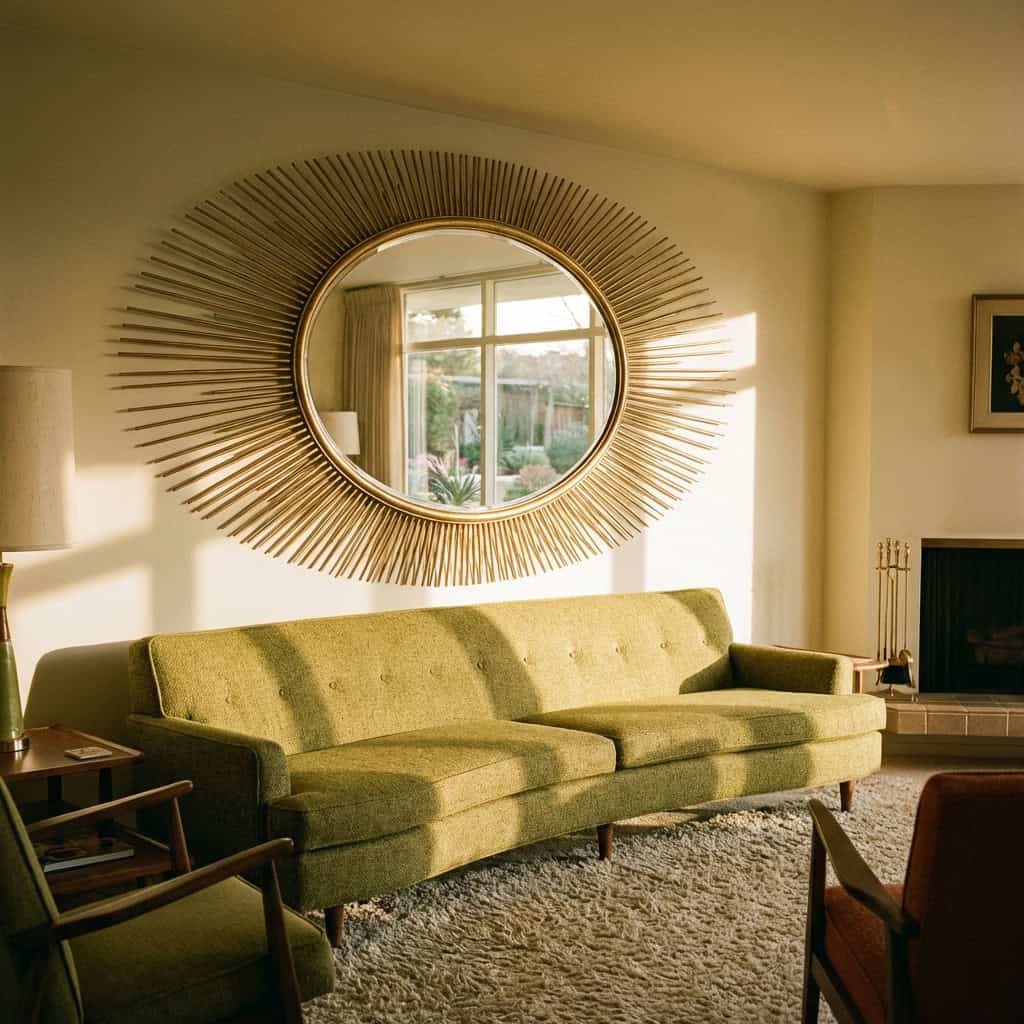
The starburst clock had a companion piece — the starburst mirror.
A round or convex mirror surrounded by radiating metal spokes, rods, or sculptural forms that created a sunburst pattern on the wall. It was typically placed above the sofa, the mantel, or the hallway console table.
The starburst mirror was a statement piece. It caught light from the picture window and scattered it across the room. It made a small entryway feel larger. And it gave any wall the mid-century modern stamp that the decade craved.
Like the starburst clock, the starburst mirror has survived every design cycle since — reproductions are sold everywhere, and originals command serious prices from collectors. The 1950s figured out that a simple shape radiating from a center point creates visual drama that never gets old.
18. The Console Radio
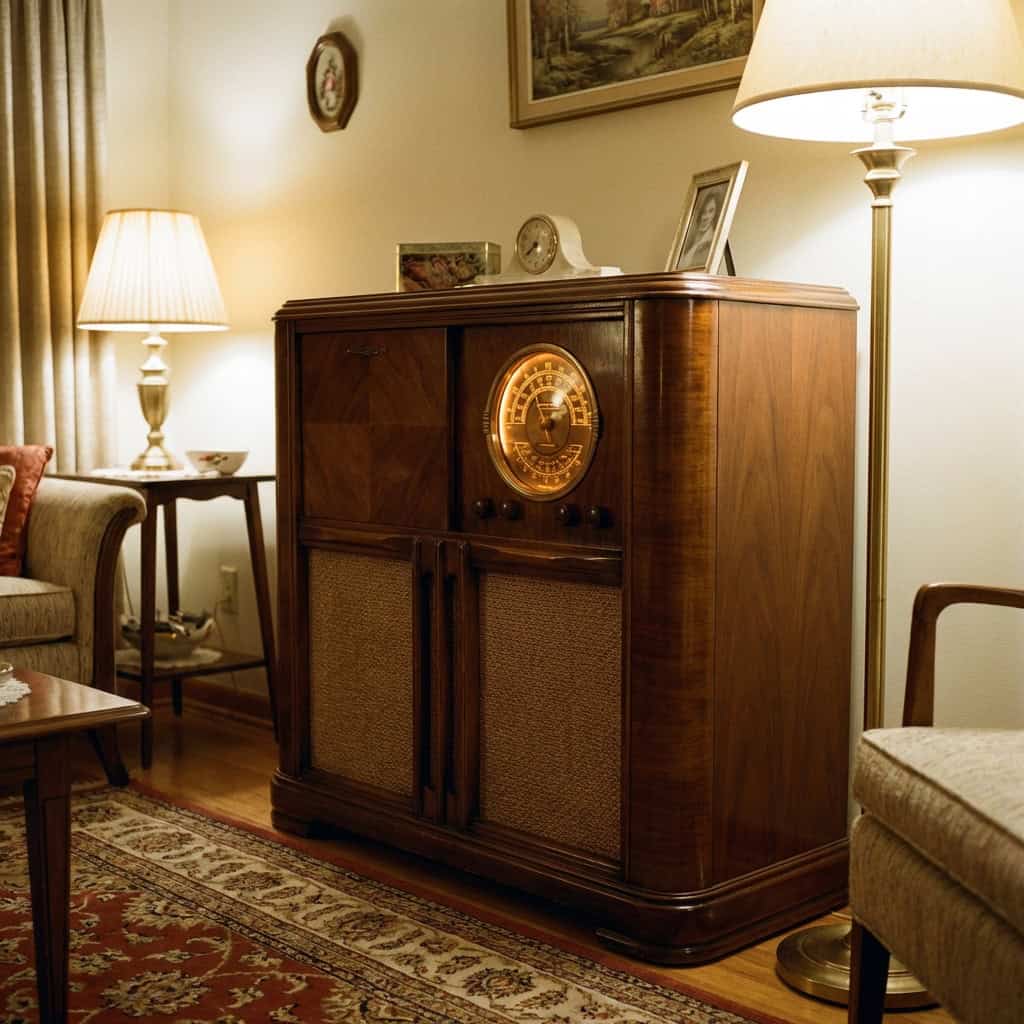
By the 1950s, the radio was being replaced by the television — but it was not gone yet.
The console radio — a floor-standing wooden cabinet with a large dial, fabric-covered speaker, and a warm, amber glow when it was turned on — still occupied a prominent place in many 1950s living rooms. Some families had both a TV and a radio console in the same room.
The radio had been the family’s connection to the outside world for 20 years. News, music, comedy shows, soap operas, and baseball games had all come through that speaker. Letting go was not easy.
Many console radios from this era were beautiful pieces of furniture — polished walnut or mahogany with Art Deco or Streamline Moderne styling that made them look more like sideboards than electronics.
The television eventually won. But the console radio’s slow fade from the American living room was one of the decade’s quieter transitions — the old world making way for the new, one evening at a time.
19. Wall-to-Wall Carpeting
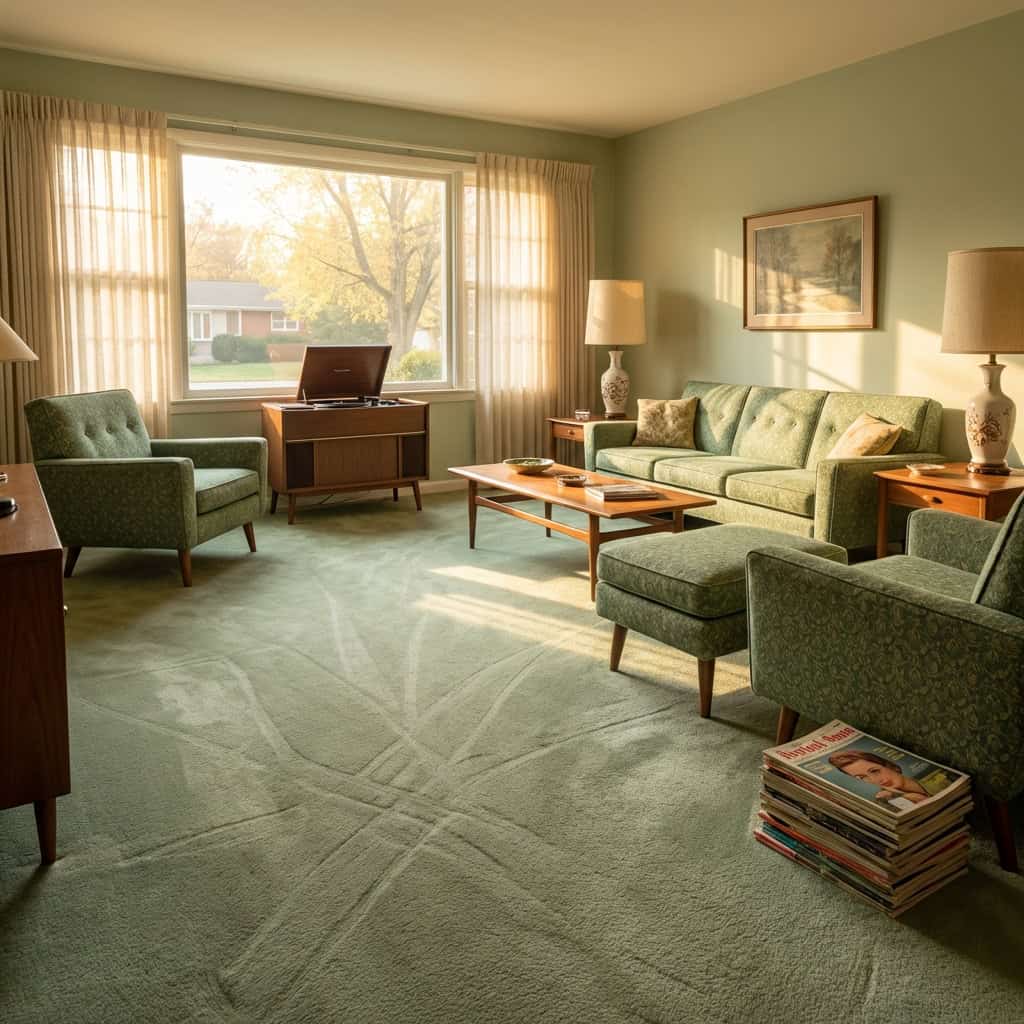
Before the 1950s, most American homes had hardwood floors with area rugs. Wall-to-wall carpeting changed everything.
New manufacturing techniques made carpet affordable for the average homeowner, and the 1950s embraced it with the enthusiasm of a nation that had just discovered central heating. Living rooms, bedrooms, hallways, and sometimes dining rooms were covered edge to edge.
The colors were the decade’s pastels — soft green, pale blue, rose, and gray. The texture was tight and low-pile, nothing like the shag that would come later. And the feeling of walking across an entire room on soft carpet — no cold hardwood, no gaps between rugs — was considered a genuine luxury.
Wall-to-wall carpeting became so standard that builders started installing it in new homes as a default feature. The hardwood floors underneath — the ones that homeowners in 2025 pay a fortune to refinish — were considered undesirable and worth covering up.
20. The Patio and Backyard Barbecue
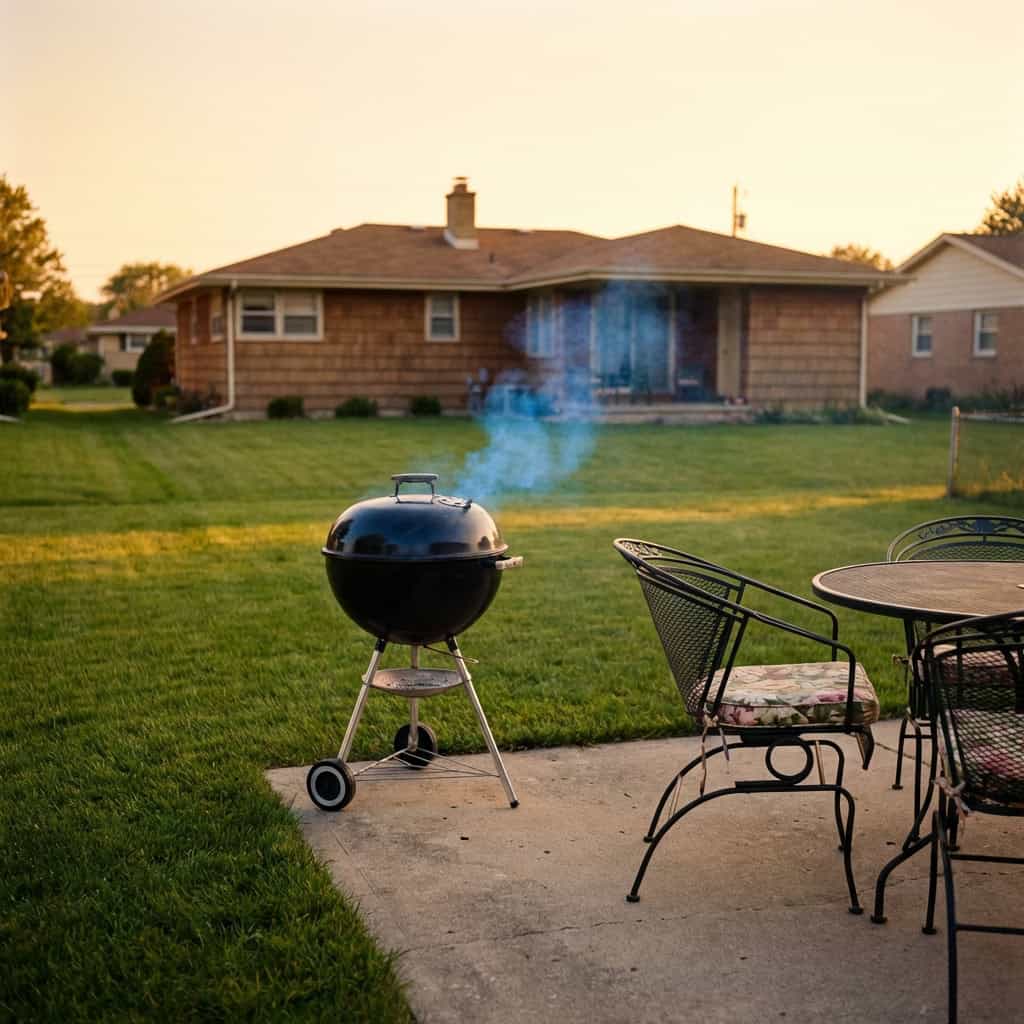
The 1950s invented the backyard as a living space.
Before the war, backyards were functional — clotheslines, vegetable gardens, maybe a shed. The 1950s suburban home turned the backyard into an outdoor room with a concrete or flagstone patio, a charcoal grill, outdoor furniture, and a lawn that was mowed, edged, and maintained with the precision of a golf course.
The backyard barbecue became a social ritual. Dad manned the grill. Mom brought out the potato salad. Neighbors came over. Kids ran around. The smoke rose into the summer sky, and for one evening, the cul-de-sac felt like a community.
The charcoal grill — usually a simple kettle or a brick-built pit — was the centerpiece. The Weber kettle grill, introduced in 1952, became one of the most iconic products of the decade.
The patio and barbecue were not just about food. They were about a way of life — suburban, social, outdoor, optimistic — that the 1950s created from scratch and every decade since has been trying to replicate.
21. Metal Window Awnings
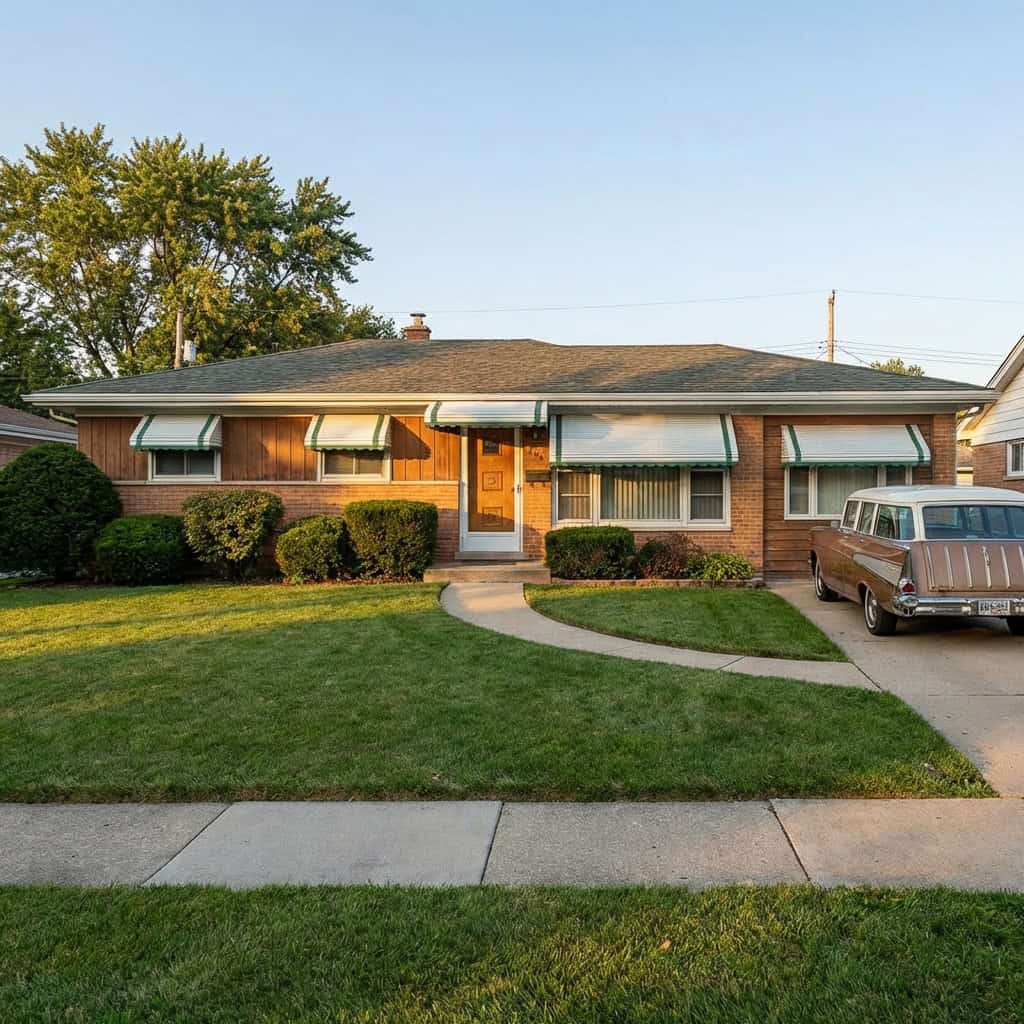
The 1950s home had a distinctive look from the street — and the metal window awnings were a big part of it.
Aluminum awnings in scalloped or angular designs were mounted above windows and doors on the exterior of the house. They came in solid colors — usually matching the house trim — or in striped patterns of green and white, red and white, or blue and white.
They served a practical purpose — blocking the sun to keep rooms cooler before air conditioning was common — but they also gave the house a distinctive, almost cheerful appearance. A row of matching awnings across the front of a 1950s ranch home was as much a part of the look as the picture window.
Metal awnings were maintenance-free and nearly indestructible. Many of them are still in place today, 70 years later, slightly faded but still doing their job.
They fell out of fashion in the 60s and 70s when air conditioning became standard and the look was considered dated. But on the houses where they survive, they add a character and a streetside personality that modern homes completely lack.
22. The Cedar Chest
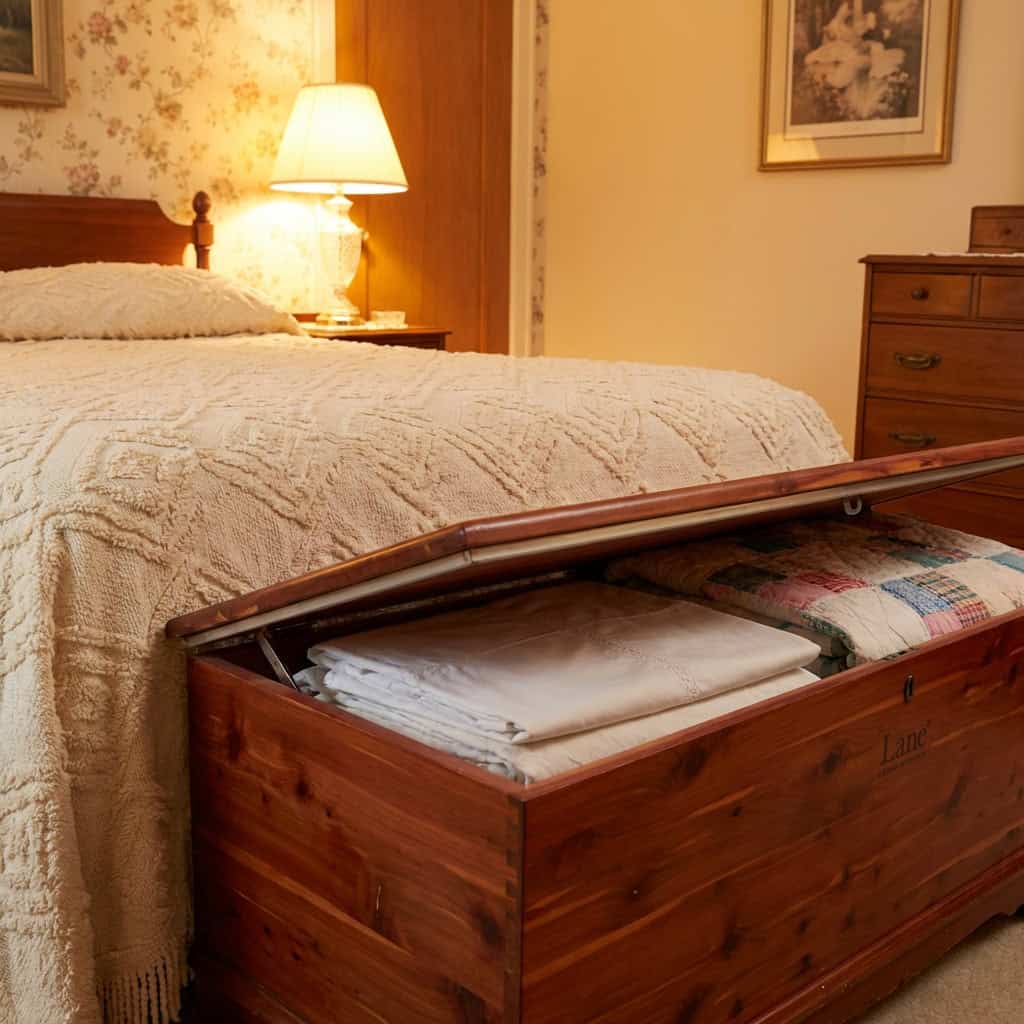
Every young woman in the 1950s received — or hoped to receive — a cedar chest.
It was a rite of passage. The Lane Company, the most famous manufacturer, marketed the cedar chest as the gift for high school graduation, for engagement, for starting a new life. It was where you stored your most important belongings — linens, quilts, keepsakes, and the items you were collecting for your future home.
The chest was solid cedar or cedar-lined, which protected woolens and linens from moths. It was also a beautiful piece of furniture — usually placed at the foot of the bed or in the hallway — with a polished finish and sometimes a brass nameplate.
The cedar chest carried emotional weight that no other piece of furniture in the 1950s home could match. It was a container for the future — for the life you were planning to build. Opening one today, decades later, still releases the warm, unmistakable smell of cedar and the memories stored inside it.
23. The Metal Porch Glider
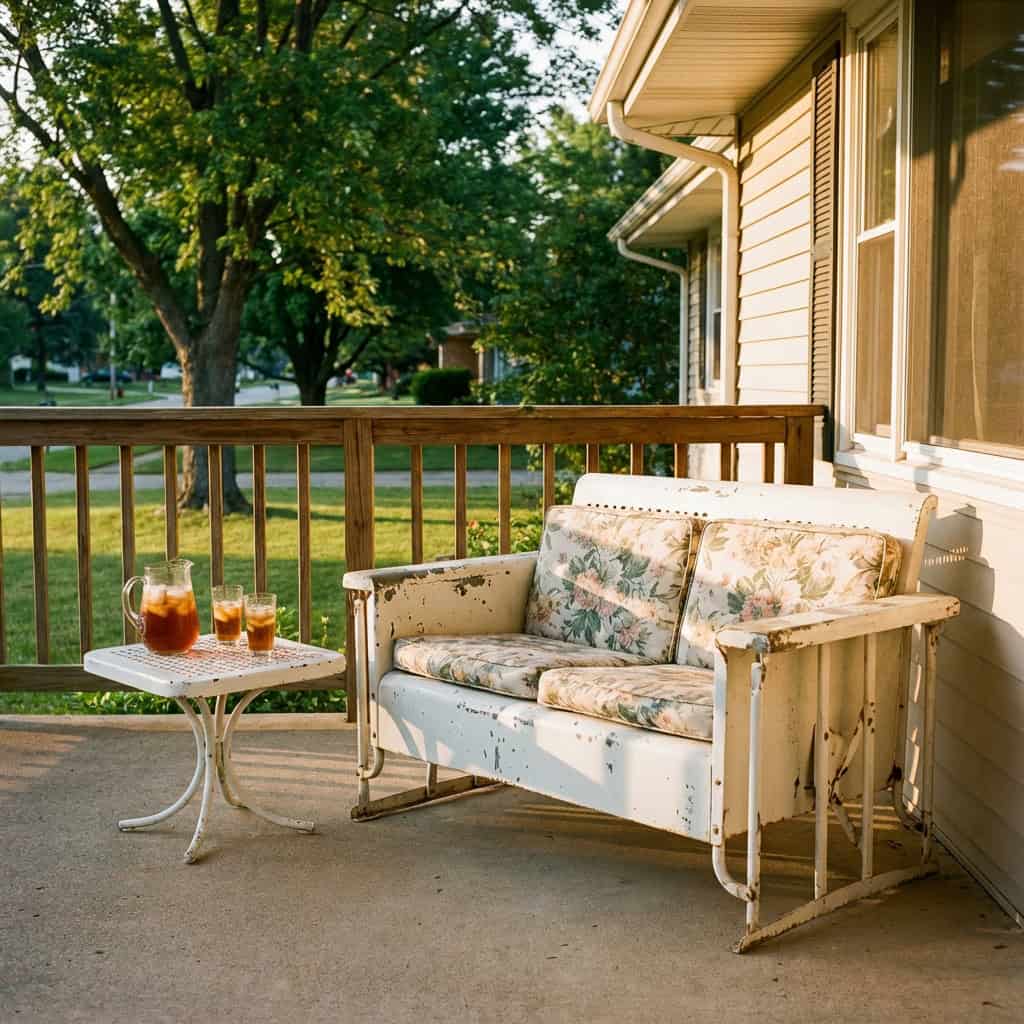
Before the porch swing, the 1950s had the glider.
The metal porch glider was a bench-style seat mounted on a frame that allowed it to slide back and forth in a smooth, linear motion — not swinging in an arc like a porch swing, but gliding on a flat plane. The motion was gentle, quiet, and hypnotic.
Gliders were made of stamped metal — usually painted white, green, or red — with a matching frame and sometimes coordinating side chairs. They sat on the front porch, the back patio, or under the breezeway.
Evenings on the glider were a summer ritual. Parents sat and glided slowly while watching the kids play. Neighbors walked by and stopped to talk. The ice cream truck came and went. The streetlights came on. And the glider kept its slow, steady rhythm.
The metal porch glider was eventually replaced by wooden and wicker alternatives, but the originals — heavy, solid, and nearly indestructible — are now highly sought after at antique shops and estate sales.
24. The First Automatic Washer and Dryer
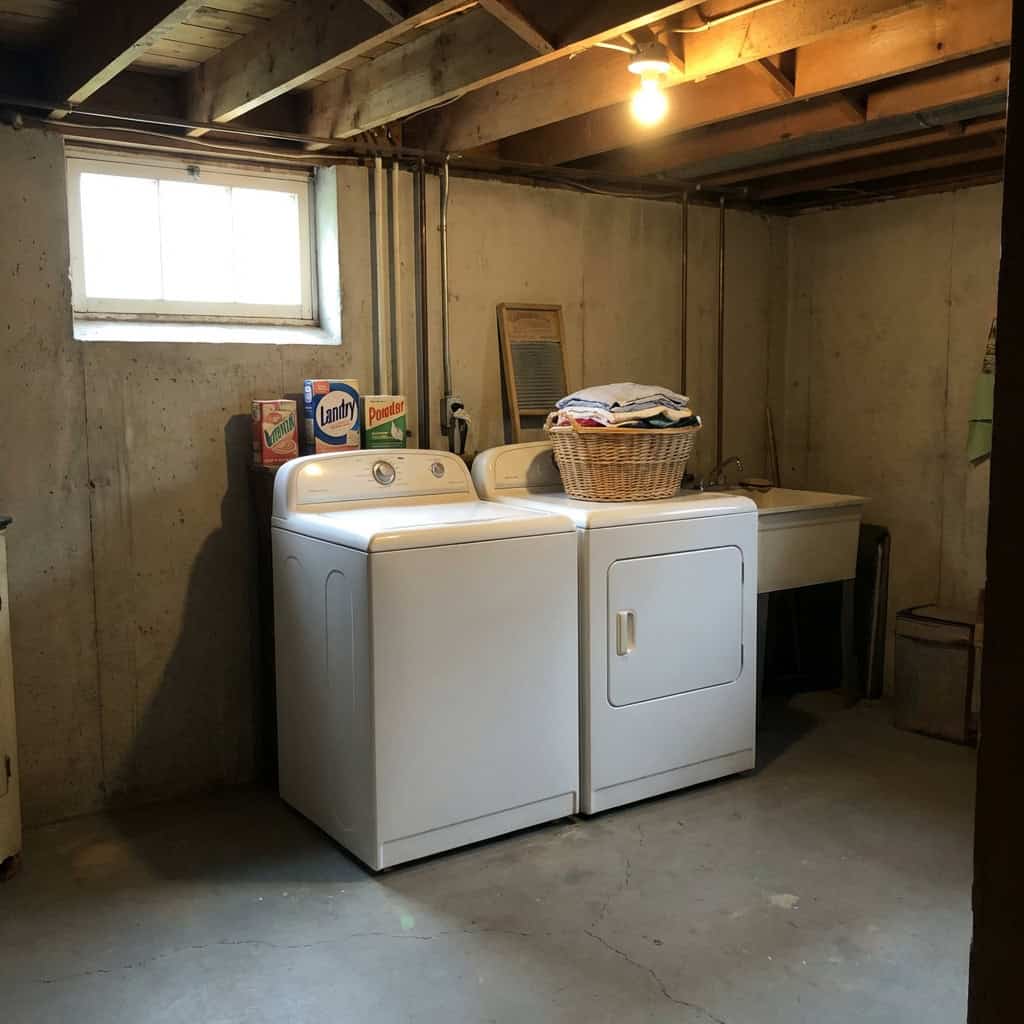
Before the 1950s, laundry was a full-day project. The automatic washer changed that overnight.
The wringer washer — which required you to feed each piece of clothing through a set of rollers by hand — was replaced by machines that washed, rinsed, and spun the clothes dry automatically. You loaded it, set the dial, walked away, and came back to clean laundry.
The automatic dryer was even more revolutionary. The clothesline — which had been a fixture in every American yard for generations — was suddenly optional. Laundry could be done in any weather, at any time, without going outside.
Appliance manufacturers marketed the washer and dryer as liberation. Advertisements showed women smiling, relaxed, and free — no longer chained to a washboard and a clothesline for an entire Monday.
The laundry pair took up residence in the basement or a dedicated laundry room, and their arrival marked the moment that housework began to shrink from a full-time occupation to something that happened in the background.
25. The Lazy Susan
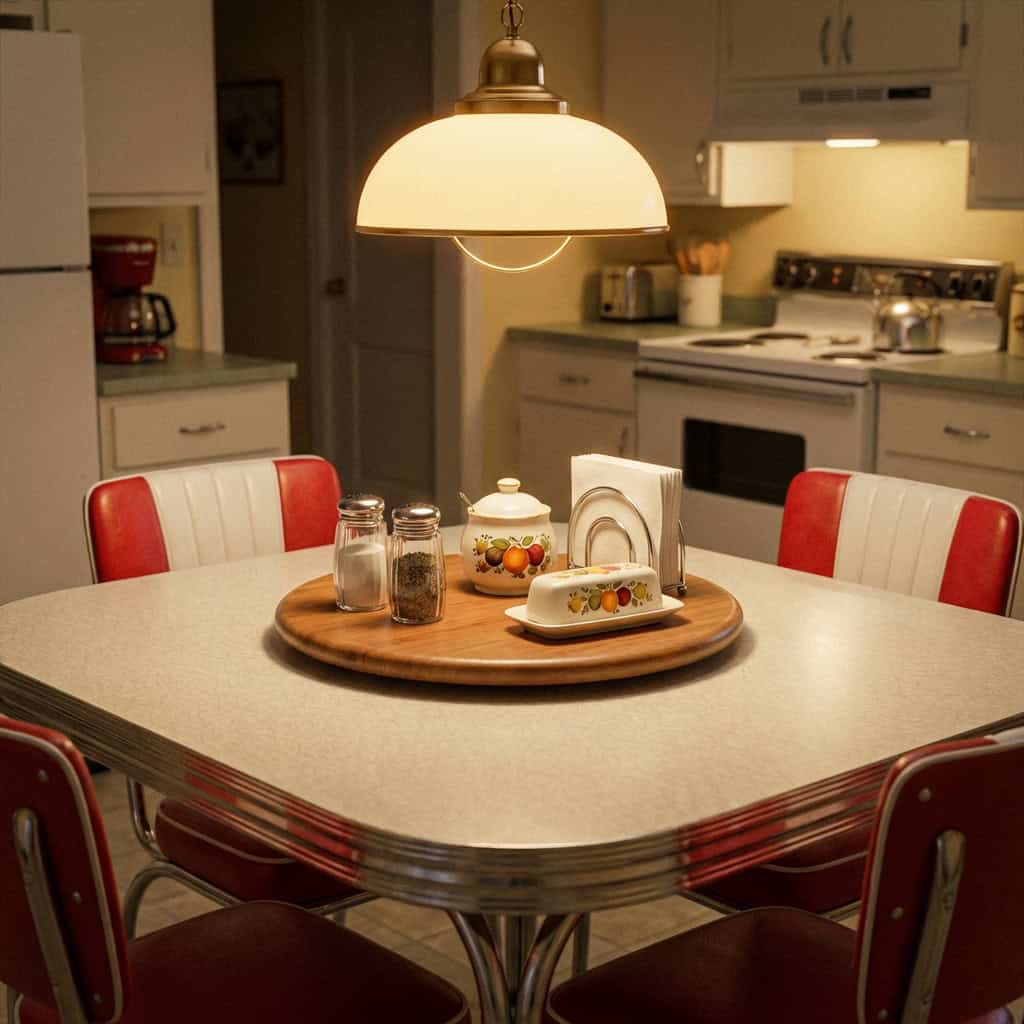
Every 1950s kitchen table had a Lazy Susan — or wanted one.
A rotating tray or turntable placed in the center of the dining table, the Lazy Susan held condiments, salt and pepper, a sugar bowl, butter, napkins, or whatever the family needed to pass around without actually passing anything.
You just spun it. The mustard came to you.
Lazy Susans were made of wood, ceramic, or the same plastic that was showing up in everything else in the 1950s kitchen. Some were built into the table itself. Others were separate pieces that sat on top.
The concept was simple, practical, and slightly goofy — a spinning tray felt like a small piece of technology at the dinner table, which fit perfectly with the decade’s love of efficiency and innovation.
The Lazy Susan never fully disappeared — you can still find them in kitchen cabinets and on restaurant tables today. But its golden age was the 1950s, when it sat at the center of the family dinner table and made the nightly meal feel just a little bit more modern.
Conclusion
That is 25. How many did you have?
The 1950s home was the beginning of everything. The television that changed how we spend our evenings. The pastel kitchen that turned appliances into design statements. The patio that made the backyard a room. The carpeting that covered the hardwood floors that we would spend the next century trying to uncover.
It was a home built on optimism — the genuine, unironic belief that a pink bathroom, a turquoise refrigerator, and a picture window facing the street were evidence that life was getting better and would keep getting better indefinitely.
Some of that optimism turned out to be justified. Some of it was naive. But standing inside a 1950s home that has not been updated — surrounded by pastel tile, Formica countertops, knotty pine walls, and a starburst mirror catching the light from the picture window — you can still feel it.
The belief that a house could make you happy.
The 1950s home did not just shelter a family. It promised one a future.