

There was a time when a desk was not just a surface. It was a statement.
It told you something about the person who sat at it — what they did for a living, how seriously they took their work, and whether they valued craftsmanship or just needed a place to drop the mail.
Every office, every school, every home in America used to have at least one. Some had three or four, each built for a specific purpose and designed to last longer than the person who bought it.
Now we work on laptops. On kitchen counters. On couches. On airplanes.
The desk — the real desk, made of solid wood with drawers that meant something — has almost disappeared from American life.
Here are 15 beautiful desks that used to be everywhere, and where they all went.
1. The Schoolhouse Desk
If you went to school in America before 1980, you sat in one of these every single day.
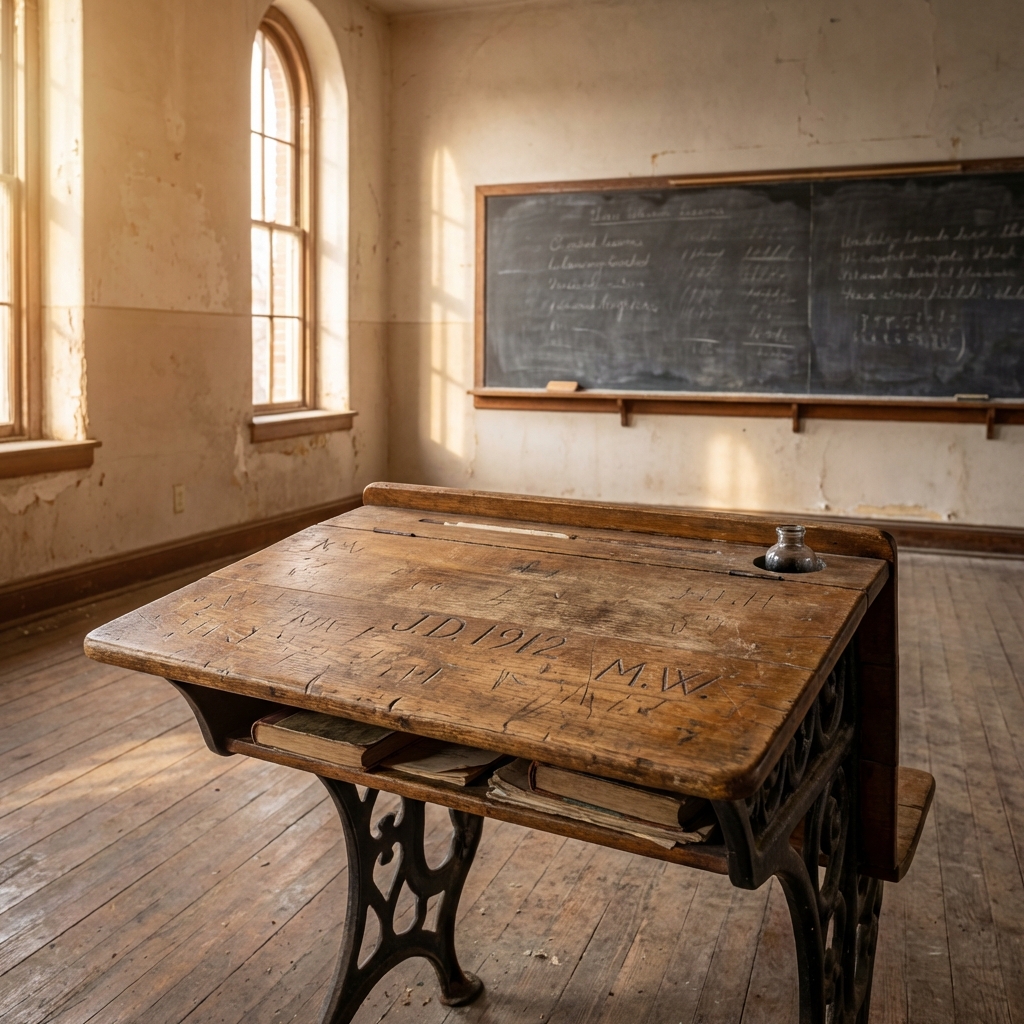
It was a one-piece unit — a cast iron frame bolted to the floor, a wooden seat, and a hinged wooden desktop that lifted up to reveal a storage compartment underneath. An inkwell hole sat in the upper right corner, a leftover from the days when students dipped pens into actual ink.
The desktops were scarred with decades of carved initials, doodles, and the occasional answer to a math test. The hinges creaked. The iron frames were indestructible.
Plastic molded chairs and laminate tables replaced them in the 1970s and 80s. The new furniture was lighter, cheaper, and stackable. It was also forgettable — which is why nobody gets nostalgic about a plastic chair, but everyone remembers the schoolhouse desk.
2. The Partners Desk
This was the power desk. The boss desk. The desk that said the person sitting behind it was not to be trifled with.
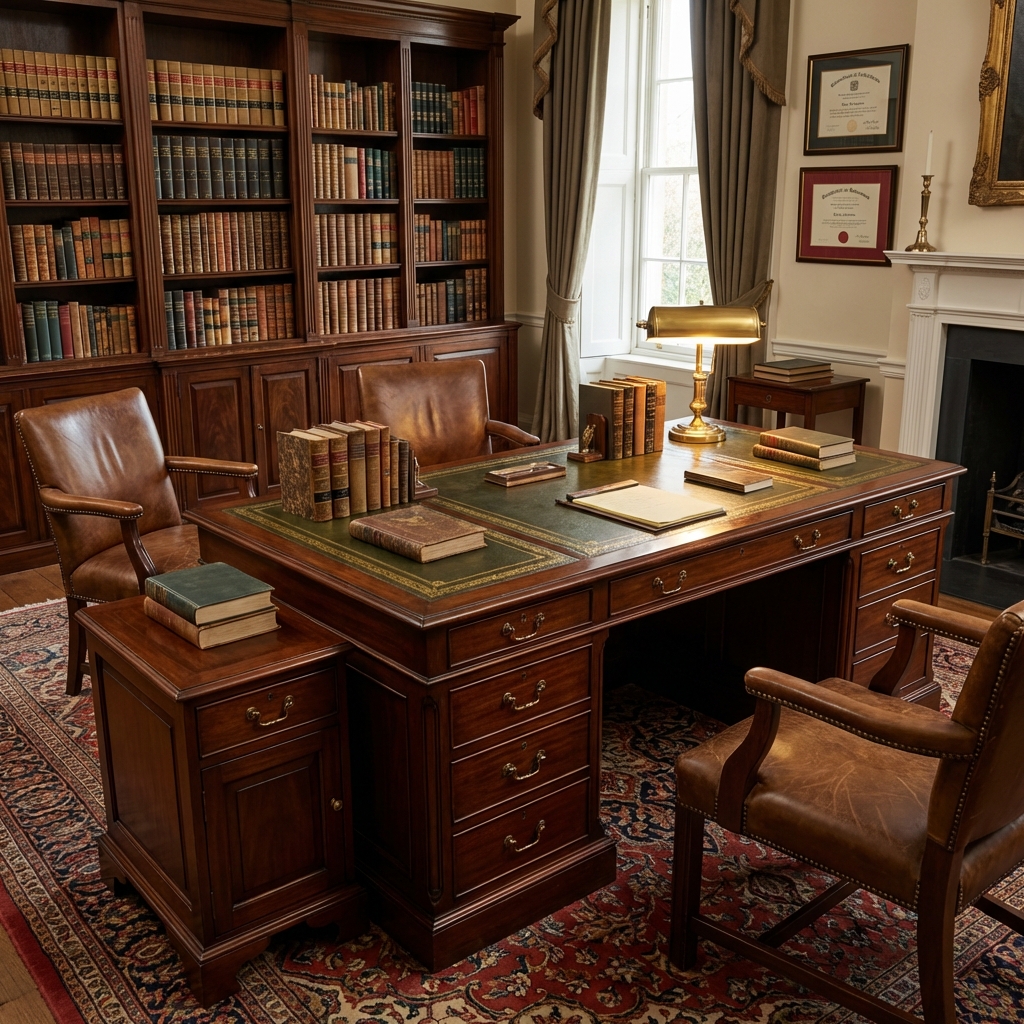
A partners desk was massive — usually five to six feet wide — with matching pedestals of drawers on both sides and a leather-inlaid writing surface on top. It was designed so two people could sit across from each other and work face to face, which is how business was conducted in law offices, banks, and counting houses for centuries.
The best ones were made of solid mahogany, walnut, or oak, with hand-cut dovetail drawers, brass hardware, and a weight that required four men to move.
Open-plan offices and computer workstations killed the partners desk. You cannot fit a monitor, a keyboard, and a second person on the same surface. So the most impressive desk ever built for an office simply ceased to exist in most workplaces.
3. The Slant-Front Desk
This was the desk of the American colonies — and for over a century, it was the most common writing desk in the country.
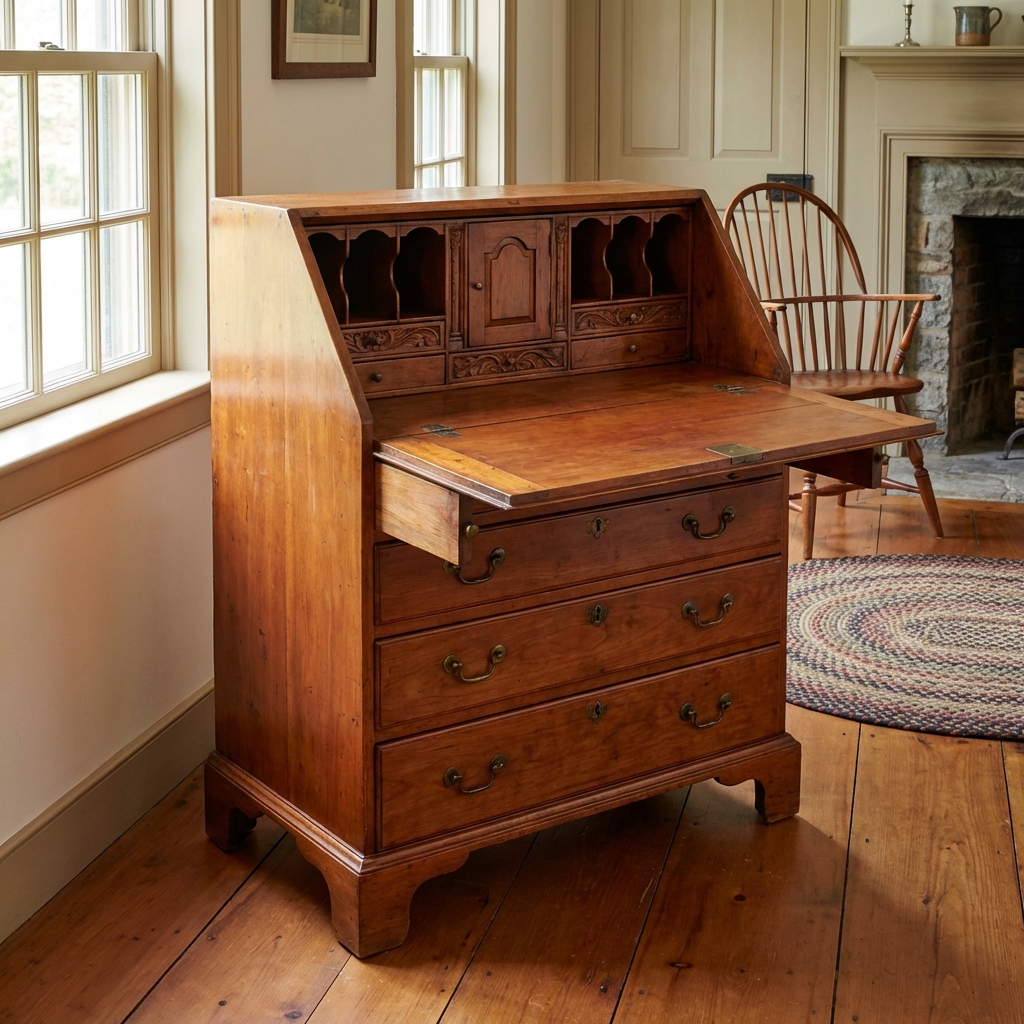
It was a chest of drawers with a hinged, angled writing surface on top. You pulled the slant front down, and it became a flat desk supported by two small pull-out arms called lopers. Behind the writing surface, a wall of tiny drawers, pigeonholes, and cubbies kept everything organized.
When you were done, you pushed everything back, closed the slant front, and the desk looked like a simple chest of drawers again.
The slant-front desk was the workhorse of colonial and Federal-era America. Every founding father owned one. Every country lawyer had one. They were built in cherry, walnut, maple, and mahogany, and the joinery on the best examples is museum-quality.
4. The Wooton Patent Desk
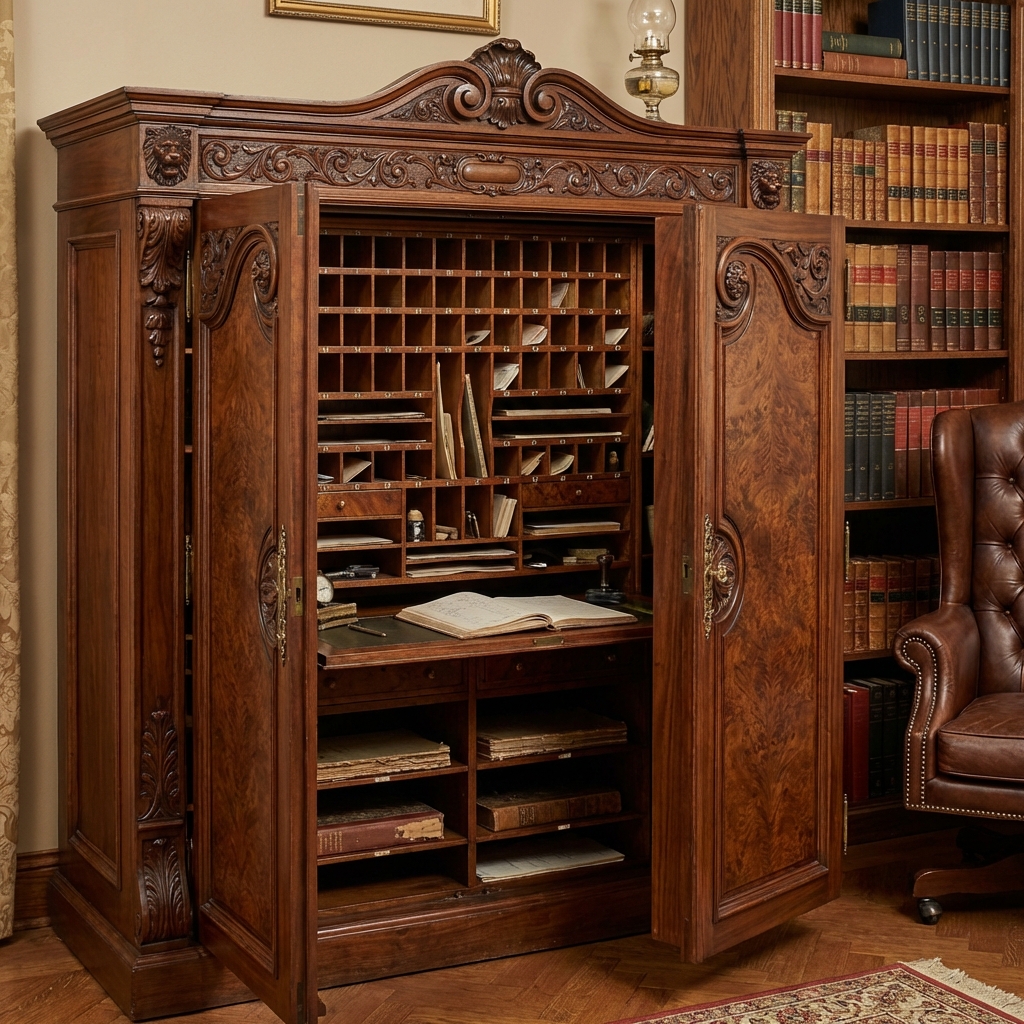
This might be the most extraordinary desk ever mass-produced in America.
Patented by William S. Wooton of Indianapolis in 1874, it looked like an ornate Victorian cabinet when closed. But when you swung open the two massive hinged panels on either side, it revealed over 100 separate compartments — drawers, pigeonholes, letter slots, and cubbies — all surrounding a central writing surface.
It was, in Wooton’s own words, “a complete office in a desk.” There was even a mail slot on the outside so letters could be delivered after hours without unlocking it.
They were sold in four grades — Ordinary, Standard, Extra, and Superior — and owned by the likes of John D. Rockefeller, Ulysses S. Grant, and Joseph Pulitzer. Even Queen Victoria reportedly had one.
The filing cabinet killed the Wooton desk. It turned out that stuffing unfolded documents into a drawer was faster than folding each one and sliding it into a pigeonhole. By the 1890s, production had stopped entirely. Today, a Wooton desk in good condition sells for the price of a luxury car.
5. The Lap Desk
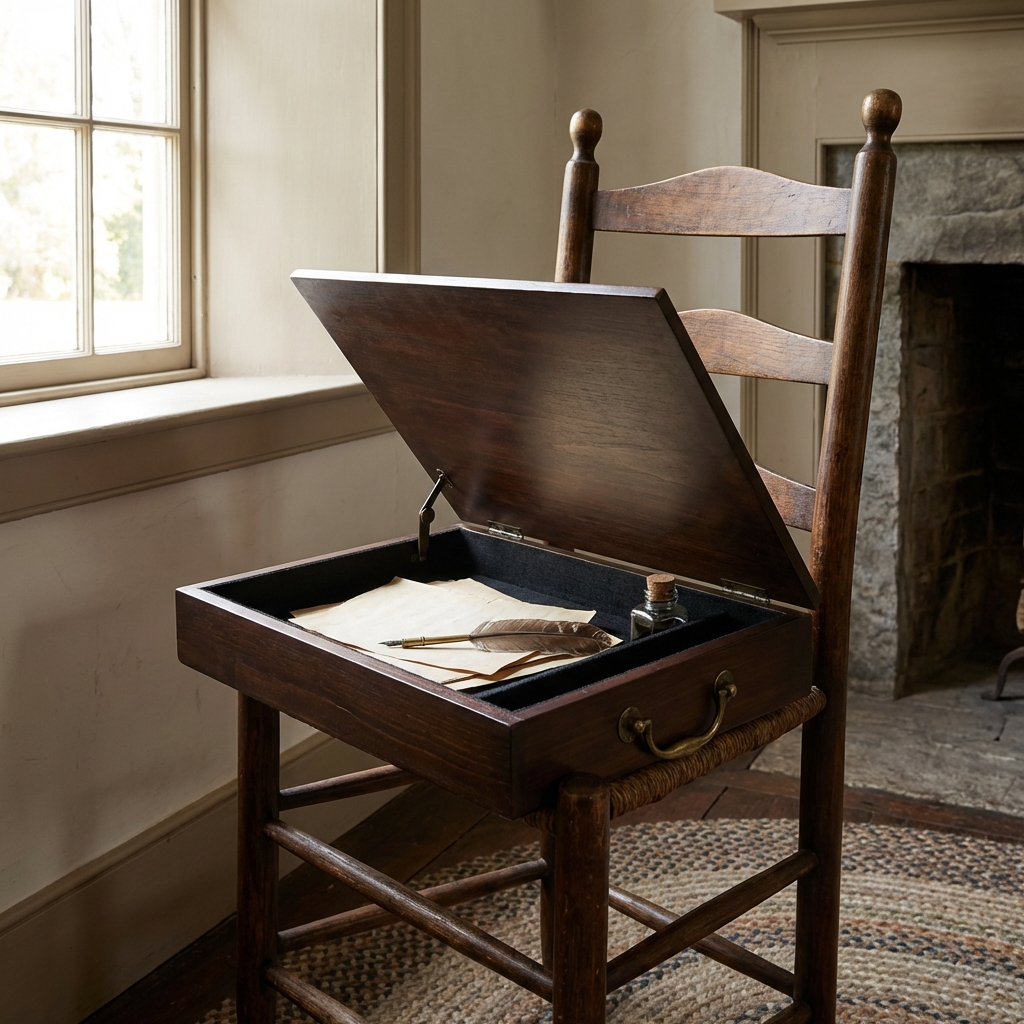
Before there were desks in every room, people wrote wherever they happened to be sitting. And they carried their desk with them.
The lap desk was a portable, hinged wooden box — usually about 15 by 20 inches — with a flat, angled top surface for writing. The lid lifted open to store paper, pens, ink, and sealing wax. Some had felt-lined interiors, secret compartments, and small brass handles for carrying.
Thomas Jefferson is said to have drafted the Declaration of Independence on a lap desk he designed himself. Abraham Lincoln reportedly used one to compose portions of the Gettysburg Address.
The ballpoint pen and the notebook made the lap desk unnecessary. But for centuries, it was the only writing surface most people owned.
6. The Plantation Desk
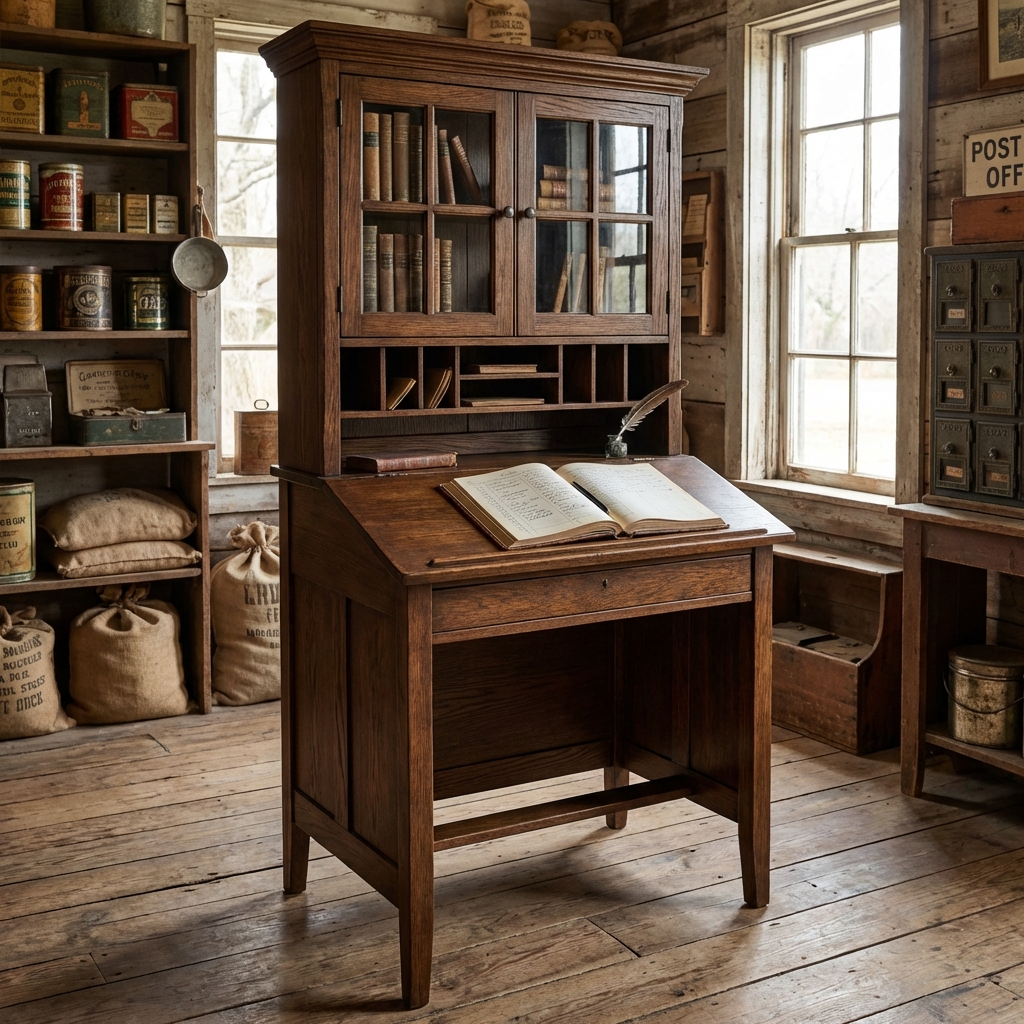
This was not a desk you sat at. It was a desk you stood at.
The plantation desk — sometimes called a clerk’s desk or standing desk — was a tall, narrow piece with a slanted writing surface at about chest height, a bookcase or hutch on top, and sometimes a cabinet below. It was designed for overseeing work, tallying figures, and managing records while standing.
The writing surface was angled like a drafting table, which kept papers from sliding and made writing more comfortable for long hours on your feet.
These were common in plantation offices, general stores, post offices, and anywhere that required someone to keep books while staying on their feet. They were built like tanks — usually from solid oak or walnut — because they had to survive decades of daily use.
The modern standing desk craze is essentially a reinvention of something that existed 200 years ago. Except the original was made of solid wood, not particle board and a pneumatic lift.
7. The Butler’s Desk
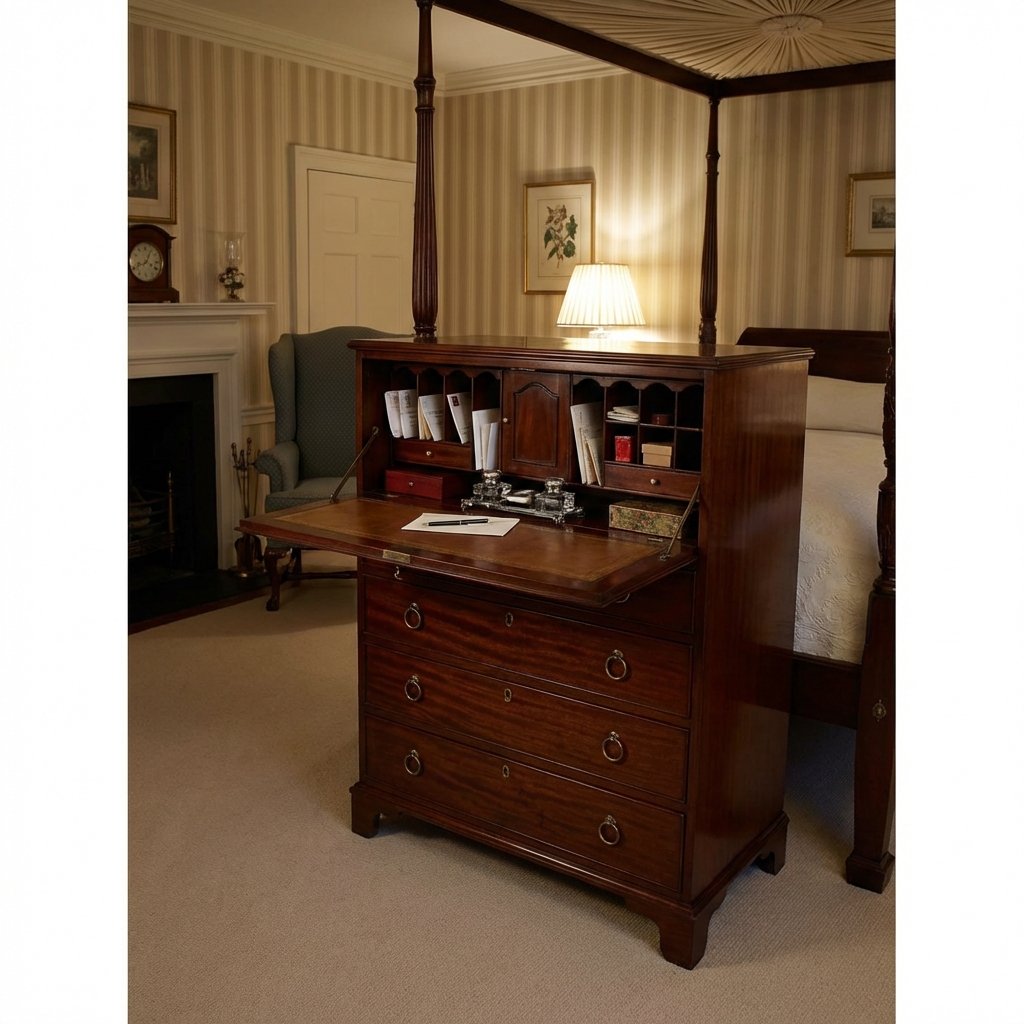
This is one of the most cleverly disguised pieces of furniture ever made.
From the front, it looked exactly like a standard chest of drawers — four or five drawers stacked neatly with matching hardware. But the top drawer was a fake. It was actually a hinged panel that pulled forward and folded down on small brass supports to create a writing surface.
Behind that false drawer front, a full desk appeared — pigeonholes, small drawers, letter compartments, and a flat writing area. When you were done, you folded the panel back up, and the desk vanished. It was a chest of drawers again.
The butler’s desk was designed for homes that did not have a dedicated study or office. It gave you a full writing desk without taking up any additional space. The name comes from the theory that the household butler used it to manage household accounts — though in practice, anyone in the house could have used it.
8. The Kidney-Shaped Desk
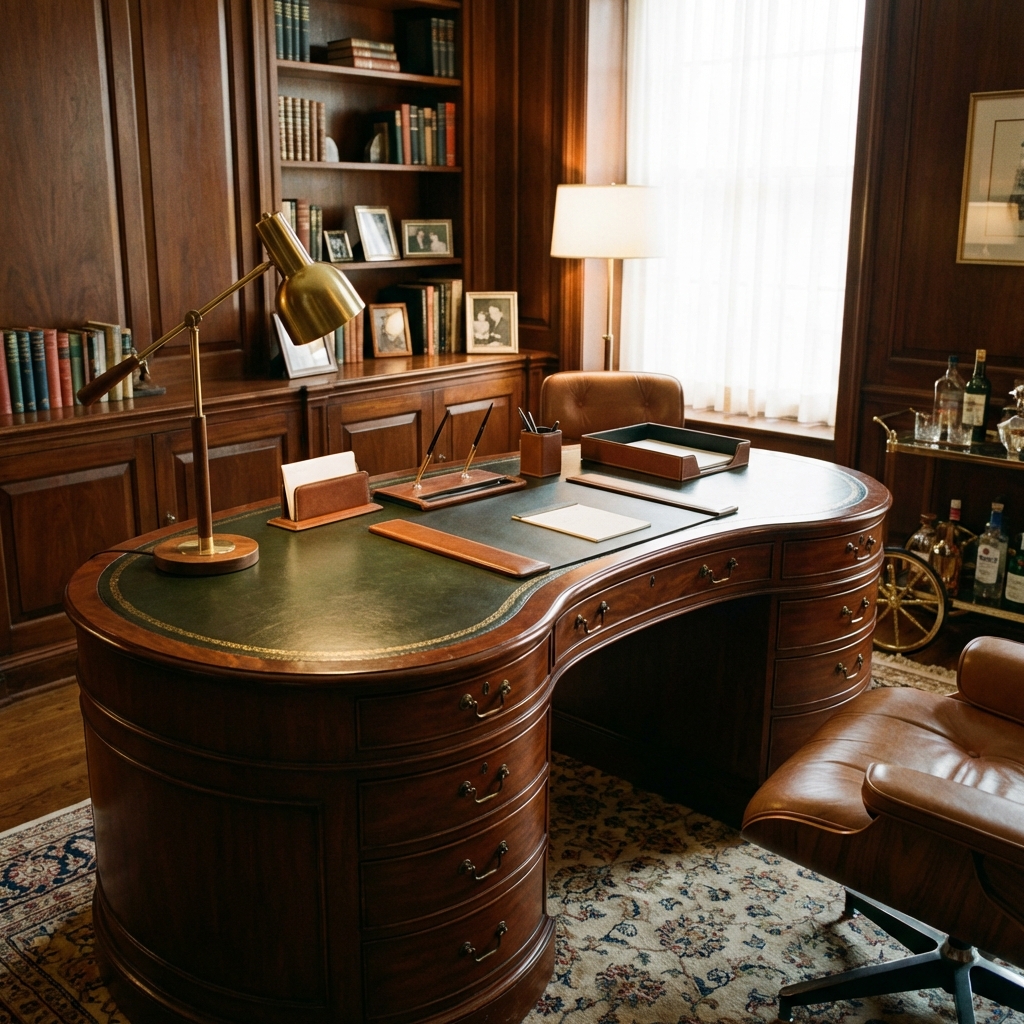
If there was a glamorous desk, this was it.
The kidney desk — named for its curved, bean-shaped top — was the desk of old Hollywood, mid-century executive suites, and every library in every mansion you have ever seen in a movie.
The curved shape was not just decorative. It wrapped around the person sitting at it, putting everything — drawers, writing surface, phone — within arm’s reach. The pedestal drawers followed the curve, and the leather-inlaid top was often hand-tooled with gold leaf edging.
They were almost always made of mahogany or walnut, and the craftsmanship required to build one was significant — every joint, every curve, every drawer had to follow the same organic shape.
The straight-edged computer desk made the kidney shape impractical. You cannot fit a monitor, a keyboard, and a mouse on a curved surface designed for fountain pens and blotters. So the most elegant desk ever designed for an executive disappeared from the workplace almost overnight.
9. The Pedestal Desk
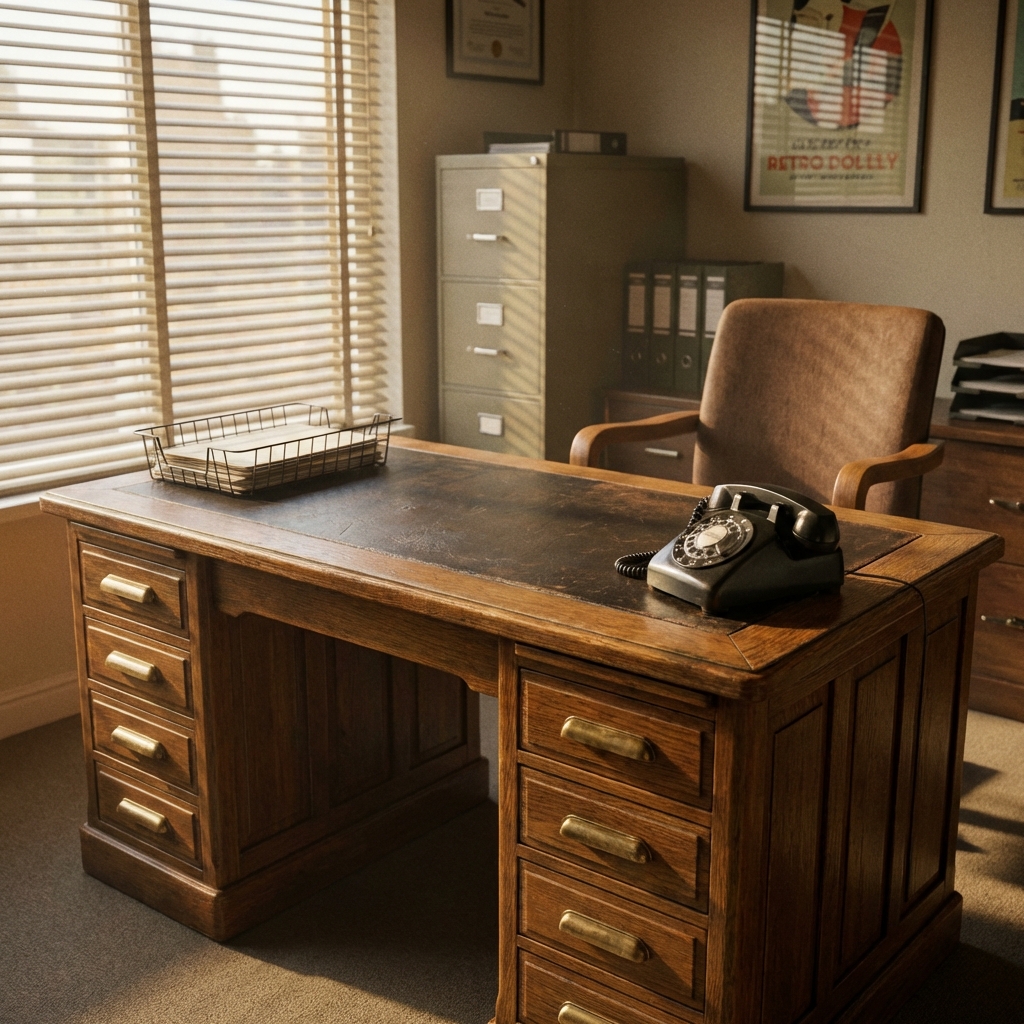
This was the desk. The default. The one that came to mind when anyone said the word “desk” for over a century.
It was a large, flat-topped writing desk supported by two pedestals — each pedestal containing three or four drawers on the front, with a wide center drawer spanning the gap between them. The top was usually leather-inlaid. The construction was solid hardwood — oak, mahogany, or walnut — and the whole thing weighed enough to require serious effort to move.
The pedestal desk was everywhere. It was in the principal’s office. The insurance agent’s office. The senator’s office. Your father’s den. It was the desk of authority.
Cubicle furniture and L-shaped computer desks wiped it out. The flat surface that was perfect for paper, pens, and a telephone was not deep enough for a monitor, a keyboard, and a tower. And just like that, the desk that defined professional American life for a hundred years was replaced by something that cost a tenth as much.
10. The Typing Table
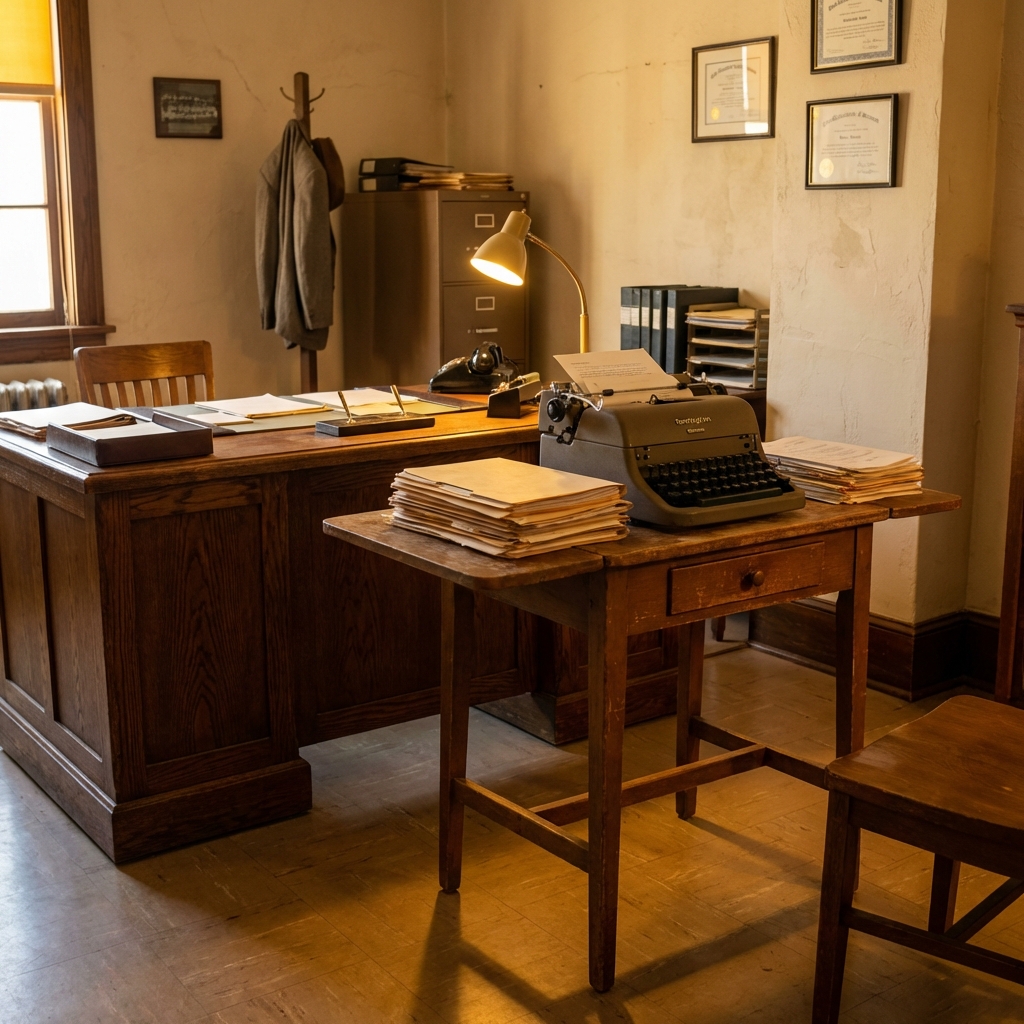
When the typewriter entered the American home and office, it needed its own piece of furniture. The regular desk would not do.
The typing table was a small, dedicated side table — usually about 24 inches wide — with a surface set at the exact height needed for comfortable typing. Many had drop leaves on one or both sides to hold papers and reference materials. Some had casters for easy repositioning.
The key design detail was the height. A typewriter required the typist’s forearms to be parallel to the floor, which was lower than a standard desk surface. The typing table solved this, and it sat beside or perpendicular to the main desk as a dedicated workstation.
When the personal computer replaced the typewriter, the typing table was instantly obsolete. The keyboard tray — a pull-out shelf built into the computer desk — replaced an entire piece of furniture with a $12 piece of hardware.
11. The School Teacher’s Desk
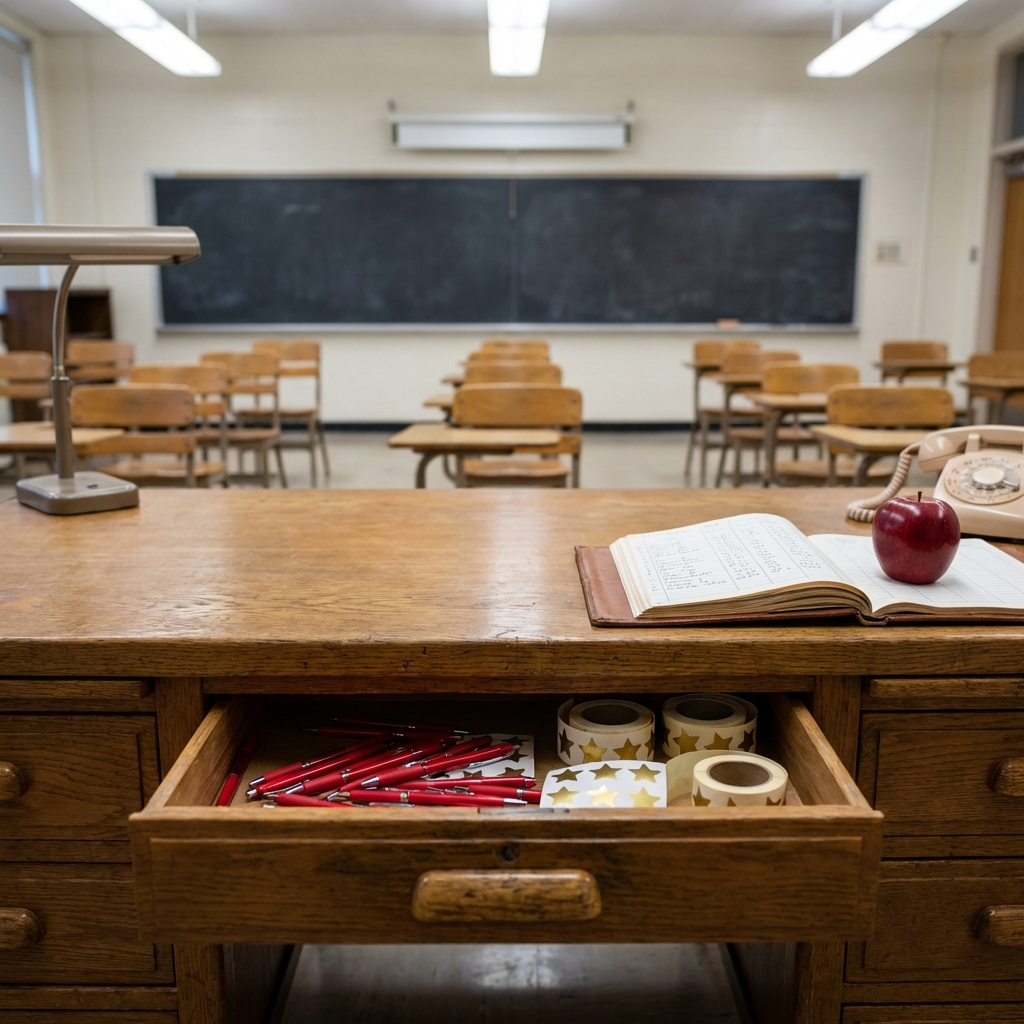
It sat at the front of every classroom in America. Larger, heavier, and more authoritative than anything the students had.
The school teacher’s desk was usually solid oak, with a flat top large enough to spread out papers and grade books, and a center drawer flanked by deeper drawers on one or both sides. Some had a modesty panel across the front. All of them had a presence — a weight and permanence that said this is where the adult sits.
The center drawer was legendary. Confiscated notes, rubber bands, red pens, gold star stickers, and a wooden ruler that served double duty as a pointer and a gentle threat. Every student knew what was in that drawer, and every student knew not to open it.
Teachers now work at folding tables, shared workstations, or whatever surface the school can provide. The dedicated, solid wood teacher’s desk is gone from most American classrooms — and with it, a small piece of the ritual that made school feel like school.
12. The Campaign Desk
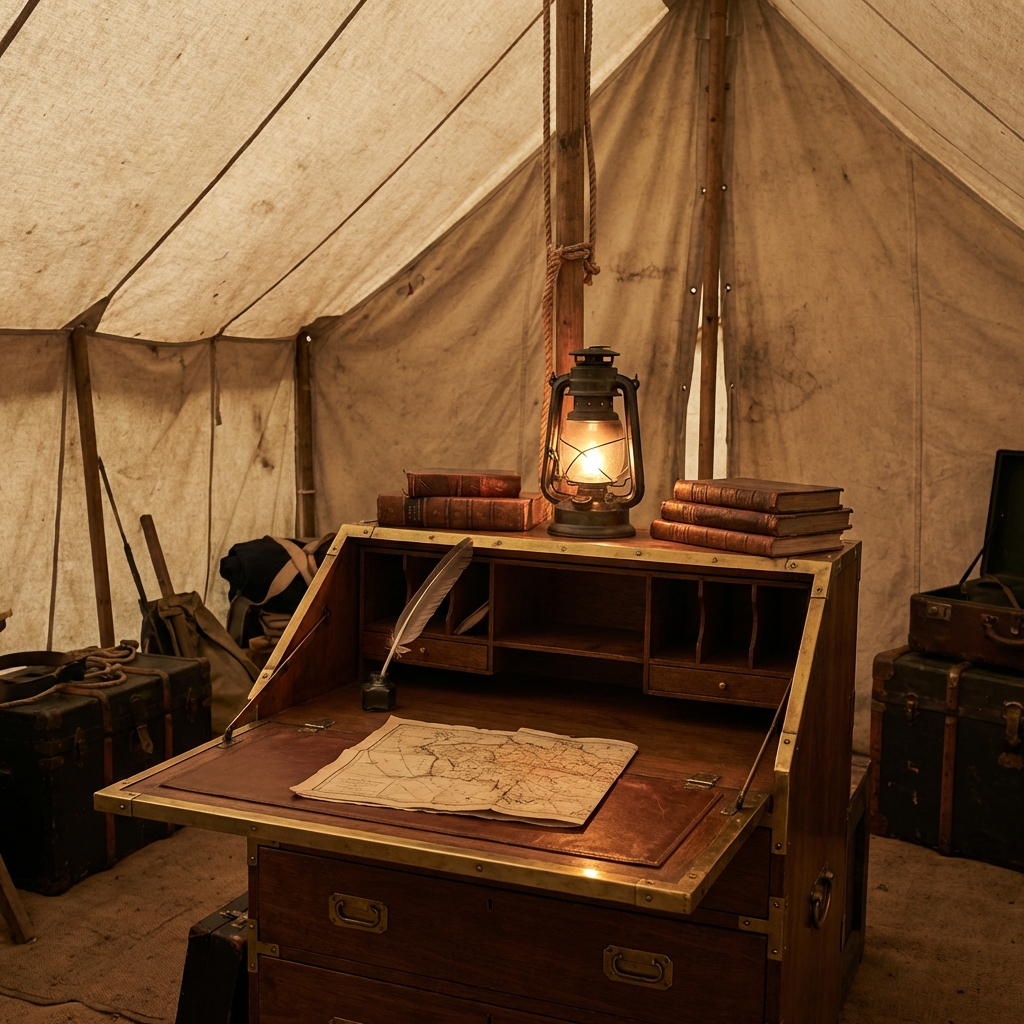
War required paperwork. And paperwork required a desk you could take apart, pack on a mule, and reassemble in a tent.
The campaign desk — sometimes called a field desk or officer’s desk — was a portable writing desk with brass-reinforced corners, flush-mounted hardware that would not snag during transport, and a design that folded flat or broke into two sections for easy carrying.
Some were simple writing boxes on folding legs. Others were surprisingly sophisticated, with multiple drawers, leather writing surfaces, and dovetailed cases that locked together for travel.
They were carried by officers in every American conflict from the Revolution through the Civil War and beyond. The brass corners and campaign hardware became such an iconic look that furniture makers eventually started producing campaign-style furniture for homes — not because people needed to move them, but because they looked fantastic.
13. The Spinet Desk
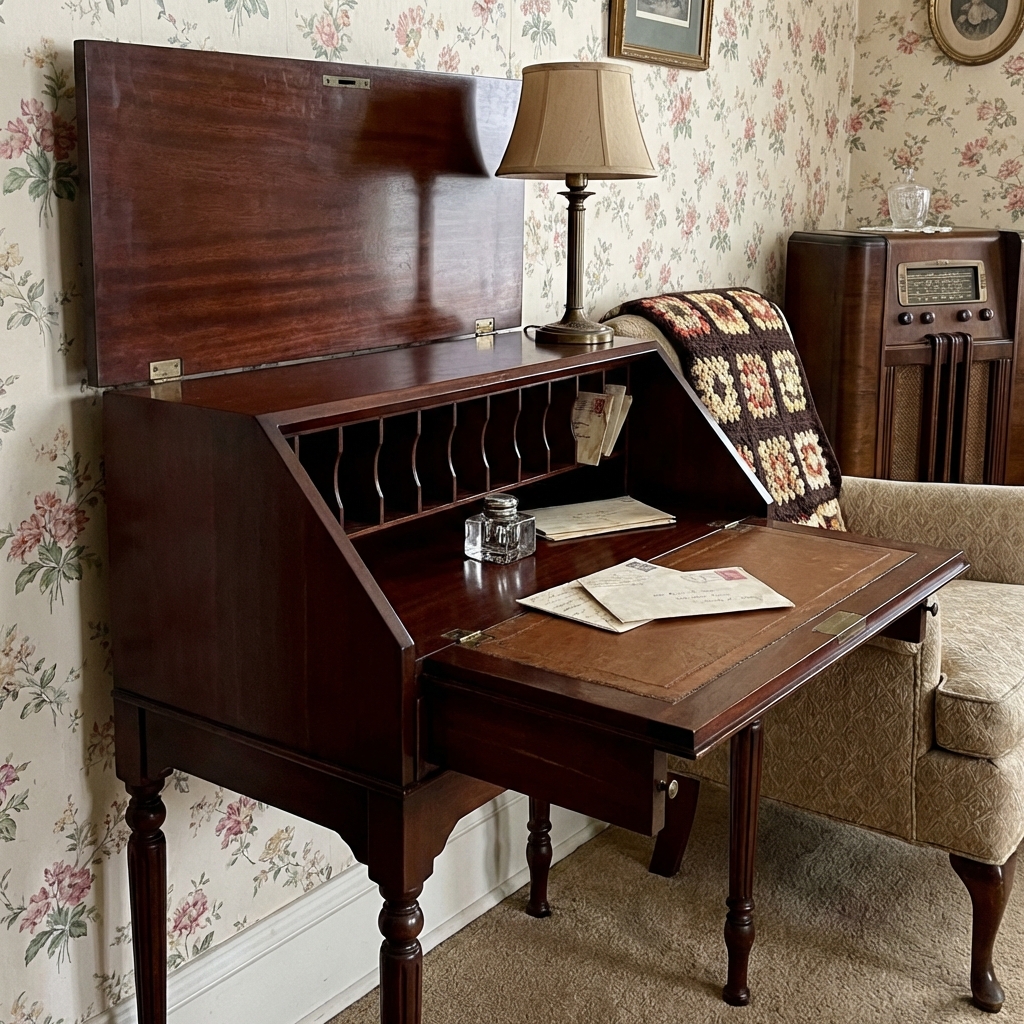
This desk spent its entire life pretending to be something else.
When closed, the spinet desk looked like an elegant side table or console — a simple flat surface on turned legs with a single drawer across the front. Nothing about it suggested it was a desk.
But the drawer was a fake. It was a hinged panel that folded in as half of the top surface flipped back, revealing a writing surface, pigeonholes, and small storage compartments underneath. A pull-out shelf extended the writing area forward.
The name came from its resemblance to a spinet — a small piano or harpsichord. In fact, the earliest spinet desks were literally made from gutted spinet pianos whose strings had worn out. Furniture makers in the 1920s and 30s mass-produced them in mahogany and walnut, and they became a staple of American living rooms.
They were the perfect desk for people who did not want a desk in their living room. Close it up, and it disappeared.
14. The Child’s Rolltop Desk
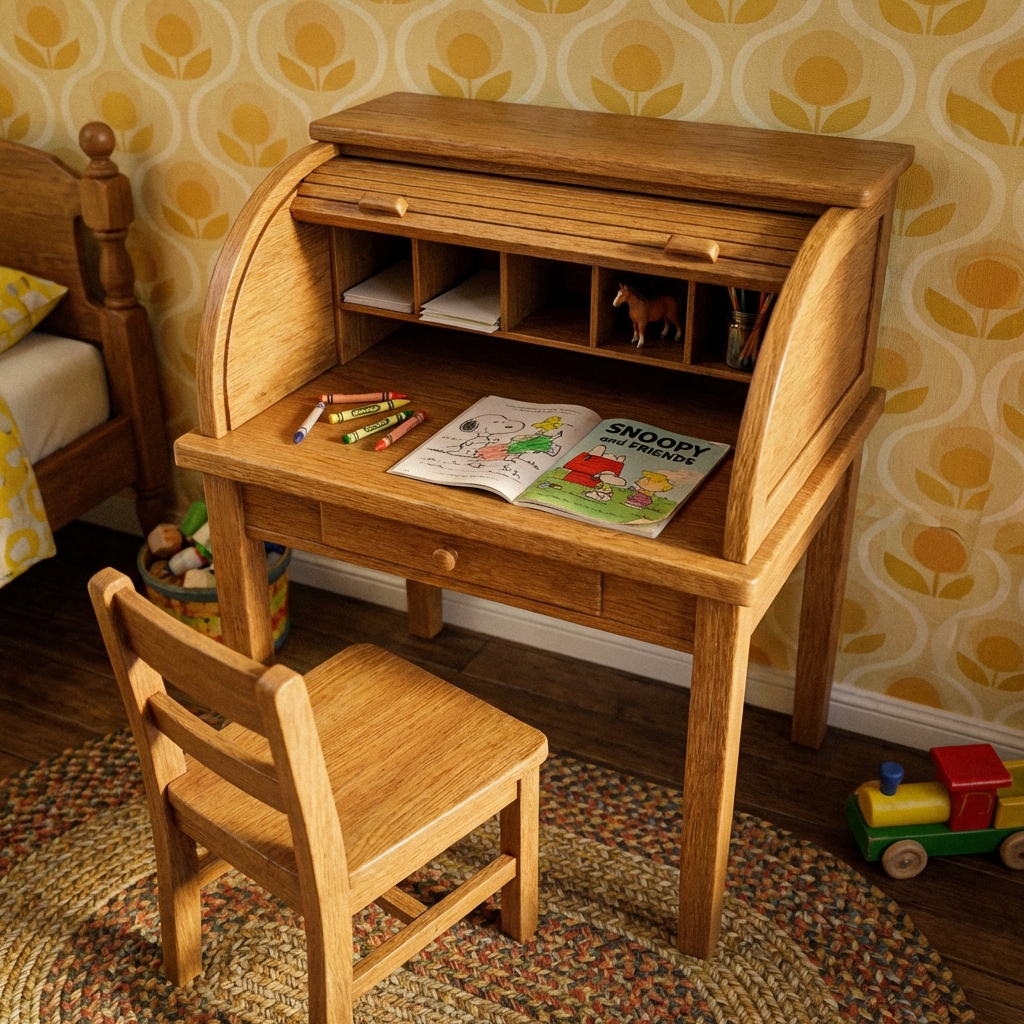
Every kid who visited grandpa’s study and saw the big rolltop desk wanted one of their own. And for a few decades, they could get one.
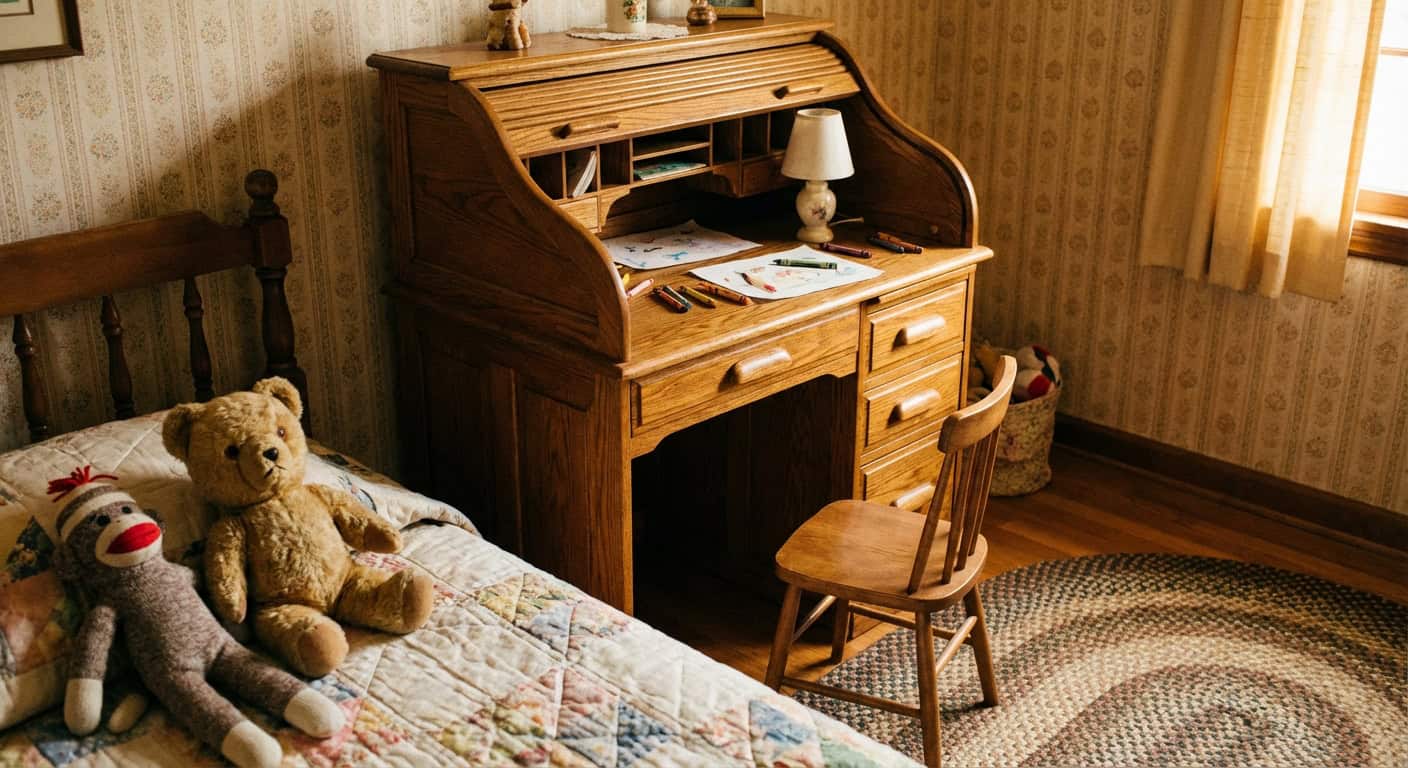
The child’s rolltop desk was a scaled-down version of the adult original — usually about three feet wide and three feet tall — with a real tambour cover that rolled up and down, small pigeonholes and cubbies inside, and a flat writing surface at the perfect height for a six-year-old.
Some were beautifully made in solid oak or maple. Others were simpler — pine or even pressed wood — but they all had the same magic. Roll the top down and your homework disappeared. Roll it up and you were open for business.
They were wildly popular in the 1950s, 60s, and 70s as children’s bedroom furniture. The combination of toy storage and workspace made them the original kid-sized command center.
Today’s children do their homework on iPads at the kitchen table. The child’s rolltop desk is a relic of an era when kids had their own workspace — and their own furniture that was built just for them.
15. The Telephone Desk
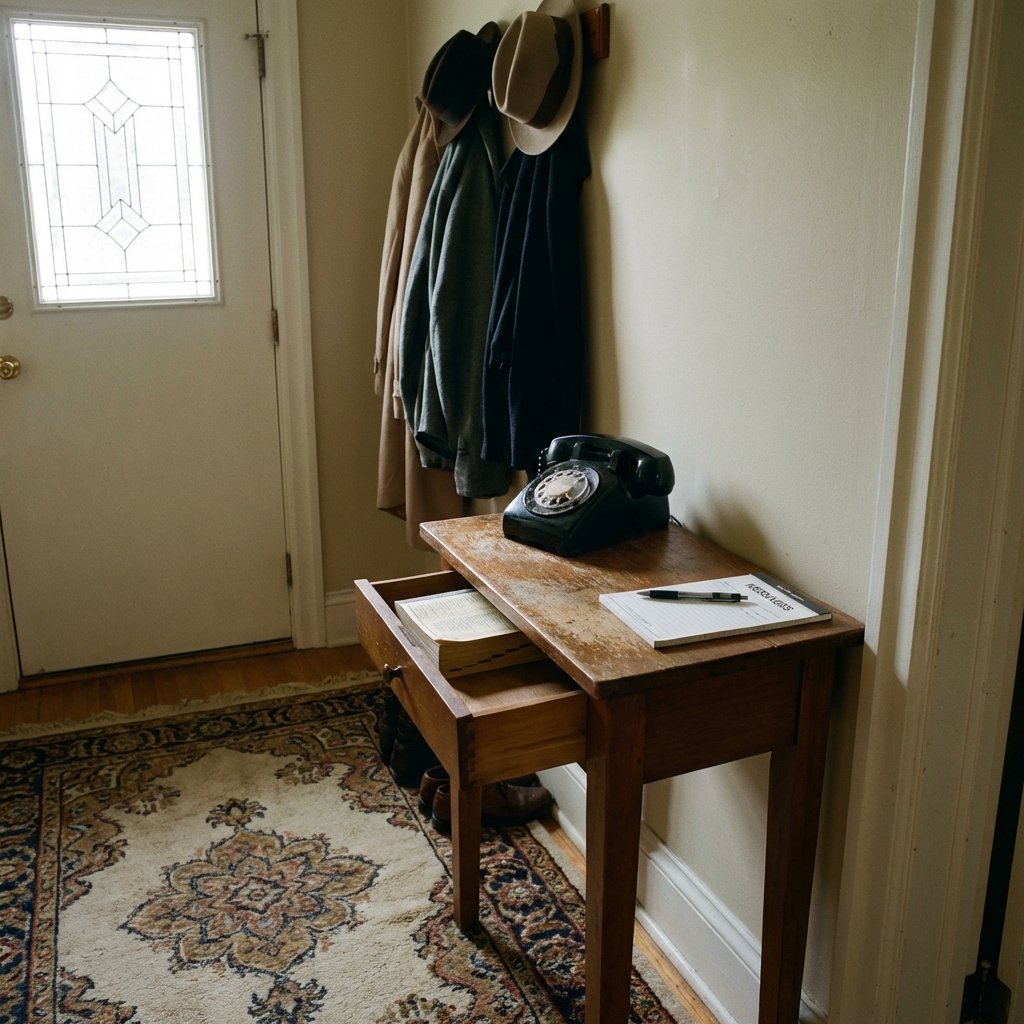
This was not the gossip bench — that was a chair. This was a small, dedicated desk built specifically for the household telephone.
It was a narrow, compact table — usually about 24 inches wide — with a flat surface just large enough for the phone, a small drawer for the phone book, and sometimes a shelf below for a notepad and pen. Some had a small hutch or shelf on top to hold an address book or a clock.
The telephone desk lived in the hallway, the kitchen, or the small nook between rooms where the phone jack happened to be. It was the communication hub of the house before communication became something you carried in your pocket.
When cordless phones arrived, the telephone desk started dying. When cell phones arrived, it was over completely. The idea that a telephone needed its own piece of furniture — that making a call required you to walk to a specific place and sit at a specific desk — feels almost unbelievable now.
Conclusion
Every desk on this list was designed for a specific job. Writing letters. Running an office. Managing a household. Teaching a classroom. Making a phone call.
And every one of them disappeared for the same reason — the job changed, and the desk did not change with it.
We do not write letters by hand anymore. We do not sit across from a business partner at a shared desk. We do not fold open a slant front to pay the monthly bills.
But the craftsmanship in those desks — the dovetailed drawers, the hand-inlaid leather, the solid wood that could survive a century — that did not become obsolete. We just stopped demanding it.
The desk your grandfather sat at was not just a place to work. It was built by someone who believed that where you work matters.
And they were right.