


You walk in and everything gleams. Gray vinyl floors, white shaker cabinets, a backsplash straight off the showroom wall. The listing says “fully renovated,” and your heart does the thing.
Slow down.
A good flip and a fast one look almost identical for the first ten minutes. The difference is what’s behind the paint, under the floor, and inside the walls — the expensive stuff that doesn’t photograph well and never makes the listing.
Flippers know exactly where your eyes go. They spend the money there and cut every corner where you won’t look. The trick is knowing where to look anyway.
Here are 24 telltale signs a house was flipped to bury its most expensive problems — and what each one is really hiding.
1. Fresh Paint in Just One Spot

Fresh paint everywhere is normal in a flip. Fresh paint in one weird spot is a confession.
Look for a single corner that’s brighter than the rest. A patch on the ceiling. A rectangle of new color under a window or around a light fixture.
Water stains and hairline cracks vanish under one coat. Inspectors see it constantly — the rest of the room is the original dingy white, but one section got the spot treatment.
Ask yourself what was there before that single patch went up.
2. A Freshly Painted Basement Wall

Crisp white paint on a foundation wall reads like an upgrade. It’s usually a cover-up.
That bright coat is hiding efflorescence — the chalky white crust that forms when water moves through concrete or block and leaves mineral salts behind. It’s not mold, but it’s a flashing sign that water is getting in.
People confuse the two all the time. Efflorescence is white, powdery, and brushes off dry. Mold is fuzzy, often black or green, and grows where moisture sits. One tells you water passed through. The other tells you it stayed.
Here’s the cruel part. Painting over a damp block wall traps moisture inside the masonry. The water can’t breathe out, so it pushes the paint off in sheets and chews up the block faster than if nobody had touched it. The cover-up actively makes the damage worse.
And the fix isn’t cheap. A coat of waterproofing paint runs you a weekend and forty bucks. A real solution — interior drain tile, a sump pump, regrading the soil outside, or sealing from the exterior — runs anywhere from $3,000 to $15,000 depending on how bad the water problem is. Full foundation crack repair with structural concerns can climb past $25,000.
So when you see one fresh white wall in an otherwise grimy basement, don’t think “they cleaned up.” Think “what are they not telling me about the water.”
Bring a screwdriver. Tap the block. If the paint flakes or the surface feels damp and soft, walk that finding straight to your inspector.
3. Bubbling or Soft Spots Under New Paint

Your eyes can be fooled. Your hand can’t.
Run your palm flat along any freshly painted wall, slow and steady. You’re feeling for bubbling, soft give, or a spongy texture that shouldn’t be there.
Paint sitting over wet drywall blisters and lifts. Press gently on a soft patch and it’ll feel like a damp cracker.
Do this everywhere — bathrooms, under windows, along exterior walls, anywhere water likes to sneak in. It costs you nothing and takes thirty seconds a room.
4. An Overpowering Vanilla Candle Smell

You know the smell. You walk in and it’s vanilla, or “fresh linen,” or three plug-ins fighting each other for the front hall.
That’s not hospitality. That’s a mask.
Heavy artificial scent is one of the oldest tricks for covering mold, mildew, pet urine, and the deep musty funk of a house that’s had a water problem. A flipper can’t sell you a smell, so they bury it under wax and chemicals.
Trust your nose over your eyes here. A musty, earthy, basement-locker smell is one of the most reliable signs of hidden moisture there is — and where there’s chronic moisture, there’s often mold growing somewhere you can’t see, inside walls, under flooring, behind cabinets.
That matters for more than the wallet. Mold spores aggravate asthma, allergies, and chronic sinus issues, and certain molds make some people genuinely sick over time. You’re not just buying a house — you’re buying its air.
Test it. Turn off the candles if you can, open a window for five minutes, then come back and smell again with a clear nose. Check the closets, the basement, and the cabinet under every sink, because that’s where the musty truth hides while the foyer smells like a bakery.
Professional mold remediation isn’t a $200 fix either. A small contained area might run a few hundred. A whole basement or an HVAC system full of spores can hit $10,000 to $30,000 once they tear out drywall and insulation. The candle is cheaper. That’s the whole point of it.
5. Brand-New Flooring Wall to Wall

New floors throughout can be a real upgrade. They can also be a five-dollar Band-Aid on a broken bone.
Luxury vinyl plank and cheap laminate go down fast over almost anything — including a rotten, water-damaged, or wildly uneven subfloor that nobody bothered to fix.
The material tells the story. Quality flooring properly installed feels solid and quiet. Bargain LVP clicked down over a bad subfloor announces itself fast.
So don’t just admire the floor. Test what’s under it.
6. Floors That Bounce or Slope Underfoot

Walk every room like you own it. Heel to toe, edge to edge, slow.
Feel for bounce. Feel for slope. Feel for that little dip in the middle of a room or the spongy give near a wall.
A floor that flexes under your weight means subfloor damage or joist trouble. A floor that visibly slopes toward one corner can mean the foundation is moving underneath all that pretty new vinyl.
Drop a marble if you want to be dramatic about it. Inspectors call uneven floors one of the surest hallmarks of a bad flip, because the surface is brand new and the problem is still right there beneath it.
7. Doors and Windows That Won’t Close Square

This one takes ten seconds and costs nothing.
Open and close every interior door. Does it latch cleanly? Does it swing open on its own? Does the gap around the frame stay even, or does it pinch at the top and yawn at the bottom?
A door frame that’s no longer a rectangle is a door frame the house twisted out of square. Windows that stick or won’t lock tell the same story.
That’s foundation settling, and no amount of new paint or flooring fixes it. Flippers almost never touch it because it’s invisible in photos and brutal to repair.
8. New Paneling or Siding Over Part of the Facade

When fresh cladding covers only one section of a house, ask what it’s hiding.
One home inspector tells a story worth keeping in your back pocket. A flip he toured had a stretch of trendy modern wood paneling slapped over part of an exterior wall — looked intentional, looked designed.
It wasn’t. Behind it was a major foundation crack. The kicker? The crack was still visible on Google Street View from before the flip, because the listing photos and the street imagery hadn’t caught up yet.
He pulled up the old image right there and matched the location to the new paneling. The cover-up was documented online the whole time.
So do this before you ever set foot inside. Pull up Google Street View and scroll back through the history. Look at the house a year ago, two years ago, five. Compare it to what you’re seeing now.
If a section of brick, block, or siding got newly clad and the rest didn’t, something underneath it didn’t want to be seen. Foundation crack repair starts around $5,000 and climbs fast once piers and structural work enter the picture.
9. Gaps, Sagging Rooflines, and a Porch Pulling Away

Step back to the curb and just look at the house as a whole.
You’re hunting for the things a renovation can’t hide because they live on the outside. A roofline that sags or dips in the middle instead of running straight. Stair-step cracks in the brick or mortar. A porch or chimney that’s visibly pulling away from the main structure, leaving a wedge-shaped gap.
Look at where window and door frames meet the wall. Triangular gaps there mean the wall has shifted around an opening that used to be square.
All of it points the same direction — structural movement that the gorgeous new kitchen did absolutely nothing to address.
A chimney leaning away from the house isn’t cosmetic. Neither is a porch slowly divorcing the front wall. These are foundation and structural problems, and they get more expensive every season they’re ignored. Underpinning a settling foundation can run $10,000 to $40,000 or more, and that’s before you fix everything the movement cracked on the way down.
Walk the full perimeter. Crouch down. Look up. The exterior tells on the flip more honestly than any room inside.
10. The Old Roof Was Left Untouched
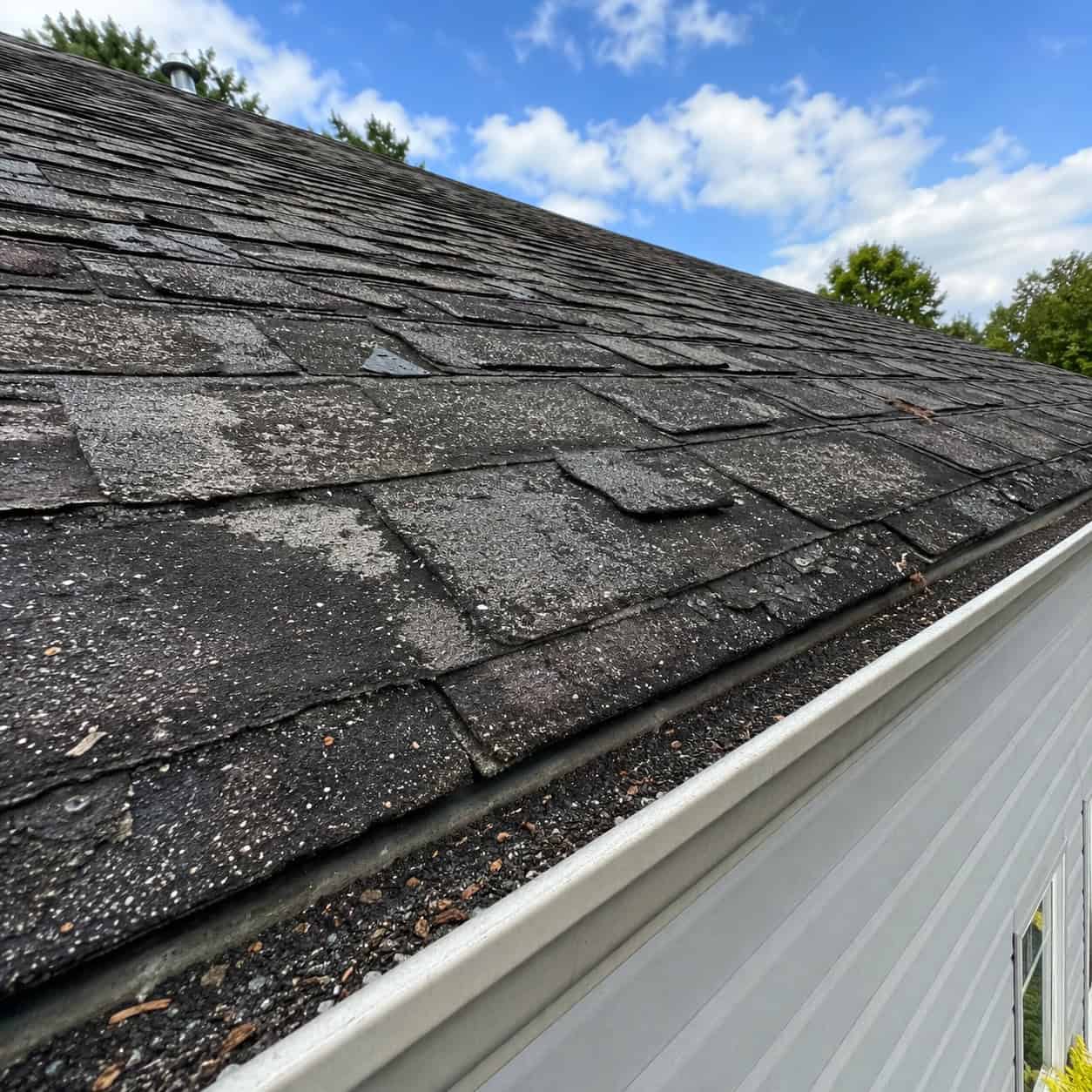
A flipper will spend $15,000 on a kitchen you’ll photograph and zero dollars on a roof you won’t.
That’s the entire game. Big-ticket items that don’t show up in listing photos — roof, HVAC, sewer line — are exactly the things flippers skip, because nobody scrolls Zillow admiring shingles.
So look up before you fall in love with the counters. A standard asphalt shingle roof lasts 20 to 25 years. If the curb appeal is brand new but the roof is curling, balding, streaked black, or losing granules into the gutters, you’re looking at a deferred expense the seller is hoping becomes yours.
Roof replacement is no small number. A typical asphalt re-roof runs $8,000 to $20,000 depending on size and pitch. Metal, slate, or tile climbs well past that. And a roof at the end of its life often means water has already been working on the decking and attic below.
Ask the age. Ask for the receipt if they claim it’s new. Get up in the attic and look for water stains on the underside of the decking, because a fresh ceiling downstairs can hide an old leak upstairs.
A beautiful house under a dying roof is a countdown clock, and you’d be buying it pre-started.
11. An Aging HVAC and Water Heater Behind New Finishes

Granite counters. Subway tile. A twenty-year-old furnace wheezing in the basement.
This combination is so common it’s practically a flip signature. The money goes where buyers look, and the mechanical systems — the genuinely expensive ones — get left exactly as they were.
Find the furnace and the water heater and read the labels. Most have a manufacture date stamped right on them, or a date code you can decode from the serial number. A furnace pushing 15 to 20 years is on borrowed time. A water heater past 10 to 12 is living on luck.
The numbers add up quick. A water heater replacement runs $800 to $3,000 installed. A full HVAC system — furnace and air conditioner — can hit $5,000 to $12,000. Then check the attic for insulation, because flippers love to skip that too, and you’ll feel the missing R-value in every winter heating bill.
None of this is hidden if you walk down the basement stairs and actually look. It’s just hidden from anyone who stops at the kitchen.
Old systems are also your best negotiating chip. A 19-year-old furnace is a real number you can knock off the price — if you bothered to find it.
12. Caulk Smeared Over Carpentry Joints

Get down close to the trim. This is where rushed work confesses.
Look at the corners where baseboards meet. They should be cut tight, mitered or coped, sitting flush. A gappy joint glooped full of caulk and painted over is the mark of someone who didn’t have time to do it right.
Same with door casings that aren’t plumb, ragged saw cuts, and trim that wanders off level.
Here’s why it matters beyond looks. The trim is the visible work — the part they knew you’d see. If they rushed the stuff in plain sight, imagine how fast they moved through the wiring, the plumbing, and the framing you can’t see.
13. Cabinet Doors and Drawers That Don’t Line Up

Open everything in the kitchen. Every door, every drawer.
Cabinetry is a dead giveaway. Doors that don’t sit even, drawers that catch or won’t fully close, gaps that grow as your eye travels down the row — all of it screams haste.
Good cabinet installation is fussy, patient work. When it’s sloppy, the installer was racing the clock.
And a flipper racing the clock in the kitchen was racing it everywhere else too.
14. Cracked Tile and Sloppy Grout Already Failing

Tile that’s cracking weeks after a “remodel” wasn’t unlucky. It was installed wrong.
Look for hairline cracks running through individual tiles, lines that don’t stay straight, and grout that’s already crumbling, discolored, or smeared messily into the gaps.
Tile is only as good as what’s under it. Lay it over a flexing floor or skip the proper substrate prep, and it fails fast — cracking, popping loose, letting water down into the subfloor.
Press on a few tiles in the bathroom floor. A hollow click or any give underneath means it’s already on its way to failing.
15. Loose, Warm, or Painted-Over Outlets

Electrical shortcuts aren’t just sloppy. They’re a fire risk.
Wiggle a few outlets gently. A receptacle that moves in the wall, or a cover plate painted right over the slots, points to fast amateur work. So do flickering lights, an outlet that’s installed upside down next to one that isn’t, and any visible wiring where there shouldn’t be.
Put your hand near outlets and switch plates that are in use. Warmth is a warning. A warm or discolored outlet means heat is building where it shouldn’t, and that’s how electrical fires start.
If the visible electrical looks hurried, assume the work inside the walls was hurried too. That’s not a cosmetic problem — it’s the kind that burns houses down.
16. Shiny New GFCIs and ‘Electrician’ Stickers That Don’t Work

New doesn’t mean working. Sometimes new is just the costume.
One documented case sticks with inspectors: a garage converted to a bonus room, fitted with brand-new GFCI outlets and official-looking electrician inspection stickers slapped on the panel. Looked permitted. Looked professional.
None of the outlets had power. Not one. The whole thing was a face — shiny fixtures and fake-out stickers over wiring that was either never connected or never done right.
So test them. Buy a $10 outlet tester and plug it into every receptacle. Press the test button on every GFCI. Confirm the stickers match real, searchable permits.
A sticker isn’t an inspection. It’s a sticker.
17. Mismatched Pipes and DIY Plumbing in the Basement

Most plumbing hides inside walls. The basement is where it has to show itself.
Follow the pipes with your eyes. You’re looking for a Frankenstein run — copper spliced into PVC into galvanized, oddball fittings, rubber couplings clamped on as a “permanent” fix, and DIY patches that scream weekend, not contractor.
A classic flip move: a cast-iron drain line that’s rusting and worn gets a patch clamped over the bad section instead of getting replaced. Cheaper today. A flood in your laundry room tomorrow.
Mismatched, slapped-together plumbing in the open basement tells you what the plumbing inside the walls probably looks like too.
18. Bargain-Bin Fixtures and Mismatched Appliances

The finishes whisper the budget.
Flimsy faucets that wobble at the base, the cheapest big-box light fixtures, a fridge from one brand sitting beside a stove from another and a dishwasher from a third — that’s a cost-cutting job, not a design choice.
Stainless and brushed nickel photograph beautifully and tell you nothing about quality. A flipper chasing the look on a tight budget bought whatever was on clearance.
If they squeezed every dollar on the stuff you can see, picture what got squeezed behind the drywall.
19. Skipped Closets, Attics, and Garages

Flippers paint what shows. Open the doors they hoped you’d skip.
Step inside the closets and look at the walls. Fresh paint in the bedroom but grimy, scuffed, original paint inside the closet means the roller stopped at the doorway. Same with the back of the linen cabinet and the inside of the pantry.
Climb up and look in the attic. Bare, no insulation, no sign anyone went up there. Check the garage — unfinished, untouched, the real condition of the house on display.
The reno stopped at eye level. Everything above and behind it is the truth.
20. Boxes Stacked on Pallets in the Basement

This one’s subtle, and it’s brilliant once you know it.
Walk the basement and look at how things are stored. Boxes resting on wooden pallets or 2x4s instead of straight on the floor. Shelving that starts a foot up the wall. Water-stained cardboard, rust rings on the bottom of metal shelving, a tide line on the block.
People who’ve been flooded stop putting things on the floor. They learn it the hard way, and the habit outlives the memory. Even if the basement is bone-dry the day you tour it, those pallets are a quiet record of every time it wasn’t.
A basement that floods is a recurring expense, not a one-time fix. The water keeps coming — after storms, during spring thaw, whenever the water table rises — and each round damages whatever it touches.
The real cure lives outside and underground. Regrading the soil so it slopes away from the house. Extending downspouts. Adding a sump pump and interior or exterior drain tile. That’s a $3,000 to $15,000 conversation, sometimes more, and it’s the kind of work a flipper trying to turn a profit in 90 days never wants to fund.
So note the storage habits. Ask directly whether the basement has ever taken on water. Then ask the neighbors, because they’ll tell you the truth the seller might not.
21. Old Single-Pane Windows Behind a Pretty Interior

A makeover kitchen behind drafty original windows is a tell.
Run your hand around the edges of the windows on a breezy day. Feel for a draft. Look for single panes instead of insulated double glazing, old aluminum frames, condensation trapped between sealed glass.
Replacing windows averages over $1,000 each installed — multiply that across a house and you see why a flipper “forgot” them. They renovated everything you’d notice and left the windows because new ones don’t show in a photo.
Drafts can also flag bigger problems. Gaps around the frames sometimes mean failing seals, rot in the surrounding wall, or siding that’s letting water in. The cold air is just the messenger.
22. No Permit History for the Major Work

An opened-up floor plan, a new deck, a finished basement, an addition — with zero permits on file. That’s a walk-away signal.
Structural and electrical work done without permits means no inspector ever checked it. You’re trusting that a flipper, working fast and cheap, got the load-bearing math right with nobody watching.
The good news is this is easy to verify. Most county assessor and building department websites let you search a property’s permit history free, in a couple of minutes, from your couch.
Match the permits to the work you can see. A removed wall and a brand-new deck with no paperwork behind them is a problem you don’t want to inherit.
23. A Suspiciously Fast Bought-Low, Sold-High Timeline

Public records leave a fingerprint, and the flip’s fingerprint is speed plus a price jump.
Most flips get bought, lightly renovated, and re-listed within 91 to 180 days. Cash buyers and iBuyers move even faster to limit carrying costs — every month they hold it eats their profit.
Pull the sale history. If the property changed hands four months ago for a price way below today’s ask, you’re almost certainly looking at a flip. That’s not automatically bad, but it changes how you inspect.
Speed is the enemy of quality. A house renovated to be lived in takes time. A house renovated to be sold takes whatever’s fastest — and you’re the one who lives with the difference.
24. The Seller Nudges You to Skip the Inspection

Anyone pushing you to waive the inspection “because everything’s new” just told you everything you need to know.
That’s the single biggest red flag of all.
A renovator who’s confident in their work welcomes an inspector. They want the validation — it helps them sell. The only people nervous about a stranger crawling the attic and testing the outlets are the ones who know what’s up there.
Never waive it. Not in a hot market, not for a “great deal,” not because the kitchen made your heart do the thing. Hire your own inspector, pay the few hundred dollars, and let them open every door you didn’t.
The pressure to skip the inspection isn’t a shortcut. It’s a warning, delivered out loud.
Conclusion
A flip done right is a gift — somebody else did the work, and you get the fresh house. A flip done to hide problems is a trap dressed in subway tile.
The whole skill is learning to look past the parts they want you to see. Run your hand on the wall. Open the closet. Walk the floor. Read the date on the furnace. Pull the permits.
Beautiful is easy. Beautiful is cheap. What you’re actually buying is everything behind the beautiful.
So slow down, bring a flashlight, and trust your nose over the vanilla candle every single time.