

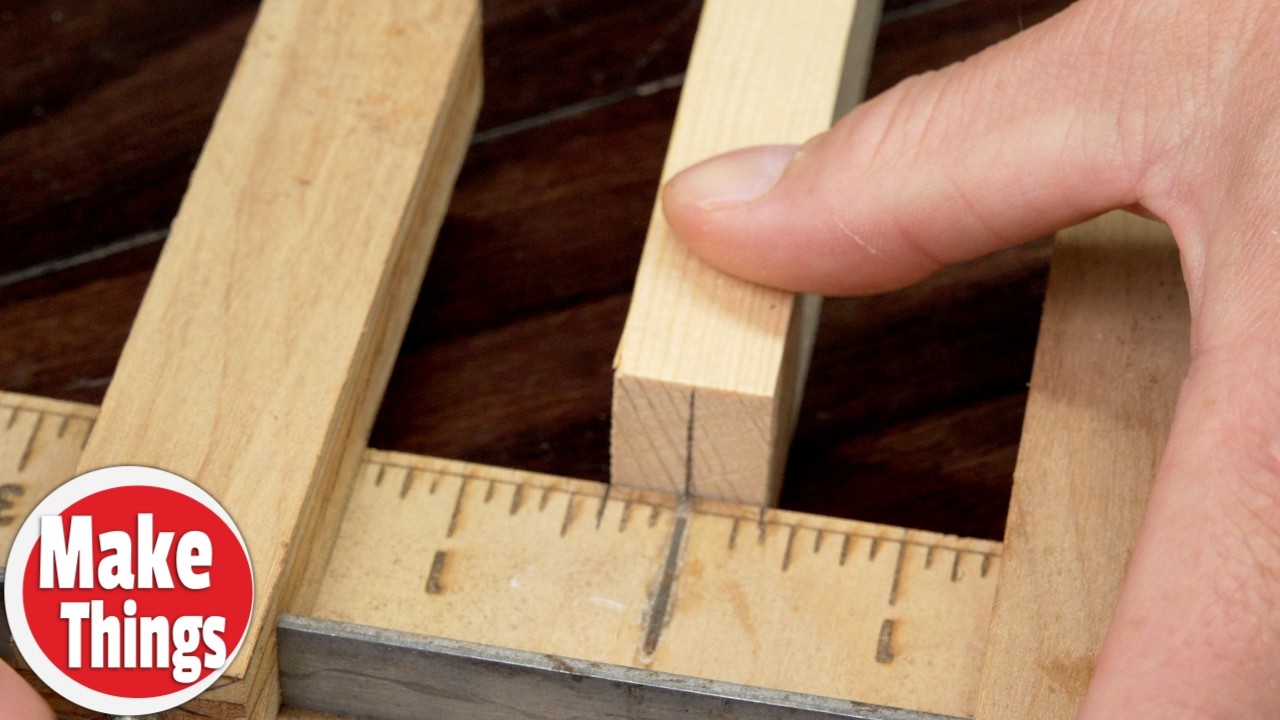
Rob from Make Things shared the woodworking tip featured in this video.
Rob demonstrates the value of a layout jig specifically designed for half lap joints while working on a large light fixture project in his shop. The jig helps solve one of the most common challenges with half lap joinery – achieving precise, consistent layout marks across multiple intersecting pieces.
Watch the full video and subscribe to Make Things:
Why Half Lap Joints Matter in Shop Projects
Rob explains that framing forms the skeleton of most three-dimensional projects, whether building light fixtures, table bases, or larger structures. The frame’s primary job is providing alignment and strength to the overall piece.
While house construction typically relies on butt joints secured with nails for speed and efficiency, shop projects face different demands. Cabinets roll around on wheels, fixtures get handled regularly, and frames experience twisting and stress that stationary structures don’t encounter.
Half lap joints offer an ideal solution for shop projects because they provide long grain glue surfaces and mechanical alignment simultaneously. They can be cut efficiently with common tools like table saws or routers, making them more practical than mortise and tenon joints when time is limited.
The Layout Challenge
The main difficulty with half lap joints lies in the layout process. When multiple pieces need to intersect at specific locations, each joint must be marked precisely to prevent loose fits and gaps that compromise the frame’s integrity.
Traditional layout methods involve measuring and marking each intersection point individually. While this works for simple projects, it becomes time-consuming and error-prone when dealing with multiple crossing pieces that must align perfectly.
How the Layout Jig Works
Rob’s jig simplifies the layout process by using the actual stock pieces as references for marking. The jig features a center pin that aligns with a marked centerline on the workpiece, along with adjustable stops that position the crossing pieces accurately.
To use the jig, the user marks the center of one piece of stock, then positions it against the center pin. The adjustable stops hold crossing pieces in place while knife marks are made on both sides of each intersection point.
The jig’s self-aligning design ensures that all joints maintain consistent spacing and alignment, even when working with multiple intersecting pieces.
Cutting and Assembly Benefits
After marking with the jig, the actual cutting becomes straightforward. Rob demonstrates using a depth gauge to ensure consistent cut depth across all pieces, then aligning the saw blade with the marked lines.
Half lap joints offer the advantage of being somewhat forgiving during assembly. If one cut runs slightly large, the opposing piece can often compensate, maintaining a reasonably tight fit overall.
These joints also provide natural clamping action during assembly. Once glue is applied and the pieces slide together, the mechanical interlock holds everything in place without additional clamping pressure.
Practical Application
This layout jig proves most valuable when building larger projects that require multiple intersecting frame members. The consistency it provides becomes crucial for maintaining alignment across complex assemblies where manual layout would be prone to cumulative errors.
For woodworkers who frequently build shop furniture, light fixtures, or other framed projects, this type of jig can significantly speed up the layout process while improving joint quality. The time invested in making the jig pays dividends across multiple future projects.
Watch the full video and subscribe to Make Things:

Matt’s Take
These are my personal thoughts and tips based on my own experience in the shop. This section is not written, reviewed, or endorsed by the original creator of this project.
Half lap joints are one of those techniques that look simple until you actually need to lay out a bunch of them on a complex project. I’ve learned the hard way that even small layout errors compound quickly when you’re dealing with multiple intersecting pieces. What starts as a 1/16″ mistake on the first joint becomes a frustrating gap by the time you reach the final assembly.
The beauty of Rob’s approach is using the actual stock as the measuring tool. This eliminates the measurement errors that creep in when you’re transferring dimensions from rulers or squares repeatedly. I’m a big fan of self-referencing jigs like this – they tend to be more accurate than trying to measure everything from scratch each time.
One safety note worth mentioning: when you’re cutting these joints at the table saw, make sure your blade height is set conservatively. It’s better to sneak up on the final depth with multiple passes than to cut too deep on the first try. Half laps are forgiving joints, but only if you leave yourself material to work with. A sharp marking knife for the layout lines makes a real difference too – those crisp lines give your saw blade something definitive to follow.