

In 1975, America was building houses in the middle of a nervous breakdown.
The oil embargo had hit two years earlier, and gas lines and heating bills had spooked the whole country. Suddenly a house wasn’t just a place to live — it was an energy bill waiting to happen. Builders started burying homes in the ground, wrapping them in earth, and aiming giant walls of glass at the winter sun. Architects who’d spent the ’60s drawing clean modern boxes started drawing something earthier, angrier, more experimental.
At the same time, the country was about to turn 200. The Bicentennial was everywhere, and a wave of red-white-and-blue nostalgia sent millions of buyers reaching backward for eagles, shutters, and Williamsburg colonials. So the decade pulled in two directions at once — half the country wanted a Space Age dome on a hillside, and the other half wanted a brick colonial with a flag out front.
And then there was the stuff in between. Mansard roofs on everything. Shag-carpeted conversation pits. Cedar shed-roofed contemporaries with diagonal siding. Geodesic domes ordered out of the back of a magazine. The ’70s produced some of the most adventurous, strangest, and most quickly-regretted houses in American history.
Drive through a development built in 1975 today and you can read all of it — the panic, the patriotism, the experiments. The houses are still standing. But almost none of what made them is being built now.
Here are 27 house styles that were everywhere in 1975. And the reasons you almost never see new ones going up today.
1. Mansard Mania

If one roof defined the 1970s, it was the mansard. Two slopes on every side, the lower one so steep it was nearly a wall, usually punched with little dormer windows and clad in dark shingles or fake slate.
It started as a nod to French elegance, but by 1975 it had escaped onto everything. Houses, apartment buildings, banks, and — famously — the Pizza Hut down the street. The steep lower slope let a builder hide a full upper story, or just cap a one-story box with something that looked fancier than it was.
Buyers loved how formal it felt. Builders loved how cheaply it dressed up a plain house. For about a decade, you couldn’t drive past a new development without seeing a row of them.
Then the spell broke. The mansard became the single fastest way to date a building to the ’70s, the architectural equivalent of a leisure suit. The compound roof angles were expensive to frame and a nightmare to reroof, and the look curdled from “elegant” to “dated” almost overnight.
Nobody builds new mansard houses now. The roof that was everywhere in 1975 is a punchline.
2. The Shed-Style Contemporary

A cluster of boxy shapes, each capped with its own single-slope roof tilting off in a different direction, the whole thing wrapped in vertical or diagonal cedar siding stained brown. No symmetry, no front-facing gable, just angles.
The style came out of California’s Sea Ranch in the mid-’60s and spread fast through shelter magazines. By 1975 it was the look for the architect-minded buyer who thought a colonial was for their parents. It felt rugged and modern at once — sophisticated and woodsy in the same breath.
The energy crisis helped it along. Builders worked clerestory windows into those slanted roofs to let in winter sun, and the angular massing felt serious and forward-thinking.
The problem was every one of those roof planes met another one somewhere, and every junction was a place for water to get in. The diagonal cedar needed constant staining. The flat-ish slopes ponded and leaked.
By the late ’80s the style was done, and the houses started looking less like architecture and more like a pile of brown boxes. New construction abandoned the shed roof entirely. You don’t see them going up anymore.
3. The Bicentennial Neo-Colonial

As 1976 approached, the country went colonial. Black shutters, brass eagles over the door, multi-pane windows, a formal symmetric facade in red brick or white clapboard, maybe a fake cupola on the garage. Williamsburg, mass-produced for the subdivision.
The Bicentennial turned patriotism into a decorating scheme. Developers leaned all the way in, and “Colonial” became the default option on every builder’s sheet for buyers who wanted something traditional and reassuring in a chaotic decade.
The 1975 version was still modest — three or four bedrooms, a sensible rectangle, a two-car garage off to the side. It was the safe, tasteful choice.
The style never technically died, which is exactly why the 1975 version vanished. The colonial kept getting bigger. The shutters multiplied, the entry grew into a two-story foyer, the garage swelled to three bays, and the square footage doubled and doubled again. Today’s “colonial” is a 4,000-square-foot production house wearing colonial costume.
The trim, tidy, eagle-over-the-door Bicentennial colonial — the one your aunt and uncle bought in 1975 — isn’t a thing any builder offers now.
4. The Geodesic Dome Kit Home

A sphere built out of triangles. You ordered the kit out of the back of a magazine or a Whole Earth Catalog, and you and your friends bolted it together over a long weekend. Buckminster Fuller had promised it was the most efficient structure ever devised, and a generation of back-to-the-landers believed him.
The dome was the ultimate 1970s statement — anti-establishment, energy-conscious, geometrically pure. It enclosed the most space with the least material, shrugged off wind and snow, and looked like the future had landed in the woods.
Living in one was another story. Nothing inside a dome is square, so every cabinet, counter, and window is a custom headache. The triangular panels met at hundreds of seams, and every seam was a potential leak. Adding a second floor or dividing rooms fought the geometry the whole way.
Banks didn’t want to finance them. Insurers didn’t want to cover them. Buyers, later, didn’t want to buy them.
The domes that survive are beloved oddities, lovingly maintained by true believers. But the kit-home dream collapsed by the 1980s, and nobody is mass-producing dome homes today.
5. The Sunken Living Room / Conversation Pit

The floor of the living room dropped two or three carpeted steps below the rest of the house, ringed with built-in seating, sometimes with a fireplace at its center. You didn’t sit in the room. You descended into it.
The conversation pit was the height of 1975 cool. It made a room feel dramatic and intimate, corralled everyone toward the center, and looked fantastic in a magazine spread with shag carpet and a slim chrome lamp arcing overhead.
Big front windows often showed the sunken floor right off to the street, so the whole neighborhood knew you had one.
Then reality set in. People tripped on the steps in the dark. Older relatives couldn’t get down into them or back out. Furniture arrangement was locked in forever. And when you eventually wanted to sell, buyers saw a carpeted hole that had to be filled back in.
Building codes and plain common sense ended the pit. New houses are built flat, floor on one level, no descent into the living room. The conversation pit is pure ’70s, gone almost everywhere.
6. The Earth-Sheltered “Underground” House

After the oil embargo, some people decided the answer was to bury the house. Earth bermed up against the walls, a thick layer of soil and sod over the roof, and usually one glass face left exposed to the south for light. From the back, it looked like a grassy hill. From the front, like a bunker with a view.
The logic was sound on paper. Dirt is a fantastic insulator, holding the interior at a steady temperature year-round and slashing heating and cooling bills — the whole point in 1975.
The logic ran into water. Putting soil against walls and on top of a roof means waterproofing has to be perfect forever, and it almost never was. The houses leaked, sweated, and grew musty. Natural light was scarce. The single exposed wall did all the work.
And when it came time to sell, the pool of buyers who wanted to live in a hill turned out to be very small. Appraisers and lenders balked.
A few devoted owners still love theirs. But the earth-sheltered house was a brief, very 1970s answer to a very 1970s panic, and new ones are essentially nonexistent.
7. The Chalet

A steeply pitched front-facing gable, deep overhanging eaves, a balcony across the upper front with sawn decorative railings, and exposed beam ends — the Swiss Alps, transplanted to ski country and lake country across America.
The chalet was the vacation house of the 1970s. It shed snow beautifully, the front gable made a tall dramatic living room, and the upper balcony off the loft bedroom felt like a postcard. Developers in mountain resorts and lake communities put up hundreds of them.
The decorative woodwork was the whole charm — and the whole problem. All that sawn gingerbread trim and the exposed beams needed regular sealing and rotted if they didn’t get it. The steep roof was tall and expensive to maintain.
Vacation-home buyers eventually wanted more square footage for the money and less fuss, and the chalet’s storybook detailing started reading as kitsch rather than charm.
New mountain construction went to bigger, simpler “mountain modern” boxes. The gingerbread chalet, so dense on the ground in 1975 ski towns, isn’t a style anyone builds new today.
8. The Passive Solar Glass-Wall House
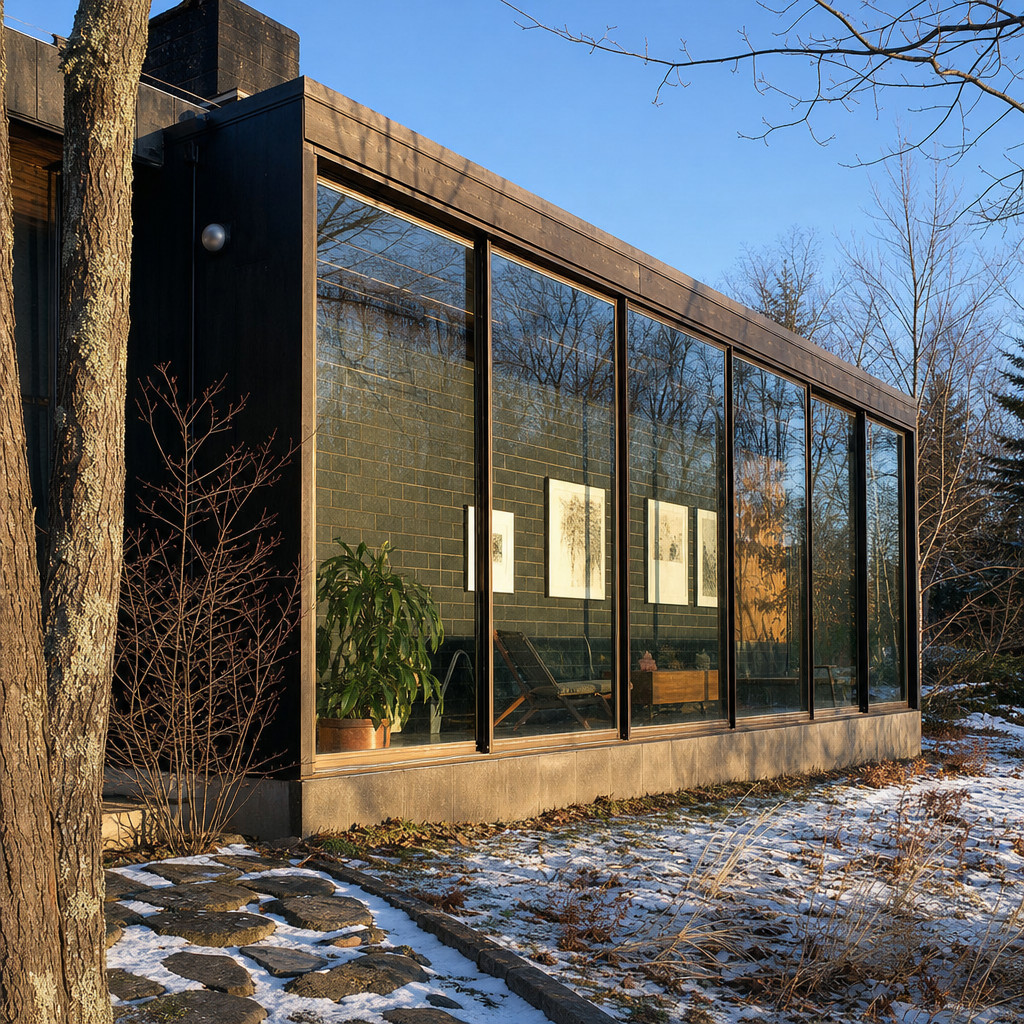
The whole south face of the house was glass, often angled, with a thick masonry wall or a row of water-filled drums behind it to soak up the sun’s heat all day and radiate it back at night. This was the Trombe wall, and in 1975 it felt like the future of free heat.
The energy crisis made solar design a genuine movement, not a fringe idea. Magazines were full of passive solar plans. The government handed out tax credits. Earnest homeowners oriented their entire house around the winter sun angle.
The trouble was that a giant single-pane glass wall is a wonderful heater on a sunny January noon and a disaster every other hour. It baked the house in summer, leaked heat all night in winter, and produced brutal glare. The technology of the glass itself just wasn’t there yet.
When energy got cheap again in the ’80s, the urgency evaporated. And modern efficiency comes from thick insulation and tight construction, not a wall of glass and a barrel of water.
The dedicated passive-solar house, with its angled glass face aimed at the sun, was a 1970s experiment that the market quietly abandoned.
9. The Tri-Level With the Two-Story Foyer Window

The split-level was still going strong in 1975, but the decade added a signature flourish — a soaring two-story window over the front entry, a tall vertical slot of glass (sometimes with a starburst or diamond muntin pattern) lighting up the foyer and stairs.
It was meant to add drama and grandeur to an otherwise modest split. You walked up to the door under this impressive column of glass, and the entry hall felt taller and grander than the house really was.
That window was an energy sieve. A two-story expanse of single-pane glass over an unheated foyer dumped heat all winter and cooked the stairwell all summer. The decorative muntins dated instantly.
The split-level itself fell out of favor for all the usual reasons — the half-staircases, the chopped-up floor plan, the awkward entry. Bolting a giant cold window onto the front didn’t save it.
New houses don’t combine the split layout with the two-story foyer window. Both halves of the idea went out of style, and the combination is a pure 1975 time stamp.
10. The Eichler-Style Atrium Tract Home

You approached the front door, opened a gate, and stepped into an open-air courtyard inside the footprint of the house — an atrium open to the sky, with the rooms wrapped around it and walls of glass looking in. Joseph Eichler pioneered it in California, and through the early ’70s the idea spread across the Sun Belt as a tract-home feature.
The atrium was a brilliant piece of theater. It brought light and garden into the center of the house, gave the family a private outdoor room, and made a modest single-story home feel like something an architect dreamed up.
It also brought the outdoors a little too far in. The atrium was conditioned space that wasn’t really livable space. Rain and leaves came in. Those glass walls facing the courtyard were single-pane and leaked heat everywhere. Heating a house wrapped around a hole open to the sky fought the energy math of the era.
Production builders moved on to simpler, tighter, cheaper plans. The atrium home became a regional cult favorite, coveted and restored by enthusiasts — but no longer built. The open-courtyard tract house is a 1970s artifact.
11. The T1-11 Plywood Contemporary

A boxy contemporary clad in T1-11 — big sheets of grooved plywood siding run vertically, stained brown or barn red — with a low-slope or shed roof and minimal trim. It was modernism on a budget, the contemporary look brought down to the price of a starter house.
T1-11 was a builder’s dream in 1975. It was cheap, it went up fast as full sheets, and the vertical grooves gave a plain box an instant “designed” texture. Whole developments of affordable contemporaries went up clad in the stuff.
The catch was that T1-11 is just plywood. Left even slightly unsealed, it soaked up water, delaminated, swelled, and rotted, especially along the bottom edge. It needed repainting or restaining on a schedule most owners didn’t keep.
By the time vinyl siding got cheap and maintenance-free in the ’80s and ’90s, T1-11 was finished as a primary cladding. Today it’s relegated to sheds and the occasional gable accent.
The whole-house T1-11 contemporary, so common in 1975 budget developments, isn’t something anyone builds new.
12. The Octagon / Hexagon Kit House

A house with eight sides. Or six. Ordered as a kit, often perched on a hillside or a lakefront, with windows on every facet and a roof that peaked in the center like a tent. The geometry was the entire selling point.
The octagon had been a Victorian fad a century earlier, and the experimental, anything-goes spirit of the ’70s revived it. The pitch was seductive — more light from more directions, a 360-degree view, a striking shape nobody else on the block had.
Living inside the angles was the reality check. None of the walls met at a right angle, so furniture never fit, rooms came out as awkward wedges and triangles, and every bookshelf or kitchen counter was a custom job. Dividing the interior into sensible rooms was a constant fight.
Banks were wary, buyers down the line were wary, and the novelty wore off fast once you tried to hang a picture or place a couch.
The octagon and hexagon kit houses survive as eccentric one-offs at the lake. As a style anyone actually builds, they’re gone.
13. The Townhouse PUD Cluster

The Planned Unit Development was a 1970s revolution in how the suburbs got laid out. Instead of identical houses on identical lots, builders clustered attached townhouses together — angular, cedar-clad, with shared walls and offset rooflines — and pooled the leftover land into common “open space,” often with a shared pool and clubhouse.
It was a genuinely new idea about suburban living. You owned your unit, the association maintained the grounds, and the density let developers preserve a chunk of green everyone shared. For young buyers and empty nesters in 1975, it was modern and low-maintenance.
The specific ’70s look hasn’t aged well. The funky angled cedar units with their brown stain and mansard or shed caps read as dated now, and the dark, small, multi-level interiors fight the way people want to live today.
Townhouses are obviously still built by the thousands. But the modern version is taller, denser, and clad in brick or fiber cement, with a very different silhouette.
The low-slung, cedar-shingled, ’70s cluster development — the one with the macramé in the window and the shared pool out back — is a period piece.
14. The Spanish Sun Belt Tract House

White or sand-colored stucco, a red clay tile roof, arched windows and a recessed arched entry, maybe a little wrought iron and a tiled house number by the door. As Americans poured into Arizona, Texas, Florida, and Southern California in the 1970s, builders threw up entire subdivisions of these by the thousands.
The Sun Belt migration was the housing story of the decade, and the Spanish ranch was its default uniform. It suited the climate and the landscape, it felt warm and vacation-like, and it was cheap to mass-produce once a builder had the stucco and tile crews running.
The style didn’t disappear so much as inflate. The single-story 1975 Spanish ranch — modest, low, tidy — got replaced in those same markets by the bigger, taller “Mediterranean,” with two stories, rounded corners, more arches, and far more square footage.
The original is everywhere in older Sun Belt neighborhoods, and almost never built new in its modest 1975 form. What gets built now is its supersized grandchild.
15. The Log Home Kit

A precut log cabin, ordered as a numbered kit and assembled on a rural lot — real stacked logs, a covered porch, a big stone chimney, and a sleeping loft under the roof. The back-to-the-land movement made it one of the defining dreams of the 1970s.
The kit was the key. Companies precut and numbered every log, shipped the whole house on a truck, and a determined owner could raise it with friends and a manual. It promised self-sufficiency, simplicity, and an escape from the suburbs — exactly the decade’s mood.
Log homes themselves never went away, but the modest 1970s kit cabin did. Logs settle, check, and need constant sealing against rot and insects; the romance came with a lot of maintenance. And the category drifted upmarket.
What you can buy today is a large, expensive, professionally built log “lodge” — a luxury second home, not a young couple’s affordable kit cabin. The humble stacked-log starter that defined 1975’s homestead fantasy isn’t really sold anymore.
16. The Slump-Block Southwest Contemporary

Across the desert Southwest, the 1970s contemporary was built of slump block — concrete blocks made to sag and look like old adobe — often paired with decorative breeze-block screen walls full of geometric holes, a flat or low roof, and a carport shading the front.
It was a smart regional answer. The heavy block walls held back the desert heat, the breeze-block screens threw patterned shade and let air move, and the whole low-slung look sat naturally in the landscape. Phoenix and Tucson and Albuquerque filled up with them.
The breeze block is the giveaway, and it’s exactly what dated the style. Those perforated screen walls scream a specific era now, the way harvest-gold appliances do. Slump block fell out of fashion as stucco took over, and the decorative screens offered no insulation in a region that increasingly wanted it.
New Southwest construction went to big stucco and tile. The slump-block-and-breeze-block contemporary, so common in 1975 desert subdivisions, is a recognizable fossil.
17. The Deck House (Acorn Post-and-Beam Kit)

A premium contemporary kit built on an exposed post-and-beam frame, with mahogany trim, tongue-and-groove cedar decking for the ceilings, walls of floor-to-ceiling glass, and broad wooden decks reaching out into the trees. Companies like Deck House and Acorn shipped these as engineered packages to well-heeled buyers on wooded lots.
This was the thinking person’s 1975 contemporary — warm, refined, architect-quality, and assembled from a precision kit rather than designed from scratch. The post-and-beam frame let the walls become glass, and the houses sat beautifully among trees and on hillsides.
The glass was the undoing. Acres of single-pane glazing was a luxury in 1975 and an energy-code violation later. The flat and low-slope roofs over all that wood needed vigilant upkeep. And the specialized post-and-beam kits came from a handful of companies that faded or folded.
The originals are coveted today and sell for real money where they sit. But the kit-built post-and-beam glass house is no longer a category a normal buyer can order. It’s a closed chapter.
18. The Double-Wide Manufactured Home

Two halves built in a factory, trucked to the site, and joined into a single wide house — a flat or very shallow roof, metal or hardboard siding, set on a lot or in a park. The 1970s was the great boom of the mobile home, and the double-wide was its move toward looking like a “real” house.
For a working family in 1975, it was the most affordable path to a three-bedroom home there was. The factory cranked them out cheaply and fast, and millions went up.
The pre-1976 versions are the ones you don’t see new, and for a hard reason — they were built before federal HUD construction standards kicked in that year. The old units were thin-walled, poorly insulated, flat-roofed, and prone to problems, and today they’re largely uninsurable and unfinanceable.
Manufactured housing is alive and well, but the modern version is a different animal, built to code, often with pitched roofs and drywall to mimic site-built homes. The flat-roofed, metal-sided 1975 double-wide is a vanishing object.
19. The Single-Slope Solar Wedge

One bold roof plane, tilted in a single direction like a ramp, with the tall wall of the house turned to the south and filled with glass. The whole house was a wedge, and the wedge was aimed at the sun. It was the energy crisis rendered as pure shape.
Where the shed style stacked several little slopes at angles, the solar wedge committed to one big sweep — high wall facing the winter sun to gather heat, low wall to the cold north side to shrug off the wind. In 1975 it looked bracingly modern and virtuously efficient at the same time.
It carried the same flaws as the rest of the solar experiments. The big south glass overheated in summer and bled warmth at night. The dramatic single slope was a large roof that drained and aged poorly. And the wedge read as aggressively of-its-moment.
When the energy panic faded, so did the wedge. The shape that felt like the responsible future in 1975 became a dated curiosity, and new construction left it behind.
20. The Garage-Forward Neo-Tudor

Toward the end of the decade, a new kind of house took over the subdivision — and the most prominent thing on its front was the two-car garage, pushed right out toward the street, with the front door tucked back beside or behind it. To dress it up, builders added a token Tudor touch: a single half-timbered gable, a bit of fake stone, a fancy door.
The two-car garage had become non-negotiable, and the cheapest place to put it was front and center. The Tudor trim was a thin layer of “character” stuck onto an essentially utilitarian box. It was the birth of the snout-forward house that would dominate the ’80s and beyond.
The garage-forward layout didn’t go anywhere — it won completely, and most houses built since look down at the street from behind their garage doors. But the Tudor costume got dropped. The half-timbering and the fake stone gable that defined the late-’70s version read as dated and disappeared.
So the specific 1970s garage-forward neo-Tudor — utilitarian box, token half-timber gable — is a transitional fossil. Its garage lived on; its Tudor mask did not.
21. The Rustic Board-and-Batten + Stone Ranch

A long ranch or low two-story clad in vertical board-and-batten siding stained dark brown, anchored by a massive rough-stone chimney and a low, brooding roofline. Earth tones everywhere — brown, rust, ochre, moss. This was the woodsy, rustic, back-to-nature side of the 1970s.
The decade fell hard for natural, earthy materials, and this house was the result — heavy, organic, blending into a wooded lot. The big stone chimney was the centerpiece, the dark vertical wood made it recede into the trees, and inside there was almost certainly a wall of the same stone behind a wood stove.
The look was deliberately dark and heavy, and that’s exactly what dated it. When the bright, white, open aesthetic took over in later decades, these houses felt gloomy, and owners started painting the wood and lightening everything they could.
The board-and-batten-and-stone ranch in full earth-tone dress was a 1975 staple. New construction doesn’t build dark and heavy like this on purpose anymore, and the original look survives mostly where nobody’s renovated it yet.
22. The Redwood Deck-and-Hot-Tub California Contemporary

A glassy contemporary trailing multiple levels of redwood deck down a hillside or out into the yard, with a sunken redwood hot tub on one of them and lots of sliding glass blurring the line between inside and out. California exported the indoor-outdoor lifestyle, and in 1975 this was its house.
The decks were the whole point — redwood was beautiful, naturally rot-resistant, and the material of choice for the era’s obsession with outdoor living, entertaining, and the brand-new backyard hot tub. The house spilled out onto platform after platform of warm reddish wood.
Redwood was the catch. Old-growth redwood became scarce and expensive, and using it to build acres of decking stopped making sense. The sprawling multi-level decks were maintenance-heavy and the first thing to rot when they weren’t sealed. And the specific glass-and-redwood-and-hot-tub package dated to its decade hard.
New construction uses composite decking and a very different aesthetic. The redwood-deck, sunken-hot-tub California contemporary was a 1975 lifestyle statement that the market and the lumber supply both left behind.
23. The Quonset / Steel-Arch House

A house shaped like a half-cylinder — a long arched roof of corrugated steel curving all the way down to the foundation on both sides, with the ends framed and windowed. The military Quonset hut, repurposed as a home, and given a second life by the experimental, do-it-yourself spirit of the 1970s.
The appeal was raw efficiency and toughness. The steel arch was cheap, went up fast, enclosed a lot of space, and could take whatever weather threw at it. For owners chasing an unconventional, low-cost, nearly indestructible house, the arch made a kind of sense.
Living inside a tube made a lot less sense. The curved walls wasted space at the edges and were nearly impossible to furnish or finish normally. The bare steel sweated with condensation and was a chore to insulate. And the silhouette was, to put it kindly, an acquired taste that few mortgage lenders shared.
The steel-arch home stayed a fringe choice even at its peak, and today it’s almost entirely confined to shops, barns, and storage. As a place to actually live, the Quonset house is a curiosity of the era.
24. The Cedar-Shake Mansard Condo Cluster

The mansard didn’t just land on houses — it took over the era’s apartment and condo complexes. Two- and three-story buildings clustered around parking courts, clad in cedar shakes, each capped with a steep mansard roof punched with little dormers. Garden apartments and the brand-new “condominium,” wearing the uniform of the decade.
The condominium was exploding as an ownership category in the 1970s, and developers needed a look that read as a notch above a plain apartment block. The cedar-and-mansard combination did the job cheaply — the shakes felt natural and woodsy, the mansard felt almost French, and the whole package looked current in 1975.
The combination has not aged gracefully. Cedar shakes weather, curl, and rot, and replacing them across a big complex is brutally expensive. The mansard reads as instantly dated, and the dark, low units feel cramped by modern standards.
New multifamily construction looks nothing like this. The shake-and-mansard condo cluster is one of the most recognizable “this was built in the ’70s” buildings there is — and nobody builds them now.
25. The Cinder-Block Florida “Sunshine” Ranch With Jalousie Windows

Across Florida, the 1970s house was a low concrete-block ranch — CBS, concrete block and stucco — with jalousie windows (those banks of horizontal glass slats you cranked open like a louver), a carport, and a screened “Florida room” off the back facing the yard.
The jalousie window was perfect for the climate as people understood it then. Crank the slats open and the whole wall became a breeze; the screened Florida room extended living space into the warm evenings. The block construction was cheap, fast, and stood up to the heat and humidity.
Jalousies turned out to be the weak link. They leak air around every slat, which is a disaster once everyone wants air conditioning instead of cross-breezes, and they’re flimsy against storms. Florida’s hurricane building codes tightened dramatically over the years, and crank-open glass slats had no future against impact-rated glass.
The blocks still stand by the hundreds of thousands. But the jalousie windows have been replaced almost everywhere, and no one builds the crank-slat Sunshine State ranch new. It’s a snapshot of how Florida lived before central air and modern storm codes.
26. The Modular / Prefab Box

Not a mobile home, and not built on site — a modular house arrived as finished boxes built in a factory, craned onto a permanent foundation, and bolted together into a house meant to be indistinguishable from a stick-built one. The 1970s pushed prefabrication hard as the answer to rising construction costs.
The promise was real and appealing. The modules were built indoors to consistent quality, the on-site work took days instead of months, and the buyer saved money on a house that, in theory, looked just like the neighbors’.
The 1975 reality fell short of the pitch. The boxes had to be sized to fit on a truck and a crane, which forced boxy proportions, low ceilings, and a flat, slightly off silhouette that read as cheap. The seams where modules met could telegraph through walls and ceilings. The stigma stuck.
Modular construction never died — and it’s quietly excellent now — but the modern version is far more sophisticated and varied in shape. The plain, boxy, obviously-prefab house of 1975 isn’t what gets delivered anymore. That particular box is gone.
27. The Stilt / Piling Beach Contemporary

At the shore, the 1970s house went up in the air — a contemporary box or wedge raised a full story on wooden pilings, clad in diagonal or vertical cedar weathered to silver-gray, with a sundeck on top and the parking tucked underneath. Fire Island, the Outer Banks, the Jersey shore, the Gulf coast all filled with them.
Putting the house on stilts was practical and stylish at once. It lifted the living space above storm surge and flooding, caught the breeze and the view up off the sand, and freed the ground for parking and storage. The weathered cedar and the angular shed-roofed shapes were pure ’70s contemporary, perched over the dunes.
The originals are increasingly hard to keep. Flood maps and coastal building codes have changed enormously, salt air and storms are merciless on wood and cedar, and many of these houses now sit in zones where you couldn’t rebuild them the same way.
New coastal construction goes higher, tougher, and is built to far stricter standards, with engineered materials instead of weathering cedar. The breezy, silver-gray, stilted cedar beach box of 1975 is steadily disappearing from the shoreline.
That’s the decade, standing in a row.
What strikes you, looking at all 27 together, is how much the houses were arguing with each other. Half of them were terrified of the energy bill — buried in the ground, wrapped in solar glass, tilted at the winter sun. The other half were homesick for 1776 — shutters, eagles, and brick colonials. And scattered between were the pure experiments: the domes, the octagons, the steel arches, the conversation pits, built by people who thought the old rules were finished and anything was possible.
Almost none of it lasted. The energy panic eased and took the bunkers and the glass walls with it. The experiments turned out to leak, or couldn’t be furnished, or couldn’t be financed. The mansards and the shag pits and the diagonal cedar curdled from cutting-edge to punchline in about ten years flat.
But the houses are still out there. Drive through any development built around 1975 and you’ll see them — the mansard caps, the brown shed roofs, the grassy berm where someone’s living room is buried, the cluster of cedar townhouses around a tired pool. They’ve been re-sided and re-roofed and renovated, but the bones are still pure 1975.
Look closely on your next drive. You’re looking at the decade America tried everything at once — panicked about energy, drunk on the Bicentennial, and absolutely certain that the future would be shaped like a triangle.