

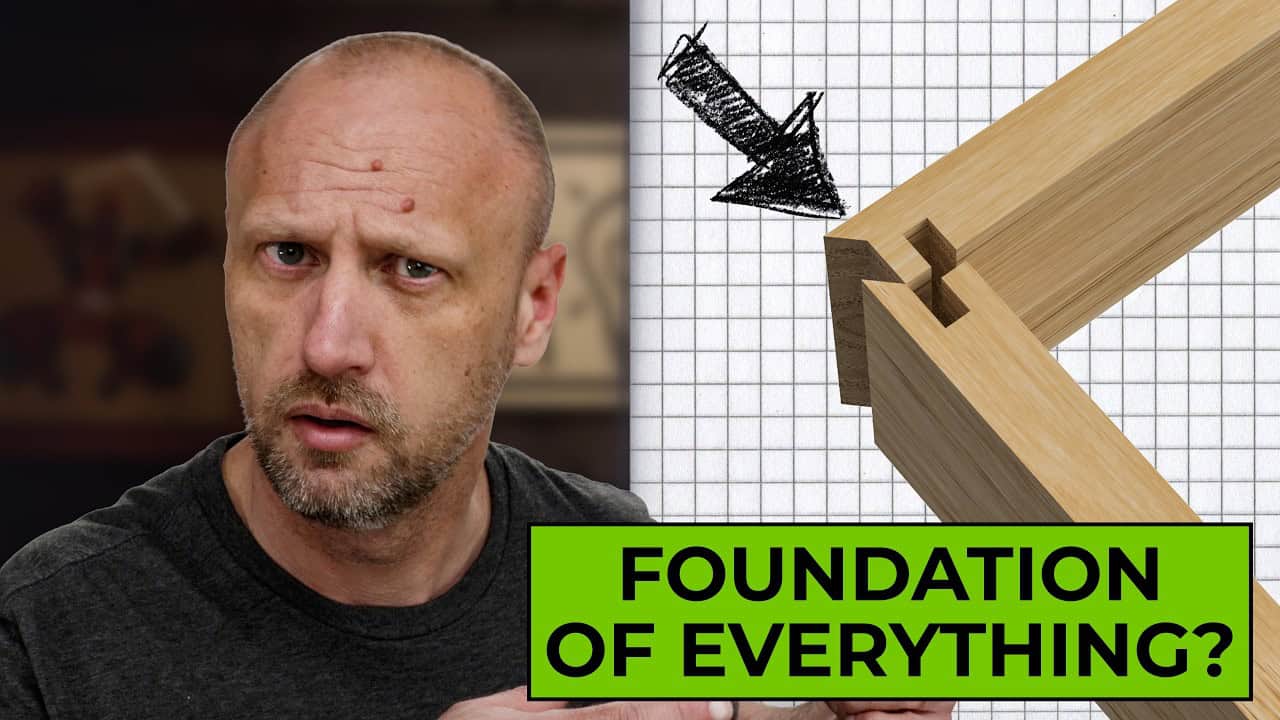
Billy from Newton Makes shared the woodworking tip featured in this video.
Billy demonstrates how mastering box-making joinery serves as the foundation for virtually any woodworking project. The video explores several essential joint types that combine to create endless possibilities in the workshop.
Watch the full video and subscribe to Newton Makes:
The Foundation of Box Making
Billy explains that box making relies on connecting boards at their intersections, creating a grid-like pattern of joint possibilities. Most joints consist of just two fundamental cuts: straight cuts and miter cuts.
This simple concept becomes the building block for more complex furniture and cabinetry projects. Once woodworkers understand how to join boards cleanly and securely, they can scale up to larger projects with confidence.
Basic Miter Joints
The classic miter joint forms the starting point for many box-making techniques. Billy emphasizes the importance of proper setup, using a combination square rather than relying on the saw’s built-in angle indicators for accuracy.
He demonstrates test cuts to verify blade angle before committing to final pieces. The setup process might seem lengthy compared to the actual cutting, but this precision proves crucial for more advanced joints later.
Rabbit Joints for Added Strength
Rabbit joints offer increased glue surface area compared to simple miters. Billy shows how to cut a notch in one board that perfectly accepts the thickness of the mating board.
The joint’s strength comes from gluing both face grain and end grain surfaces together. Billy keeps his rabbits shallow to minimize visible end grain on the finished box sides.
Combining Techniques
The rabbit miter joint combines the best aspects of both previous techniques. This joint requires cutting rabbits on both boards, with careful measurement to create interlocking geometry.
Billy demonstrates shading areas to be removed, helping visualize the cuts needed. The result eliminates visible end grain while maximizing glue surface area for superior strength.
Spline Miter Joints
The splined miter joint adds a reinforcing element to standard miter joints. Billy shows how to cut a groove across the joint line and insert a wooden spline with proper grain orientation.
Grain direction proves critical for the spline’s effectiveness. The spline can either blend invisibly with matching wood or create contrast with different species for decorative effect.
Advanced Locking Joints
The locking rabbit miter joint represents the most complex technique in the video. Billy guides viewers through multiple setup changes and cuts to create interlocking geometry.
This joint requires careful sequencing of cuts and precise blade height adjustments. The payoff comes in exceptional strength and professional appearance suitable for fine furniture work.
Universal Applications
These joinery fundamentals extend far beyond simple boxes. Billy points out how the same techniques appear in furniture, molding, shelving, and cabinetry throughout homes and workshops.
Understanding these basic joints allows woodworkers to analyze and reproduce complex projects by breaking them down into familiar components. The skills scale seamlessly from small boxes to large furniture pieces.
Watch the full video and subscribe to Newton Makes:

Matt’s Take
These are my personal thoughts and tips based on my own experience in the shop. This section is not written, reviewed, or endorsed by the original creator of this project.
Billy’s approach to box joinery really highlights something I’ve found true in my own shop work — getting your fundamentals rock solid opens up a whole world of possibilities. The way he breaks down complex joints into just two basic cuts (straight and miter) is spot on. It’s easy to get intimidated by fancy joinery, but when you realize most of it comes down to these building blocks, everything becomes more approachable.
His emphasis on setup time versus cutting time resonates with me. I’ve learned the hard way that rushing the setup phase usually costs you more time in the long run through do-overs and frustration. That combination square tip for checking miter angles is gold — those built-in saw indicators can drift over time, and a $15 square will save you from a lot of headaches.
The progression from basic miters to splined and locking joints makes perfect sense for skill building. Each technique builds on the last, so you’re not jumping into deep water without knowing how to swim. Once you’ve got these joints dialed in on practice pieces, the confidence boost is real. You start looking at furniture differently, seeing the joints instead of just the finished piece.