


The first time you walk through an old farmhouse, half of it doesn’t make sense.
Why is the front door so dressed up if nobody ever opens it? Why are the bedrooms so small? Why does the kitchen floor tilt toward the sink? Why are there two staircases?
You shrug, chalk it up to “old house quirks,” and move on with the tour.
Then you live in one for a winter. You learn which floorboards squeak on the back stairs. You close off the front parlor in November to save on propane. You realize the cast-iron thing bolted to the porch step isn’t decorative — it’s the most-used object on the property.
And slowly, everything starts to click. Every weird angle, every odd doorway, every random nook had a job to do. The people who built these houses weren’t being quirky. They were solving real problems with the tools they had. The “quirks” are just answers to questions modern homes don’t have to ask anymore.
Here are 27 things about old farmhouses that make no sense — until you live in one.
1. The Front Door Nobody Ever Uses

The front door faces the road. It usually has a transom window above it, a brass kick plate, maybe even sidelights. It’s the most architecturally impressive door on the house.
And nobody ever opens it.
The family comes in through the back, off the driveway or the mudroom. Friends come in through the back. The mail carrier doesn’t need it. The Amazon driver leans the box against it and walks away.
The front door was for company — formal visitors, the pastor, the doctor. On a working farm, those visits happened a few times a year. The back door was for the actual life of the house. That’s never changed.
2. Not a Single Bedroom Has a Closet

Walk through every bedroom in an old farmhouse and you’ll notice the same thing. No closets. Anywhere.
A few theories get passed around. Some say closets used to be taxed as rooms. Some say it was a budget thing. Both are partly true, but the bigger reason is simpler — people just didn’t own that many clothes.
A working family had a few outfits, a Sunday best, a winter coat, and that was it. Everything fit in a wardrobe, a chest of drawers, and a hook on the back of the door.
You only realize how big a problem this is when you try to live there with three pairs of shoes per kid and a closet’s worth of winter coats.
3. Two Completely Different Staircases

The “main” staircase comes off the front hall. Wide treads, finished banister, sometimes a little carpet runner. It’s the staircase the house got photographed on for the realtor.
Then there’s the other one. Tucked behind the kitchen, narrow, steep, treads worn smooth by 130 years of work boots.
That’s the kitchen stair, and it was the staircase that actually got used. Hired hands going up to bed. Kids getting sent up after chores. The cook running between the kitchen and the upstairs bedrooms with laundry baskets.
The front staircase was for company. The back one was for life. You’ll figure out within a week which one you actually use.
4. A Summer Kitchen Tacked Onto the Back of the House

You notice it from the outside first. There’s the main house, and then there’s a smaller, lower addition stuck onto the back — sometimes with its own chimney, sometimes connected through a breezeway.
That’s the summer kitchen.
Before air conditioning, cooking in July would turn the whole house into an oven. So farmhouses had a second kitchen, usually open and breezy, where canning, butchering, soap making, and most of summer’s hot work happened. The main kitchen got a break from May to September.
A lot of summer kitchens are now mudrooms or screened porches or laundry rooms. But you can usually find the old stovepipe hole in the ceiling and a chimney on the outside that doesn’t connect to anything anymore.
5. The Little Milk Door in the Kitchen Wall

Look at the back kitchen wall, near the floor, and you might find a small two-sided cabinet built right into the wall. Insulated, with a little hinged door inside and outside.
That’s the milk door.
The milkman opened the outside door before sunrise, took the empty bottles, and left full ones. Whoever was up first in the kitchen grabbed the milk from the inside without ever opening the back door. The kitchen stayed warm. The milk stayed cold. Nobody had to talk to anyone.
Most have been bricked over or turned into spice cabinets, but every once in a while you’ll find one still operational, with the original hinges and a faint smell of cool stone.
6. Walking Through One Bedroom to Get to Another

The upstairs of an old farmhouse often doesn’t have a hallway. Or if it does, it serves two bedrooms and not the third. To get to the back bedroom, you have to walk through the middle bedroom.
This drives modern families crazy. It violates every privacy rule you grew up with.
But it made sense at the time. A hallway is wasted square footage that has to be heated. If three siblings were sharing a single coal stove on the second floor, the bedrooms had to connect. The kid in the back room walked through their sibling’s room every morning of their childhood.
It still works if you have kids small enough not to mind. It just doesn’t work in a marriage.
7. A Pantry Bigger Than Some of the Bedrooms

The pantry isn’t a closet with shelves. It’s a room. With its own window. Sometimes its own door to the outside.
Wide shelves built right into the walls, a marble or wood counter for kneading bread, drawers for flour and sugar, and floor space for crocks of pickles and barrels of apples.
This was the food infrastructure of a household that grew or raised most of what it ate. You weren’t buying a week of groceries — you were storing a year of harvest. The pantry needed to hold canned tomatoes by the dozen, cured ham, dry beans, root vegetables, and whatever the orchard produced.
Modern kitchens have giant fridges and tiny pantries. Old farmhouses had small kitchens and pantries you could get lost in.
8. Floors That Slope Toward the Middle of the Room

Drop a marble in any old farmhouse and it’ll roll. Sometimes toward a doorway, sometimes toward the middle of a room, sometimes in a direction that doesn’t make sense at all.
You panic the first time. You wonder if the house is falling down.
It’s not. It’s settled. A hundred and fifty years of weight pressing on hand-hewn beams sitting on a fieldstone foundation will produce some artistic floor lines. Doors will rub in summer and clear in winter. Picture frames will go crooked overnight. You’ll buy a level and immediately regret it.
The trick is to stop expecting square. Once you accept that the house has a personality, everything gets easier.
9. Windows Angled Diagonally to Fit Under the Eaves
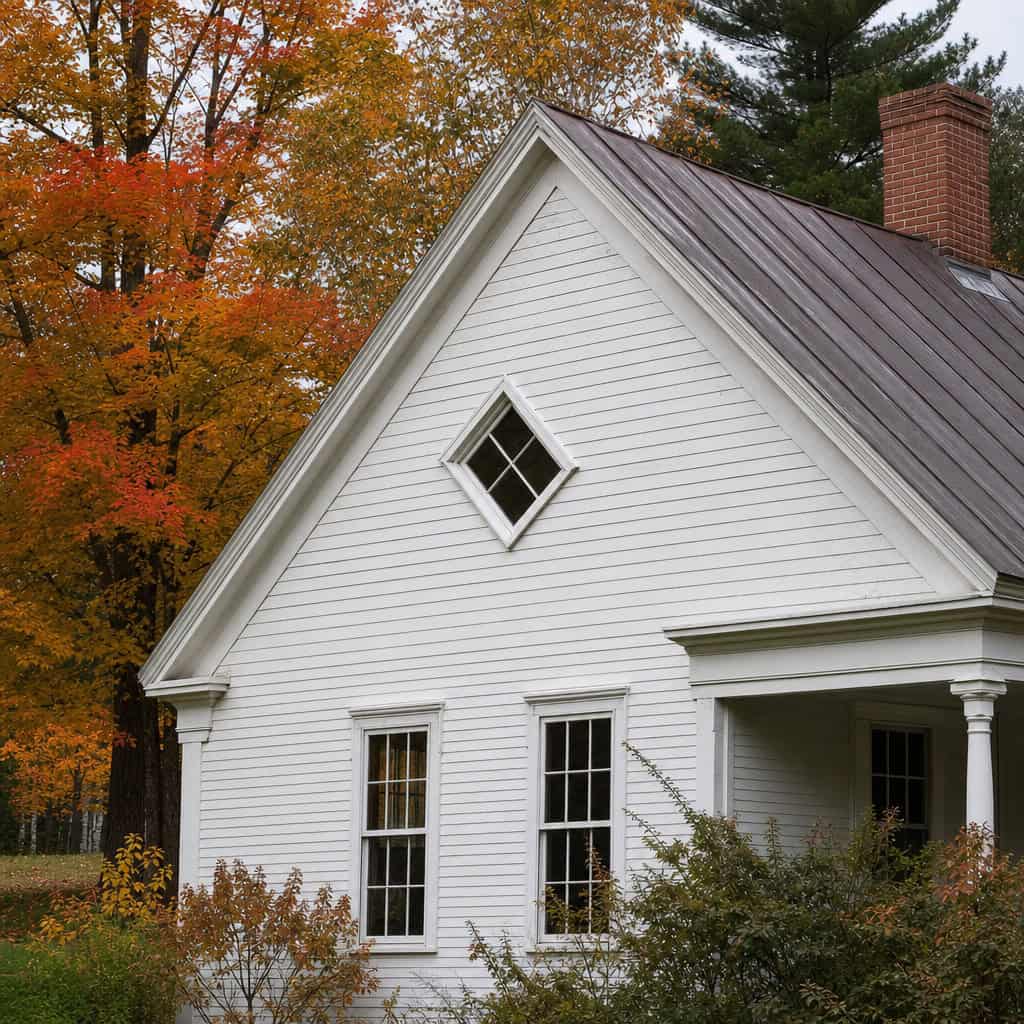
If you’ve ever driven through Vermont, you’ve probably seen one — a regular rectangular window mounted on a 45-degree angle, sitting in the side of a roof gable.
They’re called witch windows, or sometimes Vermont windows or coffin windows.
The story is they were angled so a witch couldn’t fly through them on a broomstick. The real story is more practical. When farmhouses were expanded with steep-roofed additions, builders had a standard rectangular window left over and a tight space under the new eaves. Rotating the window 45 degrees let it fit.
The whole “witch” thing came later. But it does look like a haunted house feature, so the name stuck.
10. The “Front Parlor” Nobody Is Ever Actually Allowed to Sit In

Old farmhouses had a parlor at the front of the house with the best furniture, the nicest rug, the family Bible on a side table, and a couch nobody ever sat on.
You weren’t supposed to sit on it. You weren’t supposed to walk on the rug. The room sat empty 360 days a year, waiting for funerals, weddings, the minister’s annual visit, and Christmas.
In a tiny house with not nearly enough living space, this seems insane. But the parlor wasn’t really a living room. It was a stage set for the moments that mattered, kept perfect for the times it would be needed.
The family lived in the kitchen, the sitting room, and the back porch. The parlor was for the family the world thought they were.
11. A Staircase That Ends at the Ceiling

Sometimes you’ll find a staircase in an old farmhouse that goes up four or five steps and then stops at a flat plastered ceiling.
It used to lead somewhere. A second-floor bedroom that got walled off. An attic conversion that went a different direction. A whole second story that came down in a fire and got rebuilt without the same access.
The stairs stayed because tearing them out would have meant rebuilding the floor underneath. So they sit there, half a staircase, and become a bookshelf or a plant stand or a place to set the laundry basket.
Every old farmhouse has at least one piece of architecture like this — something that used to be useful and got stranded.
12. The Root Cellar With the Dirt Floor

Down through a trapdoor in the kitchen floor, or out through a slanted door in the side yard, there’s a small room dug into the earth.
Stone walls. Dirt floor. Wooden shelves sagging under the weight of canning jars. It smells like cold soil and apples and the slight, sweet rot of last year’s potatoes.
The temperature down there is the same in February as it is in August — around 55 degrees. Before refrigerators, that constant cool meant you could keep root vegetables, apples, cabbages, and canned goods through the winter without spoilage.
You don’t need it now. But if your power goes out for three days in January, you’ll start to understand why every old farmhouse had one.
13. A Boot Scraper Bolted Into the Porch Step

Cast iron, mounted at ankle height beside the back door, often shaped like a dog or a curved bar.
If you grew up in a suburb, you might have walked past one a hundred times and assumed it was decorative.
It is not decorative.
Farms produce mud. Pastures produce manure. Working barnyards produce both at once. Coming into the house without scraping your boots first meant tracking that mess across every floor you walked on. The boot scraper was the first piece of cleaning equipment in the house, and on a real working farm, it earned its keep every single day.
14. Bedrooms So Small the Dresser Blocks the Door

Some of the upstairs bedrooms in an old farmhouse are barely bigger than the bed. There’s room for a twin frame, a small dresser, and a chair. That’s it.
A few reasons. Bedrooms were considered private and weren’t decorated for guests, so families spent the money on the rooms visitors would see. Smaller rooms held heat better when the only source was a wood stove on the floor below. And if you had eight kids, you needed eight rooms — period.
Sleep was the only thing those rooms had to do. You weren’t supposed to hang out in your bedroom. You weren’t supposed to do homework in your bedroom. You slept, you got dressed, you came downstairs.
A teenager today would lose their mind. A farm kid in 1910 didn’t have the option.
15. The Mudroom That’s the Only Working Entrance

The back of the house — not the front, not the side — has a small room with a tile or linoleum floor, a row of hooks, a bench, and a door that goes outside.
That’s where everyone enters the house. Always. Forever.
Boots come off in the mudroom. Coats go on hooks in the mudroom. The dog gets towel-dried in the mudroom. Groceries get dropped on the bench in the mudroom. Then, and only then, you go into the actual house.
A modern builder will tell you a mudroom is a luxury feature. An old farmhouse will tell you it’s non-negotiable. The house didn’t have one because it was designed by an architect — it had one because the dirt had to stop somewhere.
16. One Bathroom for the Entire House

A four-bedroom, two-story farmhouse with eight people living in it had one bathroom. Sometimes none — that came later.
This is hard to picture today. But indoor plumbing was retrofit into most of these houses long after they were built, and the easiest place to put it was wherever the pipes could reach.
That meant a single bathroom, usually carved out of a closet or a small bedroom on the second floor, fed by a stack that ran straight down to the kitchen. Everyone in the house used it. Everyone waited their turn. You learned to be efficient or you learned to wait.
You can renovate this. People do. But adding a second bathroom to an old farmhouse is the kind of job that involves opening up walls and finding things nobody wants to find.
17. Transom Windows Above Every Interior Door

Look above the doorways in an old farmhouse and you’ll often see a small horizontal window built into the wall above the door frame.
These are transom windows, and they hinge open from the bottom.
Before central air, the only way to move air through a closed house was to leave the windows and doors open — which meant losing privacy. Transom windows solved it. Close the door for privacy, leave the transom cracked open, and air still circulated through the room.
A lot of them got painted shut decades ago. Some got covered over. But if you’ve got them and you can free them up, you’ll be amazed how much better the upstairs breathes in July.
18. The Coal Chute That’s Been Bolted Shut for Fifty Years

Halfway up the foundation wall, on the outside of the house, there’s a small metal door angled into the basement.
Coal trucks would back into the driveway, drop a chute against that little door, and pour several hundred pounds of coal directly into a bin in the basement.
The bin was right next to the coal furnace. Someone — usually a kid, usually the oldest boy — shoveled coal into the furnace several times a day during winter.
The coal chute went out of use in most farmhouses by the 1960s. But the door is still there, often rusted shut, often hidden behind shrubbery. Sometimes you can still find black smudges on the wall above where the bin used to sit.
19. A Barn, Shed, or Woodshed Attached Directly to the House

In New England especially, old farmhouses are connected to their outbuildings. The kitchen leads to a small room, which leads to the woodshed, which leads to the wagon shed, which leads to the barn.
This is called a connected farmstead, or more affectionately, “big house, little house, back house, barn.”
The reason was winter. When you’ve got three feet of snow on the ground and you need to do chores at 5 a.m. in 10-degree weather, you don’t want to put on a coat and go outside. You want to walk from your kitchen, through three small heated buildings, and step into the barn.
Modern building codes hate this. Insurance companies hate this. But anyone who’s ever had to feed animals in a snowstorm understands why someone built it that way.
20. A Kitchen on the Opposite End of the House From the Dining Room

In the floor plan of an old farmhouse, the kitchen is often as far from the dining room as it’s possible to be — sometimes with two or three rooms in between.
This doesn’t make sense until you remember what kitchens used to be.
A wood- or coal-fired stove pumped out enormous heat. Cooking dinner could turn the kitchen into a 95-degree sweatbox even in October. You did not want that heat — or the smells of butchering, frying onions, and baking bread — drifting into the room where the family was eating.
So the kitchen got pushed to one end of the house. Sometimes through a butler’s pantry, sometimes through a back hall. The walk wasn’t a design flaw. It was a buffer.
21. A Door in the Middle of a Wall That Opens to Nothing

Sometimes you’ll find a perfectly good interior door — hinges, knob, panels — that opens onto a wall. Or a window. Or another door.
This usually happens because the house got reconfigured. A room got split into two. An addition got added that swallowed up a porch. A staircase got rerouted. The door stayed because removing it would have meant patching the wall and re-trimming the doorway.
So the door just sits there, opening to a dead end, slowly becoming a piece of furniture.
You’ll stop noticing it after a while. The previous owners did too.
22. A Laundry Chute From the Second Floor to the Basement

A small hinged door in the wall of the upstairs hallway, or in the bathroom, that opens onto a vertical shaft running straight down through the house.
Dirty clothes go in. Gravity does the rest.
The basket lands somewhere near the washing machine in the basement, where laundry day was a full-day affair involving a wringer washer, a clothesline, and several pairs of hands.
The chute saved someone — usually mom — from carrying laundry baskets up and down two flights of stairs. It’s such a useful little invention that you wonder why new construction stopped including them. The answer is fire code. Open vertical shafts move smoke and flame between floors very quickly.
23. Walls So Thick a Phone Signal Can’t Get Through

You hold up your phone in the middle of the living room and the signal drops to one bar. You step out onto the porch and it jumps back to full.
Old farmhouse walls are sometimes a foot or more thick. Solid masonry on the outside, plaster on lath on the inside, sometimes with a layer of horsehair binder. The walls were that thick because that’s what kept the heat in during winter and out during summer.
It works. Old farmhouses are notably cooler in August than newer ones with central air. The trade-off is that your wi-fi has to fight through twelve inches of plaster, brick, and horsehair to reach the back bedroom.
You’ll buy a mesh router. They all do.
24. Plumbing That Takes the Scenic Route Through the House
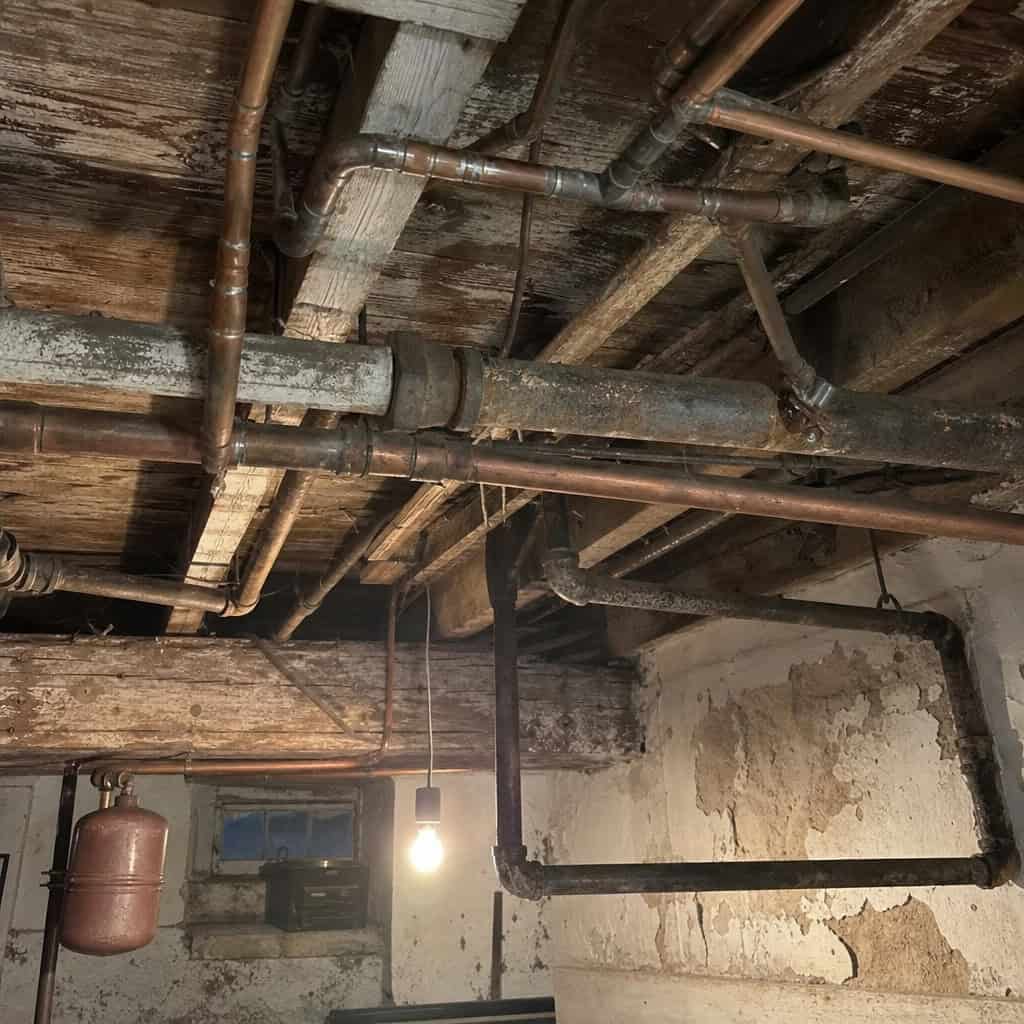
Open a cabinet in an old farmhouse and you’ll find pipes running in directions that defy logic. Up, over, down, around, through a corner, behind a beam, and back up again.
This is because plumbing wasn’t there originally. Every pipe in the house was added later — sometimes much later — and the people who added it routed it wherever they could find a path.
The kitchen sink might be fed by a pipe that goes up through the ceiling, across the attic, down through a closet, and into the wall. The upstairs toilet might share a stack with a bathroom that wasn’t there when the first floor was built.
When something leaks, finding the source can take an afternoon. When something freezes, you may not be able to reach it without opening a wall.
25. Drafts No Amount of Weatherstripping Can Fix

You can caulk every window, weatherstrip every door, and add foam insulation in every visible gap, and the house will still be drafty.
Old farmhouses leak air everywhere. Around the chimney. Between the floorboards. Behind the baseboards. Through gaps in the foundation that you can’t see because they’re hidden behind 130 years of accumulated stuff.
Some of that draft was intentional — old houses were designed to breathe, because moisture trapped inside a poorly ventilated house would cause more damage than the cold. But a lot of it is just settlement, shrinkage, and gravity working on materials that were never meant to be airtight.
You accept it. You wear a sweater. You learn which spots get hit hardest and you put your reading chair somewhere else.
26. Closing Off Half the House in Winter

By December, the heat bills become a real problem. Old farmhouses were built to be heated by burning wood or coal in specific stoves, in specific rooms, while everyone wore wool indoors.
A modern furnace trying to heat the whole house to 68 degrees has no chance.
So you close doors. You drape blankets over openings. You shut down the parlor, the formal dining room, and the upstairs guest bedroom from Thanksgiving to March, and the family lives in two or three rooms downstairs and a couple of bedrooms upstairs.
It feels weird the first winter. By the second, it feels normal. By the third, you’re amazed anyone ever heats their whole house in December.
27. Floors That Creak in a Pattern You Eventually Memorize

The last one is the most personal.
Every old farmhouse has its own song. A specific board in the upstairs hallway, the second tread on the back stairs, the floor in front of the bathroom sink, the threshold between the kitchen and the dining room — all of them make a particular sound when weight hits them.
You don’t notice it the first week. You’re too distracted by the house being unfamiliar. But by the end of the first month, you’ve started to recognize which footsteps belong to which family member just by the sound of the floor.
By the end of the first year, you’ve mapped the silent paths. You know which boards to step on and which ones to skip if you want to come downstairs at 4 a.m. without waking anyone. You learn it without trying. It just becomes part of how you move through the house.
A new house never does that. It can’t.
There’s a reason old farmhouses are still standing. The people who built them weren’t trying to make beautiful houses. They were trying to solve daily problems with whatever was on hand — heat, food, livestock, family — and the solutions piled up into the building.
Living in one means reading those solutions a layer at a time. The witch window. The milk door. The back staircase. The sloping floor. The door that opens to nothing. None of it makes sense the first time you see it. All of it makes sense the longer you stay.
And eventually you realize the house was never weird. You just didn’t know enough to understand it yet.