

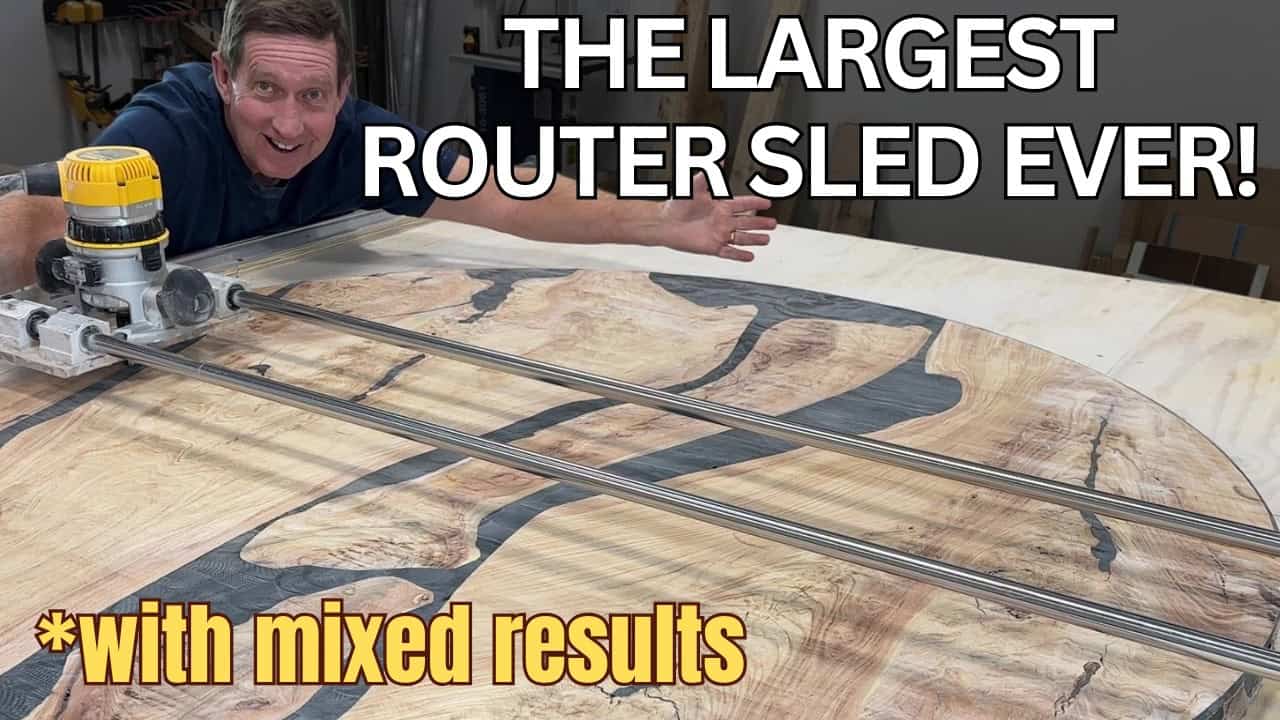
This project was built and designed by Steve from JKM Woodworking.
When tackling a massive round table project, Steve found that his original router sled’s width capacity wasn’t sufficient for the task at hand.
Watch the full video and subscribe to JKM Woodworking:
The Challenge of Scaling Up
The original router sled handled pieces with ease lengthwise but was limited in width capacity due to the cross rail length. While the original sled could accommodate unlimited length by sliding workpieces along, width was constrained by the rail system.
Steve’s solution involved sourcing longer rails, but the specific style he needed wasn’t readily available in the required length. His discovery that one rail type was essentially another with an aluminum base led to a creative workaround that maintained compatibility with existing bearing blocks.
Building a Temporary Platform
The expanded router sled demanded a much larger work surface than his existing workbench could provide. Steve constructed a temporary platform using carefully selected and prepared lumber, emphasizing the critical importance of achieving perfect flatness.
The platform construction involved straightening lumber edges with a jointer, then running everything through the planer to ensure consistent width and parallel surfaces. A plywood top created the actual work surface, with leveling feet allowing fine adjustments to achieve absolute flatness in all directions.
Assembly and Setup Challenges
Mounting the extended rail system required raising them slightly with plywood strips to accommodate the thick tabletop workpiece. Multiple checks ensured the entire assembly remained level and true throughout the setup process.
The router mounting and depth adjustment followed the same principles as the original sled, but the larger scale introduced new considerations for smooth operation and accessibility.
Operating the Supersized Sled
The expanded work area created reach limitations that required Steve to work from multiple positions, making complete passes across the workpiece impossible from a single side. This approach led to visible router marks where passes overlapped, highlighting the need for better planning in future large-scale operations.
The longer rails introduced flexibility issues that weren’t present in the original design. While the router weight wasn’t problematic, care was needed to avoid downward pressure that could cause the rails to flex and affect the final surface quality.
Original Router Sled Design Review
The original sled design utilized two rail systems working together, with side rails providing the main support structure and cross rails enabling width adjustment. The router mounting system used a simple acrylic tray that accommodated multiple router bases while maintaining precision.
The acrylic components were cut and drilled using straightforward woodworking techniques, with templates ensuring accurate hole placement. The modular design allowed for easy disassembly and storage when not in use.
This scaling project demonstrates how woodworking jigs can be adapted for larger applications while revealing the engineering considerations that become important at increased sizes. The experience provides valuable insights for anyone considering similar expansions to their shop-made tools.
Watch the full video and subscribe to JKM Woodworking:

Matt’s Take
These are my personal thoughts and tips based on my own experience in the shop. This section is not written, reviewed, or endorsed by the original creator of this project.
Router sleds are one of those jigs that seem simple until you start scaling them up. What Steve discovered here is something I’ve found with a lot of shop-made tools — the physics change when you go bigger. Those rail flex issues he mentioned are real, and they’re exactly why commercial versions of large router sleds often use box beam construction or additional support points.
The platform building approach is spot-on. Getting that base perfectly flat is absolutely critical because any twist or bow gets transferred directly to your workpiece. I always keep a decent straight edge handy for checking these setups — a 4-foot level works great for most situations. Those adjustable feet are a game-changer too, especially if you’re working on a shop floor that isn’t perfectly level.
One thing worth considering for future builds is planning your pass strategy before you start routing. Those overlap marks Steve dealt with are common when you’re working from multiple positions. Taking lighter passes and maybe marking your stopping points can help minimize them. The trade-off between working time and surface quality is always there with large pieces.
The modular design philosophy really shines here — being able to break things down for storage makes these larger jigs much more practical in smaller shops. Sometimes the best tool is the one you’ll actually use because it doesn’t take up half your shop space.