


The walls of your house are not empty.
If your home was built before 1970, there are things inside those walls that the builder put there on purpose, things that previous owners shoved in and forgot about, and things that moved in on their own and never left.
Some of them are fascinating. Some of them are valuable. A few of them are genuinely unsettling.
Every time someone opens up a wall during a renovation, they find something. Old newspapers. Strange wiring. Materials that have not been manufactured in a century. And occasionally, things that nobody can explain.
Here are 25 things hiding behind the walls of old American homes right now — and most homeowners have no idea any of it is there.
1. Horsehair Plaster

If your home was built before 1940, there is a very good chance your walls contain actual animal hair.
Horsehair plaster was the standard wall finish for centuries. Builders mixed powdered lime, sand, water, and handfuls of horsehair — usually from the tail — into a thick paste and spread it over the walls in three separate coats. The hair acted as a binding agent, holding the plaster together as it cured and preventing it from cracking.
Pull a chunk of old plaster off the wall in a pre-war home and you can see the hairs. They are dark, wiry, and woven throughout the material like rebar in concrete.
The result was a wall that was rock hard, nearly an inch thick, and would last a hundred years. Modern drywall is gypsum sandwiched between two sheets of paper. A doorknob swung too hard goes right through it.
Horsehair plaster does not care about your doorknob.
2. Knob-and-Tube Wiring

Somewhere inside the walls of millions of American homes, electricity is still running through a system that was invented in the 1880s.
Knob-and-tube wiring uses individual copper conductors wrapped in rubber and cloth insulation, strung through porcelain knobs mounted to the framing and threaded through porcelain tubes where wires pass through studs. There is no ground wire. There is no plastic sheathing. Just bare copper and century-old fabric keeping the electricity from touching the wood.
When it was installed, it was state of the art. And when left alone, it actually works fine — the open-air design allows heat to dissipate, which is why so many systems are still functioning.
The problem is that it was designed for a house that used a few light bulbs and maybe a radio. It was not designed for air conditioners, microwave ovens, and 47 things plugged into power strips.
Most insurance companies will not cover a home with active knob-and-tube. But removing it means opening every wall in the house. So it stays — humming quietly behind the plaster, doing its job the way it has since the day someone strung it up by hand.
3. Balloon Framing

If your house was built between the 1850s and the 1940s, there is a decent chance its walls are a fire hazard by design.
Balloon framing was a revolutionary construction method that used long, continuous studs running from the foundation all the way to the roofline — sometimes 20 feet or more in a single piece. It was faster and cheaper than the heavy timber framing it replaced, and it helped fuel the housing boom of the late 1800s.
The problem is that those continuous wall cavities act like chimneys. If a fire starts in the basement, it has a clear, unobstructed path through the wall cavity all the way to the attic. No fire stops. No blocking. Just a vertical channel of air and dry wood from the bottom of the house to the top.
Modern platform framing breaks those cavities at every floor with horizontal plates, which slows or stops fire from traveling vertically. Balloon framing has no such barrier.
Fire departments know this. When a balloon-framed house catches fire, the entire structure can be fully involved before the trucks arrive.
4. Lath Strips

Behind every old plaster wall, there is a hidden wooden skeleton that most people never see.
Lath strips are thin pieces of wood — usually about an inch and a half wide and a quarter inch thick — nailed horizontally across the wall studs with small gaps between them. Wet plaster was pressed over the lath, and it oozed through those gaps and hardened on the other side, forming little hooks called “keys” that locked the plaster to the wall.
It was an ingenious system. The plaster gripped the lath, the lath was nailed to the studs, and the whole thing became one solid mass. It is why old plaster walls feel like concrete when you knock on them.
When you see someone demolish an old wall, the plaster falls away in chunks and reveals row after row of these thin wooden strips — like the ribs of the house exposed for the first time in a century.
Electricians hate them. Plumbers hate them. Anyone trying to fish a wire through an old wall hates them. But they did their job better than anything that replaced them.
5. Newspaper Insulation

In a lot of old homes, the only thing standing between you and the outside air is a stack of newspapers from 1927.
Before modern insulation existed, builders and homeowners stuffed whatever they could find into wall cavities to block drafts. Newspaper was free, it was everywhere, and it was easy to crumple up and shove between studs. So that is exactly what they did.
Open up a wall in a pre-war home and you might find ten, twenty, or fifty sheets of newspaper packed into the cavity. Some are neatly folded. Some are crumpled into balls. Some were clearly shoved in by someone who was just trying to stop a draft on a cold Tuesday in February and did not think about it again for the rest of their life.
The papers are often perfectly preserved — headlines, advertisements, and all. They are a time capsule that tells you not just when the wall was built, but when it was last opened.
6. Sawdust and Hay

Newspaper was not the only thing people shoved into their walls.
In rural homes especially, sawdust was a common cavity filler. If you lived near a sawmill — and in the 1800s, most people did — you had access to an endless supply of fine wood shavings that could be packed into wall cavities by the bushel.
Hay, straw, and even dried seaweed were also used. In coastal New England, eelgrass was a popular choice because it was naturally resistant to insects and rot. Some homes have had eelgrass in their walls for over 150 years and it still looks like the day it was installed.
The insulation value of these materials is minimal by modern standards. But they were free, they were available, and they were better than nothing — which is what most walls had before the 1950s.
Open up a wall in a farmhouse and the sawdust pours out like sand from a broken hourglass. It smells like the 19th century.
7. Asbestos

There is a material inside the walls of millions of American homes that was once considered a miracle product and is now one of the most feared words in home renovation.
Asbestos was used in everything. Pipe insulation. Floor tiles. Roof shingles. Siding. Plaster. Joint compound. Duct tape. Vermiculite attic insulation. If your home was built or renovated between the 1920s and the 1980s, there is a very real chance that asbestos is somewhere inside your walls right now.
It was popular because it was fireproof, incredibly durable, and cheap. It was everywhere because nobody knew — or at least nobody admitted — that breathing its microscopic fibers could cause fatal lung disease.
Asbestos that is intact and undisturbed is generally not dangerous. The problems start when you sand it, cut it, drill into it, or demolish it — which is exactly what happens during every renovation.
This is why asbestos abatement is one of the most expensive line items on any old house renovation budget. You cannot just throw it in a dumpster. It has to be removed by licensed professionals in protective equipment and disposed of at a regulated facility.
It is the invisible guest that nobody invited and nobody can afford to remove.
8. Lead Paint

The walls of your old house are not just painted.
They are painted eight times. Maybe twelve. Maybe twenty. Layer upon layer upon layer, going back decades, each coat applied directly over the last because scraping and priming is work that nobody wanted to do in 1954 any more than they want to do it now.
And beneath those layers — usually the oldest, closest to the wood — is lead paint.
Lead-based paint was the industry standard for centuries because it was durable, it dried to a hard finish, it resisted moisture, and it held color beautifully. It was in virtually every home built before 1978, which is when the federal government finally banned it.
The paint is not dangerous as long as it is intact. But when it chips, peels, or gets sanded during a renovation, it creates toxic dust that is especially harmful to young children.
In most old homes, the lead paint is still there. It was never removed. It was just painted over — buried under a dozen newer coats, quietly waiting behind every door frame, window sash, and baseboard in the house.
9. Old Gas Lines

Before electricity, American homes ran on gas.
Gas lighting was the standard in urban homes from the mid-1800s through the early 1900s. Thin iron or brass pipes ran through the walls from a basement gas meter to fixtures in every room — wall sconces, pendant lights, even desk lamps. You turned a small valve, struck a match, and the room filled with a warm, slightly flickering glow.
When electricity arrived, most homes were wired alongside the existing gas lines rather than replacing them. The gas fixtures were removed, the pipes were capped — sometimes — and the walls were closed up.
Those pipes are still in there.
In some homes, they were never properly capped. In others, the gas was never fully disconnected. Contractors working on old homes occasionally discover live gas lines that have been sitting dormant behind plaster for a century, still connected to a meter nobody remembers.
10. Hidden Chimney Flues

Not every chimney goes where you think it does.
Old homes often had multiple fireplaces — sometimes one in every room. Each fireplace had its own flue running up through the walls to the roofline. When central heating arrived and the fireplaces were sealed up, those flues did not disappear. They were just hidden.
Open up a wall in a Victorian home and you might find a perfectly intact brick flue running vertically through the house that nobody knew was there. Sometimes the fireplace opening was drywalled over. Sometimes the entire chimney breast was framed out and turned into a closet. Sometimes a previous owner just wallpapered right over the mantel.
These hidden flues can cause problems. They create air channels that carry drafts, moisture, and even smoke from the remaining active fireplace. They can also be a structural asset — the brick mass stores heat, and many homeowners who discover a hidden fireplace choose to reopen it.
The chimney was there first. The wall came later.
11. Cast-Iron Plumbing

Somewhere beneath your bathroom, there are drain pipes that weigh more than your refrigerator.
Cast-iron plumbing was the standard in American homes from the late 1800s through the 1970s. The pipes were heavy, thick-walled, and virtually indestructible. A four-inch cast-iron drain pipe weighs about four pounds per foot — an entire house worth of drain piping could weigh several hundred pounds.
Plumbers connected the sections using molten lead and oakum — a tarred hemp fiber packed into the joints. It was slow, skilled work. Every joint was hand-poured and hand-packed.
The pipes were built to last, and many of them have. It is not uncommon to find fully functional cast-iron drains in homes that are 120 years old. The metal develops a thick layer of internal scale over the decades, but the pipe itself just keeps working.
Modern PVC replaced cast iron because it is lighter, cheaper, and faster to install. It also sounds like a waterfall inside the wall every time someone flushes a toilet. Cast iron was silent.
That is a trade-off nobody talks about.
12. Cloth-Wrapped Electrical Wiring

In the decades between knob-and-tube and modern Romex, there was an awkward middle child of residential wiring that is still hiding inside millions of walls.
Cloth-wrapped wiring — sometimes called “rag wire” — was common from the 1920s through the 1960s. The copper conductors were insulated with rubber, then wrapped in a woven fabric sheath, usually cotton or rayon. It looked like a thick, braided cord running through the walls.
The rubber insulation was the weak link. Over time — and we are talking decades — the rubber dried out, cracked, and crumbled away, leaving bare copper conductors with nothing but a thin layer of deteriorating fabric between them and the wood framing.
This wiring is not as immediately recognizable as knob-and-tube, so it often gets overlooked during inspections. But it can be just as dangerous, especially in homes where the circuits have been overloaded with modern electrical demands.
If you pull off a switch plate in an older home and see fabric-covered wires instead of the familiar yellow or white plastic Romex, that is what you are looking at.
13. Previous Renovation Layers

Every old house is a layer cake.
Open up a wall in a home that has been lived in for a century and you will find the evidence of every person who ever tried to “fix it up.” Drywall nailed over plaster. Plaster applied over even older plaster. Paneling glued over drywall that was nailed over plaster that was applied over lath that was nailed to studs that were hand-hewn from trees that were standing when Lincoln was president.
Each layer tells a story. The 1970s paneling says someone wanted to modernize. The 1950s drywall says someone got tired of patching plaster cracks. The original horsehair plaster underneath says someone built this wall to last forever and was right.
Contractors call this “the archaeology of renovation.” Every layer has to come off before you can get to the framing, and every layer fights you on the way out.
The irony is that the oldest layer is almost always the strongest.
14. Original Architectural Details Buried Under “Improvements”

Somewhere behind the flat, featureless drywall of a “renovated” old home, there is a hand-carved archway that someone decided was not modern enough.
This happens constantly. Previous owners — or worse, house flippers — cover up original architectural details because they do not match the current trend. Crown molding gets drywalled over. Built-in cabinets get framed out and turned into flat walls. Arched doorways get squared off. Pocket doors get sealed shut and forgotten.
The details are almost always still there. Wood does not rot behind drywall unless there is a moisture problem. The molding is still nailed to the framing. The pocket door is still in the wall, sitting on its track, waiting for someone to come find it.
Every year, old home owners post photos online of what they found when they peeled back a “modern” renovation. Original leaded glass transoms above doors. Hand-turned stair balusters hidden behind a plywood enclosure. Wainscoting in perfect condition behind a layer of 1970s paneling.
The details were too expensive to build. They cost nothing to destroy. And they are still there — buried, not gone.
15. Old Razor Blade Slots

This one stops people in their tracks every time.
If your home was built between the 1920s and the 1970s and it has an original medicine cabinet in the bathroom, look at the back wall of that cabinet. There is a good chance you will find a narrow slot — about an inch and a half wide — cut directly into the wall.
That slot was for used razor blades. You finished shaving, popped the blade out of the razor, and dropped it through the slot into the wall cavity. That was it. That was the disposal system.
Nobody ever retrieved them. Nobody ever planned to. The blades just fell between the studs and stayed there — forever.
Open up a bathroom wall in one of these homes and you will find a pile of rusty razor blades sitting on the bottom plate. Sometimes a few dozen. Sometimes hundreds. All stacked on top of each other like a tiny, forgotten junkyard inside the wall.
The slot was a standard feature of recessed medicine cabinets for decades. It was printed in the installation instructions. “Dispose of used blades through the slot provided.”
Nobody thought about what would happen 80 years later when someone opened that wall.
16. Prohibition-Era Liquor Bottles

Between 1920 and 1933, it was illegal to manufacture, sell, or transport alcohol in the United States.
So people hid it in their walls.
Contractors renovating homes from this era routinely find bottles — sometimes individual, sometimes entire stashes — tucked between studs, buried under floor joists, or shoved into wall cavities and sealed behind plaster. Whiskey, gin, homemade wine. Some bottles are still full.
In one well-documented case, a couple renovating their home found dozens of bottles of Old Smuggler whisky inside the walls and under the floors. The bottles dated to the 1920s, and the full ones were estimated to be worth up to a thousand dollars each at auction.
The bottles were hidden in a hurry and never retrieved — either because the owner forgot where they put them, got arrested, or simply never came back.
Ninety years later, the walls gave them up.
17. Old Coins and Cash

People did not always trust banks.
During the Depression — and for decades before and after it — families hid money inside their homes. Wall cavities, floor joists, attic rafters, and the spaces above door frames were all common hiding spots. Some people used tin cans. Some used cigar boxes. Some just folded bills and shoved them into cracks.
A contractor in Ohio found $182,000 in Depression-era currency inside a bathroom wall. A couple in Minnesota found a forgotten wall safe with jewelry and documents. A family in Kansas found gold coins in a tin can wedged between studs.
The money was hidden by people who survived economic collapse and learned the hard way that the safest place for their savings was inside their own walls, where they could touch it.
Some of it has been found. Most of it probably has not.
18. Stained Glass Windows

Few things hit harder than finding a beautiful stained glass window that has been sealed behind drywall for 50 years.
It happens more often than you would think. When tastes changed — or when a previous owner just wanted a “cleaner look” — stained glass windows were covered over rather than removed. Some were drywalled from the inside. Some were bricked up from the outside. Some were paneled over and forgotten.
One homeowner in Chicago discovered two stained glass windows in the “Chicago Prairie” style completely encapsulated inside a wall — paneled over on the interior and bricked up on the exterior. They had been there for decades, perfectly preserved in the dark.
Stained glass was expensive when it was installed. It is exponentially more expensive to replicate now. The windows that survive inside walls are often in remarkably good condition because they have been protected from sunlight, weather, and the most dangerous force of all — someone deciding they are outdated.
19. Love Letters and Personal Documents

Walls hold secrets, and not all of them are made of wood and wire.
One of the most common — and most emotionally striking — things found inside old walls is personal correspondence. Love letters between couples. Letters from soldiers overseas. Birth certificates. Marriage documents. Family photographs tucked behind baseboards or slipped into wall cavities through cracks.
A family renovating their home found 31 love letters written by a World War I soldier to the woman he married when he returned. The soldier had built the house in 1920. The letters were found stuffed inside the wall cavity behind plaster, where they had been sitting for nearly a century.
Why they were there is anyone’s guess. Maybe they were hidden intentionally. Maybe they fell behind a piece of furniture and slipped through a gap in the baseboard. Maybe someone wanted to keep them close — literally inside the walls of the home they shared.
The walls held them. The walls always hold them.
20. Time Capsules Left by Builders or Families

Some things inside walls were put there on purpose — with the clear intention that someone in the future would find them.
Builders, especially in the 1800s and early 1900s, sometimes sealed small items inside walls or foundations as a record of the home’s construction. Tools, receipts, blueprints, photographs, newspapers, and handwritten notes have all been found behind plaster and inside sealed wall cavities.
One homeowner renovating a 150-year-old Victorian found a wooden box inside a wall containing the original blueprints for the house, receipts for construction supplies, and several tools used during the build. The family framed everything in glass and hung it on the wall.
In Portland, Oregon, a homeowner discovered that the previous owner — novelist Chuck Palahniuk — had sealed a time capsule inside the wall containing a signed copy of his book, family photographs, and a history of the house.
These are not accidents. These are messages, placed deliberately inside the walls by people who understood that houses outlast the families who build them.
21. Shoes Hidden Inside Walls
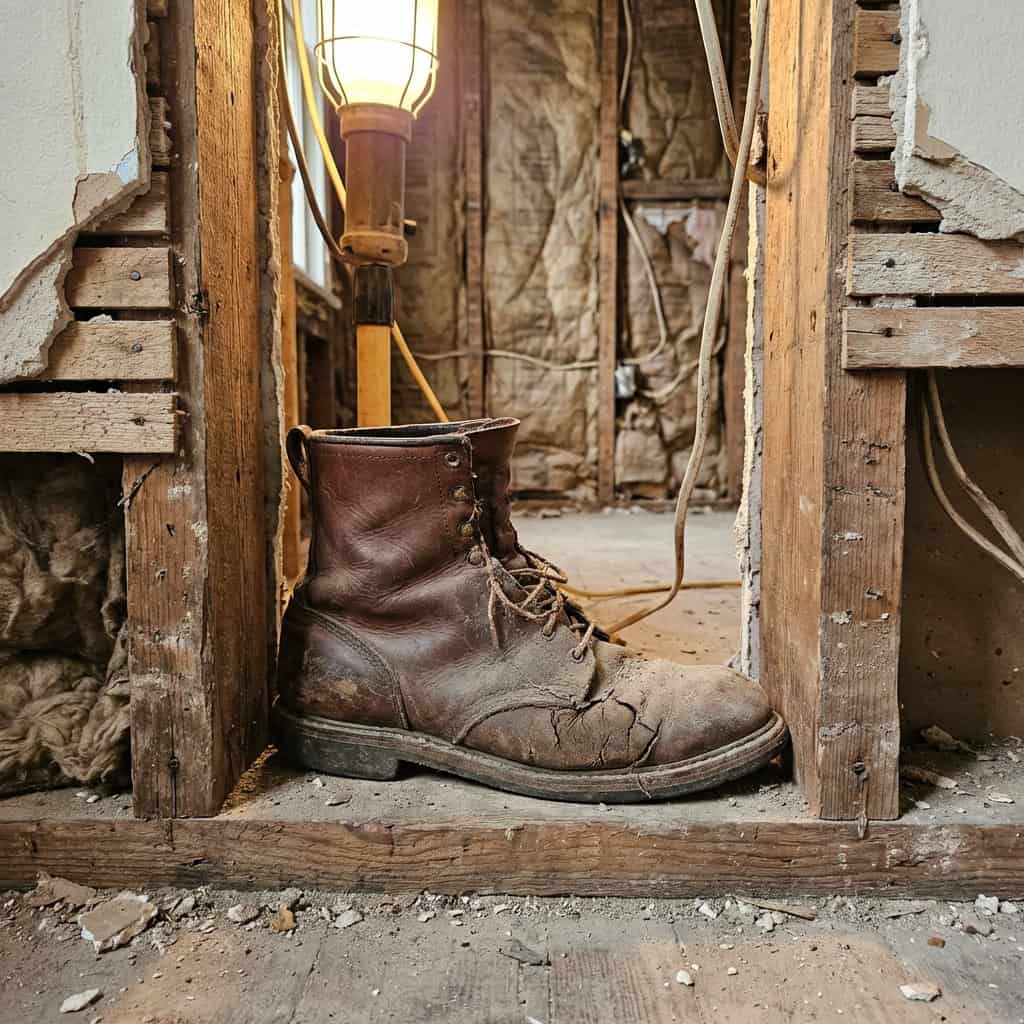
This one has no practical explanation — only a superstitious one.
For centuries, people hid worn shoes inside the walls, floors, and chimneys of their homes. The practice dates back to at least the Middle Ages in Europe and was carried to America by early colonists. The shoes are almost always old and well-worn — they were not new shoes being stored, they were used shoes being concealed on purpose.
The belief was that a concealed shoe would protect the household from evil spirits, bad luck, or witchcraft. The shoe — carrying the essence of the wearer — acted as a spiritual trap or guardian, warding off whatever might enter through the walls.
The finds are so common that there is an actual academic project dedicated to documenting them — the Deliberately Concealed Garments Project, which has cataloged thousands of examples found in buildings across Europe and North America.
If you find a single old shoe inside your wall during a renovation, it was not lost. It was placed there — deliberately, carefully, and with complete sincerity — by someone who believed the walls needed protection.
22. Sealed-Off Rooms and Staircases

Every once in a while, someone opens a wall and finds an entire room on the other side.
It sounds impossible, but it happens with surprising regularity. Floor plans change. Additions are built. Rooms are divided, combined, and reconfigured by successive generations of owners, and sometimes a room — or a staircase, or a hallway — ends up walled off and forgotten.
A family in Wisconsin lived in their home for 43 years before discovering an entire room they never knew existed behind a wall.
In larger homes, especially those built in the late 1800s, servant staircases and back hallways were common. When the homes were converted to single-family use or divided into apartments, these service areas were often sealed up rather than incorporated into the new layout.
The rooms are usually empty. Sometimes they contain furniture that was too heavy to move. Sometimes they contain nothing but dust and the faint outline of wallpaper that has not seen light in decades.
23. Massive Beehives

Not everything hiding in your walls was put there by humans.
Honeybees are drawn to wall cavities. The space between studs is dark, protected, and temperature-stable — everything a colony needs. Bees enter through a small crack or gap in the exterior, build comb between the studs, and expand the colony year after year without anyone inside the house knowing.
By the time the homeowner notices — usually because of a persistent buzzing sound, unexplained honey stains on the wall, or bees appearing inside the house — the hive can be enormous.
One Florida family called a beekeeper after getting tired of occasional stings. When the shower wall was opened up, it revealed a seven-foot-tall hive stretching from floor to ceiling, housing approximately 80,000 bees.
The hive had been growing for years. The bees were not aggressive — they were just living their lives, building their city, raising their young, all inside a wall that the family showered next to every morning.
24. Handwritten Notes and Messages From the Original Builders
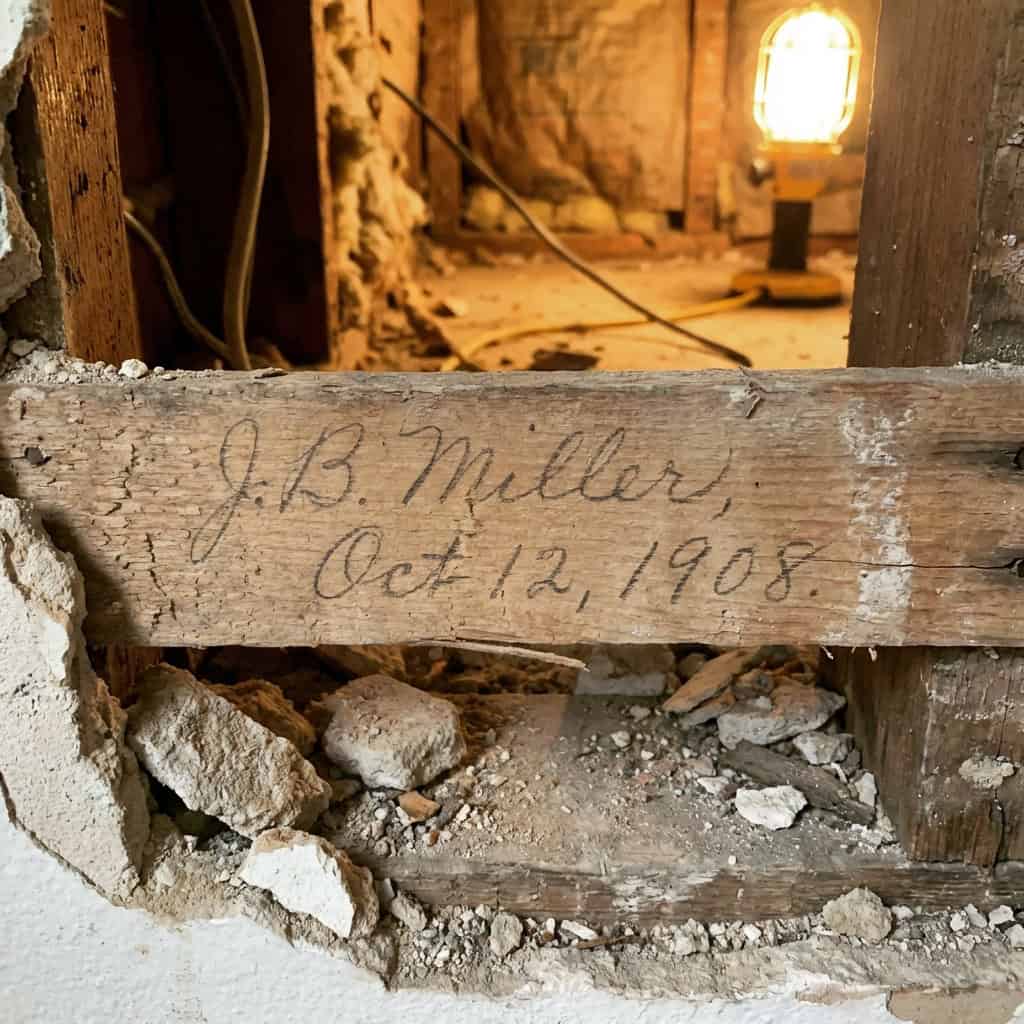
Builders have always known that someone would eventually open the walls they built.
Some of them left notes. A penciled name and date on a stud. A short message scrawled on the back side of a piece of lath. A paragraph written on the subfloor, hidden under the finished flooring, that no one would see until the floor was pulled up a century later.
These notes are everywhere in old homes. Most are simple — a name, a date, sometimes a brief record of the weather or the progress of the job. “John O’Brien, June 14, 1903.” “Finished this room today, hot as hell.” “If you are reading this, that means you are remodeling the bathroom again.”
Some are more elaborate. Builders have left drawings, jokes, complaints about the homeowner, and — more than once — predictions about the future.
They are tiny, personal, and unrepeatable. A human being stood in that exact spot, built that exact wall with their hands, and took 30 seconds to leave a mark that would outlast their entire life.
25. Layers of Wallpaper

Pull a piece of wallpaper off the wall in an old home and you will find another wallpaper underneath.
Pull that one off and there is another.
And another.
Old homes can have a dozen or more layers of wallpaper stacked on top of each other, each one applied directly over the last. Nobody stripped the old paper first — they just pasted the new pattern right on top. Every layer represents a different owner, a different decade, a different idea of what a room should look like.
The outermost layer might be a neutral beige from the 2000s. Underneath that, a floral from the 1980s. Then a bold geometric from the 1970s. Then a pastel stripe from the 1950s. And at the very bottom, pressed against the original plaster, a Victorian pattern with intricate scrollwork and hand-mixed colors that has not been manufactured in over a century.
It is a timeline of American taste, applied in reverse, preserved on your walls by nothing more than paste and the universal human reluctance to do prep work.
Every old house is a record of the people who built it, lived in it, and changed it over the decades. The walls hold all of it — the good decisions and the bad ones, the things that were meant to last forever and the things that were meant to be forgotten.
If you live in an old home, know this — the walls around you are not empty. They are full of stories, full of materials you have never heard of, full of objects that have been sitting in the dark for longer than you have been alive.
And someday, when someone opens one of those walls, every single one of those stories comes out.