

Walk into a house built in 1940 and close the front door.
You hear it. That heavy, solid thud of a real wood door latching into a real wood frame.
Now walk into a house built last year and close the front door.
You hear a hollow click. The door weighs nothing. The trim flexes when you lean on it. The walls sound empty when you knock on them.
Something happened between then and now. Not progress. Not innovation. Cost cutting.
Modern builders have figured out how to make a house look finished while using the cheapest possible materials and the fastest possible methods. The result is a home that photographs well for the listing but starts falling apart before the warranty expires.
Here are 17 cheap shortcuts modern builders take that the craftsmen who built your grandparents’ house would never have allowed.
1. Hollow-Core Interior Doors

Open any interior door in a new construction home. Pick it up off the hinges if you can. It weighs almost nothing.
That is because it is hollow. Two thin sheets of molded hardboard glued to a cardboard honeycomb core. That is your interior door.
In an older home, interior doors were solid wood — usually pine, fir, or oak — with raised or recessed panels that were mortised and tenoned together. They had weight. They had substance. They blocked sound. You could feel the quality every time you turned the knob.
A hollow-core door costs a builder about $30. A solid wood panel door costs $150 to $300. Multiply that by 15 doors in a house and you can see why builders made the switch.
You can hear your kids’ music through a hollow-core door from three rooms away. You could not hear a conversation through a solid one.
2. Orange Peel Textured Walls

Run your hand along the wall in most new construction homes and you will feel a bumpy, uneven texture that looks like the skin of an orange.
That texture is not a design choice. It is a shortcut.
Smooth walls require skilled labor. The drywall has to be taped, mudded, sanded, and finished multiple times to achieve a flat, seamless surface. That takes time and money.
Orange peel texture is sprayed on with a machine in minutes. It hides imperfections in the drywall, uneven seams, nail pops, and sloppy mudding that would be obvious on a smooth wall.
Older homes had smooth plaster walls — applied by hand in multiple coats by skilled plasterers. Those walls are still smooth 80 years later.
3. MDF Trim and Molding

Look closely at the baseboards, door casings, and crown molding in a new home. If it is painted white, there is a good chance it is not wood.
It is MDF — medium density fiberboard. Essentially sawdust and glue pressed into a board.
MDF is cheap, easy to cut, and takes paint well. But it swells and disintegrates when it gets wet. Kick a baseboard made of MDF and it dents like cardboard. Set a leaky potted plant next to it and it bubbles and falls apart.
Older homes used solid wood trim — pine, poplar, or oak — that was milled with deep, complex profiles by craftsmen who treated trim work as an art form. That wood is still solid 100 years later.
4. Vinyl Plank Flooring

It is the fastest-growing flooring product in America. It looks like wood. It kind of feels like wood. And it costs a fraction of the price.
But it is plastic.
Vinyl plank flooring is a printed image of wood grain laminated onto a PVC core. When it is new, it looks convincing. But it scratches easily, the pattern repeats noticeably, and it has a hollow, artificial sound when you walk on it.
Older homes had real hardwood floors — oak, maple, or pine — nailed down board by board. Those floors could be sanded and refinished five or six times over their lifetime. Vinyl plank cannot be refinished at all. When it wears out, it goes in the dumpster.
5. OSB Sheathing Instead of Plywood
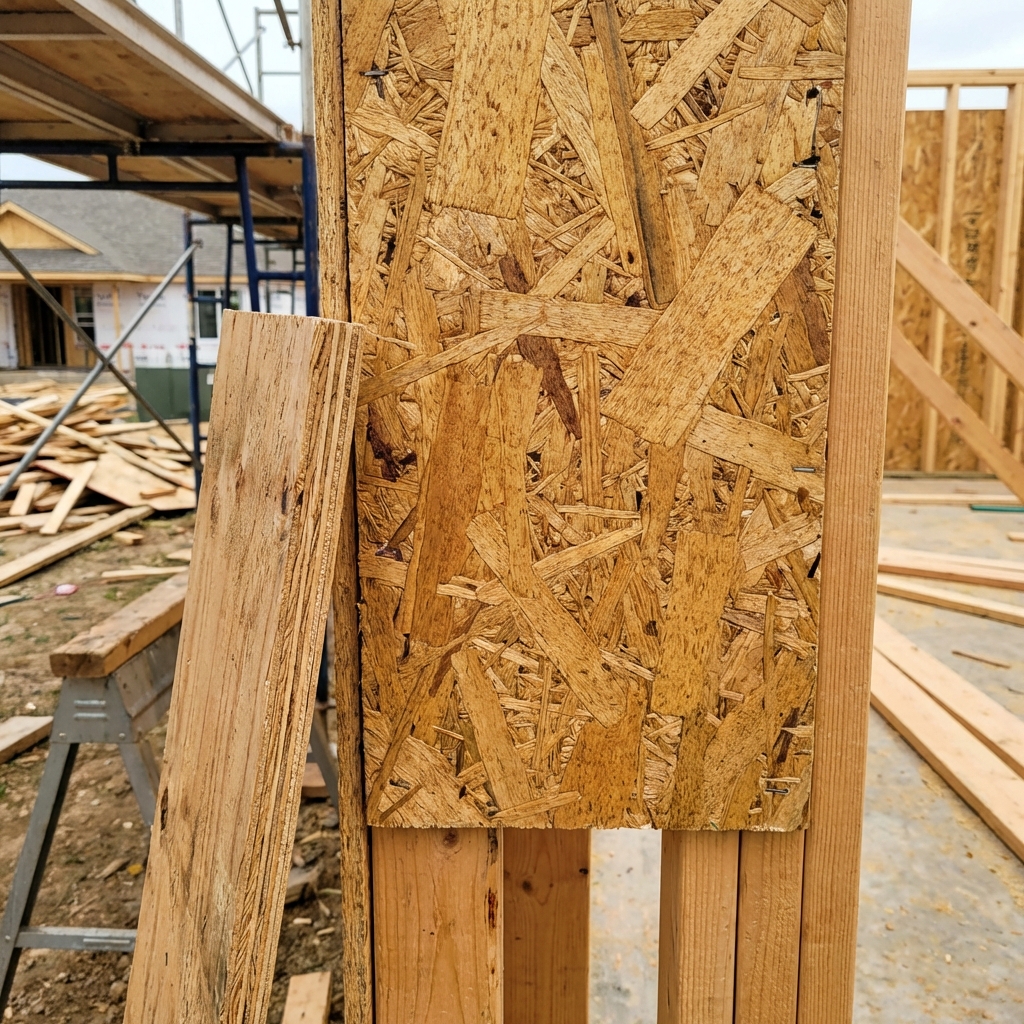
Pull off the siding on a modern home and what do you find underneath? OSB — oriented strand board. It looks like compressed wood chips glued together. Because that is exactly what it is.
OSB is significantly cheaper than plywood, and it does the job structurally. But it has one critical weakness — it does not handle moisture well. If OSB gets wet and stays wet, it swells, delaminates, and loses its structural integrity.
Older homes used solid board sheathing or plywood, both of which handle moisture far better. The trade-off was purely financial — OSB saves the builder money, and the homeowner gets a wall that is less forgiving of any water intrusion.
6. Finger-Jointed Trim

Look at the trim in a new home from the side. If you can see tiny zigzag joints every few inches, you are looking at finger-jointed lumber.
This is short pieces of low-grade wood glued together end-to-end to create a longer board. It is then primed white and sold as “paint-grade trim.”
There is nothing structurally wrong with it. But it is a far cry from the single, long pieces of clear-grain solid wood that old builders used for trim. And if the paint ever chips or the joint fails, you will see the ugly seam underneath.
It is one of those shortcuts that works fine until it does not.
7. Particle Board Kitchen Cabinets

Open the cabinet doors in a new construction kitchen and look at the box — not the door, the box itself.
In most builder-grade kitchens, the cabinet boxes are made of particle board or melamine-coated MDF with a thin laminate veneer. The doors might look nice, but the structure holding everything together is essentially compressed sawdust.
Load those shelves with heavy dishes and canned goods. Add the moisture and steam of daily cooking. Within a few years, the shelves sag, the hinges pull out, and the laminate starts peeling.
Older kitchen cabinets were built from solid wood or quality plywood with real hardwood face frames. They lasted decades. Many are still in service today.
8. Hollow Stair Rails and Newel Posts

Grab the newel post at the bottom of the stairs in a new home and give it a shake.
If it wobbles, it is hollow. Many modern stair components are hollow boxes wrapped in a veneer or paint-grade shell. They look right. They feel wrong.
In an older home, the newel post was a single, solid piece of wood — often turned on a lathe, sometimes hand-carved. It was anchored deep into the framing and could support the weight of a grown man leaning on it.
The difference is obvious the first time you touch one.
9. Paper-Thin Baseboards

Modern builder-grade baseboards are typically three inches tall and about a half-inch thick. They are flat, featureless strips with no profile or detail.
Compare that to the baseboards in a home built before 1950. They were commonly five to seven inches tall, three-quarters of an inch thick, and milled with an elegant profile — an ogee, a bead, or a stepped detail that gave the room visual weight and character.
Baseboards are one of those details that most people do not consciously notice, but the difference between cheap, thin trim and substantial, profiled trim completely changes how a room feels.
10. Vinyl Windows

Vinyl windows are now the standard in new construction because they are cheap to manufacture, easy to install, and never need painting.
They also flex in the wind, yellow in the sun over time, and cannot be repaired — only replaced.
Older homes had real wood windows — usually double-hung with rope-and-pulley sash weights built into the wall cavity. They could be repaired indefinitely. A broken pane was a $5 fix. A rotted sill could be patched or replaced by anyone with basic carpentry skills.
A vinyl window that fails gets thrown in a landfill and replaced with another vinyl window. The old wood window was designed to last the life of the house. The vinyl window is designed to last about 20 years.
11. Glued-On Faux Stone and Brick
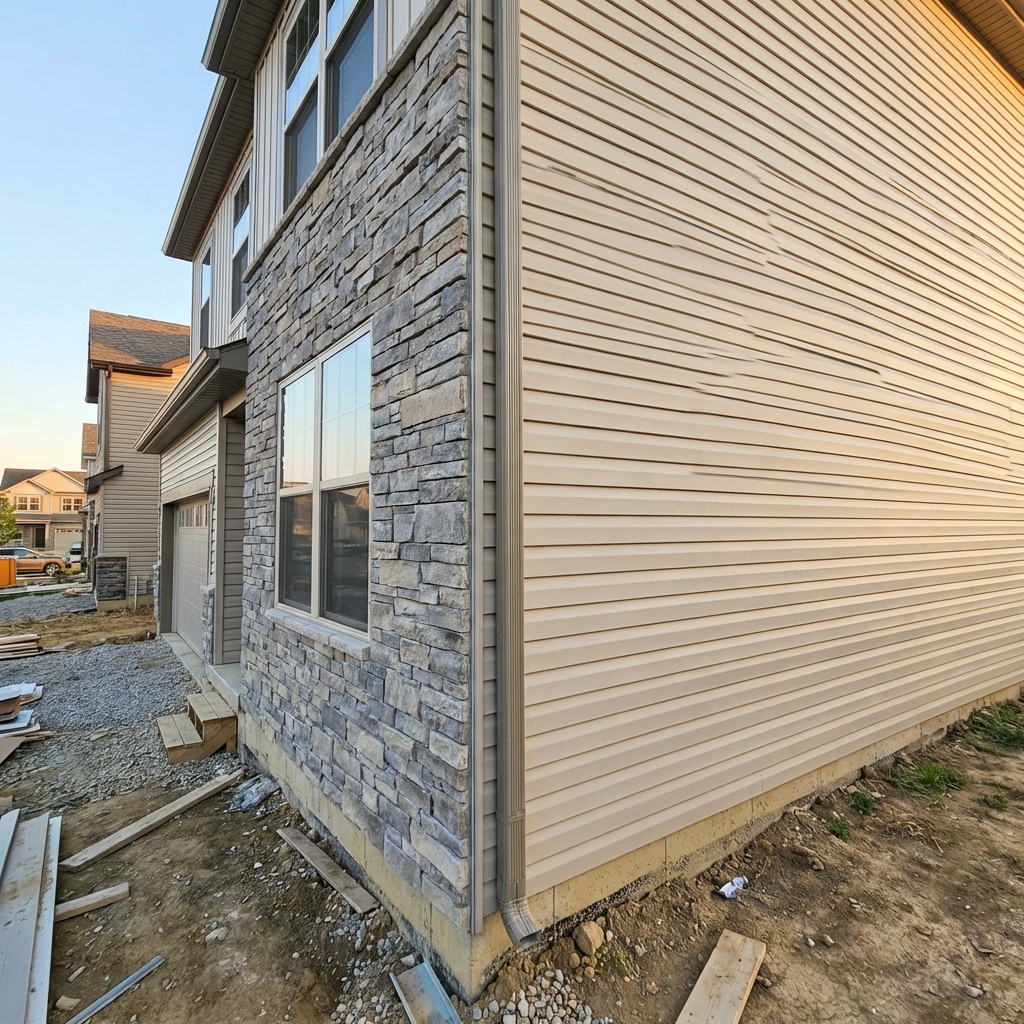
Drive through a new subdivision and look at the front facades. You will see gorgeous stone or brick on the front of the house — and vinyl siding on every other side.
That stone is almost certainly not real. It is manufactured stone veneer — concrete molded and painted to look like natural stone, adhered to the wall with mortar.
It looks convincing from the street. But it is a fraction of the thickness and weight of real stone, and it depends entirely on the quality of the installation to keep moisture out. Improperly installed manufactured stone is one of the leading causes of moisture damage and mold in modern homes.
Real masonry on older homes was structural. It was the wall. It did not need adhesive because it held itself up.
12. Spray Texture Ceilings

Look up in most new construction homes and you will see a stippled, popcorn, or knockdown texture on the ceiling.
Like the orange peel walls, this is a shortcut to hide imperfections. Spraying texture on a ceiling is fast and cheap. Finishing a ceiling to a smooth, flat surface is slow and expensive because gravity makes every flaw visible.
Older homes often had smooth plaster ceilings, sometimes with decorative medallions around the light fixtures. The craftsmanship overhead matched the craftsmanship at eye level.
Now the ceiling is an afterthought.
13. Single Coat of Cheap Paint

New construction homes are typically painted with one coat of the cheapest contractor-grade flat paint available. It covers. It is fast. And it starts showing scuffs, marks, and wear within months.
Older homes were painted with oil-based primers and multiple coats of quality paint. The finish was durable, washable, and lasted for years.
The paint in a new home is a placeholder. Most homeowners end up repainting within the first two years because the builder-grade paint cannot withstand the demands of daily life.
14. Flimsy Pocket Door Hardware

Pocket doors have made a comeback in modern homes because they save space. But the hardware used in most new construction pocket doors is the cheapest available.
The thin metal tracks bend. The rollers wear out. The door starts to jump, stick, or fall off the track entirely. Within a few years, the pocket door becomes a source of constant frustration.
Older pocket doors rode on heavy-duty iron tracks with ball-bearing rollers that lasted indefinitely. The door slid smoothly and stayed on track for decades.
Modern builders use pocket doors for the appeal but install hardware that is not built to last.
15. Paperboard-Backed Drywall

Modern walls are drywall — gypsum sandwiched between two sheets of paper. It goes up fast, it finishes easily, and it is incredibly cheap.
But drywall is fragile. A doorknob swung too hard puts a hole right through it. Moisture causes it to crumble. And it has zero structural value — it is just a surface.
Older homes had lath and plaster walls — thin wood strips nailed to the framing with multiple coats of lime-based plaster applied on top. Those walls were rock hard. You could not put a hole in them with a doorknob. They insulated better, they dampened sound better, and they lasted a century or more.
Drywall replaced lath and plaster not because it was better, but because it was faster.
16. Prefab Roof Trusses

Most modern homes use prefabricated roof trusses — engineered triangles made of dimensional lumber and metal connector plates, built in a factory and craned into place.
They work. They are structurally sound. But they fill the entire attic space with a web of lumber that makes the attic almost unusable for storage.
Older homes used hand-cut rafters with a ridge board. This method left the attic wide open — a massive, usable space that many homeowners converted into rooms, offices, or storage.
Prefab trusses are faster and cheaper to install. But they trade a functional room for a crawl space you can barely walk through.
17. Minimal Roof Overhang

Look at the roofline of a new construction home. In many cases, the roof barely extends beyond the wall. The eaves are narrow — sometimes just a few inches.
This saves money on materials and framing. But a minimal overhang means rain runs directly down the exterior walls, hammering the siding, windows, and foundation with every storm.
Older homes had generous overhangs — sometimes 12 to 24 inches — that shielded the walls from rain and provided shade to the windows in the summer. It was a simple design feature that protected the entire house.
Cutting the overhang saves the builder a few hundred dollars and costs the homeowner years of accelerated wear on their exterior.
Conclusion
None of this means modern homes are bad. They are more energy efficient, safer in earthquakes and hurricanes, and built to current code.
But the materials and methods used to finish them — the parts you see and touch every day — have been cheapened to the point where the word “craftsmanship” does not apply.
The house your grandparents lived in was built by people who assumed someone would be living in it 100 years later. The house built last year was built by people trying to hit a price point.
And that is the difference you feel every time you close the door.