

Walk into any Home Depot or Lowe’s, and you’ll find an entire aisle of DeWALT, Makita, and Milwaukee.
They’re solid tools. They’ll get the job done.
But if you spend any time in woodworking forums, watch enough shop tours on YouTube, or talk to the guy at the local woodworking club whose dovetails are impossibly tight—you’ll start hearing brand names you’ve never seen on a big-box shelf.
These are the brands that serious woodworkers discover through years of trial, error, and hard-won shop time.
The ones that show up in every “what’s the one tool you wish you’d bought sooner?” thread.
The ones that, once you try them, make you wonder how you ever got along without them.
You won’t find most of these at your local hardware store. Some you can only buy direct from the manufacturer.
Others are tucked away in specialty woodworking retailers that most hobbyists don’t even know exist.
But every single one has earned a devoted following among the people who care most about precision, quality, and getting the details right.
Here are 13 of them.
#1: Woodpeckers
The Red Tools That Became a Status Symbol
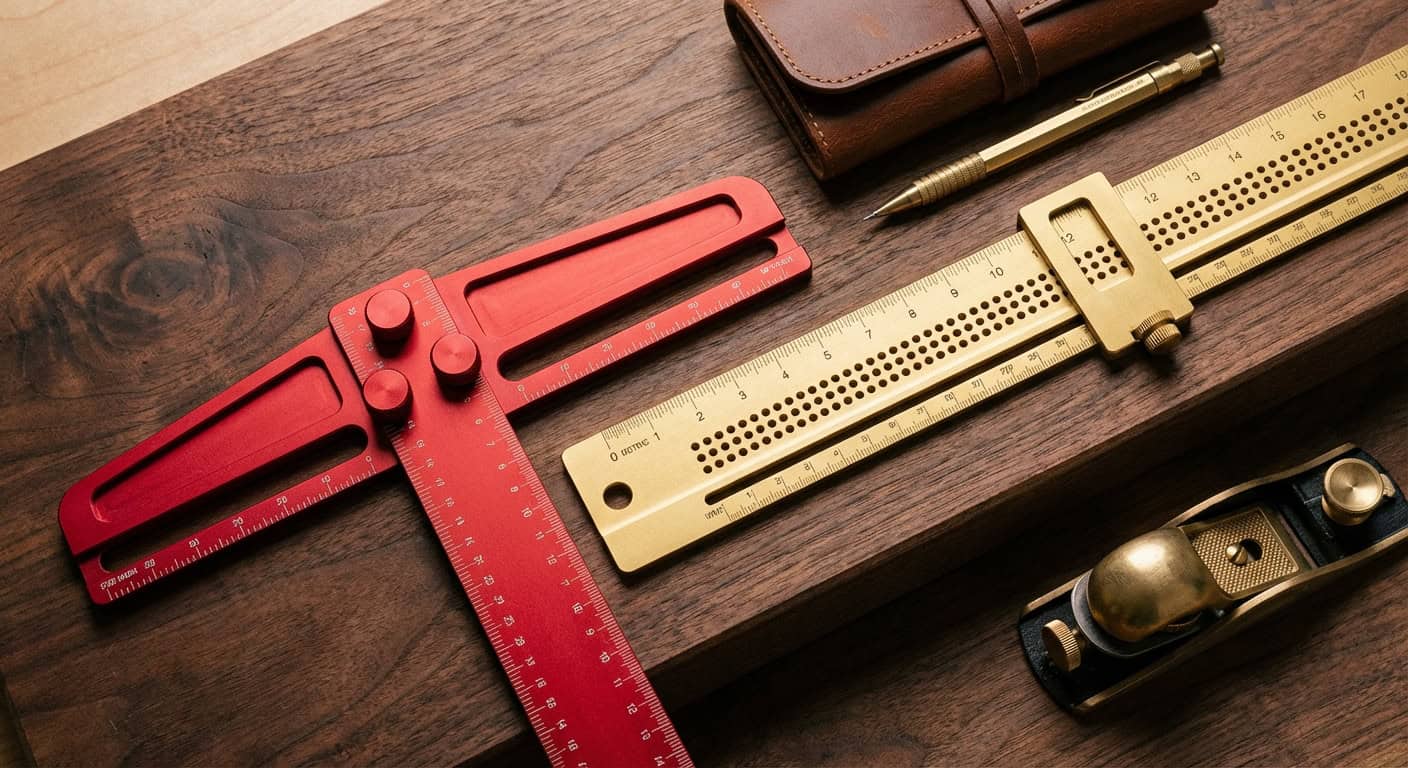
If you’ve ever scrolled through a woodworking forum or watched a shop tour video, you’ve seen them—those unmistakable bright red, CNC-machined aluminum tools hanging on someone’s shop wall.
That’s Woodpeckers.
Based in Strongsville, Ohio, Woodpeckers has been making precision layout and measuring tools since the early 1990s.
Every tool is machined from solid aluminum or steel, laser-engraved, and anodized in that signature red. They’re not just pretty to look at—they’re dead accurate, which is the whole point.
What they’re known for: Precision squares, setup bars, rules, T-squares, and an ever-growing lineup of specialty tools like their ClampZILLA, ThinRip Guide, and MortiseMatch.
The standout product: Their precision woodworking squares.
Here’s the dirty secret of woodworking—that combination square you grabbed off the rack at the hardware store? There’s a very good chance it’s not actually square.
Woodpeckers squares are guaranteed accurate, and once you check your old square against one, you can’t unknow what you find. Many woodworkers have had the uncomfortable experience of realizing every “mystery gap” in their joinery traced back to a cheap square.
Woodpeckers also runs limited-edition “One-Time Tool” releases—specialty items they manufacture once and never again. These sell out fast and have developed an almost collector-level following.
Expect to pay: $30–$80 for rules and small squares, $100–$200+ for larger precision tools and specialty items. Not cheap, but these are buy-it-once tools that will outlast you.
Where to buy: Woodcraft (their exclusive national brick-and-mortar retailer) and woodpeck.com.
#2: Incra
Micro-Adjustable Precision That Borders on Obsessive
If Woodpeckers is the brand woodworkers display on their wall, Incra is the brand they argue about in forums at 11 PM.
And the arguments are always the same—someone asks about router table fences, and within three replies, an Incra owner shows up to explain why their LS Positioner changed their life.
Incra has been around since the late 1980s, and their entire philosophy is built around one idea: micro-adjustable positioning. Their fence systems let you move a router fence or table saw fence in increments of 1/1000 of an inch. That’s not a typo. One thousandth.
What they’re known for: The LS Positioner fence system, precision marking rules with tiny incremental holes for pencil-point accuracy, and a range of miter gauges and crosscut sleds.
The standout product: The LS Positioner Super System. It’s a complete fence system for router tables or table saws that uses a rack-and-pinion mechanism for dead-repeatable positioning.
No more bumping your fence a hair and hoping you got it right. You dial in a position, lock it, and it’s there—every single time. Woodworkers who do box joints, dovetails, or any repetitive precision joinery consider this tool non-negotiable.
There’s a reason the Incra LS system often has a multi-month backorder. The demand never stops.
Expect to pay: $50–$100 for marking rules, $250–$500+ for fence systems depending on configuration.
Where to buy: incra.com direct, Woodcraft, Amazon, and various specialty retailers.
#3: Veritas (Lee Valley)
Where Innovation Meets Hand Tool Tradition
Veritas is the tool-manufacturing arm of Lee Valley, a Canadian company that’s been serving woodworkers since 1978.
While Lie-Nielsen (another brand worth knowing) built its reputation by perfecting classic Stanley-style hand planes, Veritas took a different path—they redesigned them.
Veritas hand planes and marking tools don’t just replicate what’s worked for 150 years. They rethink the engineering while keeping the soul of the tool intact.
Their bevel-up planes, for instance, offer a different cutting geometry that many woodworkers find more versatile than traditional designs.
What they’re known for: Hand planes, marking gauges, sharpening systems, and a wide range of hand tool accessories. Their product catalog reads like a wish list for anyone who works with edge tools.
The standout product: Their wheel marking gauge.
It’s a deceptively simple tool—a small wheel cutter on an adjustable beam—but it scribes lines so clean and precise that pencil marks feel primitive by comparison. At around $40, it’s one of those tools that delivers a disproportionate improvement to your work for the money.
Their low-angle jack plane is another favorite that shows up on “desert island tool” lists constantly.
Expect to pay: $30–$60 for marking and layout tools, $200–$400+ for hand planes.
Where to buy: leevalley.com direct (they ship from Canada and the U.S.).
#4: Starrett
The 140-Year-Old Standard Everything Else Gets Checked Against
Starrett isn’t a woodworking company. They’re a precision measurement company that’s been making tools in Athol, Massachusetts since 1880.
Their primary audience is machinists and metalworkers. But somewhere along the way, woodworkers figured out that when you need a measuring tool you can trust with your life, Starrett is the name.
In woodworking circles, a Starrett combination square isn’t just a tool—it’s a reference standard.
It’s what you check your other squares against to see if they’re true. When forum users talk about “checking for square,” the unspoken assumption is that they’re checking against a Starrett.
What they’re known for: Combination squares, steel rules, protractors, and precision measuring instruments. Made in America, machinist-grade accuracy.
The standout product: The Starrett 11H or 12” combination square. It’s the one tool that experienced woodworkers say you should buy first, because without a reliable reference square, you can’t trust anything else in your shop.
Every measurement, every fence setting, every jig you build—all of it depends on knowing that your square is actually square.
Expect to pay: $80–$150 for a quality combination square, $15–$40 for steel rules.
Where to buy: Amazon, industrial supply houses, Woodcraft, and starrett.com.
#5: Narex
Czech-Made Chisels That Punch Way Above Their Price
Every woodworking forum has the same recurring question: “What chisels should I buy?” And the answer, with remarkable consistency, is “Narex.”
Not because they’re the absolute best chisels ever made—that title belongs to names like Lie-Nielsen or Japanese makers—but because they offer genuinely excellent quality at a price that doesn’t require a second mortgage.
Narex has been making tools in the Czech Republic since 1919. That’s over a hundred years of edge tool manufacturing.
Their chisels are forged from chrome-manganese steel, hold an edge well, and come with comfortable beech or hornbeam handles that feel right in your hand.
What they’re known for: Bench chisels, mortise chisels, carving tools, and turning tools. Their Richter line is the premium tier, while their standard line is already better than most of what you’ll find at the hardware store.
The standout product: The Narex Richter bevel-edge bench chisels. For around $80–$100 for a set, you get chisels that will hold their own against tools costing three times as much.
They come sharp enough to use right out of the box with minimal honing, and they respond beautifully to sharpening. For a beginning or intermediate woodworker, there is simply no better value in chisels.
Expect to pay: $40–$60 for a standard set, $80–$120 for the Richter line. Individual chisels from $10–$30.
Where to buy: Amazon, Lee Valley, and Taylor Toolworks.
#6: JessEm
Canadian Precision for Your Router Table and Beyond
JessEm is one of those brands that woodworkers discover when they decide to upgrade one specific thing in their shop—usually a router lift—and then end up going down a rabbit hole of everything else the company makes.
Based in Canada and in operation since 1998, JessEm builds router lifts, miter gauges, precision squares, and rulers.
Everything they make reflects a philosophy of repeatable, measurable precision. Their tools aren’t flashy. They just work exactly the way they’re supposed to, every time.
What they’re known for: The Mast-R-Lift router lift, Mite-R-Excel miter gauge, and more recently, their precision stainless steel squares and rulers.
The standout product: The Mast-R-Lift II. This router lift turns your router table from a rough-adjustment tool into a precision machine. Height adjustments are repeatable to 0.002 inches using a crank mechanism with clear markings.
Woodworkers who’ve used basic router setups describe installing a Mast-R-Lift as a transformative experience—suddenly, the router table becomes as precise as any other tool in the shop.
It’s worth noting that Incra actually sells a version of this lift under their own brand, which tells you everything about how well-regarded it is.
Expect to pay: $200–$350 for the Mast-R-Lift, $100–$200 for miter gauges, $25–$60 for precision squares and rulers.
Where to buy: jessem.com direct, Woodcraft, Amazon, and various online retailers.
#7: Micro Jig
The Pushblock That Should Be Mandatory Equipment
Micro Jig is essentially a one-product company that built its reputation on solving the scariest moment in woodworking: pushing a piece of wood through a spinning table saw blade with your hands inches away.
The GRR-RIPPER, their flagship product, is a pushblock that grips and controls a workpiece from three directions—down, forward, and against the fence—all at once. It uses adjustable rubber grip pads and a unique bridge design that straddles the blade, so you maintain full control of both the fence side and the offcut side of the cut.
What they’re known for: The GRR-RIPPER pushblock system, the MICRODIAL tapering jig, and various table saw safety accessories.
The standout product: The GRR-RIPPER. If you’ve ever felt your stomach tighten when ripping a thin strip on the table saw, this tool exists to solve that exact problem.
It keeps your hands well above the blade while giving you more control over the workpiece than you’d have with bare hands alone. It’s also brilliantly designed for making repeated narrow rips safely—something that’s genuinely dangerous without proper workholding.
The GRR-RIPPER has been essentially unchanged for years because the design just works. That’s the kind of tool longevity that defines a great product.
Expect to pay: $60–$80 for the basic GRR-RIPPER, $90–$130 for advanced kits with accessories.
Where to buy: microjig.com, Amazon, Rockler, Woodcraft.
#8: FastCap
Clever Solutions for Annoyances You Didn’t Know Had a Fix
FastCap is the brand you discover when another woodworker hands you their tape measure and you realize it’s better than every tape measure you’ve ever owned. “What is this?” you ask.
And then you’re on their website for an hour.
Founded by Paul Akers in the late 1990s, FastCap doesn’t make big-ticket power tools. They make the small stuff—tape measures, pencils, edge banding, adhesives, organization systems, and shop accessories—but they make every single one with a “why didn’t someone think of this sooner?” level of thoughtfulness.
What they’re known for: The Old Standby tape measure, PerfectFence, Kaizen foam for tool organization, specialty adhesives, and an almost endless catalog of shop accessories.
The standout product: The Old Standby tape measure. It sounds absurd to get excited about a tape measure, but this one has a consistent hook (no slop), easy-to-read markings, a flat profile option for precise marking, and it just feels right.
Many woodworkers keep three or four of them scattered around the shop. FastCap also makes a story stick tape and a left/right reading tape that solve specific layout frustrations.
Expect to pay: $8–$15 for tape measures, $10–$30 for most shop accessories. This is probably the most affordable brand on the entire list.
Where to buy: fastcap.com direct, Amazon, Woodcraft.
#9: Leigh Industries
The Dovetail Jig That Ended the Debate
If you want to cut dovetails with a router, there’s really only one conversation—and it starts and ends with Leigh.
Leigh Industries has been making dovetail jig systems out of British Columbia, Canada since the early 1980s. Their jigs are adjustable, repeatable, and built to last decades.
While other dovetail jigs come with fixed spacing and limited options, Leigh’s system allows infinite adjustment of pin and tail spacing. You’re not locked into a template—you design the joint.
What they’re known for: The D-series dovetail jigs, the FMT mortise and tenon jig, and the Super Jig.
The standout product: The Leigh D4R Pro dovetail jig. It cuts through dovetails, half-blind dovetails, sliding dovetails, and box joints with a level of adjustability that no other jig on the market matches.
The finger assembly system lets you set any spacing you want, and the results look like hand-cut joints. Woodworkers who own one tend to use the phrase “game changer” a lot.
These jigs haven’t changed dramatically over the years because the design doesn’t need to change. That’s the definition of an evergreen tool.
Expect to pay: $250–$500+ depending on model and configuration.
Where to buy: leighjigs.com direct, Woodcraft, select online retailers.
#10: Wixey
Digital Readouts That Take the Guesswork Out of Your Machines
Wixey makes one category of product—digital readouts and angle gauges—and they’ve built a loyal following by doing it well and keeping prices reasonable.
If you’ve ever tilted your table saw blade to what you thought was 45 degrees only to discover your miter joint has a visible gap, Wixey exists to make sure that never happens again.
Stick their digital angle gauge on your blade magnetically, and you get an instant, precise reading. No more squinting at the crude angle scale stamped into your saw’s casting.
What they’re known for: Digital angle gauges, digital readouts (DROs) for planers, router tables, table saw fences, jointers, and drill presses.
The standout product: The Wixey WR300 Type 2 digital angle gauge. It’s a small magnetic gauge that sticks to any metal surface and gives you a precise digital angle reading.
Use it on your table saw blade, your miter gauge, your jointer fence—anywhere you need to know an exact angle. It’s one of those $25 tools that eliminates an entire category of frustration.
Their planer readouts are equally popular, giving you an exact digital thickness reading instead of relying on the imprecise depth scale built into most planers.
Expect to pay: $25–$30 for the angle gauge, $30–$70 for machine-specific DROs.
Where to buy: wixey.com, Amazon, Woodcraft, Rockler.
#11: iGaging
Precision Measuring at a Fraction of the Price
iGaging fills an important gap in the market—affordable digital measuring tools that are actually accurate.
When woodworkers can’t justify spending Starrett money on digital calipers or don’t want to pay Wixey prices for every DRO in the shop, iGaging is where they turn.
They’ve been around for over 15 years, making digital calipers, digital readouts for planers and table saws, setup blocks, and various measuring accessories.
The fit and finish isn’t luxury, but the accuracy holds up—and for most woodworking applications, accuracy is what matters.
What they’re known for: Digital calipers, DROs for planers and other machines, setup blocks, and height gauges.
The standout product: Their 6” digital calipers and planer DROs. Digital calipers are the only reliable way to measure board thickness coming out of a planer or to check the width of a dado.
A good caliper takes the guesswork out of fitting mortise-and-tenon joints. iGaging gives you that capability for under $25, while comparable Mitutoyo calipers run $100+.
Popular Woodworking has noted that their accuracy holds up against much more expensive brands.
Expect to pay: $15–$25 for digital calipers, $30–$50 for DROs and specialty measuring tools.
Where to buy: Amazon, Taylor Toolworks, Rockler
#12: TSO Products
Precision Accessories for the Track Saw Ecosystem
TSO Products occupies a very specific niche—they make precision accessories for track saw systems—and they do it at a level of engineering that has earned them a devoted following among track saw users.
If you own a Festool, Makita, or any other track saw, you’ve probably dealt with the challenge of getting a perfectly square crosscut. You can mark and align by hand, but it’s slow and inconsistent.
TSO solved this with products that are CNC-machined from solid aluminum and designed to integrate seamlessly with existing guide rail systems.
What they’re known for: Precision triangles for guide rails, the TPG parallel guide system for repeatable rip cuts, and measuring/marking tools designed specifically for track saw workflows.
The standout product: The GRS-16 Guide Rail Square. It’s a precision triangle that clamps directly onto your track saw guide rail and gives you a dead-on 90-degree crosscut with zero calibration. Slide it on, clamp the draw latch, and cut.
That’s it.
For woodworkers who break down sheet goods or crosscut panels regularly, this single accessory transforms the track saw from “pretty accurate” to “machinist-level precise.”
Expect to pay: $100–$200 for the guide rail square, $200–$350 for the parallel guide system.
Where to buy: tsoproducts.com direct.
#13: SawStop
The Holy Grail of Table Saws
SawStop is becoming more mainstream—you can find them in some specialty retailers now, and other manufacturers are starting to develop their own flesh-detection systems.
But for serious woodworkers, a SawStop table saw remains the aspirational centerpiece of the dream shop. It’s the tool that makes the wish list before the shop is even built.
The reason is simple.
The table saw is statistically the most dangerous tool in a woodworking shop, responsible for tens of thousands of emergency room visits every year. SawStop’s patented brake system detects contact with skin and stops the blade in less than 5 milliseconds.
The blade drops below the table surface, and instead of losing a finger, you get a small nick and need to replace a $100 brake cartridge.
Every woodworker who owns one has a version of the same story: “I’ll never own another brand.”
What they’re known for: Table saws with flesh-detecting brake technology, available in professional cabinet saw, contractor, and jobsite models.
The standout product: It depends on your shop and budget, but the Professional Cabinet Saw (PCS) is what most woodworkers dream about. It’s a serious, heavy-duty cabinet saw with a best-in-class fence system—and it happens to also save your fingers.
The Jobsite model is popular with smaller shops and people who need portability without sacrificing the safety system.
Here’s the thing about SawStop that goes beyond safety: even without the brake system, these are excellent table saws. The fence is accurate and locks down flat. The dust collection is well-designed. The motor runs smooth.
The safety feature isn’t compensating for a mediocre saw—it’s the cherry on top of a saw that would compete on quality alone.
For many woodworkers, a SawStop represents a milestone.
It’s the tool that says “I’m serious about this hobby, I’m going to be doing it for a long time, and I want to keep all ten fingers while I do.”
Expect to pay: $500–$600 for the Jobsite, $1,600–$2,000 for the Contractor, $3,000–$4,500+ for the Professional Cabinet Saw.
Where to buy: sawstop.com, Woodcraft, Rockler, and select specialty retailers.
This Is Just the Beginning
These 13 brands are the ones that come up most often when serious woodworkers talk shop. But they’re not the only names worth knowing.
There are premium hand plane makers, specialized carving tool brands from Switzerland and Germany, power tool companies that sell direct and save you hundreds, clamp manufacturers whose products make your big-box clamps feel like toys, and retailers that every woodworker should have bookmarked.
We put together a free downloadable guide that covers all of it—30+ brands across every category, plus a buying guide that shows you where to find deals, discount sources, the best times of year to buy, and specialty retailers that most people don’t know about.
Good tools aren’t cheap.
But the right tools—from the right brands—last a lifetime and make every project better. Once you know where to look, you’ll never go back to guessing at the hardware store.