

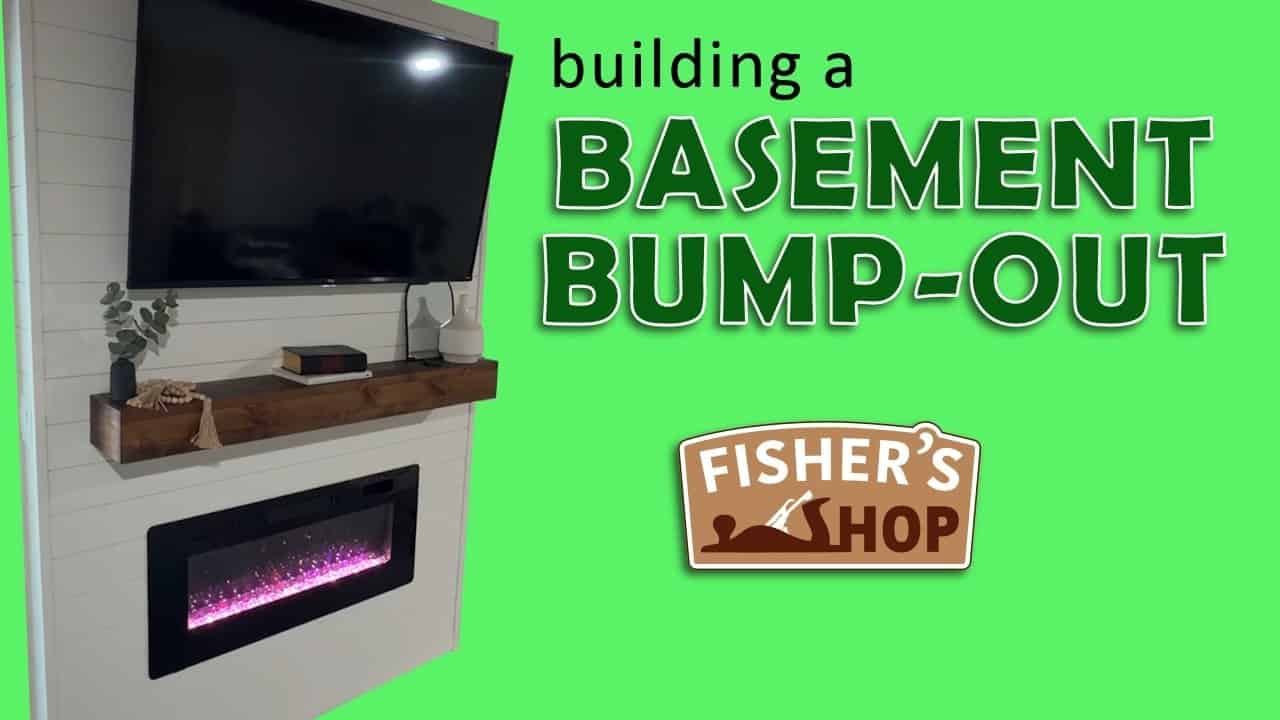
This project was built and designed by Drew Fisher from Fisher’s Shop.
Drew visits a friend’s house to build a bump-out entertainment center that becomes the focal point of a basement living area. The project stays approachable for beginners while covering framing, shiplap cladding, electrical relocation, and finishing touches.
Watch the full video and subscribe to Fisher’s Shop:
Design
The bump-out is a simple, bold move that frames a TV and electric fireplace into a single accent wall. The design focuses on clean lines, a recessed TV cavity, and a mantel to tie the assembly into the room.
Drew opts for horizontal shiplap across the main face with vertical shiplap on the sides to add subtle contrast. This combination keeps the look modern but warm and allows the bump-out to work with many styles of basements.
Lumber Prep and Materials
The build uses common, locally available lumber and sheet goods so the project is accessible for most DIYers. Plywood is used for a rigid substrate while dimensional lumber forms the framing and backing for mounting points.
Drew emphasizes that a track saw or circular saw with a straight edge will handle the plywood work, and the project tolerates small inaccuracies. This forgiving nature makes it a good practice build for those growing their tool skills.
Framing and Joinery
The bump-out starts as a simple framed box assembled from 2x lumber and fastened together with screws to create a sturdy skeleton. Care is taken to square and shim the bottom members so the final unit sits true against an imperfect basement floor.
Strategic blocking is added behind the TV opening so the mount and other heavy items have solid anchorage points. Through-screwing into existing joists and sill plates secures the unit to the structure without complicated joinery.
Cladding with Shiplap
Plywood sheathing is applied first to stiffen the frame and provide a nailable surface for the shiplap. The shiplap is then installed horizontally on the face and vertically on the sides, with careful attention to the first board being level to set the run.
Rough cutouts around the fireplace and TV cavity are refined with a trim router and flush-trim bits to create clean openings. The shiplap method allows gaps and small errors to be hidden by trim or filled later with caulk.
Electrical and Tech Integration
Electrical work is kept straightforward: switches are relocated and new receptacles are added to serve the TV and fireplace while keeping cords hidden behind the bump-out. Drew runs a short power stub behind the cavity to power the TV and media devices neatly.
The design leaves the TV mounted in a recessed cavity so it can sit flat or be pulled out and swiveled, offering flexibility for viewing angles. Blocking behind the cavity provides strong mounting locations for the TV bracket.
Finishing and Mantel
After filling nail holes, sanding, and trimming, edge molding is applied to conceal raw plywood and shiplap edges and to give the bump-out a finished appearance. Trim and caulk smooth transitions so paint reads as a single, cohesive surface.
The mantel mounts with a French cleat for a secure, level installation and receives a simple wax finish for protection without heavy sheen. Final paint coats unify the assembly and turn the bump-out into the room’s centerpiece.
Lessons Learned and Takeaways
The project demonstrates that a high-impact built-in can be achieved with basic framing skills and commonly available tools. Drew’s approach prioritizes practical solutions: beefy backing for mounts, shimmed framing for flatness, and forgiving cladding techniques.
Adaptations are easy—swap the cladding style, change the mantel, or size the bump-out to fit different TVs and fireplaces—so the concept is useful for many retrofit and finishing projects. The result is a personalized focal wall that adds both function and character to a basement.
Conclusion
The bump-out entertainment center is an approachable project that combines framing, shiplap cladding, simple electrical work, and finish carpentry to create a commanding focal point. Drew’s methodical but relaxed approach makes it a practical next project for DIYers who want a big visual payoff without complex joinery.
Get Drew’s plans here: https://fishersshoponline.com/plans/p/bumpout

Matt’s Take
These are my personal thoughts and tips based on my own experience in the shop. This section is not written, reviewed, or endorsed by the original creator of this project.
What I love about this approach is how it turns a basic framing project into something that looks built-in and intentional. The bump-out concept is brilliant for basements where you’re often dealing with uneven floors and walls that aren’t perfectly square. By building the frame as a separate unit and then shimming it level, you’re working with the space instead of fighting it.
The electrical planning here is spot-on too. Running power behind the cavity during construction saves you from having visible cords or trying to fish wires later. If you’re tackling something similar, think through all your power needs upfront — TV, soundbar, streaming devices, maybe even USB charging ports. It’s much easier to run an extra circuit now than to add one after everything’s buttoned up.
That horizontal-meets-vertical shiplap detail is a nice touch that breaks up what could otherwise be a big blank wall. The mixed orientation gives you visual interest without getting too busy. And using a flush-trim bit to clean up those rough cutouts around the fireplace opening? That’s the kind of detail that separates a DIY project from something that looks professionally installed.
The French cleat mantel mount is smart thinking — it distributes the load evenly and gives you that rock-solid connection you want for something that might get decorations or books placed on it.