

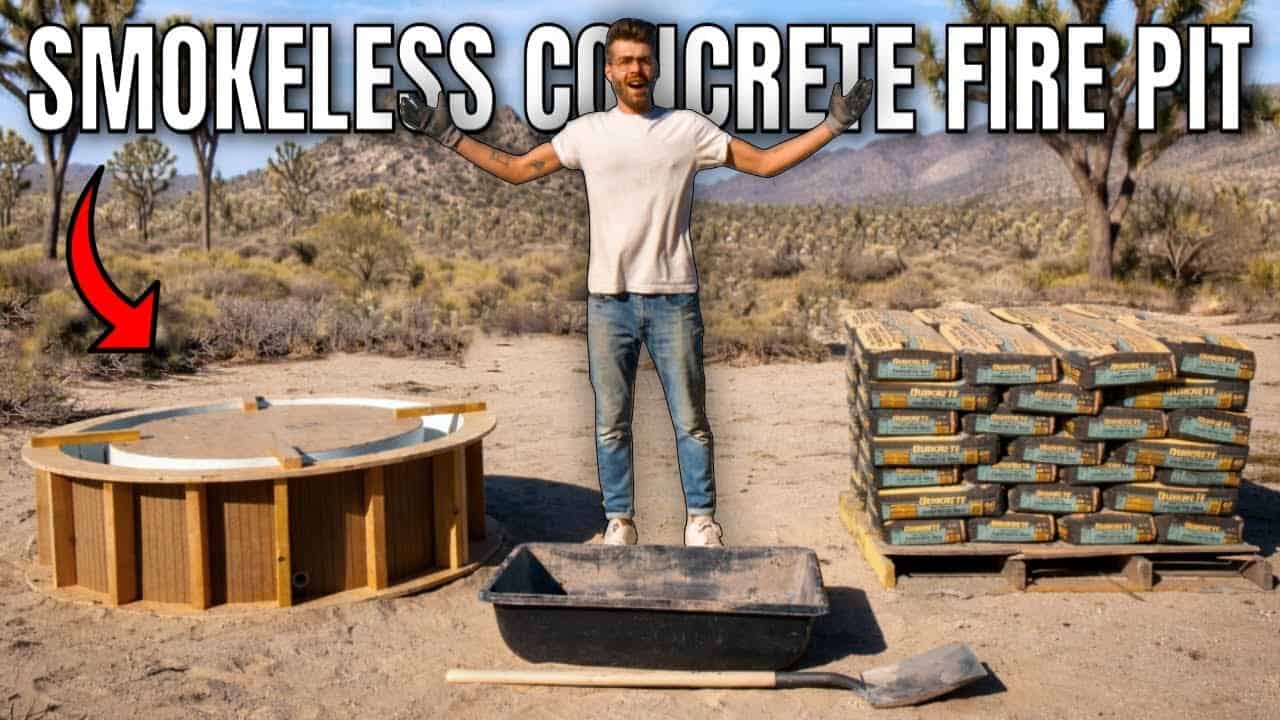
Mike Montgomery from Modern Builds built and designed this project.
Mike presents a tall, round concrete fire pit designed to be friendly for cooking while minimizing smoke by feeding air back into the combustion zone.
Watch the full video and subscribe to Modern Builds:
Design
The fire pit emphasizes a clean, modern silhouette with a taller profile and a wide ledge that doubles as seating or a prep surface for cooking.
Instead of decorative flourishes, the design prioritizes functionality: an inset ledge to hold a cooking grate and a circular combustion chamber that encourages efficient airflow.
Formwork and Prep
Mike built reusable circular forms from plywood and thin melamine panels, bending the melamine by cutting relief slits on the back to achieve tight radiuses without foam molds.
He reinforced the molds with internal blocking and applied release agents so the cured concrete would demold cleanly, and he added access points and bracing where the air intake tubes would pass through.
Creating the Smokeless Airflow
The smokeless effect comes from a ring of air intake tubes placed at the base of the inner wall to feed oxygen to the fire from below and behind the burn zone.
These vents are sized and spaced to channel fresh air up through the burning material so smoke is reburned rather than blown across the cooking surface.
Mixing and Pouring
Rather than a step-by-step bag count, Mike highlights a workflow that balances a wetter mix for smooth walls with drier batches packed into the mold to reduce voids.
He mixed by hand, poured progressively around the form, tamped to consolidate, and used tools to break surface bubbles, demonstrating that a mixer isn’t strictly required for a project of this scale.
Capstones and Cooking Ledge
The top ledge is made from separate cast capstones formed in melamine molds with a recessed ledge for the cooking grate so the grate sits flush with the concrete surface.
Mike used foam inserts and silicone fillets to create neat rounded corners and a solid seating surface for the grill ring, then demolded and finished the cast pieces before assembly.
Demolding and Finishing
Careful disassembly of the molds revealed a clean finish with some air bubble texture, and Mike used simple mechanical methods to extract the air-vent pipes without damaging the edge detail.
He also notes that metal grill finishes can flake when new, so a few gentle burn-ins and replacements with fire bricks for direct contact surfaces help ensure longevity.
Lessons Learned
Mike shares practical takeaways about form flexibility, recommending specific spacing for relief cuts in bent melamine to avoid delamination and improve durability.
He also advises patience with curing, the value of rebar or internal reinforcement where weight and handling matter, and accepting a few cosmetic bubbles for a solid, functional result.
Why this Build Matters
This project demonstrates how accessible concrete work can create a functional, modern outdoor cooking centerpiece without exotic tools or materials.
The combination of simple form techniques, air-intake engineering, and pragmatic finishing makes it a useful reference for anyone wanting to make a smokeless fire pit that works for cooking.
Please support Mike by visiting his website: https://www.modernbuilds.com/.

Matt’s Take
These are my personal thoughts and tips based on my own experience in the shop. This section is not written, reviewed, or endorsed by the original creator of this project.
Concrete fire pit builds like this really showcase how thoughtful design can solve practical problems. The smokeless aspect isn’t just a gimmick — those air intake tubes create a secondary burn that dramatically reduces the eye-watering smoke we’ve all dealt with around traditional fire pits. The key is getting that airflow pattern right so fresh oxygen feeds the flames from below rather than getting pulled across the cooking surface.
Mike’s approach to the formwork is smart, especially using relief cuts in the melamine to bend those curves. That’s a technique worth remembering for any curved concrete work. When you’re cutting those relief slits, spacing them about every inch works well for tight radiuses. Just be gentle with the demolding — concrete can chip if you rush it, and those air intake holes are vulnerable spots during removal.
The separate capstone approach is clever too. Casting everything as one piece would be a nightmare to handle and finish. Breaking it into manageable components lets you get clean edges and that flush grill ledge without wrestling with an unwieldy monolithic pour. Plus, if you ever need to replace a section, you’re not tearing apart the whole pit.
For anyone considering a similar build, remember that concrete continues curing for weeks. Don’t rush the first fire — let it cure fully and start with smaller burns to gradually drive out any residual moisture.