

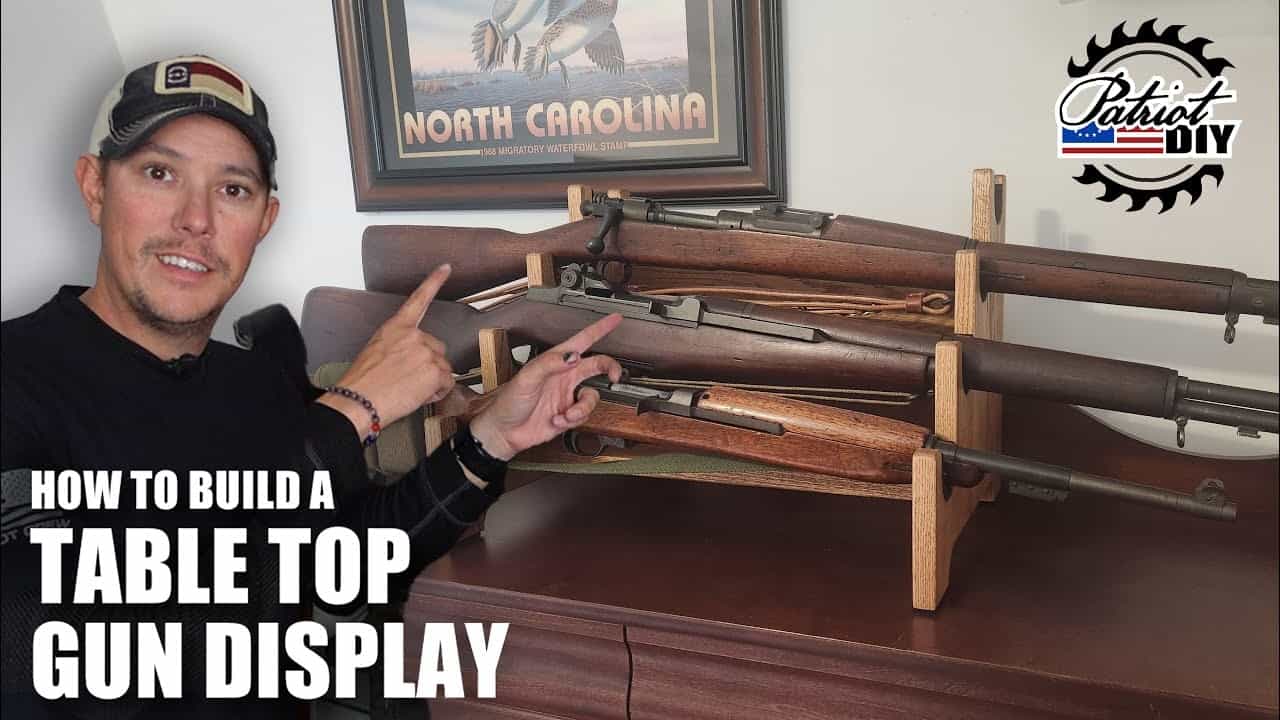
Jason from PatriotDIY built and designed this project.
This tabletop display is a compact oak stand that holds four long guns and presents them cleanly on an office or den shelf.
The build uses simple joinery and shaping to create a refined, approachable piece suitable for beginner to intermediate woodworkers.
Watch the full video and subscribe to PatriotDIY:

Design
The stand is straightforward in silhouette: two side panels with shaped notches for the gun rests joined by three horizontal stretchers to form a stable frame.
The rounded top corners and soft edge profiles give a finished look while keeping the focus on the rifles rather than ornate details.
Jason keeps the design intentionally simple so the grain and finish of the oak take center stage, which also makes the project repeatable and quick to lay out.
That simplicity makes it a great shop project to practice matched grain and consistent layout without getting bogged down by complex joinery.
Lumber Prep
The whole build is milled from a single 1×8 board of red oak, demonstrating efficient material use and minimizing waste. Boards are cut, edge-joined, and squared before layout so that matching grain across the side panels looks intentional and continuous.
Jason uses biscuits to ensure perfect alignment when gluing up the panels, which is a forgiving method for beginners and helps eliminate twist or misalignment during the glue-up.
Taking time to scrape dried glue and trim panels to final size keeps the edges clean for the next steps.
Joinery
Instead of pocket holes, Jason opts for dowel joinery to assemble the stretchers to the side panels, using a self-centering dowel jig for consistent hole placement.
The approach is simple and strong when executed with precise layout and a drill press for vertical accuracy.
The build could just as easily use pocket holes or biscuits depending on tool preference, but the dowel method shown highlights the value of precise layout and test-fitting. Careful fit of the dowels and even glue application produces a tight assembly that needs minimal clean-up after clamping.
Shaping & Sanding
Gun rests are cut from the side panels using a hole saw to define the arcs and a bandsaw to remove excess material, then refined on a spindle sander for a snug, finished profile. Jason leaves a little extra stock when cutting and trims to fit as needed, which is a helpful habit when shaping is involved.
Edge work is handled with a radius jig and a roundover bit to soften all exposed corners, producing a smooth, tactile result that reads as professional. Final sanding across all components removes tool marks and prepares the wood for finish absorption and even color.
Finishing
For the finish, Jason applies a wipe-on Danish oil followed by sprayed polyurethane topcoats, which brings out the oak grain while providing durable protection.
Letting the oil cure before topcoats and applying multiple thin polyurethane layers helps achieve a consistent sheen and long-lasting surface.
Small finishing touches include adhesive felt in each gun rest and on the feet to protect firearms from scratches and to keep the stand from sliding.
Those little details make the display practical as well as attractive and are easily adapted to other finishes or protective materials.
Why This Build Matters
This project teaches important shop fundamentals: layout accuracy, edge-joining, shaping with a bandsaw and router, and clean assembly techniques that scale to many furniture projects.
The limited scope makes it a focused learning opportunity without requiring an extensive toolset.
Builders can adapt the plans to different woods, vary the profiles, or switch joinery methods to suit available tools and skills, making the stand a flexible design exercise.
The result is a useful, attractive piece that showcases careful work and thoughtful finishing.
Get Jason’s plans here: https://www.etsy.com/listing/4446716961/table-top-4-gun-display-digital-build.

Matt’s Take
These are my personal thoughts and tips based on my own experience in the shop. This section is not written, reviewed, or endorsed by the original creator of this project.
The dowel joinery Jason chose here is a great middle ground between simplicity and strength. While pocket holes would be faster, dowels create a cleaner look since there’s no visible hardware, and they’re plenty strong for a display piece like this. The key is really in the layout accuracy and using a quality self-centering jig to keep everything aligned.
That hole saw approach for cutting the gun rest profiles is smart — it gives you a perfect arc to work from, then the bandsaw removes the waste quickly. I’d definitely recommend going slow with the spindle sander on oak since it can burn easily if you linger in one spot. Test-fitting as you go prevents over-sanding, which is tough to fix once you’ve gone too far.
The finishing approach of Danish oil followed by poly is solid for a piece that’ll see handling. The oil soaks in and enhances the grain, while the poly topcoats provide the durability you want for something that’ll have guns placed on and removed from it regularly. Those felt pads are a nice touch — they protect both the guns and the surface the stand sits on.
This is exactly the type of project that teaches fundamentals without overwhelming a newer woodworker. Clean layout, basic shaping, and straightforward assembly that builds confidence for tackling more complex furniture down the road.