
Drive through a modern subdivision, and you see precision.
Straight lines. Perfect 90-degree angles. Flat, sensible roofs.
But for a brief moment in the 1920s, American builders threw away the ruler.
They didn’t want precision. They wanted fantasy.
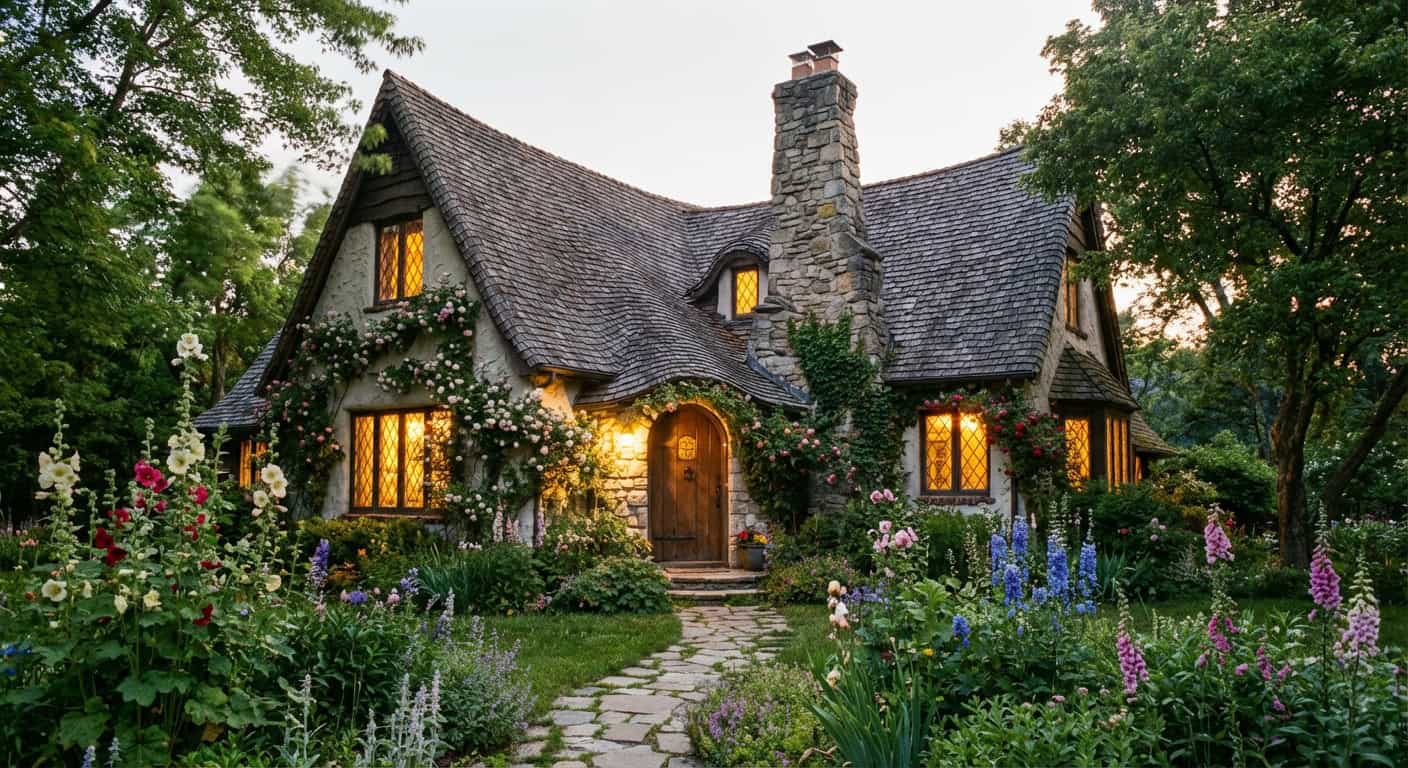
Inspired by soldiers returning from WWI Europe and the booming silent film industry in Hollywood, a trend called “Storybook Style” exploded across the country.
Builders made roofs sag on purpose. They made chimneys crooked. They splashed stucco on walls to make them look 500 years old.
They were building stage sets for everyday life.
We stopped building them because they were inefficient, expensive, and a nightmare to frame.
But when you see one today, you can’t help but smile.
Here are 20 American Storybook cottage styles that prove we used to have a lot more fun with our homes.
1. The False Thatch Roof
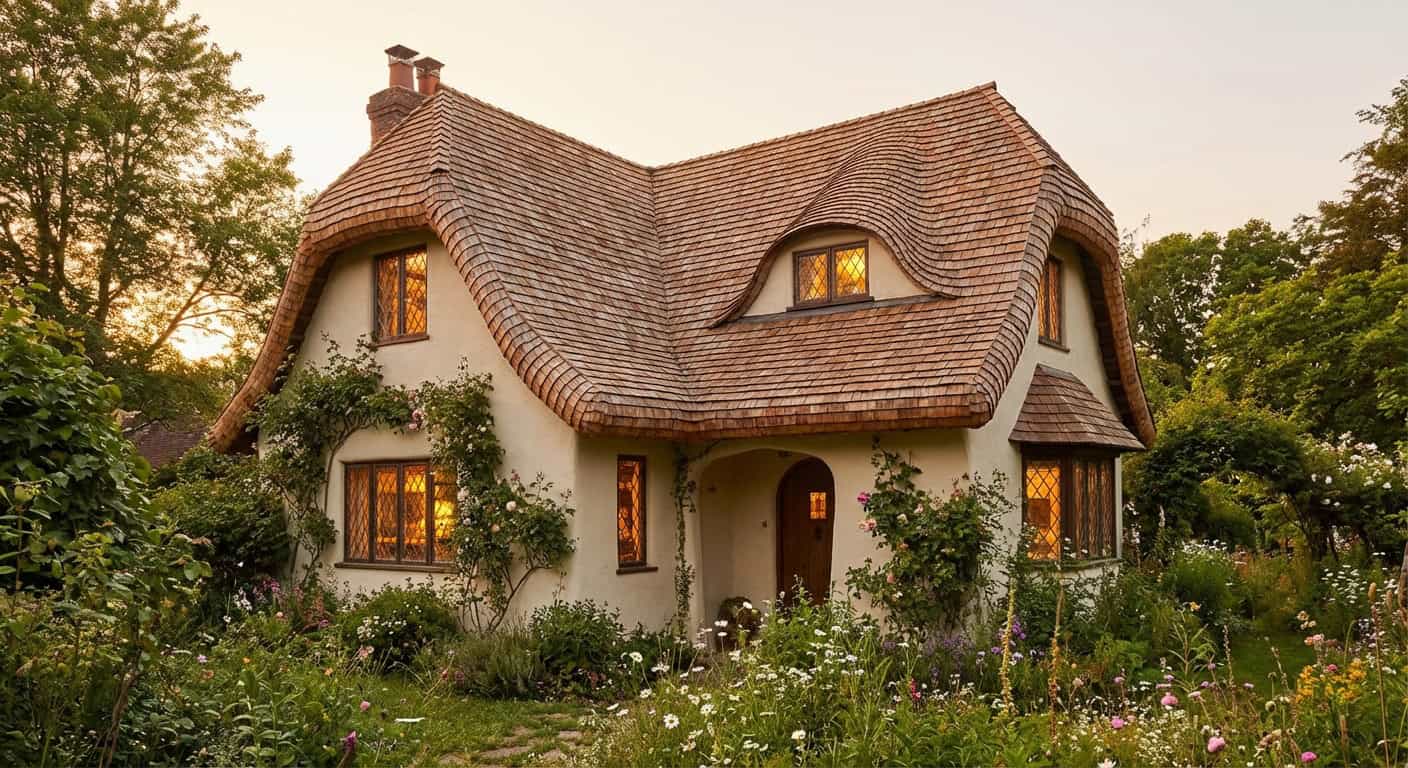
In the English countryside, roofs were made of straw (thatch). In 1920s America, we wanted the look without the fire hazard.
Builders developed a technique of steaming cedar shingles and rolling them around the eaves.
It created a soft, melted look that made the house feel like a mushroom.
It required incredible craftsmanship to curve wood like that. Today, we just slap on flat asphalt and call it a day.
2. The Normandy Turret

Soldiers coming back from France fell in love with the rural farmhouses of Normandy.
The defining feature? The silo-shaped tower.
In American versions, this tower usually held the entryway or a spiral staircase.
It adds a touch of castle-like grandeur to a tiny home. Now, a round room is considered a “waste of space” by developers.
3. The “Catslide” Cottage

This style is all about the roof.
One side is short; the other sweeps all the way down to the first floor, like a slide.
It makes the house look like it is hugging the ground.
It’s visually stunning, but try finding a contractor today who knows how to frame a roof that asymmetrical.
4. The Hollywood “Spadena” Style

This is the peak of the style. Named after the famous “Witch’s House” in Beverly Hills, these homes were built to look dilapidated on purpose.
The roofs were built to look like they were collapsing. The shutters were hung crookedly.
It was distinct. It was playful. It was a rebellion against the stiff Victorian rules of the previous era.
5. The Carpenter Gothic

Popularized in places like Martha’s Vineyard, these are the “Gingerbread Houses” of America.
They are defined by their steep pointed roofs and the intricate, lace-like wood trim cut by scroll saws.
They look like wedding cakes made of wood.
We stopped building them because painting that much intricate trim is a homeowner’s worst nightmare.
6. The Stone “Cotswold” Cottage

These homes tried to mimic the limestone cottages of the Cotswolds in England.
They used massive, irregular stones and heavy slate roofs.
The goal was to make a brand new house look like it had been standing since the 1400s.
Today, shipping that much heavy stone would cost more than the house itself.
7. The Half-Timbered Tudor

You see cheap imitations of this in the suburbs, but the original 1920s versions were the real deal.
The dark wood beams (half-timbering) against the white stucco created a stark, medieval look.
It was decorative, yes, but it sold the fantasy of being an English Lord on a surprisingly small budget.
8. The “Mushroom” House

Some builders hated straight lines so much they abandoned them entirely.
“Mushroom” houses feature flowing curves, rounded doorways, and roofs that look like organic caps.
They look like they grew out of the earth rather than being built upon it.
9. The Dovecote Entrance

In medieval Europe, keeping pigeons (doves) for eggs was common.
In 1920s America, we didn’t need the pigeons, but we loved the look.
Architects would build elaborate “birdhouses” directly into the brickwork above the front door.
It’s a tiny, whimsical detail that adds instant history to a facade.
10. The Swiss Chalet Revival

Americans have always loved the idea of a mountain hideaway.
The Swiss Chalet style brought the Alps to the suburbs.
With massive overhanging roofs to hold snow and decorative carved balconies, they were cozy and sturdy.
They fell out of style because they look a bit out of place if you aren’t actually on a mountain.
11. The “Crooked” Chimney Cottage

Why build a straight chimney when you can build a fun one?
Storybook masons would lay bricks in spiral patterns or add random stones to make the chimney look teetering.
It suggested that the house was built by a distinct character, not a machine.
12. The Wavy shingle

Standard roofing is all about straight horizontal lines.
Storybook roofers would lay shingles in waves, varying the exposure to create a rippling texture.
It mimics the look of an old, settling roof. It takes three times as long to install, which is why your roofer will refuse to do it today.
13. The Spanish Revival Casita

In California and Florida, the “Storybook” style took a Spanish turn.
These “Casitas” were small but rich in detail.
Arched doorways, iron window grilles, and heavy wooden gates made even a 1,000-square-foot house feel like a fortress.
14. The Boulder Bungalow

Instead of cut stone, these houses used massive, round river rocks.
The result is a house that looks bumpy, heavy, and incredibly permanent.
It feels like a bear’s den turned into a home.
Masonry like this is a lost art; fitting round rocks together tightly is incredibly difficult.
15. The French Eclectic

This style mixes a bit of everything.
It combines the steep roofs of French country homes with American materials.
The defining feature is often the “flared” eaves at the roofline, giving the house a little upward flip at the edge like a skirt.
16. The Mission Bell Tower

Drawing from the California Missions, these small homes featured a “Campanario” (bell wall) right on the front.
Did you need a bell to call the family to dinner? No.
Did it look incredibly romantic? Absolutely.
17. The Lead-Glass English Cottage

Modern windows are giant sheets of clear glass.
Storybook cottages used diamond-paned casement windows.
They distorted the view slightly, making the outside world look like an impressionist painting.
They were drafty and inefficient, but they offered a privacy and coziness that plate glass can’t match.
18. The “Hobbit” Stucco Nook

The Storybook style hated sharp corners.
Builders would smooth wet plaster over corners to create rounded, soft edges.
It creates a subconscious feeling of safety and comfort, like being inside a handmade clay pot.
19. The Medieval Fortress Facade

Some homeowners wanted their castle, even if it was on a 50-foot lot.
These homes featured heavy, planked wooden front doors with iron strap hinges and tiny “peep” windows.
It was a way to say, “This is my castle, keep out,” in the most charming way possible.
20. The Technicolor Victorian

While not structurally “Storybook,” the “Painted Lady” trend fits the vibe.
In the Victorian era, houses were often earth tones. The “Storybook” revival saw people painting these old dames in wild, candy-colored hues.
It turns a street into a candy shop.
Conclusion
We don’t build houses like this anymore.
They are too labor-intensive. A wavy roof takes three times as long as a straight one. A round tower costs a fortune in custom framing.
But these houses remind us that a home doesn’t have to be just a box for living.
It can be a story.
If you are lucky enough to own one of these whimsical treasures, don’t “modernize” it.
Keep the drafty windows. Keep the crooked chimney.
You are living in a fairy tale.