

This project was built and designed by Izzy Swan.
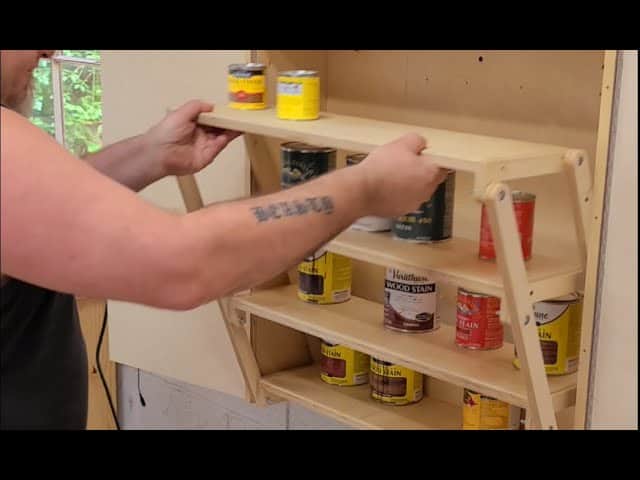
Izzy shares a prototype for a wall-mounted cabinet that folds down into a usable table while letting the items on the shelves stay in place.
The concept is aimed at tiny homes and van life applications where every inch of space and every minute saved matters.
Watch the full video and subscribe to Izzy Swan:

Design
The core idea is a slim cabinet that mounts to a wall and folds down into a table, with internal shelves that remain usable when the surface is lowered.
Izzy explores practical choices—like shelf depth, number of tiers, and hinge placement—to balance stability with compactness for small living spaces.
Fabrication and Prep
Parts for this prototype were cut and assembled using CNC-cut components and simple fixtures to speed the layout and test fit.
Attention to countersinking and edge cleanup helped keep hardware flush and reduced tear-out during drilling and assembly.
Joinery & Hardware
Hinge points are handled with bolts that act as pivot pins, with one side using a nut and the other side threaded into the plywood to avoid protruding hardware.
Izzy deliberately leaves a little friction in the pivots so the table moves freely but holds position under light loads.
Assembly and Adjustment
The prototype includes cabinet doors with removable pins and a drop mechanism that folds the shelf down into a usable surface without clearing the items off. Small issues like a bit of play at the drop were noted and easily addressed with a cabinet mount or minor hardware tweaks in a finished build.
Finishing & Next Steps
This initial model is a proof of concept; Izzy plans a second prototype to compare different approaches and then will build a refined version in hardwood.
Finishing choices, hardware upgrades, and slightly increasing shelf depth are part of the planned improvements to make the piece comfortable as both a dining surface and a small workspace.
Why This Build Matters
Space-saving furniture that keeps items in place while changing function solves a real friction point for tiny living and van life, making daily routines faster and more pleasant.
The project also highlights the value of rapid prototyping—testing ideas quickly, learning from fit and use, and iterating toward a more polished final product.
This design shows how thoughtful hardware and simple mechanics can add meaningful functionality to compact homes without complicated modifications.
It’s a useful reference for makers who want to adapt the idea for different spaces or refine the mechanism for greater load or comfort.
Please support Izzy by visiting his website: https://www.izzyswan.com/.

Matt’s Take
These are my personal thoughts and tips based on my own experience in the shop. This section is not written, reviewed, or endorsed by the original creator of this project.
Space-saving furniture like this really showcases how clever design can solve multiple problems at once. The pivot mechanism Izzy uses is brilliant—keeping just enough friction to hold position while still allowing smooth operation is that sweet spot you’re always chasing in functional hardware. Too loose and it won’t stay put, too tight and it becomes a chore to use every day.
The bolt-as-pivot approach is smart for prototyping since you can easily adjust tension and swap out hardware as you dial in the feel. For anyone thinking about adapting this concept, consider your wall mounting carefully—that folding action puts different stresses on the attachment points than a typical cabinet would see. Make sure your wall anchors and mounting method can handle both the vertical load and the leverage when the table’s extended.
I really appreciate Izzy’s prototyping approach here. Building a quick version to test the concept before committing to expensive hardwood is exactly how you avoid costly mistakes. That little bit of play he mentions at the drop point is the kind of thing you only discover by actually using the piece—no amount of planning on paper would catch that detail.