

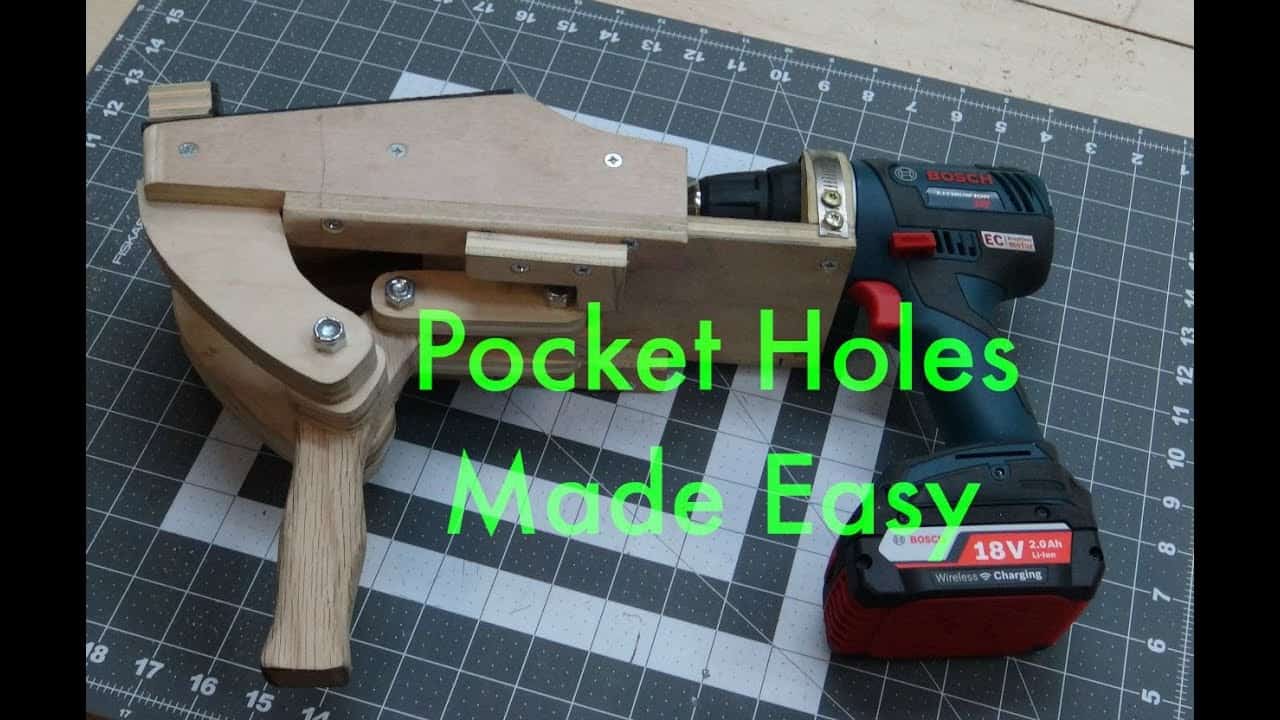
This project was built and designed by Izzy Swan.
Izzy set out to make a compact, portable pocket-hole machine that could either travel to a workpiece or be mounted to a bench, with a single smooth motion to cut holes quickly.
The concept prioritizes speed and simplicity over a complicated clamping routine, serving as a proof of concept for a more refined, adjustable version to follow.
Watch the full video and subscribe to Izzy Swan:


Design
The jig was designed around a single drill axis set at a fixed angle and a sliding assembly that carries the drill straight into the workpiece.
Izzy favored a lightweight footprint so the device could be moved to large panels instead of bringing panels to a stationary machine.
Rather than elaborate fences and stops, the layout relies on a simple guide rail and captured drill slide to produce repeatable pocket holes with one motion. This approach keeps setup time low and makes the jig useful for both on-site and bench-mounted work.
Lumber and Prep
The prototype was built mostly from plywood, milled and stacked to create the base, guide rails, and a wooden bush that acts as the drill guide.
Quick adhesives were used to hold parts during assembly so the build moved fast and allowed for iterative shaping and fitting.
Careful trimming and filling dials in the fit of the sliding components, and small trim tools are handy for cleaning up exposed edges for a tight, consistent slide. The result is a captured slide that stays aligned while under load.
Drill Mounting and Actuation
Instead of a built-in motor, the jig accepts a hand drill that rides in a wooden sleeve and is clamped in place for use. A simple hose-clamp style fastening secures the tool to the slide and keeps it stable during the drilling stroke.
Actuation is handled by a linkage and a single handle that pulls the drill forward into the workpiece and retracts it, so one motion produces a pocket hole. A traction pad on the actuator helps the user keep a steady grip while cutting holes.
Troubleshooting and Fit
Because the guide in the prototype is wood rather than a hardened bearing, there is a small amount of play during drilling, which Izzy acknowledges as a limitation of this first version.
Small adjustments—like tightening the slide fit and trimming filler material—improve repeatability and reduce wobble.
The build process highlighted useful shop tricks for finishing edge and fit, including trimming and flush cutting to make seams invisible and ensure the drill slide is captured cleanly. Those little refinements make the jig feel more robust even in prototype form.
Performance and Next Steps
The prototype performs well as a proof of concept and demonstrates that a portable, single-motion pocket-hole jig is practical and fast for many panel and rail applications.
The tradeoff is that a finished product will need a more precise guide and a built-in trigger or power solution for safer, smoother operation.
Izzy plans to refine the design into an adjustable, more user-friendly version and to share plans so others can build or adapt the concept. The next iteration will address the play in the guide and add conveniences like an integrated trigger mechanism.
Why This Jig Matters
Reducing setup time and moving the jig to the workpiece instead of the other way around changes how pocket holes can be used on large panels and assemblies.
A lightweight, repeatable device helps speed production and makes pocket-hole joinery more accessible for shop and on-site work.
The approach also encourages iterative design: test a simple idea, learn where precision is needed, and then refine the mechanism for the next version.
That cycle is a practical roadmap for anyone rethinking specialty jigs in the shop.
Please support Izzy by visiting his website: https://www.izzyswan.com/.

Matt’s Take
These are my personal thoughts and tips based on my own experience in the shop. This section is not written, reviewed, or endorsed by the original creator of this project.
Pocket hole joinery gets a bad rap sometimes, but it’s genuinely useful for quick assemblies and situations where you need solid joints without complicated setups. What’s clever about this design is how it flips the typical workflow — instead of wrestling large panels over to your benchtop jig, you bring the tool to the work. That’s a game-changer when you’re dealing with cabinet doors or big tabletops.
The single-motion concept really appeals to me. Most pocket hole jigs require you to clamp the workpiece, position the jig, drill the hole, then repeat. Here, once your drill is mounted, it’s just pull and release for each hole. That kind of workflow improvement adds up fast when you’re cutting dozens of holes for a project.
Safety-wise, having that captured slide is smart — it keeps the drill from wandering or binding unexpectedly. The wooden guide bush is an interesting choice for a prototype. While it’ll wear over time, it’s dead simple to replace and lets you dial in the fit without machining metal parts. For a production version, a hardened steel guide would definitely be the way to go, but plywood works great for proving out the concept.
The whole approach here — build simple, test the idea, then refine — is solid shop philosophy. Sometimes the best way to figure out what you actually need is to build something that works and see where it falls short.