
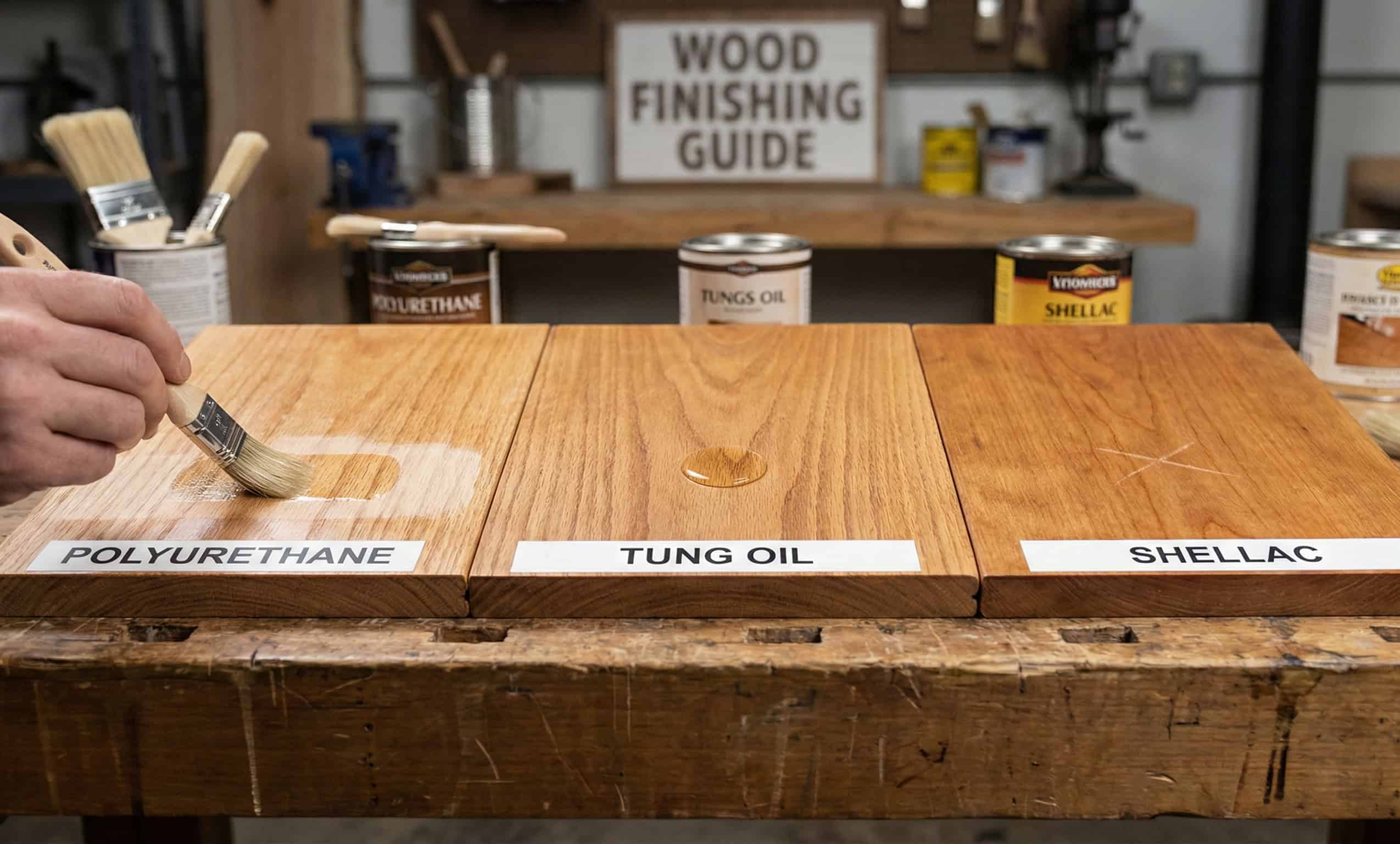
Wood finishes can be confusing because many of them look almost identical on the can and even on the wood.
The problem is that once a project gets used, those finishes can behave very differently.
I’ve seen a lot of frustration come from picking the wrong finish for the job, even when the application was done correctly.
This guide breaks down some of the most commonly confused wood finishes and explains how they actually hold up in real use.
Quick Comparison: Commonly Confused Wood Finishes
| Finish Pair | Why They’re Confused | How They Actually Behave | Best Use Case |
|---|---|---|---|
| Polyurethane vs Varnish | Both form a clear protective film and are often treated as the same finish | Polyurethane builds a harder surface that can chip, while varnish stays more flexible and wears gradually | Poly for floors and heavy wear, varnish for furniture and outdoor use |
| Wipe-On Poly vs Oil Finish | Both wipe on easily and feel similar during application | Wipe-on poly still creates a plastic film, oil finishes soak in with little surface build | Wipe-on poly for light protection, oil for appearance and easy refresh |
| Hardwax Oil vs Oil-Based Poly | Both aim for a natural, low-sheen look | Hardwax oil allows spot repairs but offers less protection, poly resists wear but is harder to repair | Hardwax oil for desks and furniture, poly for tabletops |
| Danish Oil vs Tung Oil | Both are labeled as “oil” finishes | Danish oil is a blend that cures faster, tung oil products vary widely and often dry slowly | Decorative projects with low wear |
| Shellac vs Lacquer | Both dry fast and leave a smooth finish | Shellac is sensitive to heat, water, and alcohol, lacquer is more durable but solvent-sensitive | Shellac for decorative pieces, lacquer for cabinets |
Polyurethane vs Varnish
Why they’re often confused
Polyurethane and varnish are frequently used interchangeably, and many people assume they are basically the same thing. Both create a protective film and are commonly brushed or wiped on.
How they behave over time
Polyurethane forms a harder, more plastic-like surface that resists abrasion very well. When it fails, it often chips or peels instead of wearing away evenly.
Varnish stays a bit more flexible, which helps it handle temperature changes and wood movement. It usually wears down gradually rather than cracking or chipping.
When each one makes sense
Polyurethane works well for floors and surfaces that see constant abrasion. Varnish is often a better choice for furniture and projects exposed to changing conditions.
Wipe-On Poly vs Oil Finishes
Why these get mixed up
Wipe-on poly feels similar to oil during application, which leads many people to assume it behaves the same way. Both are easy to apply and forgiving for beginners.
What happens after curing
Wipe-on poly still builds a thin plastic film, even if it takes more coats to get there. Oil finishes soak into the wood and leave very little protection on the surface.
This difference becomes obvious once the project is used. Wipe-on poly resists wear better, while oil finishes show wear sooner but are easier to refresh.
A common mistake
Many people think they’re using an oil finish when they’re actually applying diluted polyurethane. That misunderstanding often leads to surprise when repairs don’t blend in.
Hardwax Oil vs Oil-Based Poly
Why both finishes are popular
Hardwax oil is popular because it leaves a natural look and feel. Oil-based poly is popular because it offers strong protection with minimal upkeep.
Durability expectations
Hardwax oil offers some water resistance, but it is not a thick protective barrier. Oil-based poly creates a tougher surface that resists spills and abrasion much better.
The tradeoff shows up during repairs. Hardwax oil can usually be spot-repaired, while poly often requires sanding a much larger area.
Choosing based on use
Hardwax oil works well for desks, furniture, and pieces that benefit from easy touch-ups. Oil-based poly is a better choice for tabletops and high-use surfaces.
Danish Oil vs Tung Oil
What people expect
Many people assume Danish oil and tung oil are similar because both include the word “oil.” The names make them sound like simple, natural finishes.
What’s really happening
Danish oil is usually a blend of oil, varnish, and solvents. Products labeled “tung oil” vary widely and may not be pure tung oil at all.
This affects drying time and durability. Danish oil cures faster and offers slightly more protection than oil alone.
When they work best
These finishes make sense when appearance matters more than durability. They are less ideal for surfaces exposed to moisture or heavy wear.
Shellac vs Lacquer
Why they look similar
Shellac and lacquer both dry quickly and leave a smooth finish. They are often sprayed or padded on in thin coats.
How they react to use
Shellac is sensitive to heat, water, and alcohol. Lacquer handles those conditions better but can still be damaged by strong solvents.
This matters once a piece leaves the shop. A shellac finish can fail quickly on a dining table.
Best use cases
Shellac works well for decorative furniture and shop projects. Lacquer is better suited for cabinets and furniture that see daily use.
Conclusion
Most finishing problems don’t come from poor application. They come from choosing a finish that doesn’t match how the project will actually be used.
Once you understand how finishes behave over time, picking the right one gets much easier. Matching the finish to the job saves frustration and leads to better results.