

This project was built and designed by Billy from Newton Makes.
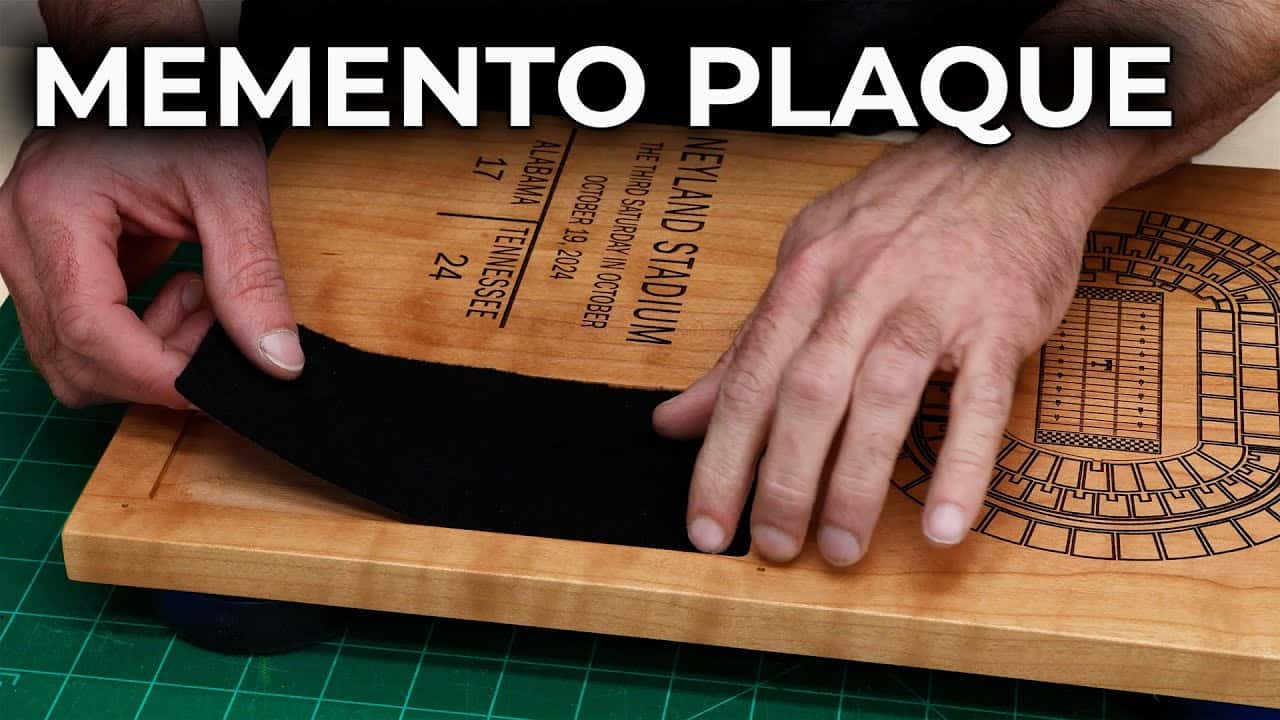
Billy repurposed a thick piece of cherry into a commemorative wall plaque to mark a deeply personal moment: a father taking his son to their first game at Neyland Stadium and preserving that memory in wood and engraving.
Watch the full video and subscribe to Billy’s channel:
Design
The plaque centers on a simple, honest aesthetic: matched cherry grain, an engraved layout of Neyland Stadium, and a recessed window for a commemorative ticket.
Engraving focused on key visual elements—stadium seating sections, the football field, and the checkerboard end zone—while the date and final score personalize the piece for the family.
Lumber Prep and Acclimation
Billy began by milling a thick piece of cherry and then letting the boards acclimate before final milling to avoid later movement like cupping or twisting.
He milled in stages, removing only what was necessary, and checked flatness after each rest period so the final plaque would remain stable over time.
Edge Preparation and Glue-Up
Grain matching was a priority, so the two boards were oriented to flow together visually before being glued into a single panel for the plaque.
To get a near-perfect joint, both mating edges were run across the jointer at the same time so each face matched the other, producing a tight seam after glue-up and sanding with a drum sander to final thickness.
Routing, Ticket Recess, and Hanging
The plaque incorporated a shallow recess for a printed, commemorative ticket that sits on a black felt backing and is protected beneath a piece of acrylic secured with small screws.
A keyhole slot was routed for wall mounting, and pilot holes were used to ensure the hanging hardware sits flush and secure; these routing operations were kept shallow and precise to preserve the plaque’s profile.
Shaping and Final Surface Prep
Edges were softened and the panel sanded through progressive grits to remove tool marks and refine the engraved details before finishing.
Attention to the engraving included cleaning out finish from the cut lines so the detail stayed crisp rather than filled with finish residue.
Finishing
Billy applied a hard wax finish, worked in with a pad and wiped off excess to avoid sticky buildup and to maintain a tactile, natural surface on the cherry.
After curing, light buffing and additional thin coats brought depth to the grain while preserving the engraved contrast and the visual separation around the ticket recess.
Why This Memento Matters
The project is an example of using maker skills to give a memory physical form, turning a shared experience into an heirloom that can be hung and revisited over time.
Technically, it reinforces useful shop habits—acclimation, edge matching, careful routing and finish cleanup—while emotionally it highlights how a simple object can hold a large personal meaning.
Please support Billy by visiting his website here: https://www.newtonmakes.com/shop.

Matt’s Take
These are my personal thoughts and tips based on my own experience in the shop. This section is not written, reviewed, or endorsed by the original creator of this project.
Billy’s approach to lumber acclimation really caught my attention here. That step-by-step milling process—taking off material, letting the wood rest, then checking for movement—is one of those shop habits that separates frustrating projects from successful ones. Cherry can be particularly finicky about movement, so giving it time to settle between operations is smart shop practice that saves headaches down the road.
The edge jointing technique he used is a classic move worth remembering. Running both pieces through the jointer at the same time automatically compensates for any slight angle in your fence or setup. Even if your jointer isn’t perfectly tuned, you’ll still get mating edges that fit together seamlessly. It’s one of those simple tricks that consistently delivers better glue joints.
That keyhole routing operation deserves a safety mention—shallow passes are definitely the way to go, especially in hardwood like cherry. Taking too aggressive a cut with a keyhole bit can grab and cause tear-out or worse. The same goes for any routing near the edges of a finished piece. Multiple light passes give you better control and cleaner results.
Projects like this remind me why I love woodworking. Sure, the technical skills matter, but using those skills to capture a memory? That’s what makes this craft special. Years from now, this plaque will still be hanging there, holding that father-son moment in wood and grain.