

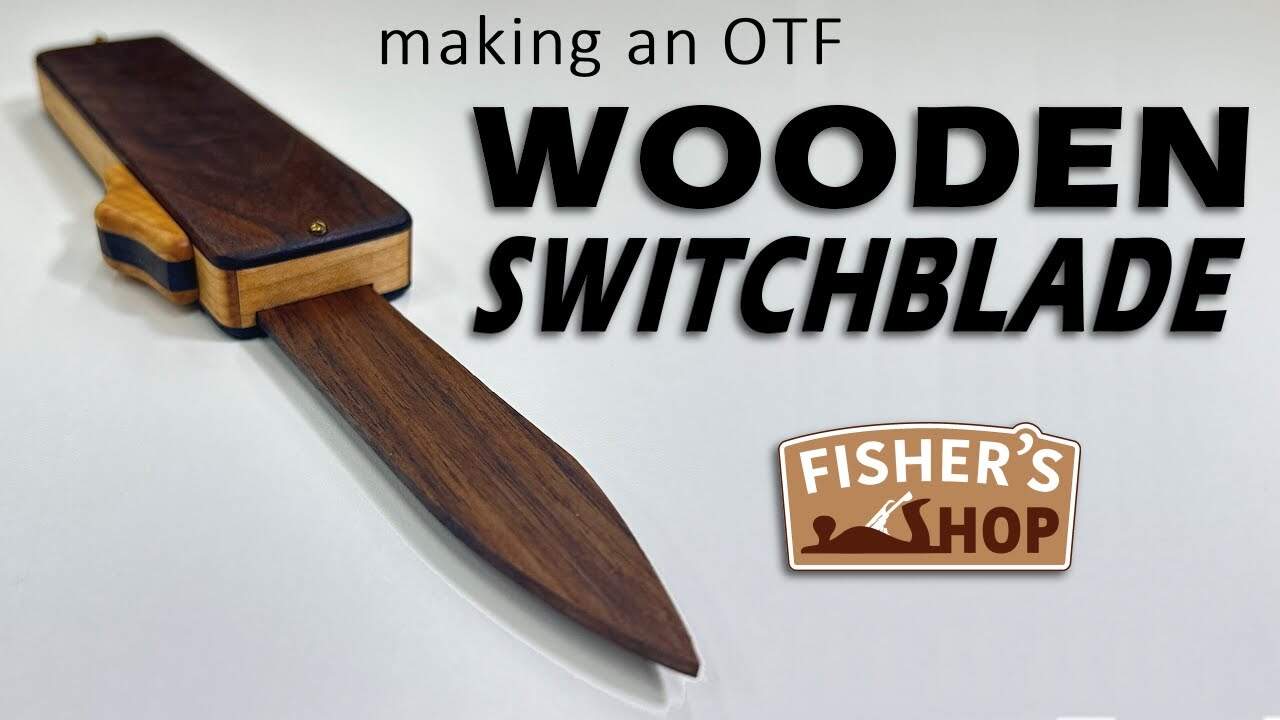
This project was built and designed by Drew Fisher from Fisher’s Shop.
Drew set out to design a fully wooden out-the-front (OTF) switchblade that would both deploy and retract the blade using the same basic principles as a metal F-style mechanism.
Watch the full video and subscribe to Drew’s channel:


Design and Development
The project began in CAD to work out the mechanism and proportions before any wood was cut, and Drew iterated through multiple prototypes to refine the locking system.
Early attempts failed or required major revisions, but each prototype revealed exactly where engagement, clearance, or springing action needed improvement until a fourth design finally worked reliably.
Materials and Layout
Drew used contrasting hardwoods to build the blade, slide, and housing, cutting pieces from thin planed stock and transferring shapes with printed stencils for accuracy.
Rather than machining a deep groove into a single block, the slide groove was formed by assembling thin pieces around the channel, which simplified layout and ensured precise placement relative to the stencil.
Mechanism and Locking
The core mechanism relies on two locking pins that are biased upward and two notches on the blade—one for the deployed position and one for the retracted position.
Instead of metal springs, Drew used rubber bands as the energy source and as the linkage between the locking pins so the pins would push up and engage the blade until the slide’s ramps depressed them at the correct moment.
How the Action Works
The blade rides between interior risers and is free to slide until a notch is captured by a locking pin; when the slide is moved, angled ramps press the pins down and rubber bands stretch around a small dowel on the blade to store energy.
When a pin is depressed far enough the stored energy in the rubber bands releases and the blade snaps to the opposite locked position, allowing both deployment and retraction with the same parts.
Assembly, Fit, and Shaping
Assembly involved stacking and gluing walls, risers, and plates to form a clamshell body that allows easy access to the internals for tuning or replacing rubber bands and blades.
Final shaping was done with a bandsaw, belt sander, and files to clean bandsaw marks and refine profiles; small decorative choices—contrast woods and brass screws—give the finished piece a polished look.
Finishing and Maintenance
The finished knife was sealed with a hard wax oil, which enhances the wood tone and provides a smooth, durable surface that’s easy to buff and maintain.
The clamshell construction makes routine maintenance simple: the top can be removed to adjust or swap out rubber bands and to change the blade for different uses.
Lessons and Adaptations
The build is a compact study in mechanism design, showing how careful geometry, controlled clearances, and simple elastic elements can replace more complex metal hardware.
Many of the techniques—layering parts to form channels, using counter-sinks for elastic knots, and iterating prototypes—are adaptable to other small mechanical wood projects and teaching exercises.
Why This Build Matters
Beyond being a novelty, the wooden OTF switchblade highlights practical problem-solving: it demonstrates prototyping, mechanical engagement, and how to get reliable motion from inexpensive materials.
It’s a useful project for someone wanting to explore mechanical design in wood without specialized metalworking tools, and it rewards iteration and careful testing.
Get Drew’s plans here: https://fishersshoponline.com/plans/p/switchblade.

Matt’s Take
These are my personal thoughts and tips based on my own experience in the shop. This section is not written, reviewed, or endorsed by the original creator of this project.
What strikes me about this build is how Drew approached the mechanical challenge methodically. Starting in CAD and working through multiple prototypes is exactly the right approach when you’re dealing with precise clearances and timing. It’s tempting to dive straight into cutting wood, but complex mechanisms like this really benefit from that upfront design work.
The rubber band solution is brilliant from both a materials and safety standpoint. Beyond being easier to work with than metal springs, rubber bands are inherently safer in a shop environment and make the whole mechanism more forgiving. If something binds up or goes wrong, you’re dealing with stretchy rubber rather than stored metal spring energy.
I really appreciate the clamshell construction approach. Building up the internal channels by layering thin stock rather than trying to rout deep grooves into a solid block is much more accessible for most home shops. It also gives you better control over the precise dimensions of those channels, which is critical when you need smooth, consistent blade travel.
The choice to use contrasting woods isn’t just aesthetic—it actually helps you see how the mechanism works, which makes troubleshooting and adjustments much easier. Sometimes the best design choices serve both form and function.