

These projects were built and designed by Nick Starrett from Nick Starrett.
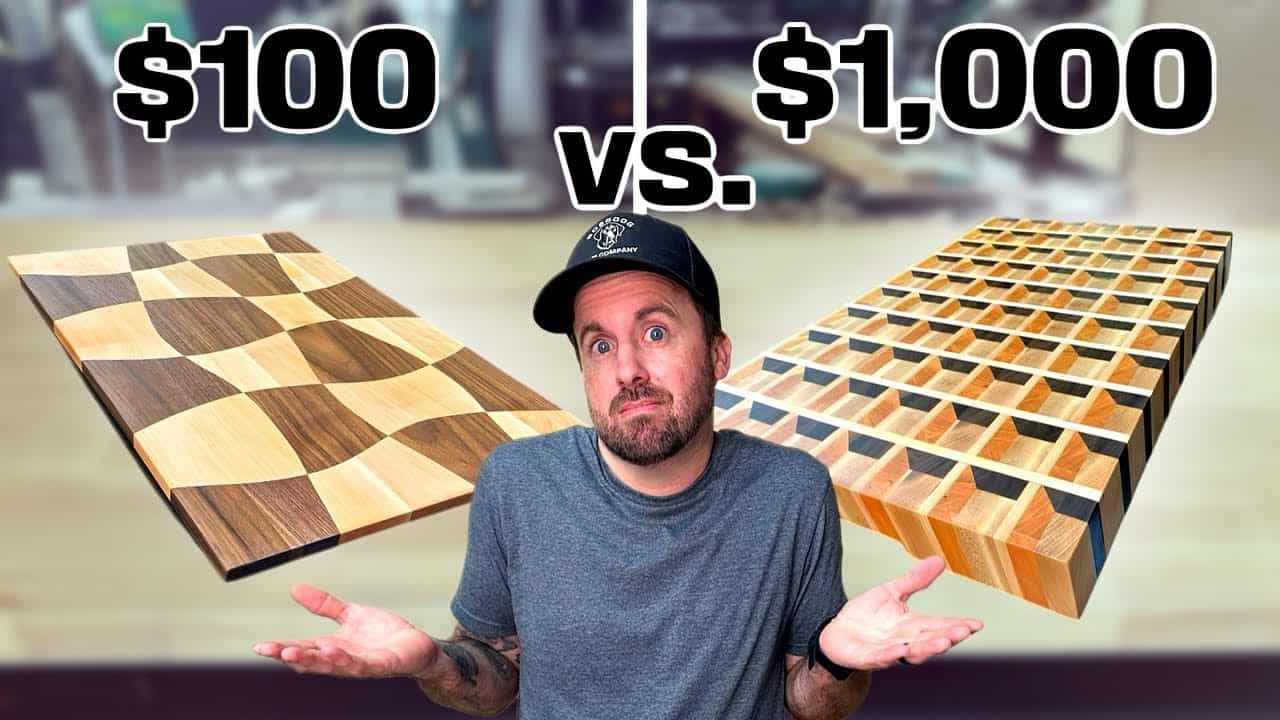
Nick compares two striking cutting board designs side by side: a relatively simple patterned board called the Day Tripper and a much more involved waffle-pattern end-grain board.
Watch the full video and subscribe to Nick Starrett:
Day Tripper (the $100-style board)
The Day Tripper is a visually appealing, approachable design that pairs maple and walnut in alternating panels to create a flowing, organic pattern.
Construction centers on gluing up separate maple and walnut panels, planing them flat, then using double-sided tape to sandwich and resaw squiggly lines on the bandsaw; the resulting pieces are shuffled and glued back together for the final pattern.
Shaping and finishing are straightforward: panels are planed, sanded, aligned, and the maker routs simple handles before applying finish to make the grain and color pop.
From a business perspective this design is material-light and fast to produce; using the creator’s numbers for materials and labor, two boards from the same build yielded a net profit of about $59.72 on a retail value of $230, roughly a 26% margin.
Waffle Pattern Board (the $1,000 board)
The waffle-pattern end-grain board is a more complex, multi-species design that mixes cherry, maple, and walnut to create a three-dimensional waffle effect when viewed from the side.
It requires many staged glue-ups, precise angled cuts (including 45° faces to form triangular elements), and several resaws and crosscuts to assemble the waffle modules that give the board its depth and texture.
Flattening and finishing can demand extra equipment or jigs; Nick demonstrates both a large drum sander workflow and an alternate flattening method using a router-based flattening jig for shops without a wide belt sander.
Although the waffle board uses more material and time, it also commands a much higher retail price; with the creator’s estimates the build cost landed around $639.29 and produced about $360.71 in profit on a $1,000 selling price, roughly a 36% margin.
Why These Builds Matter
Side-by-side, the two boards show how design complexity, material selection, and time investment change both the maker’s workload and the product’s market position.
Simpler, repeatable patterns like the Day Tripper are easier to scale and have good per-hour returns when produced in batches, while the waffle board is a higher-ticket piece that rewards advanced techniques and uniqueness but requires more setup and careful execution.
Techniques demonstrated — precise glue-up sequencing, alternating grain orientations, strategic use of tape for resawing, and router-based flattening jigs — are adaptable to many projects and useful for makers working with limited shop space or equipment.
For makers deciding what to offer, the choice comes down to business goals: produce consistent, lower-effort pieces for steady sales, or invest in standout designs that command premium prices but need careful work and more materials.
Please support Nick by visiting his website here: https://www.nickscustomwoodworks.com/.

Matt’s Take
These are my personal thoughts and tips based on my own experience in the shop. This section is not written, reviewed, or endorsed by the original creator of this project.
The comparison between these two cutting board approaches really highlights something important about woodworking as a business—there’s no single “right” path. The Day Tripper’s clever use of double-sided tape for the resaw operation is a smart shop trick that saves time and material waste. That bandsaw technique creates those flowing lines without the precision headaches you’d get trying to route or hand-cut similar curves.
End-grain boards like the waffle design are definitely a step up in complexity, but they’re also where you can really showcase advanced glue-up skills. Those staged assemblies require thinking several steps ahead, and getting all those grain orientations right takes practice. The router flattening jig Nick shows is a great solution for shops without drum sanders—I’ve seen similar setups work really well for wide panels.
From a safety standpoint, both projects involve a lot of glue-up work, so proper clamp pressure and adequate cure time become crucial. With the waffle board especially, any weak joints will show up fast under the stress of flattening. The higher material costs on complex boards also mean less room for error, which is worth considering when you’re building confidence with multi-species glue-ups.
The profit margins tell an interesting story too. While the waffle board has better percentage returns, the Day Tripper’s faster turnaround means potentially higher hourly rates if you can batch production efficiently.