

Drive far enough down any country road and you’ll still find one. A barn leaning into the wind, its boards gone silver, its roofline sagging just a little at the ridge. You slow down without meaning to. There’s something about an old barn that makes you do that.
For two hundred years, barns were the most important building on the farm — more important than the house, in a lot of cases. The house kept the family alive. The barn kept the family fed. And because every region had its own weather, its own crops, and its own settlers carrying their own traditions across the ocean, no two parts of the country built them the same way.
A barn in the Pennsylvania hills looks nothing like a barn on the Tennessee ridgelines. A barn built to cure tobacco looks nothing like a barn built to keep potatoes cold. Each one was an answer to a very specific question, solved by people who couldn’t run to the hardware store for a fix.
Most of these styles aren’t built anymore. The farming changed, the craft faded, and the wide-open metal pole building on a concrete slab won. But the old ones are still out there, quietly telling you exactly what mattered to the people who raised them.
Here are 23 old barn styles you’ll almost never see built anymore — and the story behind each one.
1. The English Barn

This is where it starts. The English barn was one of the very first styles built in the colonies, and if you’ve ever pictured a plain, honest, no-nonsense barn, you’ve pictured this one.
It’s small and rectangular, usually no bigger than thirty by forty feet, with a simple A-frame roof and big hinged wagon doors right in the middle of the long side. No basement. No fancy angles. Just a sturdy box set on level ground.
Inside, a center aisle ran straight through as a threshing floor, with livestock kept on one side and feed stored on the other. You drove the wagon in one door and out the other.
The boards were vertical, and more often than not, they were left unpainted to weather into that soft gray you still see today. Simple, but it set the template for everything that came after.
2. The Dutch Barn

The Dutch barn is one of the oldest and rarest barns in America, and the moment you see one, you understand why people fall in love with them.
The roof is the giveaway — a broad, low gable that sweeps down almost to the ground, like the whole building is hunching its shoulders against the weather. Dutch settlers brought the design to New York and New Jersey back in the 1700s.
What’s remarkable is the bones. The frame is built around a rigid H-shaped core that carries the entire load, which is part of why so few survive — and why the ones that do are usually still standing dead straight.
There’s even a quiet connection to church architecture. The center wagon aisle and the side aisles echo the nave of a cathedral. Farmers may not have thought of it that way, but they built something close to sacred.
3. The Pennsylvania Bank Barn

If you’ve spent any time in southeastern Pennsylvania, you already know this one even if you never knew its name. It’s the big one built right into the side of a hill.
That hillside placement is the whole trick. By banking the barn into a slope, a farmer could drive a wagon straight onto the upper level while the animals lived on the ground floor below. Two stories, both with their own front door, no ramp required.
The other signature is the forebay — the upper floor juts out past the lower wall, hanging over the barnyard like an overbite. It sheltered the animals and the doors below from rain and snow.
Brought over by Swiss and German settlers, these barns went up across Pennsylvania from the early 1800s until about 1900. They were built massive, and they were built to last. A lot of them have outlasted the farms they served.
4. The New England Barn

The New England barn looks like the English barn’s taller, more practical cousin — and that’s basically what it is.
The big change is the doors. Instead of opening on the long side, they moved to the gable end, the short wall under the peak of the roof. That one shift let farmers build longer and add on as the farm grew, just by extending the building back.
These went up all over rural New England through the 1800s. They tended to run bigger than the old English barns, and many added a full basement underneath for manure storage and livestock.
It was a quiet, sensible evolution. No flourish, no showing off — just a better answer to the same old problem of fitting more under one roof.
5. The Connected Farmstead

This one isn’t a single barn so much as a slow-motion idea, and it’s pure northern New England.
Up in Maine and New Hampshire, where winters could trap you indoors for days, farmers stopped building the barn as a separate structure. Instead they linked everything together — the main house, then a smaller ell, then a shed or workshop, and finally the barn, all connected in one long chain.
There’s even a children’s rhyme for it: “big house, little house, back house, barn.” You could walk from your kitchen to your cattle without ever stepping into a blizzard.
It was brilliant for the climate and a little terrifying for fire risk, since one bad spark could take the whole farm. But on a February morning with three feet of snow outside, nobody was complaining.
6. The Round Barn

Somewhere in the 1800s, a few forward-thinking farmers looked at the humble rectangle and thought: what if we did this all wrong on purpose?
The round barn was born partly out of belief and partly out of math. The Shakers, who first built them, thought the circle was the most perfect form. The agricultural colleges that later championed them had numbers to back it up — a circle encloses more space with less wall, so you spent less on materials.
Inside, the layout was genuinely clever. Cattle stood in a ring facing the center, feed came from a silo in the middle, and a farmer could work his way around without ever stepping around a post or backtracking.
Their heyday was short, roughly 1880 to 1920, before the practical realities of building a curved wall caught up with everyone. They’re rare now, and a well-kept one will stop traffic.
7. The Octagonal Barn

The round barn had a many-sided sibling, and for a lot of farmers it was the more sensible choice.
The octagonal — or polygonal — barn delivered nearly all the efficiency of a circle without forcing carpenters to bend wood into curves. Eight straight walls were a whole lot easier to frame than one continuous round one.
You’ll often spot a cupola perched right at the peak, both for ventilation and for looks, which gives these barns a tiered, almost wedding-cake silhouette against the sky.
One of the earliest polygonal barns in the country traces back to George Washington, built in 1796. Even the father of the country, it turns out, was tempted to reinvent the barn.
8. The Monitor Barn

Here’s a barn that borrowed its best idea straight from a factory floor, and you can see it the second you look at the roof.
The center section of the roof is raised up higher than the two sides, and that raised band is lined with windows — a feature called a clerestory. The whole thing looks like a smaller roof riding piggyback on a bigger one.
The point was light and air. Those upper windows poured daylight down into the middle of the barn and let hot, stale air escape out the top. For dairy farms in the late 1800s, that meant healthier cows and a barn you could actually see in.
It was a working idea dressed up as a handsome one. Farmers got better conditions for their animals and a striking roofline in the bargain.
9. The Gambrel Barn

Close your eyes and picture a barn. Odds are you just pictured this one.
The gambrel roof — two slopes on each side, a gentle one up top and a steep one below — is so tied to barns in the American imagination that we barely register it as a choice. But it was a smart one, and it caught on for a reason.
That double-pitched shape opened up an enormous loft underneath, far more usable space than a simple A-frame allowed. And in the early 1900s, when a farmer needed somewhere to pile a mountain of loose hay, that loft was everything.
Add a few roof ventilators and some dormers and you’ve got the classic red barn off a postcard. We’ve seen it so many times we forget somebody had to invent it.
10. The Gothic-Arch Barn

If the gambrel barn was the answer, the gothic-arch barn was the showoff who came along later and asked, “but what if it were prettier?”
Instead of straight roof slopes meeting at hard angles, this barn curves. The whole roof bends in one smooth arc from the eaves to the ridge, like an upside-down boat hull set down on four walls. People sometimes call it the rainbow-roof barn, and once you hear that, you can’t unsee it.
The curve wasn’t just for looks. It carried even more loft space than the gambrel and shed snow beautifully, with no flat spots for it to pile up.
Building that arch took real skill, often with laminated wood ribs bent into shape. When you find one still standing, you’re looking at a craftsman who decided function and beauty didn’t have to be enemies.
11. The Prairie Barn

This is the barn of the wide-open West, and everything about it was built big to match the land.
Also called the western barn, the prairie barn went up across the plains and ranch country in the 1800s. It’s tall and steep-roofed, with an enormous hay loft riding above the working floor and often a hooded opening at the gable peak for hauling hay up by pulley.
Out where the herds were huge and the winters meant real shelter for livestock, a farmer needed volume — room for animals, room for feed, room for everything. The prairie barn gave it to them.
It’s the silhouette most of us draw when we draw “a barn.” Big, proud, and built for country where you can see the weather coming from a mile off.
12. The Crib Barn

Head down into Appalachia and the Ozarks and the barns get a lot more honest. The crib barn is about as bare-bones as a barn gets, and that’s exactly its charm.
The basic unit is the crib — a small, square pen built of rough logs, often left unchinked so air could move right through the gaps. String a few cribs together under one roof and you’ve got yourself a barn.
Farmers used the cribs for whatever they needed: a pen for livestock here, a bin for corn or fodder there. Need more room? Add another crib. It was farm-building you could do yourself with an axe and a strong back.
No paint, no plan, no architect. Just logs, sweat, and the good sense to keep it simple. A lot of them are still leaning out there in the hollows.
13. The Double-Crib Barn
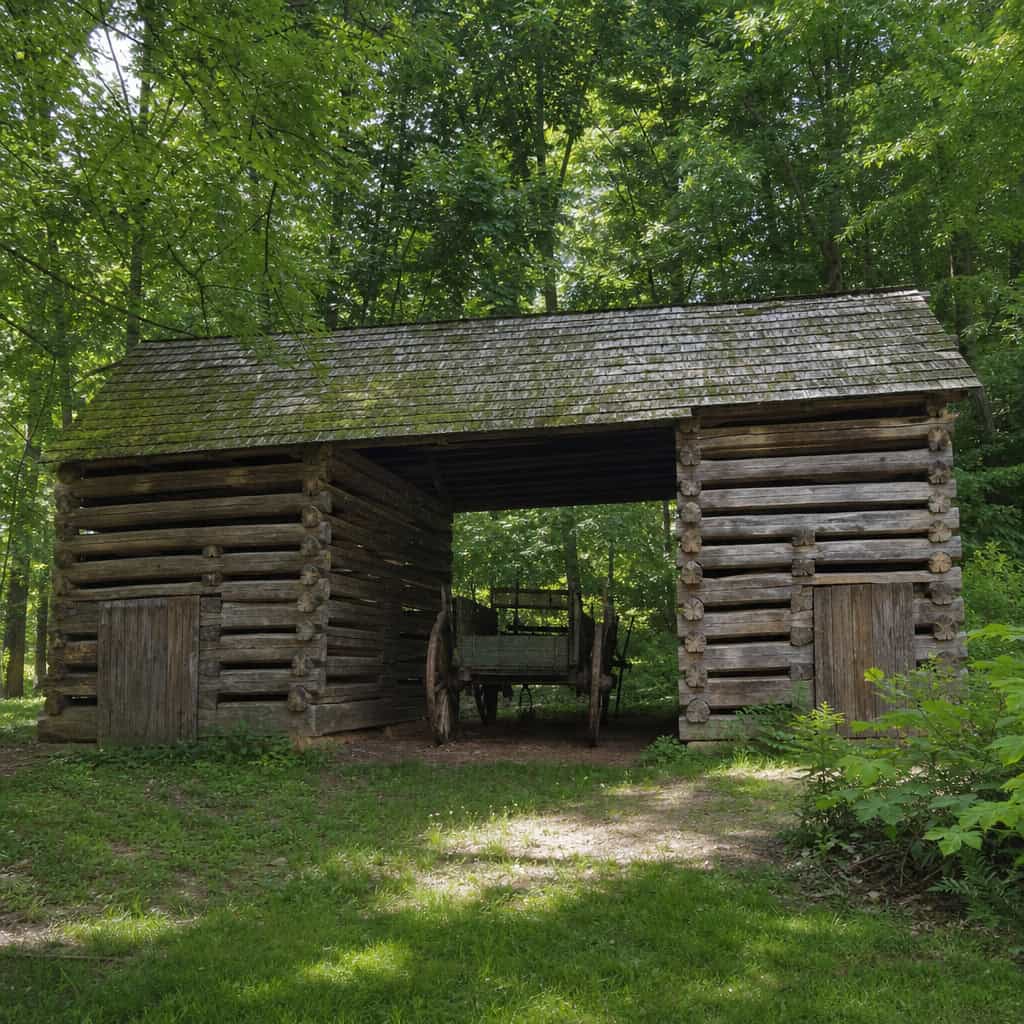
Take the crib barn, build two cribs instead of one, and leave a gap down the middle — now you’ve got the double-crib barn, and that gap changes everything.
The open breezeway running between the two cribs is the heart of it. If that setup sounds familiar, it’s the same idea as a dog-trot house, where two rooms share a roof with a cool, shaded passage between them.
That passage did real work. It was a shady spot to park a wagon, work out of the sun, or let a breeze cut through on a brutal summer afternoon. The cribs on either side handled storage and stock.
It was a clever bit of folk engineering — comfort and function from nothing but smart placement. People who had very little still figured out how to build for the heat.
14. The Cantilever Barn

Of all the barns on this list, this is the one that looks like it shouldn’t be possible. And it’s so rare it was essentially built in just two counties on earth.
The cantilever barn has a massive upper loft that hangs way out past the small log cribs holding it up. The loft seems to float, way too big for the little legs underneath it. It’s the kind of thing that makes you tilt your head and wonder how it’s still up.
You’ll find them almost exclusively in Sevier and Blount counties in the Tennessee Smokies, mostly built between 1870 and 1915. The overhang made loading hay from a wagon easier, and the sheltered space underneath kept equipment and animals out of the rain.
The design traces back to Western Europe, carried over and then perfected in one little pocket of Appalachia. Photographs of them barely do the trick justice — you really have to stand under one.
15. The Tobacco Barn

A tobacco barn doesn’t look like a barn for storing things. It looks like a barn built to breathe, and that’s precisely what it was.
Run your eye down the side wall and you’ll see it: rows of hinged panels or gapped boards, all designed to swing open. Tobacco doesn’t get stored, it gets cured, and curing leaf takes a careful, constant flow of air over weeks.
So farmers built tall, dark barns with adjustable vents up and down the sides, hung the harvested leaves on laths from the rafters, and then played the weather like an instrument — opening panels on dry days, closing them when the air turned damp.
You’ll find them across the South and the Connecticut River Valley, some of them going back nearly four centuries. No two regions vented them quite the same way, because everybody’s tobacco and weather were a little different.
16. The Hop Kiln

Here’s a barn most people have never heard of, even though there was a time when, as the old saying went, every other farm seemed to have one.
The hop kiln — also called a hop house or oast — existed to dry hops for brewing beer. And drying hops took serious, controlled heat, which is why these barns came with something no other barn had: tall kiln towers, often with a rotating cowl on top that spun with the wind to draw the hot air up and out.
Those pointed towers give the hop kiln a profile unlike anything else on the farm. From a distance they can look almost like a little chimney village.
When the hop industry shifted and shrank in many regions, the kilns went quiet. The ones still standing are oddities now, their strange roofs hinting at a crop the land no longer grows.
17. The Potato Barn

This is the barn that’s trying its best not to be seen — and that was the entire idea.
A potato barn, or root storage barn, had one job: keep the harvest at a steady, cool temperature in the dark so it wouldn’t sprout or rot before it reached market. Light and heat were the enemy.
So these barns sit low to the ground, often with their walls bermed into a hillside or banked with earth, and almost no windows to speak of. They look half-buried, hunkered down, more like a bunker than a barn.
You’ll spot them in serious potato country, where they stretch out long and low across the fields. Plain as they are, they were doing precision climate control with nothing but dirt, thick walls, and gravity.
18. The Pole Barn

The pole barn is the moment the old ways start giving way to the new — and it’s the one style on this list you actually still see going up today.
Instead of a complicated timber frame resting on a foundation, a pole barn does something almost cheeky: it sets large posts straight into the ground and builds off those. Simple, fast, and cheap.
It caught on starting in the 1930s, right as engine-powered tractors and equipment got big enough that farmers needed wide, open, post-free space to park and work. The old barns, with their posts and lofts and milking parlors, suddenly got in the way.
It’s the practical winner of the bunch, which is exactly why the romance drained out of it. A pole barn keeps the rain off just fine. It just doesn’t make you slow the truck down.
19. The Scandinavian Log Barn
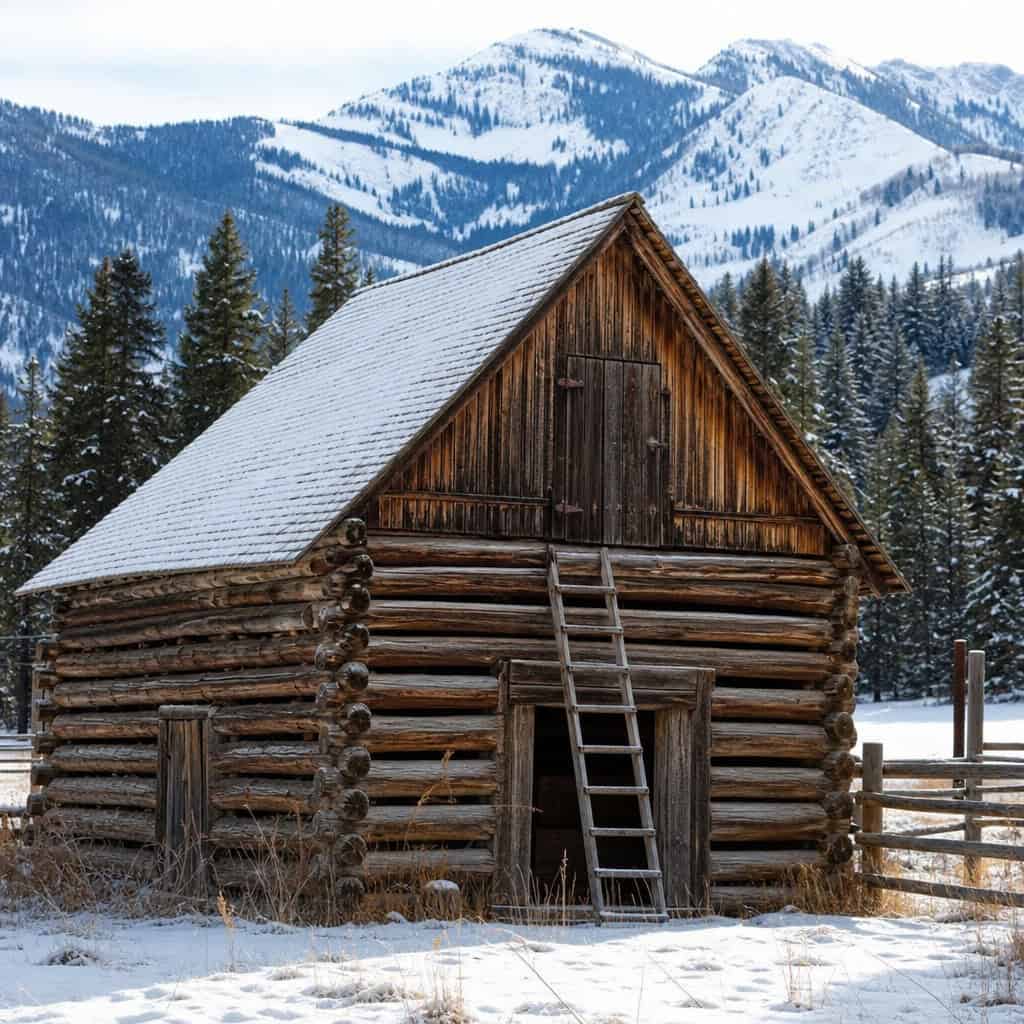
Out in the upper Midwest and the mountain West, immigrants from Finland and the Nordic countries built barns the way they’d built them back home — out of logs, and built to take a winter seriously.
These barns lean on heavy log construction, squared or left round, notched together at the corners with a craftsmanship that came over in the settlers’ hands. In places like Idaho, whole pockets of Finnish log barns still dot the landscape.
A common feature was a raised loft or upper level for hay, keeping the precious dry feed up off the cold, damp ground. Everything about them says built by people who knew real cold.
They’re a reminder that a barn was never just a barn. It was a piece of the old country, rebuilt board by board and log by log in a brand-new place.
20. The Stone Barn

In the German and Pennsylvania Dutch country, some farmers didn’t trust wood to do the whole job — so they built in stone.
A stone barn is exactly what it sounds like: thick masonry walls, often field stone gathered right off the land as the fields were cleared. The result is a barn with the heft and permanence of a small fortress.
Stone did things wood couldn’t. It held temperature steady through the seasons, shrugged off fire, and simply refused to rot. Many were built as bank barns too, set into a hillside, marrying two tough ideas into one nearly indestructible building.
That’s why so many of them are still here. While wooden barns have come and gone, the stone ones just keep standing, looking like they could go another two hundred years without trying.
21. The Adobe Barn

Travel to the Southwest and the whole rulebook changes, because out there the enemy isn’t snow or rot — it’s heat. And the answer was adobe.
An adobe barn is built from earth itself, packed into thick walls of sun-dried mud brick. Those heavy walls do something clever in the desert: they soak up the brutal daytime heat slowly and release it overnight, keeping the inside steady when the outside swings wildly.
The look is unmistakable. Low, earthen, often flat-roofed, the color of the ground it stands on, as if the barn grew up out of the soil rather than being set on top of it.
It’s the same wisdom as every other barn on this list, just answering a different question. Use what the land gives you, and build for the weather you’ve actually got.
22. The Madawaska Twin Barn

Far up in northern Maine, along the Madawaska region near the Canadian border, farmers came up with a barn so specific it’s named for the place that made it.
The Madawaska twin barn is two full barns joined together in the middle, connected to form an H-shape. Two big structures, one shared link, standing as a single working unit.
That connector did the heavy lifting, giving farmers a sheltered, joined space between the two halves — useful when the weather turned and you needed to move between buildings without facing the elements.
It’s a regional quirk you won’t find much of anywhere else. Stumble on one and you’re looking at a solution invented by a handful of farms for one particular corner of the country.
23. The Wisconsin Dairy Barn

We’ll finish with the one that might be the most iconic working barn of them all — the barn that built America’s Dairyland.
The Wisconsin dairy barn took the handsome gambrel roof and put it to serious industrial work as the dairy boom took off. Long and tall, lined with windows to keep the cows in light and air, topped with roof ventilators to move the heat — every feature aimed at producing milk at scale.
The signature, though, is what stands next to it: the silos. One or two tall cylinders rising up alongside the barn, holding the silage that fed the herd through the long northern winter. That barn-and-silo pairing became the very picture of the American dairy farm.
By the time you’ve driven past your hundredth one, it stops looking like architecture and starts looking like the landscape itself. Which is maybe the highest honor a barn can earn — to become the thing we simply expect to see.
A Last Look Down the Road
Here’s the thing about every barn on this list: not one of them was designed to be beautiful. They were designed to solve a problem — the snow, the heat, the hops, the herd, the hill out back.
The beauty came as a byproduct. When you build something honestly, out of what you have, to do exactly what it needs to do, it tends to come out looking right. That’s a kind of craftsmanship we don’t see much anymore, replaced by the same metal building from one coast to the other.
So the next time you catch one of these out a car window — leaning, weathered, half-swallowed by a field — take the long way and slow down. Somebody built that with their hands to answer a question you can still read in its shape.
They really don’t make them like they used to. And one by one, they’re going. Look while you still can.