


The furnace runs fine in October. That’s the trap.
Old houses don’t fail gradually. They fail all at once, at 3 a.m., when the wind shifts and the power drops and a supply line in an uninsulated 1920s kitchen wall finally lets go.
A 1912 foursquare has open stud bays running from the sill to the attic. A Victorian might have six chimney flues, five of them decorative and all of them open. A stone-foundation cellar has copper hanging bare from the joists in forty-degree air. None of that matters in August.
Then the first real storm comes through, and the house tells you exactly what you should have done in September.
Here are 29 things worth having in place before that happens.
1. A Main Water Shutoff You Can Actually Turn

Most old-house winter disasters aren’t cold. They’re water.
And the single thing standing between a pinhole leak and a ruined first floor is a valve that hasn’t been touched since the Carter administration. Brass gate valves seize in the open position — the stem corrodes, the packing hardens, and the handle either spins uselessly or snaps off in your hand.
Test it now, in daylight, with a bucket handy. If it won’t close fully and reopen smoothly, have it replaced with a quarter-turn ball valve. That’s a ninety-minute plumber visit in October and a catastrophe in January.
Hang the right wrench on the pipe beside it. Tell everyone in the house where it is. Utah State University Extension puts knowing your shutoff at the top of its frozen-pipe guidance for exactly this reason.
2. Battery-Backed Carbon Monoxide Alarms on Every Floor

This is the one that kills people.
The Consumer Product Safety Commission puts generator-related carbon monoxide deaths at roughly 100 Americans a year, and the spike lands squarely in storm season — the same week the power drops and somebody drags a generator a little too close to the house. CPSC’s winter-storm guidance is blunt: never run a generator in a garage, a basement, a crawlspace, or within 20 feet of any window or door, even with the garage door open.
Old houses stack the deck further. Atmospheric boilers and water heaters vent by natural draft alone, and when a bath fan or a kitchen hood outruns the flue, combustion gases spill back into the cellar. Unlined masonry chimneys, oversized flues built for coal, and abandoned thimbles sealed behind plaster all make backdrafting more likely, not less.
Put an alarm on every level, including the basement near the heating plant and one within 10 feet of each sleeping area. Battery-backed or fully battery-powered — a plug-in unit is useless in the exact scenario you’re preparing for.
Check the manufacture date stamped on the back. CO sensors expire, usually between 5 and 10 years, and a dead sensor still chirps and blinks like a live one.
- Alarm sounds: get outside first, then call 911
- Headache, dizziness, nausea in more than one person at once
- Symptoms that fade when you leave the house
- Soot or scorch marks around a furnace or water heater draft hood
The U.S. Consumer Product Safety Commission publishes updated winter-storm guidance every year. Read it once. It takes four minutes.
3. A Telescoping Roof Rake

Anyone raised in a snow belt knows the sound — aluminum scraping shingles, snow thumping into the shrubs.
Pulling the first three or four feet of snow off the eave line is the cheapest ice-dam prevention money buys. No ladder, no roof walking. You stand in the yard and work the blade down.
Old houses build dams faster than new ones because the attic leaks heat, and a shallow-pitch porch roof off a 1920s bungalow is the classic failure point. Buy the 20-foot telescoping version, not the 16.
4. A Large-Capacity Battery Power Station

Most old houses can’t take a whole-house standby generator without a service upgrade first. A 100-amp panel from 1958 with a bank of fuses isn’t getting an automatic transfer switch bolted to it — not without an electrician rewriting the whole entrance.
And a gas generator can never run indoors. Not in the cellar, not in the breezeway, not in the garage with the door up.
A large LiFePO4 battery station solves both problems. The Pecron F3000LFP is a good example of the class: 3,600W output, 3,072Wh of storage, zero exhaust, and quiet enough to sit in a hallway.

⭐ Editor’s Pick — I Own This One
This is the exact model I bought for my own house, and it’s the one item on this list I’ll recommend without a single hedge. It has been rock solid, it’s quiet enough to forget it’s running, and going into storm season with 3,000-plus watt-hours charged and sitting in the hall is a completely different feeling than hoping the power holds. If you buy one thing off this list, make it this.
That’s an affiliate link — if you buy through it we earn a small commission at no extra cost to you.
Run the math on what that actually covers. A boiler circulator pump and control board draw roughly 100 watts combined — call it 2.4kWh over 24 hours, and you’ve still got 600Wh left in the tank. A modern refrigerator averages around 1.5kWh a day because the compressor cycles rather than running continuously. A 1/3 HP sump pump pulls about 800 watts while running, but in a typical storm it runs a couple of minutes an hour, not constantly.
Heat, food, and a dry cellar for a day and a half on one charge. Add a pair of 200W solar panels and you stretch that considerably in a multi-day outage.
What it won’t do is run electric resistance heat, a well pump with a hard start, or a central AC compressor. Know the difference before the lights go out, and label which circuits matter.
Charge it to full in late October. A LiFePO4 pack holds its charge for months, which is exactly the point.
5. Storm Windows — Interior or Exterior

Original single-glazed sash loses heat. Replacing it with vinyl loses the house.
The National Park Service treats storm panels as the preservation-correct answer: you keep the wavy glass, the old growth pine, and the hand-planed muntins, and you cut heat loss to near double-pane numbers.
Exterior triple-track works on most houses. Interior magnetic acrylic panels are the move for renters, landmark districts, and anyone who doesn’t want hardware on the outside.
Hang them before the weather turns. Nobody wants to be on a ladder in December.
6. A Chimney Sweep’s Receipt Before the First Fire

Creosote is the leading cause of chimney fires, and it builds fastest in exactly the conditions old houses create — cool flue temperatures, oversized masonry passages, and slow-burning fires banked overnight.
The Chimney Safety Institute of America recommends an annual inspection, and “inspection” matters as much as “cleaning.” A sweep with a camera finds what you can’t: cracked terra cotta, missing mortar joints between flue tiles, a shared flue where the boiler and the fireplace both vent into the same passage.
Pre-1940 chimneys frequently have no liner at all — just brick laid up around a void. Add a century of settlement and you get gaps that let hot gas into the framing.
Watch for the abandoned coal-stove thimble, too. Old houses are full of them, plastered over in an upstairs bedroom, and a sealed thimble that’s only covered with wallpaper is a direct path for smoke and CO into a room where people sleep.
Book it in September. Every sweep in the county is three weeks out by Halloween.
7. Pipe Insulation for the Cellar and Crawlspace Runs

Walk your basement with a flashlight and look up.
In most pre-war houses the supply lines hang bare from the joists, running the length of a rubble-stone cellar that sits at 40 degrees all winter with air moving through the foundation. Foam sleeves cost a few dollars a length and slide on in minutes.
Pay special attention to the runs along exterior walls and anything crossing in front of a basement window. That’s where they freeze.
8. A Radiator Key and Fresh Air Vents

Nobody can find a radiator key in January.
Buy two now, keep one in the kitchen drawer, and bleed every hot-water radiator before the heating season. Trapped air at the top of a cast-iron section means the bottom half heats and the top stays cold, and you’ll blame the boiler for a problem that takes ten seconds to fix — This Old House walks through it.
Steam systems are different. Those little air vents on the side of each radiator crust shut with mineral scale, and a dead vent means a stone-cold radiator no matter how hard the boiler works.
Replacements run about $15. Keep a spare or two on the shelf.
9. A Wi-Fi Freeze Alarm for the Unheated Rooms

Every old house has a room the heat never reached. The bedroom over the porch. The one off the back stairs behind a door that’s been closed since 1990. The sunroom somebody added in 1954 with no ductwork.
A $25 sensor that texts your phone at 40 degrees costs less than one square foot of plaster repair.
Put them where pipes run through cold space, not where you’d be comfortable standing. The point isn’t comfort — it’s the twelve hours of warning you get before something splits.
10. Draft Snakes, Door Sweeps, and Bronze V-Strip

A hundred-year-old door that’s racked out of plumb won’t seal against foam tape. It compresses in one spot and gaps in three others.
Spring bronze V-strip is the historically correct fix and it’s still sold by the roll. Nail it to the jamb, let the spring take up the irregular gap, and it’ll outlast you — original bronze from the 1920s is still working in plenty of houses.
Add a sweep at the bottom and a weighted draft snake for the one door that whistles. You know which one.
11. Spare Fuses — and a Panel Somebody Has Labeled

Plenty of old houses still run an Edison-base fuse box in the cellar, and it’s fine as long as it’s maintained and correctly fused.
Keep spares in the right amperages taped to the panel door. Never oversize — a 30-amp fuse on a 15-amp circuit means the wire becomes the fuse.
And retire the penny trick for good. That’s how houses burn.
Label the circuits while you can see. Fumbling with a flashlight in a wet cellar is the wrong time to learn which fuse runs the boiler.
12. A Sump Pump With Battery Backup

Storms don’t arrive one problem at a time. A January thaw drops four inches of rain on frozen ground, the water table jumps, the wind takes a line down, and your sump pump goes quiet at the exact moment it matters.
A pump that only works when the grid works isn’t a pump. It’s a pump-shaped object.
The stakes are higher in an old house than a new one. The cellar holds the boiler, the oil tank, the electrical panel, and often the water heater — all of it sitting on or near the floor. Six inches of standing water means a flooded burner, a condemned panel, and a five-figure mechanical replacement on top of whatever’s stored down there.
A dedicated battery backup system with its own float switch and a deep-cycle battery will move water for 6 to 10 hours of continuous pumping. Test it in the fall by unplugging the primary and pouring a bucket into the pit.
Check the discharge line too. If it exits below the frost line and the outlet ices over, the pump runs, builds pressure, and burns out against a plug of ice.
Replace the check valve every few years. They’re $12 and they fail silently, letting the same water cycle back into the pit until the motor cooks.
13. Heat Cable for the One Pipe That Always Freezes

Every old house has one, and you already know which.
It’s usually a kitchen or bath line, because the kitchens and bathrooms added between 1920 and 1955 got plumbed the fast way — straight up an uninsulated exterior wall with no thought to what February does.
Self-regulating heat tape wraps the pipe and draws more power as the temperature drops. It’s the right fix when rerouting means opening up plaster you’d rather not touch.
Buy the self-regulating type only. Constant-wattage cable can overheat where it overlaps itself.
14. Seasoned Firewood and a Heat Source That Doesn’t Need Electricity

Green wood hisses, smolders, and coats your flue with creosote. Wood that was cut, split, and stacked under cover a full year ago actually throws heat.
Check the ends. Seasoned splits show radial checking and sound hollow when you knock two together. Moisture meters are $20 and you want to see under 20%.
One hard truth: an original open fireplace is a net heat loser. It pulls more warm air up the flue than it radiates into the room — which is why the Victorians who built them also owned stoves.
An insert or a freestanding stove on a non-combustible hearth is the real backup. That’s the appliance that keeps a room at 65 with the power out for three days.
15. A Chimney Balloon for the Flues You Don’t Use

A big Victorian can have six flues. Five of them are decorative now, and all six are venting heated air to the sky, around the clock, all winter.
An inflatable chimney pillow or a rigid damper plug seals the throat for about $50. You’ll feel the difference in the room within a day.
Tie a bright tag to the mantel or the damper handle. Somebody eventually decides to light a fire in a fireplace nobody’s used in years, and a balloon they didn’t know about turns a cozy evening into a smoke-filled house.
16. A Full Fuel Tank — Oil, Propane, or the Coal-Bin Equivalent

Delivery trucks don’t come up unplowed roads. And dealers serve their automatic-delivery contracts first, will-call customers last — which means the people who wait are the people who run out.
Top off in October. It’s the cheapest insurance in the house.
Stick the tank yourself rather than trusting the float gauge. Those gauges are frequently 40 years old, and a stuck float reading a comfortable half-tank is one of the great old-house lies.
17. Headlamps and LED Lanterns — Not Candles

The nostalgia is real. Candlelight in an old parlor looks like something out of a painting.
It’s also open flame in a balloon-framed house full of century-dried framing, horsehair plaster, and open stud cavities that run like chimneys from the cellar to the roof. Add lace curtains and a drafty window and you’ve built a fire.
Headlamps beat flashlights because they leave both hands free — which matters on steep cellar stairs with a bucket. Keep a lantern on each floor and lithium spares in a drawer.
The CDC makes the same call on candles during outages. Skip them.
18. Tarps, Plastic Sheeting, and Five-Gallon Buckets

Drywall gets wet and sags. Lath-and-plaster gets wet and comes down in sheets.
That’s the difference nobody warns new old-house owners about. Plaster is gypsum or lime over wood lath, and it absorbs water greedily. The lath swells, the keys that lock the plaster to it snap, and a ceiling that survived 110 years lets go in an afternoon — usually the ornamental medallion first, because it’s the heaviest section.
A slow ice-dam leak that a modern ceiling would shrug off can cost you an irreplaceable run of cornice.
So stage the response before you need it. Keep 6-mil poly, a couple of blue tarps, a roll of duct tape, and four or five five-gallon buckets in one spot in the basement where you can grab them in the dark.
When a stain appears, don’t wait for it to spread. Punch a small drain hole in the center of the bulge with a screwdriver and set a bucket under it — a controlled quarter-inch hole saves the rest of the ceiling. Sheet the floor and any furniture underneath with poly first.
Photograph everything as it happens. Timestamped photos of the active leak matter far more to an adjuster than photos of the aftermath.
19. Ice Melt That Won’t Eat Your Masonry Steps

Rock salt is a masonry solvent with good marketing.
Chloride blends drive into the pores of brownstone, soft brick, bluestone, and pre-war concrete, then expand during freeze-thaw cycles and pop the face off in flakes. They also corrode the iron railing pins set in lead pockets, and a rusting pin splits the stone around it.
Use sand for traction. If you need actual melting, magnesium chloride is the gentlest of the salts — used sparingly, swept up after.
Your steps are original. The bag of ice melt is not.
20. A Boiler or Furnace Tune-Up on the Calendar

Old heating plants are astonishingly durable. A 1975 cast-iron boiler can outlive three high-efficiency units — but only if somebody looks at it once a year.
The parts that fail are small and specific: the low-water cutoff, the pressure relief valve, the oil filter and nozzle, the thermocouple.
Buy the spare filter and nozzle in October and set them on top of the boiler. A tech who shows up in a storm with the wrong part on the truck is a tech who comes back tomorrow.
21. A Transfer Switch or Interlock If You Own a Generator

Backfeeding a generator through a dryer outlet energizes the utility line outside your house. Linemen have died that way.
It also bypasses every overcurrent protection in your panel and puts unregulated power into century-old wiring.
The right answer is a manual transfer switch or a listed interlock kit on the panel. On an old service, the electrician may tell you the panel needs replacing before an interlock is even permitted — which is a fall project with a permit, not a Saturday-night scramble.
Make that call in September.
22. Drained Hose Bibs and Shut-Off Sillcocks
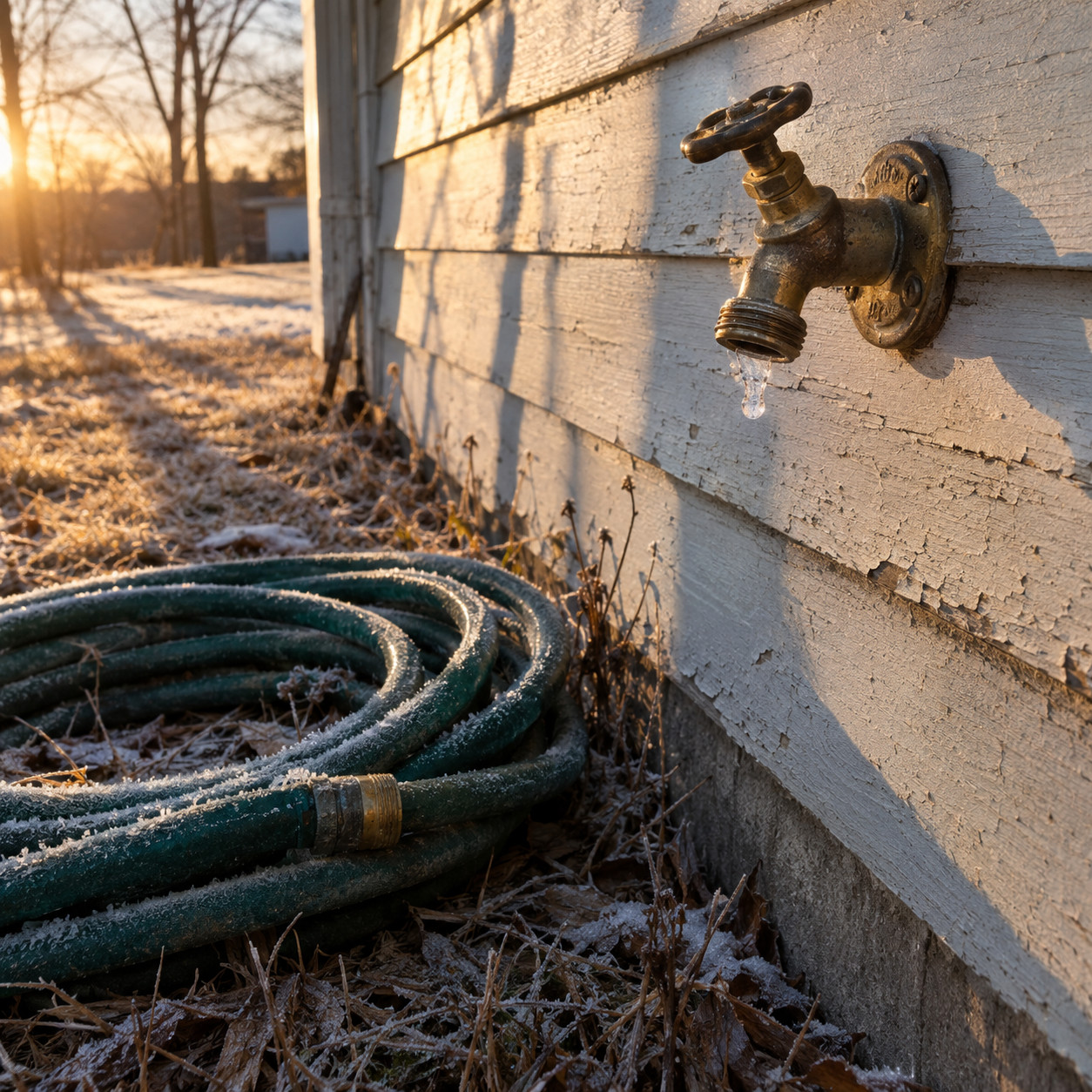
Non-frost-proof sillcocks were standard until the 1970s, and they’re still on most old houses.
Three steps, ten minutes: disconnect every hose, close the interior stop valve in the basement, then open the outside spigot and let the stub drain.
Leaving a hose attached is the classic mistake — it traps water against the valve seat, where it freezes and splits the pipe just inside the wall. State Farm flags it in its winter-prep guidance every single year because it keeps generating claims.
23. Clean Gutters and Downspouts That Discharge Away From the Foundation

Wet leaves left in a gutter freeze into a solid plug. Meltwater backs up, gets under the first course of shingles, and runs down the inside of the wall.
Built-in box gutters on 19th-century houses are worse. They’re framed into the cornice itself, so a failure doesn’t drip off the eave — it drains straight into the soffit framing and down behind the siding where you won’t see it for two years.
Clean them after the last leaf drops, not before. Then check that every downspout carries water at least four feet from the foundation.
24. Attic Air Sealing at the Chimney Chase and Open Stud Bays

The roof rake treats the symptom. This is the disease.
Ice dams form when heated air escapes into the attic, warms the roof deck, melts snow from underneath, and that meltwater refreezes at the cold overhang. Balloon-framed houses from roughly the 1830s through the 1930s have stud cavities that run uninterrupted from the sill plate to the attic floor — a direct chimney for warm air, multiplied by every bay in the house.
The chimney chase is usually the biggest single hole. Code requires a 1-inch clearance to combustibles around masonry, so there’s a framed gap around the brick, and in old houses it’s often wide open. Seal it with sheet metal and high-temperature fire-caulk — never expanding foam against a hot flue. This Old House covers the full sequence.
Then hit the rest: top plates, the gap around the attic hatch, old knob-and-tube penetrations, plumbing stacks, and the open bays above interior partition walls.
One serious caution before you crawl up there. If the insulation is loose grayish-brown pebbles that look like tiny accordions, that’s vermiculite — and vermiculite in a pre-1990 attic may contain asbestos from the Libby, Montana mine that supplied most of the U.S. market. Don’t disturb it. Don’t rake it, don’t vacuum it, don’t stack boxes on it.
Have it sampled by a certified inspector first. Testing runs a couple hundred dollars. Disturbing it and finding out afterward costs a great deal more, and not just in money.
25. A Tree Survey Over the Roof and the Service Drop
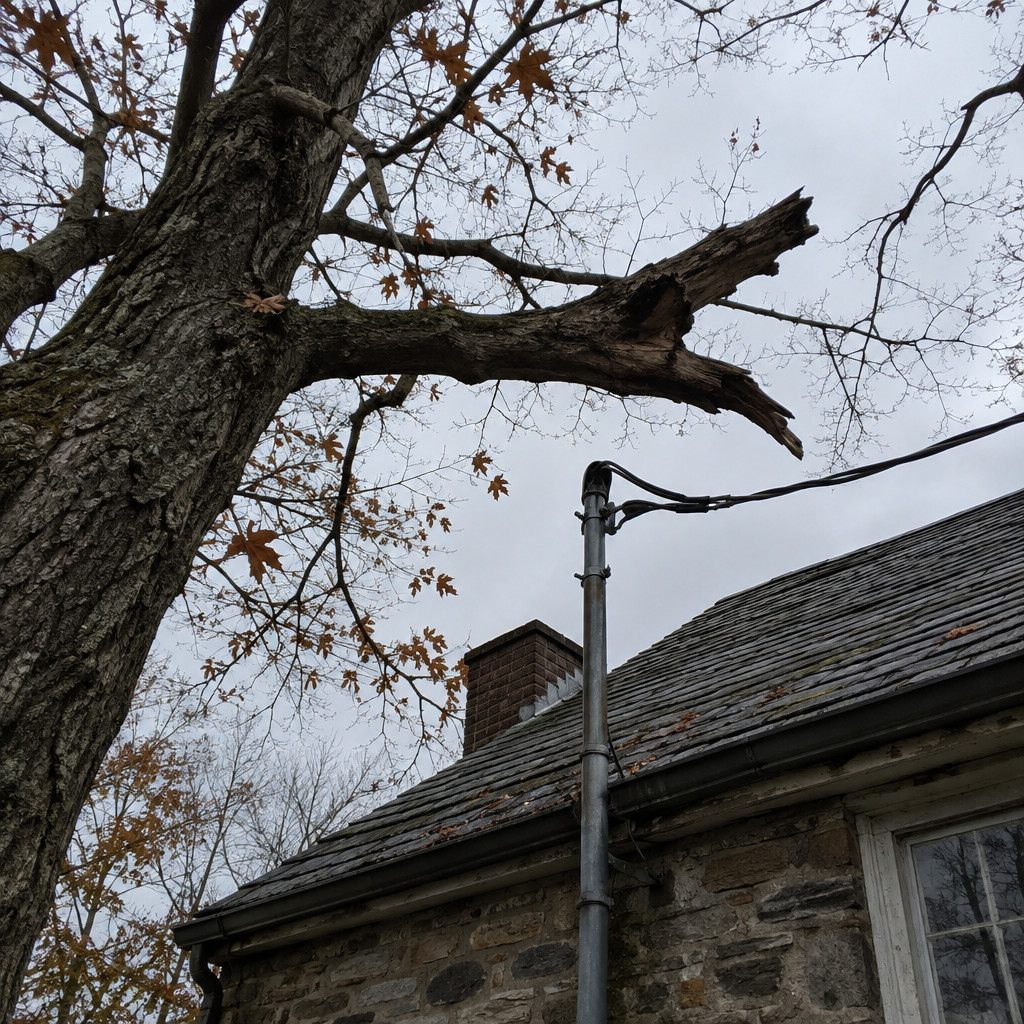
The maples that make an old neighborhood look like a postcard were planted around 1910. They’re 80 feet tall now, and they’re leaning over slate.
Walk the property with binoculars in late fall, after the leaves drop and the structure shows. Look for deadwood, included bark at crotches, and any limb hanging over the roofline or the service drop to your weatherhead.
An ice storm loads a branch with hundreds of extra pounds. A limb through the roof is bad; a limb that tears the weatherhead off the wall is worse, because the utility won’t restore power until you hire an electrician to reattach it — and every electrician in the county is booked.
Prune before the ice, not after.
26. Stored Water — Especially on a Well

No power means no well pump. No pump means no drinking water, no washing, and no flushing.
Store a gallon per person per day, three days minimum. Then, when a storm is forecast, fill the bathtub — that’s roughly 40 gallons of flush water, one bucket at a time into the bowl.
This single habit turns a three-day outage from an evacuation into an inconvenience. Ready.gov keeps a full supply checklist if you want to build out the rest of the kit.
27. Heavy Curtains or Portieres for the Tall Windows

Eight-foot sash is gorgeous and it’s a heat sink.
Nineteenth-century households solved this with fabric: heavy lined drapes at the glass, portieres hung in the doorways between rooms. It wasn’t just decoration — it was the thermal layer, and it worked.
Cold glass creates a downdraft. Warm room air touches the pane, chills, drops to the floor, and slides across the room at ankle height, which is why a room can read 68 on the thermostat and feel like 60 in the chair by the window.
Close them at dusk, open them on sunny mornings. Free heat in, less heat out.
28. A Photo Inventory and an Insurance Policy You’ve Actually Read

Standard replacement-cost coverage pays to rebuild your house to current code with current materials. That’s the whole problem.
Current materials means finger-jointed pine casing and a drywall ceiling. It does not mean quartersawn white oak trim milled to an 1890s profile, a run plaster cornice, leaded glass, or heart pine flooring that came out of a forest that no longer exists. An adjuster will pay to make the room functional. Functional is not what you bought.
Ask your agent three specific questions before winter. Does the policy include ordinance-or-law coverage for code upgrades triggered by a repair? Is there an agreed-value or historic-home endorsement available? And does it cover matching — replacing an entire run of siding or trim rather than patching one section that won’t blend?
Also understand what’s excluded. Most policies cover sudden burst pipes but not gradual seepage, and flood is never included in standard homeowners coverage — it’s a separate NFIP or private policy, and it typically carries a 30-day waiting period. Buying it during a storm warning doesn’t work.
Then do the inventory. Walk every room with your phone on video, narrating as you go, and open the closets and cabinets. Shoot close-ups of the millwork profiles, the newel post, the hardware, the plaster details. Photograph serial numbers on the boiler and appliances.
Upload it to cloud storage, not just the phone. The phone might be in the house.
Take twenty minutes. It’s the highest-value thing on this list that costs nothing.
29. One Room You Can Hold at 60 Degrees

Here’s what the pocket doors were for.
Before central heat, these houses were zoned by design — pocket doors to close off the parlor, transoms to move warm air when you wanted it, portieres in the openings that had no doors, and a stove in the room where the family actually sat. Nobody heated a 3,000-square-foot house in 1890. They heated a room.
You can still do it. Pick the room with the stove or insert and the fewest exterior walls. Close the pocket doors. Hang a blanket over the stair opening to stop the warm air from climbing. Roll a towel at the base of every door.
Sleep in there if it comes to that. People did, for a century, and they were fine.
An old house isn’t fragile. It’s just honest — it shows you exactly where the weak points are, every winter, on schedule.
Work through this list in September and October and the first storm becomes weather instead of an emergency. Wait, and the house will pick the lesson for you.
The houses that are still standing after 120 winters are the ones somebody paid attention to in the fall.